
For St James’ feast day, I thought I would post my translation of the Apostolic Letter “Deus Omnipotens”, issued in 1884 by Pope Leo XIII. I translated it last year for someone on Substack but thought it would be good to post on his feast day as it explains the history of his relics in Compostela.
APOSTOLIC LETTER
IN WHICH THE JUDGMENT ISSUED
BY THE CARDINAL ARCHBISHOP OF COMPOSTELA
REGARDING THE IDENTITY OF THE BODY OF ST. JAMES THE GREATER, APOSTLE
AND ALSO OF SS. ATHANASIUS AND THEODORE, HIS DISCIPLES, IS CONFIRMED.
LEO, BISHOP
SERVANT OF THE SERVANTS OF GOD
FOR PERPETUAL REMEMBRANCE.
Almighty God, who is marvellous in His saints, most providently willed that, while their souls are received into heaven and are drenched with eternal joy, their bodies, interred on/in? earth, are venerated with singular observance by men and adorned with the splendour of religion. — In these, indeed, the providence and mercy of God clearly appear, who, although He allows many things to divinely happen through them, at the same time looks after our benefit and the glory which His saints obtain on earth. For these are most blessed heavenly tokens/assurances?, which remain with us, as often as we visit them, as we recall the admirable series of the most illustrious virtues with which they brilliantly shone as examples to others in the course of mortal life, and we are strongly led to imitate them. Moreover, according to John Damascene, the bodies of the saints are perpetual fountains in the Church, from which, like healthgiving streams, celestial gifts, benefits, and all things which we most need, are poured out into Christian peoples. — Therefore, it is not surprising if by the provident plan of God, certain bodies of the saints, previously forgotten to posterity as if they lay hidden in the darkness, come to light most especially in these times, when the Church is troubled by the greatest storms, and Christians need a sharper incitement to virtue. In our turning century, when a most terrible war has been declared by the power of darkness against the Lord and against His Christ, fortunately however and by divine intervention, the sacred ashes of Saint Francis of Assisi, Saint Clare the Virgin Lawgiver, Saint Ambrose the Bishop and Doctor, the martyrs Gervasius and Protasius, and the Apostles Philip and James, were found. — To their number are to be added Saint JAMES THE GREATER, Apostle, and his disciples Athanasius and Theodore, whose bodies were recently discovered in the principal church of the city of Compostela.
From the constant and widespread discourse among all, handed down from the age of the Apostles and confirmed by the public letters of Our Predecessors, it is reported that the body of Saint James, after he had been condemned to a martyr’s death by King Herod, was secretly taken away by two of his disciples, Athanasius and Theodore. They greatly feared that no relics of the holy Apostle would remain if the Jews got hold of the body, so they placed it on a ship and set sail from Judea, then safely crossed to Spain, and having sailed around, they landed at the farthest coasts of Galicia, where, as pious and ancient tradition holds, Saint James had performed his apostolic duties by divine counsel after Christ’s ascension into heaven. There, when they reached the Spanish city which was called Iria Flavia, they decided to stay on a small estate, and they buried the mortal remains of the Apostle, which they had brought with them, in a crypt dug out of stone within a place built of Roman work, and erected a small chapel over it. But when the course of their life was completed and Athanasius and Theodore had surrendered to nature, the Christians, who inhabited those places, both because of the distinguished reputation of the two men and so that they would not be separated after death from the body they had piously guarded in life, placed both in the same tomb, each at the side of the Apostle.
Shortly after the Christians were harassed and then slain, wherever the Roman Emperors ruled, the sacred underground tomb was hidden for some time. However, when peace was restored among the Spaniards, who held Saint James in special reverence, news about the transfer of his body spread, and a gathering began at the burial site, with perhaps no less devotion than that at the tombs of the Prince of the Apostles in Rome and elsewhere, and the cemeteries of the Hieromartyrs were visited. However, as the years passed, first the barbarians, then the Arabs under the command of Musa invaded Spain, and those regions adjacent to the sea in particular were frequently ravaged; the sacred tomb, with the chapel cut down and overturned, lay hidden in obscurity under the piles of ruins for a long time.
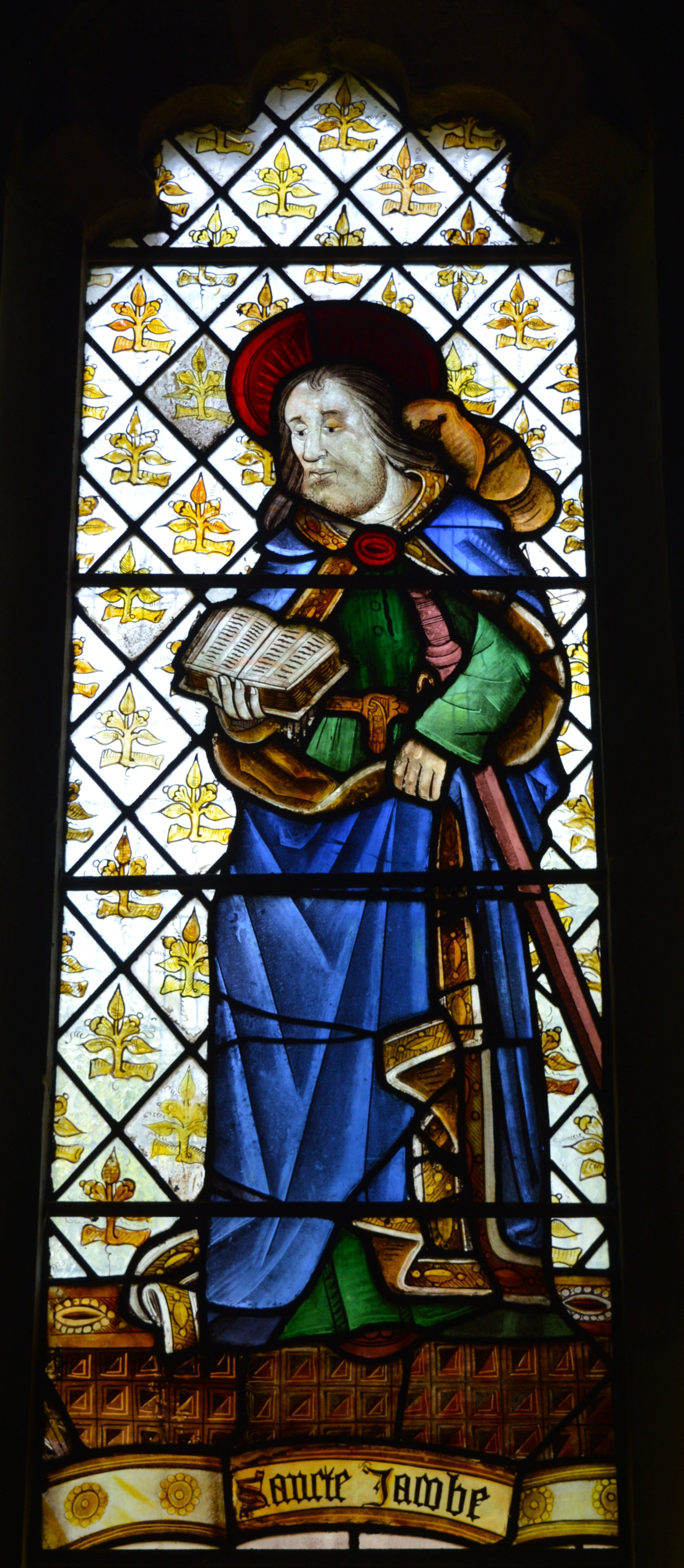
St James, in early 16th century glass at Llanasa
Yet, the memory of the sacred relic was not obliterated by age among the Spaniards. At the beginning of the 9th century, when King Alfonso, who was called the Chaste, ruled Spain, and Theodomir was Bishop to the Church of Iria Flavia, it is consistently reported that a star, refixed to the sky and most splendid, appeared above the crypt containing the relics of Saint James and his two disciples, its brilliance indicating the place where the sacred ashes had been laid. Bishop Theodomir, perceiving this [star] as a happy omen to himself, directed prayers to be made to God, then having removed and cast aside the debris of the old chapel, he reached the place where, as if in a familiar tomb, the three bodies of the saints lay in distinct tombs. Then, that this holy place might be better protected by human defences, he built a wall around it and encircled the sacred treasure with solid foundations. When these things came to the ears of King Alfonso, he immediately approached the holy Apostle’s tomb with reverence, took care to have the old chapel rebuilt from the ground in a new form, and ordered that the possession of that land, with boundaries extended to three miles, be permanently attributed to the protection of the temple. Meanwhile, the city near the crypt, which until then was called Iria Flavia, gave itself the name Compostella under the better auspices from the sight of the shining star.
But to distinguish the Apostle’s tomb, apart from that heavenly sign, many things were divinely done, so that not only from neighbouring communitie and towns but also from distant places, peoples would come to pray at the sacred ashes. Therefore, King Alfonso III, following the example of his predecessor, undertook the construction of a larger shrine, yet in such a way that the ancient tomb remained intact, and, having completed the work speedily, he adorned it at royal expense.
At the end of the 10th century, the savage Arab forces once again made an incursion into Spain, plundered several towns, and carried out a great massacre of the citizens, laying waste to everything with sword and fire. The most infamous Emir Almansor, who was aware of the worship at the tomb of Saint James, had already set his mind on plundering and destroying it; he believed that if he could accomplish this, he would have conquered the greatest stronghold of the Spaniards, in which was all their hope. Therefore, he commanded those whom he had placed in charge of his raiders to march directly to Compostela, attack the city, and consign the shrine and all the holy things to complete destruction by fire. But God extinguished the fire that had already started and was spreading at the threshold of the presbytery, and struck Almansor and his forces with hideous torments, so that the pillagers withdrew from Compostela and nearly all, along with Almansor, perished by a sudden death. — The extinguished and scattered ashes of this hostile ferocity still stood around the burial chamber, a testament to divine protection. When Spain had emerged from these evils, Bishop Didacus Pelaez of Compostela, in the very ruins of the old shrine, began to build a larger edifice from scratch, which, enhanced with splendid decoration and majesty by his successor Bishop Didacus Gelmirez, was granted the name and rights of a Basilica. This Bishop’s main concern was to recognize the sacred relics entrusted to him, and, raising them high on the wall, made the tomb inaccessible. In the course of this work, he did not hesitate to separate a certain part from the sacred bones and sent it as a gift to the holy Atto, Bishop of Pistoia, along with a letter. Part of this, upon modern expert inspection, was found to have been taken from the head: for it is what is called the mastoid process, still sprinkled with blood, as it was struck by the blow of a sword when the head was being severed from the neck. These relics, famous for miracles and revered with singular devotion for the ancestral piety of the citizens, are still venerated by the Church of Pistoia with great piety. — Meanwhile, the fame of the Spanish Sanctuary spread far and wide, attracting to the place countless cohorts of pilgrims from nearly all parts of the world, and the frequency of visits grew so much that they were rightly compared to the huge throngs of pilgrims travelling to the holy places in Palestine and to the sanctuaries of the Apostles Peter and Paul. Therefore, our predecessors, the Roman Pontiffs, reserved the dispensation of the vow to undertake the pilgrimage to Compostela to the Apostolic See.
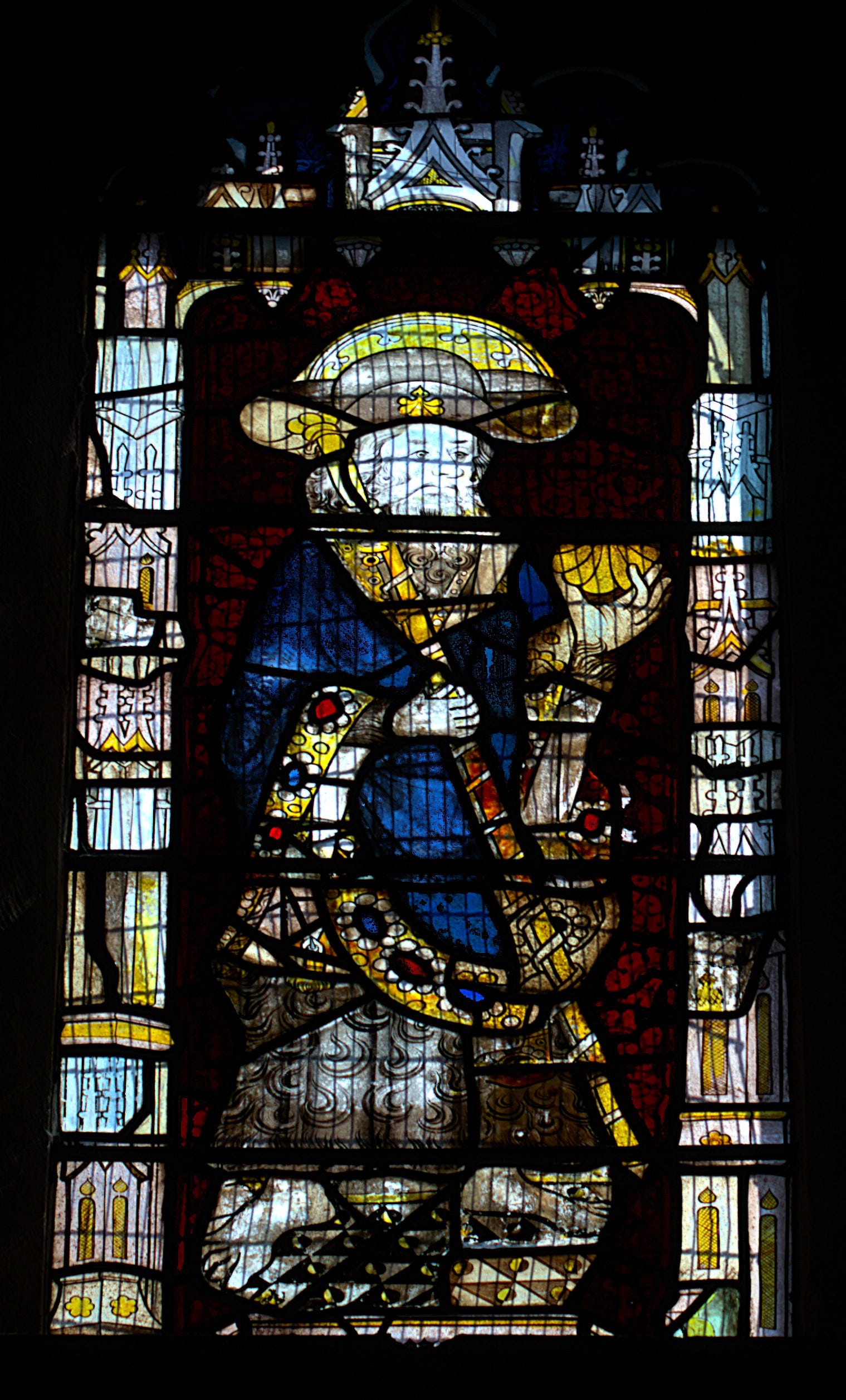
St James in 15th century glass at Ludlow.
Before the end of the sixteenth century, a foul and fierce storm arose, which, raging throughout almost the whole of Spain, put the sacred tomb of the Apostle in danger not so much a common danger, as a particular one. For, with war declared between the Spanish and the British, those who had fallen away from the Catholic faith to heresy had resolved to plunder and destroy the sanctuaries of the Catholics, and to violate and erase all things sacred. Therefore, in Galicia, a region close to the sea, with their army deployed, they overturned sacred buildings, burned with heretical fury images of the blessed heavenly beings, relics, and all things held most sacred, , then having turned to Compostela, they moved their camps there to extinguish what they called a pernicious superstition. — At that time, the most pious Archbishop Ioannes a Sancto Clemente presided over the Church of Compostela, who, having consulted with the Canons about safely hiding the sacred relics of the Saints, took upon himself this chief concern for the remains of Saint James. But as the enemies pressed on, in a hurried work by him, the three bodies were secretly buried: however, he took care that a new tomb was constructed from the ruins of the old one, built in the Roman style, so that some testimony of their identity might remain for posterity. After a retreat from arms and the dangers of war had been driven back, the citizens of Compostela, and the pilgrims who frequently visited those places, were certain that the sacred ashes were still in the same place where they had originally been laid to rest. Subsequent generations held the opinion of their forefathers, albeit in our times it is believed by the faithful that the same sacred relics are kept in the apse of the greater sacred chapel, for which reason they would approach closer to worship there, and the Basilica’s clergy would conclude daily prayers there with the singing of an antiphon.
When our Venerable Brother, S.R.E. Cardinal Paya y Rico, the current Archbishop of Compostela, several years ago began the work of restoring the Basilica, he took up a plan which he had long considered, to investigate the location where the relics of Saint James and his disciples Athanasius and Theodore were situated. For this task of great importance, he selected the most skilled men established in the ecclesiastical state to direct the workers. But contrary to everyone’s expectations, the project failed. After the entire hypogeum and all the cavities still existing around the main altar had been explored, nothing was found. Finally, where the prayerful devotion of the clergy and people was mostly carried out, in the center of the apse behind the main altar, no less, and in front of another inner altar, the floor was dug up, and when the work had proceeded two cubits, the workers came upon a chest, on whose lid a cross was seen to be inscribed. The chest was made of stones and bricks [or tiles] taken from an older crypt and tomb. In the presence of witnesses, the lid was removed, and bones belonging to three male skeletons were found. Concerning all these matters, the Venerable Brother, Cardinal Archbishop of Compostela, in accordance with the decrees of the holy Council of Trent, having heard the advice of learned and pious men, and the opinions of the most learned experts, compiled a plan of action, and an inquiry was made, whether it could be established that the relics discovered were the bodies of Saint James the Greater, Apostle, and his two disciples, Athanasius and Theodore? Considering all these things according to the precepts of ecclesiastical discipline, and applying discerning judgment, he approved and ratified it. Then the same Venerable Brother Archbishop of Compostela sent all the acts and his verdict to Us, and humbly requested that the same verdict be confirmed by the supreme judgment of Our Apostolic authority.
Graciously accepting the prayers brought before Us, since we well know that the venerable tomb of Saint James the Greater can rightly be considered among the most famous sanctuaries that are revered and celebrated with holy pilgrimages throughout the world by Christians for the fulfilment of undertaken vows: the same having been endowed with privileges and honours by Our Predecessors Paschal II, Callixtus II, Eugene III, Anastasius IV, and Alexander III, through issued constitutions, we desired that such diligence be applied to this important matter, as the Apostolic See always customarily exerts. Wherefore, from the Sacred Council presiding over the sacred rites, we designated several Cardinals of the Holy Roman Church, namely, Domenico Bartolini Prefect, Raphael Monaco La Valletta, Mieczysław Ledóchowski, Luigi Serafini, Lucido Maria Parocchi, Angelo Bianchi, and Tommaso Zigliara; as well as officials of the same Sacred Congregation, our beloved sons the Masters Vincenzo Nussi, Apostolic Protonotary, Lorenzo Salvati, secretary of acts, Augusto Caprara, Examiner of celestial honours, along with Luigi Lauri, Assessor; to whom we committed the examination of the same matter. Having convened at Our Vatican Residence on the 20th of May of this current year, with all matters called to scrutiny under severe examination, the response given was: ‘delayed, and for further thought.’
Indeed, the intention was that some observations of greater significance should be more thoroughly adjudicated. — To expedite the resolution of this matter, we ordered our beloved son Master Augustin Caprara, Promoter of the Holy Faith, to travel to Compostela to inspect, inquire, and report on each and every detail. He, having heard the witnesses whom he had previously sworn in; having resolved some contradictions that seemed to exist in their accounts; having consulted experts in archaeology, history, and anatomy from Madrid and Compostela, who would offer opinions on the matter; having examined the ruins of the older tomb and compared these with those from which the chest containing the relics was constructed, and also having inspected the place under the apse where these were found; finally, having again questioned physical experts about each of the sacred bones’ parts, returned to Rome and completed his assigned duty with a detailed report. — Therefore, with the same gatherings collected at the Vatican on the 19th of July of this year, with the fog of doubt having been discussed and the light of truth more clearly risen, the following question was proposed:
“Whether the judgment pronounced by the Cardinal Archbishop of Compostela regarding the identity of the relics found in the centre of the apse of the great chapel of the Metropolitan Basilica, attributed to Saint James the Greater, Apostle, and his disciples Athanasius and Theodore, should be confirmed in this case, and for the purpose under discussion?”
And Our beloved Sons the Cardinals, together with the Prelates and Officials, having considered all that had been presented, judged these matters to be so true and so well established that they could not be refuted. They therefore concluded that there existed certain knowledge of the matter, such as is required in cases of this kind according to the sacred canons and the Constitutions of Our Predecessors, the Supreme Pontiffs. Accordingly, they gave the following decision:
“Affirmative, or the judgment should be confirmed.”
After these matters had been reported to Us by our beloved son, Cardinal Domenico Bartolini, Prefect of the same Congregation of Sacred Rites, We were filled with no small joy and gave heartfelt thanks to the Supreme God, who has pleased that His Church, especially in such times of wickedness, should be enriched by this new treasure. Therefore, we gladly upheld and confirmed in all respects the aforementioned opinion of the special Congregation of Sacred Rites. Moreover, we ordered that on the 25th of July, dedicated to Saint James the Apostle, Our decree of confirmation be publicly proclaimed in the Church of the Spanish Nation, Holy Mary of Montserrat in the City, after the reading of the Gospel, in the presence of our beloved son Cardinal Domenico Bartolini, Prefect of the Congregation of Sacred Rites, and our beloved sons the Masters Lorenzo Salvati, secretary of acts, Augustino Caprara, Examiner of celestial honours, together with Aloisio Lauri, Assessor, and Giovanni Ponzi, as notary.
Now, however, wishing to secure the provisions established by the aforementioned decree with a more solemn document of Apostolic authority, and by a new act of Our confirmation, following in the footsteps of Our Predecessors, namely Benedict XIII, Pius VII, and Pius IX, who rendered judgment on the identity of the bodies of the holy figures: Augustine, Pontiff and Doctor, Francis of Assisi, Ambrose, Pontiff and Doctor, and the martyrs Gervasius and Protasius; We also, having dispelled any doubts and controversies, approve and confirm by Apostolic authority, from certain knowledge and also of Our own accord, the judgment of Our Venerable Brother, the Cardinal Archbishop of Compostela, regarding the identity of the sacred bodies of Blessed James the Greater, Apostle, and his holy disciples Athanasius and Theodore, and decree it to be firm and valid forever. Furthermore, We desire and command that no one shall be permitted to separate, remove, or transport the sacred Relics, which are now placed in the old repository and sealed, or parts thereof, under penalty of excommunication ‘latae sententiae’, the absolution from which We and Our Successors reserve entirely for Ourselves.
Therefore, we commit and command all and each of our Venerable Brothers, the Patriarchs, Archbishops, Bishops, and other Prelates of the Churches, to solemnly publish these present letters in each province, diocese, and city in the best manner they deem expedient; so that this most auspicious event may become known everywhere, and that, with an increased devotion, all Christians may celebrate it, and undertake sacred pilgrimages to that most holy tomb, as our ancestors were accustomed to do. — And that we may more effectively obtain the patronage of Saint James the Apostle and his disciples for the Holy Church of God and for the entire Christian commonwealth, we kindly grant in the Lord, by the tenor of these presents, a plenary indulgence and remission of all sins to all and each of the Christians of both sexes, who, truly repentant and having confessed on a day to be selected by the local Ordinaries, and refreshed with the holy Body of Christ in sanctuaries anywhere dedicated to God under the name of Saint James the Apostle, and in their absence, in any sanctuary designated by the Ordinaries, having implored the aid of Saint James for the most pressing needs of the Church and for its exaltation, for the extirpation of heresies and wicked sects, and having poured out pious prayers before God, which indulgence can also be applied by way of suffrage to the souls detained in the flames of purgatory.
And since the most noble Spanish Nation has marvellously preserved the Catholic faith intact and unblemished through the wonderful aid of Saint James, that God in His mercy might grant it the grace, through which, amid such a deluge of errors, with its Patron serving as mediator and intercessor before God, it may strengthen its spirit towards the holiness of its ancestral religion and to a zeal for piety, we also grant for the coming year the most ample privilege bestowed by Alexander III, Our Predecessor, of earning a full Jubilee in the year when the feast of Saint James on the 25th of July falls on a Sunday, and even when on that same day, the sacred solemn festivals of the finding and elevation of his body will be held, this to be observed in the manner and with the same faculties contained in the Constitution of that Supreme Pontiff, given on the 25th of July in the year 1179.
We also decree that these letters and whatever is contained in them shall at no time be subject to accusations of cheating or deception [these words are very difficult to translate, this is the best I can think of], or any fault of nullity or invalidity, nor of Our intention, or any other defect whatsoever, but shall always and forever be valid and effective, and achieve and maintain their full and complete effects; and thus we wish them to be considered by all of whatever rank, order, pre-eminence, and dignity; commanding that copies of these present documents, even those printed but signed by the hand of some public notary and sealed by a person constituted in ecclesiastical dignity, are to be accorded the very same faith as would be accorded to these documents, were they exhibited or shown.
Let no one at all, therefore, dare to infringe upon this page of Our approval, ratification, reservation, concession, remission, commission, and will, or oppose it with reckless daring. But if anyone should presume to attempt this, let them know that they will incur the wrath of Almighty God and of the Blessed Apostles Peter and Paul.
Given at Rome at Saint Peter’s in the year of the Incarnation of Our Lord one thousand eight hundred and eighty-four, on the Kalends of November, in the seventh year of Our Pontificate.
C. CARD. SACCONI Pro-Datarius — F. CARD. CHISIUS
Cardinal C. Sacconi, Pro-Datary — Cardinal F. Chisius.
VISA DE CURIA i. DE AQUILA E VICECOMITIBUS
Seen by the Court, i.e., by De Aquila and Vicecomites
Loco + Plumbi
In place of the lead [seal].
Reg. in Secret. Brevium
Registered in the Secretariat of Briefs.
I. CUGNONIUS
I. Cugnoni
No posts
Comments
Nothing yet. Say the first thing.
Sign in to join the conversation.