

By Mile 3, the crowd has thinned. Legs ache, the early buzz is gone. You notice some of the people at the starting line were only there for the photo op.
It’s easy to think this moment comes from bad luck, a bad market, or a broken playbook. In reality, it’s almost always the same root cause: incentives — who’s rewarded for sticking with you, and who benefits more from walking away.
We obsess over GTM models, pricing strategies, and PMF playbooks that worked for someone else, but those were all built on top of that author’s incentives — their market, timing, and stakeholders’ motivations. Change those, and the same moves can either carry you forward or sink you.
Nowhere is that truer than today. AI is rewriting what’s possible in every industry. It’s flooding the market with playbooks that promise to map the road ahead. Some will prove exactly right. Others will break the moment they hit a slower-moving customer, a messy vertical, or politics you didn’t plan for.
Innovation will keep reshaping the tools, the pace, and the playbooks — but the forces driving each stakeholder’s actions remain largely consistent. If you don’t see them, and design for them, no playbook will carry you to Mile 10.
If the underlying motivations of your customers, team, and investors aren’t aligned with your success, the sharpest insight will warp, and no framework will save you. Misread those incentives, and you risk KPI theatre, false traction, and burning runway before Mile 3. Get them right, and you keep the right people running with you, mile after mile.
The first mile of a startup often feels like flight.
You’ve got a working demo, a buzzing waitlist, maybe even a viral clip. Customers are curious. Investors lean in. Everyone looks like they’re at Mile 10.
But early markets have a way of collapsing the signals:
Users click more than they commit.
Buyers run pilots but rarely purchase.
Investors chase demos, not durability.
Those signals reward movement over outcomes — tricking founders into mistaking adrenaline for traction. That illusion plants the seeds of the Mile 3 struggle.
The very things that make Mile 1 exciting — buzz, pilots, investor interest — also create pressure to act as if the finish line is close. Founders hire ahead of revenue, expand the roadmap for prospects who never sign, and spend as if growth is inevitable. When those early signals fade, the commitments made in Mile 1 become the weight you have to carry up the first real hill.
By Mile 3, the early applause has faded. The easy wins dry up. The grind sets in.
It’s here you learn that not everyone who started the race signed up to run all 26 miles. Some joined for the upside. Some for the story. Some to test the waters.
At Mile 3, the shiny vision that brought everyone together meets reality, and incentives quietly decide who stays, who drifts, and who drops out.
Some people leave because the upside they joined for no longer looks likely — a budget evaporates, an early hire’s equity cliff passes. Others drift when their role or political capital has shifted. A few double down because their career, credibility, or identity (or even a pending promotion) is now tied to your success.
The startup journey isn’t won in bursts of speed or flash-in-the-pan success. It’s won by those who understand the why behind every person’s commitment, and by designing around those incentives to keep the team, the customers, and yourself in the race — mile after mile.
Seeing who’s still in the race is one thing. Reading their signals is another — and those signals aren’t always what they seem.
Once the early momentum slows, feedback rarely arrives pure. Incentives shape not just what people do, but what they say about what they do.
In startups, the noisiest signals are often the least trustworthy because they’re the ones people are most incentivized to send. Praise can be polite cover for doubt, or early enthusiasm masking internal politics. Even “successful” pilots can be driven by optics, not outcomes.
A stakeholder’s version of events is almost always tilted toward what they’re rewarded for. Taken at face value, those signals — the customer’s “we’re happy”, the investor’s “let’s keep talking”, the employee’s “I’m committed” — can hide deeper misalignment. Different on the surface, they’re all shaped by the same undercurrent: incentives quietly steering the outcome.
One startup celebrated a game-changing pilot with a top bank: high usage, a vocal champion. But the champion wasn’t the budget owner. When procurement stepped in, the deal collapsed. The company had already staffed for the account, and the fallout meant layoffs.
Another team built early traction on heavy subsidies. When the grants ended, so did the customers.
Even inside the company, sales reps optimized for activity metrics they could game, coasting until their guaranteed draw ended, then moving on.
In each case, the problem wasn’t bad actors. It was incentives rewarding something other than long term success. And the reverse is also true: when incentives align, even a flawed framework or half-right insight can carry you further than you’d expect.
These examples play out differently on the surface, but underneath they’re all driven by the same forces, and those forces tend to live in just a few places.
Incentives don’t live only in paycheques and stock options. They show up in three layers that shape almost every decision:
Economic — Budgets, compensation, equity.
Career — Promotion paths, internal credibility, future positioning.
Emotional — Autonomy, trust, identity.
Misalignment in any one of these layers can end a relationship overnight. The flip side is just as powerful: when one of these incentives is firmly tied to your win, people will often stay far longer than you expect.
Strong alignment usually mixes extrinsic incentives (the tangible rewards like comp, equity, or budgets) with intrinsic ones (autonomy, trust, identity, meaningful work). The most durable commitments rest on both.
Time is the only real truth serum; the miles reveal it. And because incentives shift over time, the same stakeholder can move from aligned to misaligned as budgets, priorities, or politics change. Map these layers early, and use each mile as a checkpoint: see who’s still leaning in, whose incentives have shifted, and where new alignment is emerging. Over time, the race is won by strengthening the right relationships before the wrong ones trip you up.
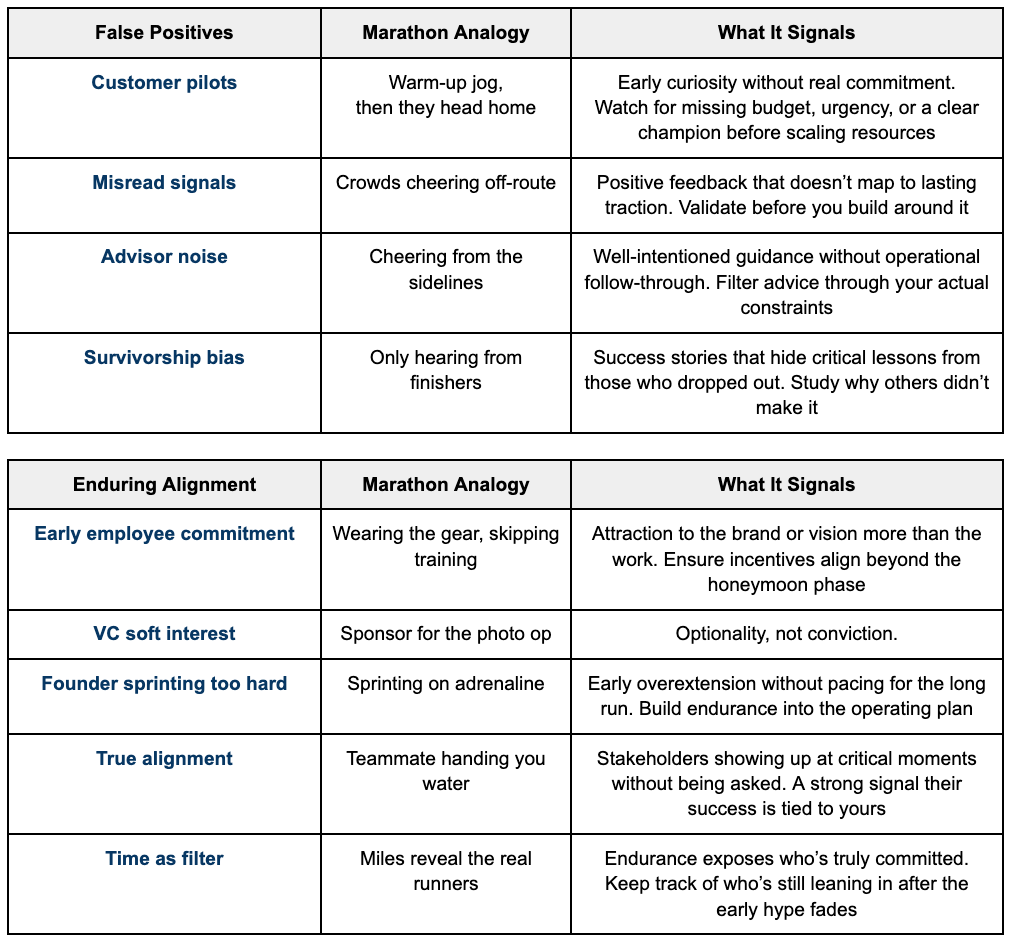
You’ll know you’ve hit this stretch when the once-responsive champion is slow to reply, usage has flattened even though everyone says they’re “happy,” or pilots are stuck in procurement purgatory. If two or more of these show up at once, you’re here.
When that happens, look past the surface and ask: What game are they actually playing? It might not be the one you thought you were in. That’s when it’s time to map incentives so you can focus on the relationships that will survive the climb and let go of the ones that won’t.
One founder I know keeps her method simple, but it works. I’ve adapted it into what I call The Mile 3 Incentive Map:
Write the name of every stakeholder (e.g. customers, hires, investors, advisors, partners) on a Post-it
Under each, list what they want most, what they fear most, and the constraints that shape their decisions (spoken + unspoken)
Map where those incentives align with your success and where they pull apart
Stress test: What happens to each of them at Mile 3? Who digs in? Who drifts? Who quietly exits?
If you’ve done enterprise account mapping, this will feel familiar, but here the lens is broader than just your ICP. For customers, employees, investors, or advisors, scan for five core categories.
Definition of success – How they’re measured (OKRs, KPIs, mandate), what “winning” looks like, and whether their personal reputation is tied to your success.
Access to resources – Do they control budget, authority, or the key decision you need, and can they actually deploy it here?
Risk profile – Is working with you seen as a safe bet or a career risk?
Influence – How much leverage do they really have, given the current politics and org structure?
Appetite – Are they wired for experimentation or predictability? Is this a “now” problem or a “someday” project for them?
You don’t need to interrogate all five every time, even a quick scan will tell you whether someone’s likely to climb the next hill with you or quietly drop out.
Before the week is out, list your top 10 stakeholders. Circle the three whose incentives are most fragile. Call one today and ask them — plainly — what success looks like for them now.
The point isn’t to “fix” every misalignment; it’s to see it early enough to adapt. Not every mismatch is fatal — some short-term incentives, even those at odds with your long-term vision, can still be useful if you know they’re temporary and you’re clear-eyed about the tradeoffs. A customer chasing optics might help land the funding you need. An early hire building their résumé might still get you to the next milestone. The key is knowing which bets buy you time, and when to step off before they slow the whole race.
Stop assuming alignment. Ask: What does success look like for you?
Recognize traps: polite feedback, pilot fatigue, equity-cliff complacency.
Balance explicit incentives with intrinsic motivation: autonomy, trust, meaningful work. Test real commitment when the early applause fades.
Find out who’s running your marathon and who’s just jogging alongside for the photo op. Then double down on the ones running with you.
Because the tech, the frameworks, the hype cycles — SaaS, mobile, web3, today’s AI wave, and whatever comes next — will keep shifting. Frameworks can be useful, but they’re only shortcuts. Maps drawn for someone else’s terrain. Every hype cycle spawns more of them, and many will be wrong for your race, shaped for a different vertical, market size, stage, or geography than yours.
Incentives, on the other hand, are the current under the surface. You can’t change the tide, but you can learn to swim with it. See them clearly, design around them, and Mile 3 stops being the wall — it becomes the stretch where you break from the pack.
When the noise fades, you’ll know who’s still moving toward the same horizon — and why. That clarity is rarer than any playbook. And far more durable.
Comments
Nothing yet. Say the first thing.
Sign in to join the conversation.