
Participants of its being. It is, we are.
He is, we are. Ah, bella! He is, we are,
Within the big, blue bush and its vast shade
— Wallace Stevens, A Study of Images I
Marshall McLuhan’s Book of Probes, designed and illustrated by David Carson, is the philosophical equivalent of whatever Peewee’s Playhouse was to Saturday morning television in the 1980s. It’s full of odd things which, in your excitement at the sheer bounty on offer, you fiddle with for an enchanted moment before tossing it off-screen and grabbing another one. Phil Ford and I have done this in two Weird Studies episodes, one of them recent.1 But it’s a testament to the wonder of The Book of Probes that you could devote entire podcast series to it without ever becoming repetitive, though you may occasionally contradict yourself.
Years ago on the show, I floated the idea that Heraclitus was one of the rare thinkers whose work is made complete by existing only in fragments. McLuhan was like that: he thought in fragments—or probes, as he called them. My father-in-law took a class with McLuhan at the University of Toronto in the late sixties, when the media sage was teaching out of his own coach house on campus. Apparently, he would lie on a sofa and speak extemporaneously, delivering one zinger after another. Students sat around like seekers at the oracle of Delphi. Heady days.

As gnomic as some of McLuhan’s probes may have seemed when he first uttered them, many now emit the dull glow of the obvious. Who, today, would scratch their heads at the “global village,” or quarrel with the claim that “environments are not just containers” but “processes that change the content totally?” On the other hand, some probes remain as provocative now as they ever were. Given McLuhan’s track record as a modern prophet, we would do well to pay these heed and ponder them seriously. Here is one example I’d like to explore, not prophetic so much as magical:
Effects are perceived, whereas causes are conceived. Effects always precede causes in the actual developmental order.
To be fair, this idea didn’t originate with McLuhan. Tracing its history would take us back to David Hume and the Islamic philosopher Al-Ghazali, and even farther into the past, to the Stoic metaphysicians. McLuhan’s sharp formulation, however, brings into focus something genuinely strange about our access to reality.
What he is saying is that there exists a difference of kind between effects and causes. An effect and its cause aren’t just different things, but different types of thing. Effects, as he says, are perceived. They are events, sheer occurrences that follow one another around us and within us. First there is a bush, then a fire, then ashes. By contrast, causes are never perceived but always mentally inferred after the fact. Causal explanations are conceptual stories we tell based on the effects we perceive. It is only once we see the ashes that we can say, “the fire burned up the bush.” If we had no memory, there would only be effects, which is to say events, one after another. The idea of causation would never arise.
For there to be causes, there must be narrative; and for narrative, there must be recollection. Henri Bergson, whom McLuhan read carefully, made this point rather cogently in the 1890s.2 If one insists that causality must nevertheless be a real component of nature, independent of whether anyone is there to think or remember the events composing the universe’s history, then one is effectively saying that there is memory in the universe, memory in matter. Indeed, says Bergson, it may well be that matter is memory.
But can you ever see “matter?” Can you see “nature?” Matter and nature are ideas: things conceived, but never perceived. What McLuhan calls “the actual order of development” is experience as such. Even the most impartial student of nature is first and foremost an observer, and observation is itself an event among events.
Let’s come back to the image of burning wood. As Hume might have pointed out, what I perceive in fact is wood, then fire, then ashes. I never perceive the causal connection between them. If only one bushfire had ever occurred in the history of the world, and I’d been lucky enough to be there, I would never have extracted from this singular event the idea of burning. I would have said, first there was a bush, then there was this bright and hot thing (perhaps even a creature, so livingly did it dance), and then there were ashes. My report would have sounded like those of people who have encountered aliens. First this happened, then that: I saw what I saw, but I can’t tell you what it is. Wood, fire, and ashes are percepts. Burning, however, is not something I ever perceive, but only something I conceive about what I’ve perceived: a concept.
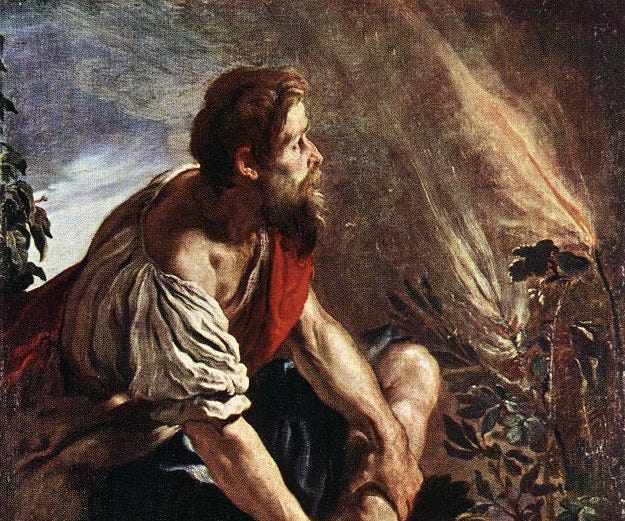
“The bush bursts into flames” is a percept. “The bush burns to ashes” is a conceptual relation. It’s this difference, which we overlook because of an ingrained tendency to mistake things for the concepts by which we represent them to ourselves, that leads us to call the eldritch creature that Moses encountered in the desert the Burning Bush. That name is actually a misnomer; Blazing Bush would be more accurate, because while Moses’s magic bush blazes, it is never consumed: it is a purely phenomenal event, like something out of a dream. It says it right there in the scripture: “Moses looked; there was the bush blazing but it was not being burnt up.” (Exodus 3:2)
To blaze is perceptual (hence poetic). To burn up is conceptual (hence prosaic). This does not mean that fire does not really consume wood. It means that our experience of the world is composed of percepts and concepts that normally appear fused, until deeper reflection pries them apart. When we do this, we discover that we inhabit two worlds at once: a world of effects and a world of causes.
Modern philosophy tends to place the world of causes “out there,” as the objective structure of reality, while relegating effects to the “inside,” as subjective appearances. McLuhan’s probe invites us to consider the possibility that this picture is exactly backwards. After all, what is more external than an effect given directly to the mind and senses? Call it “subjective” if you like; as event, an effect is defined by its externality, its objectivity. I am never identical with an event but only ever one part of it. If there were no events, no effects, then nothing would be perceived, and nothing could be conceived. Even mental effects—dreams, visions, sudden insights—are external events in this sense. Conversely, what could be more “internal” than a causal relation? Search the world as carefully as you wish: you will never encounter a causal relation anywhere, but only ever more events, from which you infer ever more relations. This is precisely what science does.
Speaking of science, in Galileo’s time there was much debate concerning the origin of the tides. Fisherman had their stories: myths and legends that worked well enough for them. I imagine that many such stories involved the moon, but in the absence of a theory of gravity, any connection between the tides and the moon would have been understood magically, as a just-so story. Learned people had more technical ideas about the tides, and Galileo thought he had come upon the best explanation yet. The tides, he argued, were caused by the Earth’s motion as it spun around the sun. Just as water sloshes in a bucket when you carry it from the well, so the seas slosh around the Earth’s deepest cavities as the planet flies through space.
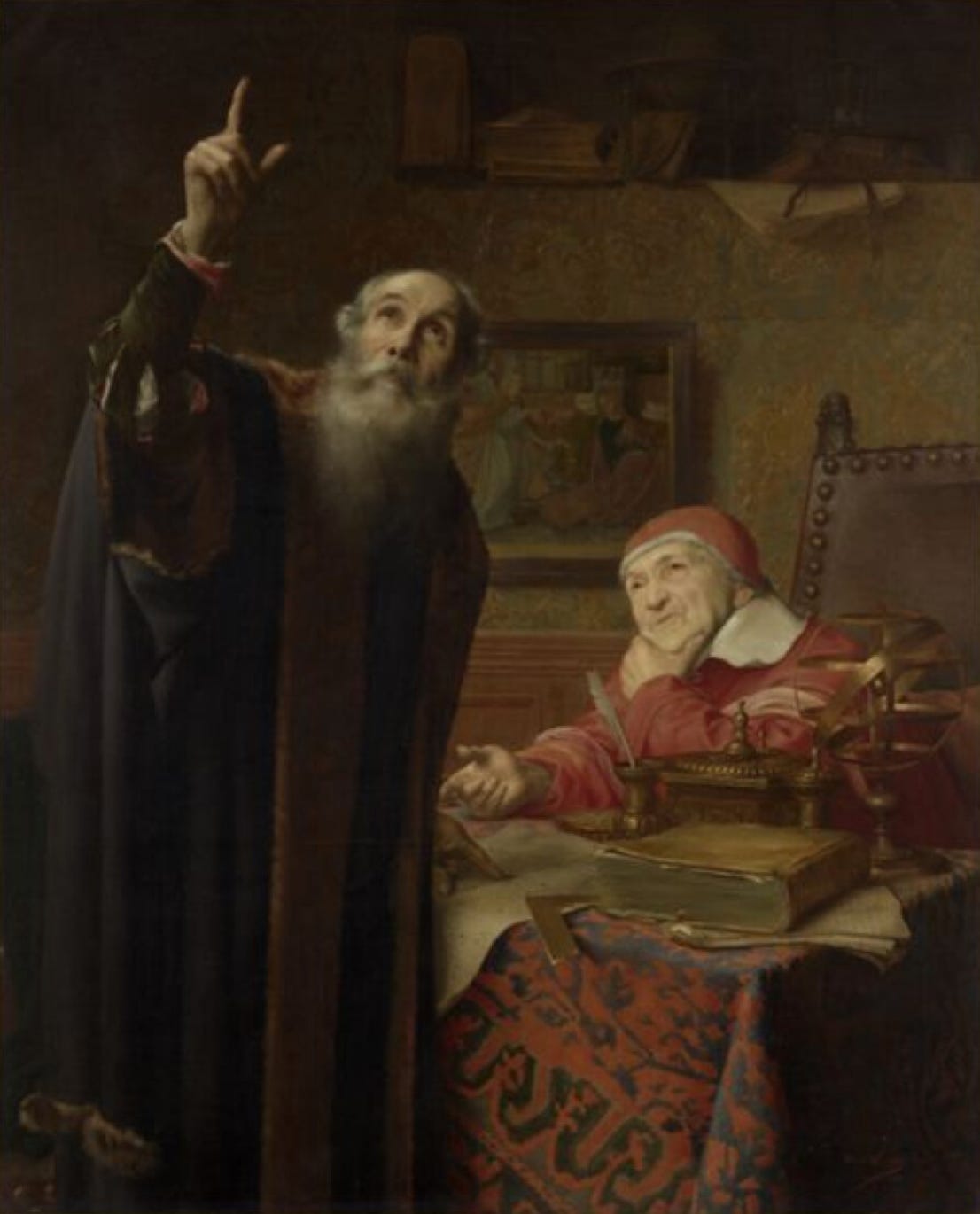
The theory was wrong, but you have to admit that it was a good one. Given that Galileo believed space to be filled with a subtle medium rather than a vacuum, the analogy made sense. If Pope Urban VIII objected to it, it wasn’t because he had a better physical theory, but because Galileo, in his characteristically modern way, claimed his explanation was definitive. For the pope, only God could be the true “cause” of anything. Ultimately, the world existed as a sheer event issuing from a creative act that exceeds all exhaustive explanation. Here’s how Brooke and Cantor articulate Urban’s objection to Galileo’s tide theory in Reconstructing Nature:
God in his omnipotence could produce a natural phenomenon in any number of ways and it was therefore presumptuous for any philosopher to claim that he had determined a unique solution. It was surely possible that the tides were produced by some mechanism quite other than by the earth’s compound motions.3
The only final explanation for anything is God, which for our purposes simply names that which brings forth the world as a pure event in a way that is, for us, entirely inexplicable. This means that, while it might have been the case that the Earth’s motion causes the tides, the nature of reality is such that any causal explanation ultimately exists on the same plane as the events it purports to explain: it too is a sheer effect—in the “special effects” sense of the term—bursting forth from the creative act which alone bestows existence.
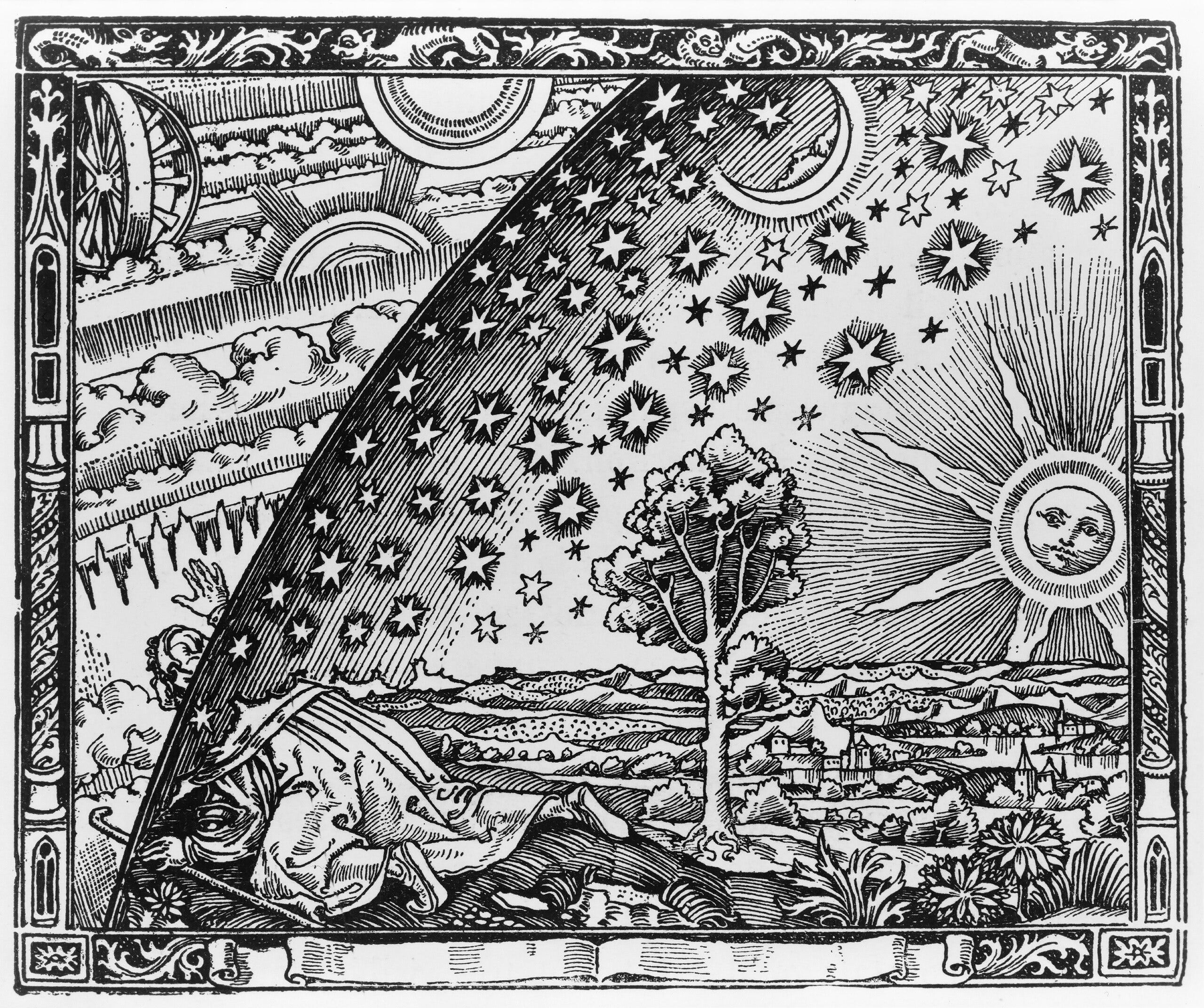
Seen in this light, Urban’s objection anticipates, in theological form, the principle later articulated by Karl Popper, namely that in order to qualify as scientific, a theory must always remain open to refutation. No explanation is final because no explanation ever escapes the order of events it seeks to explain: we never have enough information to stand outside that order. In other words, we are, inevitably, inhabitants of a world of effects that graciously lends itself to causal thinking, a mystery that kindly lends itself to problem-solving. The key word here is “lend.” That science works at all is remarkable. That it does not dissolve mystery but only deepens it is more remarkable still.
McLuhan, who was not only Catholic but a daily communicant, understood this well. When he tells us that effects are perceived and causes conceived, he is not dismissing scientific or theoretical thinking but situating them within a sacramental vision of reality, one in which human explanation is neither denied nor rendered absolute. On this view, science, art, and philosophy are allied practices: each is a way of moving within the dream of the real without ever reaching the bottom. For the dream, as another Catholic once put it, hath no bottom.
The book is Matière et Mémoire (Matter & Memory).
John Brooke and Geoffrey Cantor, Reconstructing Nature: The Engagement of Science and Religion, p. 110. My emphasis.
No posts
Comments
Nothing yet. Say the first thing.
Sign in to join the conversation.