
Isn’t it nature that most immediately recalls to our minds intimations of what is beyond nature? — Quentin S. Crisp
This week, Erik Davis and I finished our Weirdosphere course on Moby-Dick. It’s been a long, strange voyage, with the two of us taking turns sounding the depths of Melville’s visionary yarn. At the risk of losing readers who haven’t read the book, I’ll say it’s been a blast squeezing the sperm with Erik and our truly thoughtful and erudite students these last six weeks. I would gladly have gone on squeezing it for six more.
Incidentally, sperm-squeezing is as good a starting point as any for the meditation I have in mind. It refers to chapter 94, “A Squeeze of the Hand,” wherein our narrator Ishmael, being on his first whaling voyage, discovers the special pleasure of plunging his hands into vats of spermaceti to “squeeze back into fluid” the lumps that have begun to congeal since the substance was siphoned from a slain whale’s skull.1 Seizing those slippery globules of solidifying sperm and satisfyingly massaging them back into oil, Ishmael finds himself unwittingly grabbing his fellow crewmen’s hands in the goop. Far from causing any awkwardness, however, this becomes for him a source of fellow feeling unlike anything else he will experience aboard the Pequod:
Such an abounding, affectionate, friendly, loving feeling did this avocation beget; that at last I was continually squeezing their hands, and looking up into their eyes sentimentally; as much as to say—Oh! my dear fellow beings, why should we longer cherish any social acerbities, or know the slightest ill-humour or envy! Come; let us squeeze hands all round; nay, let us all squeeze ourselves into each other; let us squeeze ourselves universally into the very milk and sperm of kindness.
It’s this knack for finding the magical in the mundane, the miracle in normality, that makes Ishmael such a congenial guide to the world of nineteenth-century whaling and an ideal narrator for what would otherwise have been a tragedy so dour as to beat the anti-cathartic downers of the following century’s arts and letters to the punch. Immediately after the passage quoted above, Ishmael gives his grounded philosophy a memorable formulation. “By many prolonged, repeated experiences,” he writes, “I have perceived that in all cases man must eventually lower, or at least shift, his conceit of attainable felicity; not placing it anywhere in the intellect or the fancy; but in the wife, the heart, the bed, the table, the saddle, the fire-side, the country.”
Commendable words, to be sure. But if we left it there, we’d overlook a crucial tenet of Ishmaelian metaphysics, namely that there is no essential opposition between the earthbound simplicities he recommends here and the most transporting mystical experience. Indeed, one intuition that Melville seems to confirm in Moby-Dick is that the extremophile askesis of the mystical practitioner—monk or stylite, flagellant or psychonaut—serves one purpose alone: to prepare the heart and mind for the weird rediscovery of the extraordinary within the ordinary, the sudden realization of the radical improbability of the ostensibly banal. Astral projection, ecstatic union, commerce with daimonic entities, levitation: these things certainly qualify as encounters with mystery, but it is a mystery laden with madness, which sends us drifting through the gulf of infinite possibility that the imagination has already assured us is the case, against the protestations of the intellect. What point is there in sensing the depths of that eldritch gulf if the experience doesn’t immediately alert us to the most astounding levitation act of all: the always-precarious floating of a reliable causal order—a cosmos amenable to hearts, beds, and tables—in the very depths of the abyss?
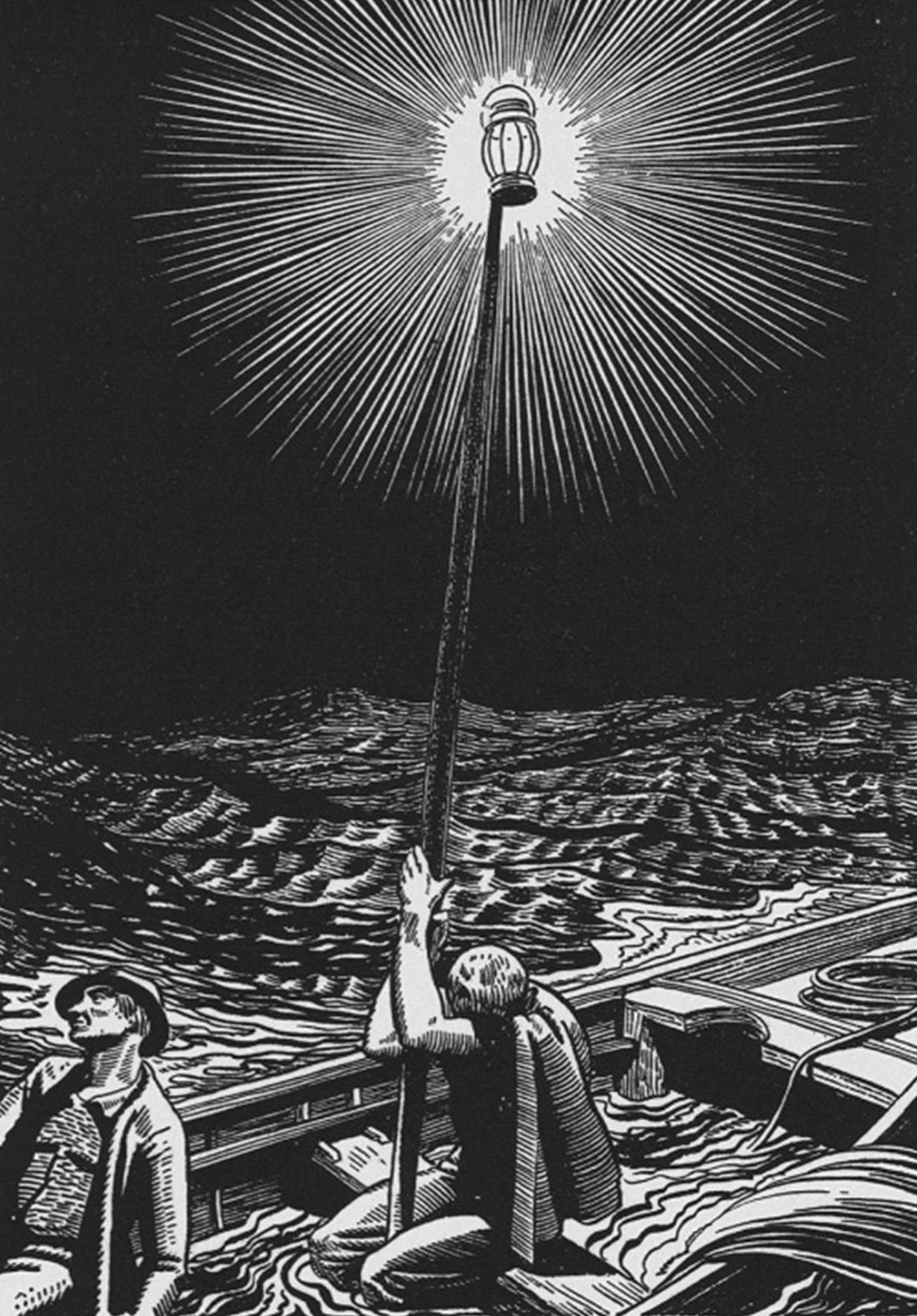
The idea was well expressed by that most Ishmaelian of post-Melville writers, G.K. Chesterton. Nothing special or unusual about mysticism, he writes in Orthodoxy; far from a derangement of the senses, it is the mark of health and common sense:
Mysticism keeps men sane. As long as you have mystery you have health; when you destroy mystery you create morbidity. The ordinary man has always been sane because the ordinary man has always been a mystic. He has permitted the twilight. He has always had one foot in earth and the other in fairyland. He has always left himself free to doubt his gods; but (unlike the agnostic of to-day) free also to believe in them.
Moby-Dick permits the twilight; it is an education in twilight-permission. Indeed, the term “twilight” appears several times in the text, almost always to connote an uncertainty and indeterminacy more fundamental than any fixity or certitude. Above all, this is a book that proclaims radical mystery. Unlike its Romantic precursors, however, it doesn’t do so by shoring up an island of enchantment against the tsunami of science and reason, but by surfing the wave.
Erik’s lectures in our course focused on the naturalism of Moby-Dick, its virtually unprecedented (in fiction) engagement with the non-human world on its own terms. It’s in those infamous “documentary” chapters that this naturalism prevails; those long digressions on cetology, oceanography, sailing, and the technical minutiae of the whaling business. However, rather than espouse the muscular hubris of scientism, insisting (as many of his contemporaries did with increasing confidence) that the empirical investigation of nature would strip the world of the magic our benighted ancestors projected upon its wholly mundane surfaces, Melville gives us a naturalism whose every advance only uncovers more strangeness. “Dissect him how I may,” he writes of the sperm whale, “I go but skin deep; I know him not and never will.” Or as Erik put it while discussing that scene where the Pequod comes upon the floating carcass of a giant squid, with such bizarre, monstrous creatures quantitatively available to the student of nature, who needs the Kraken?
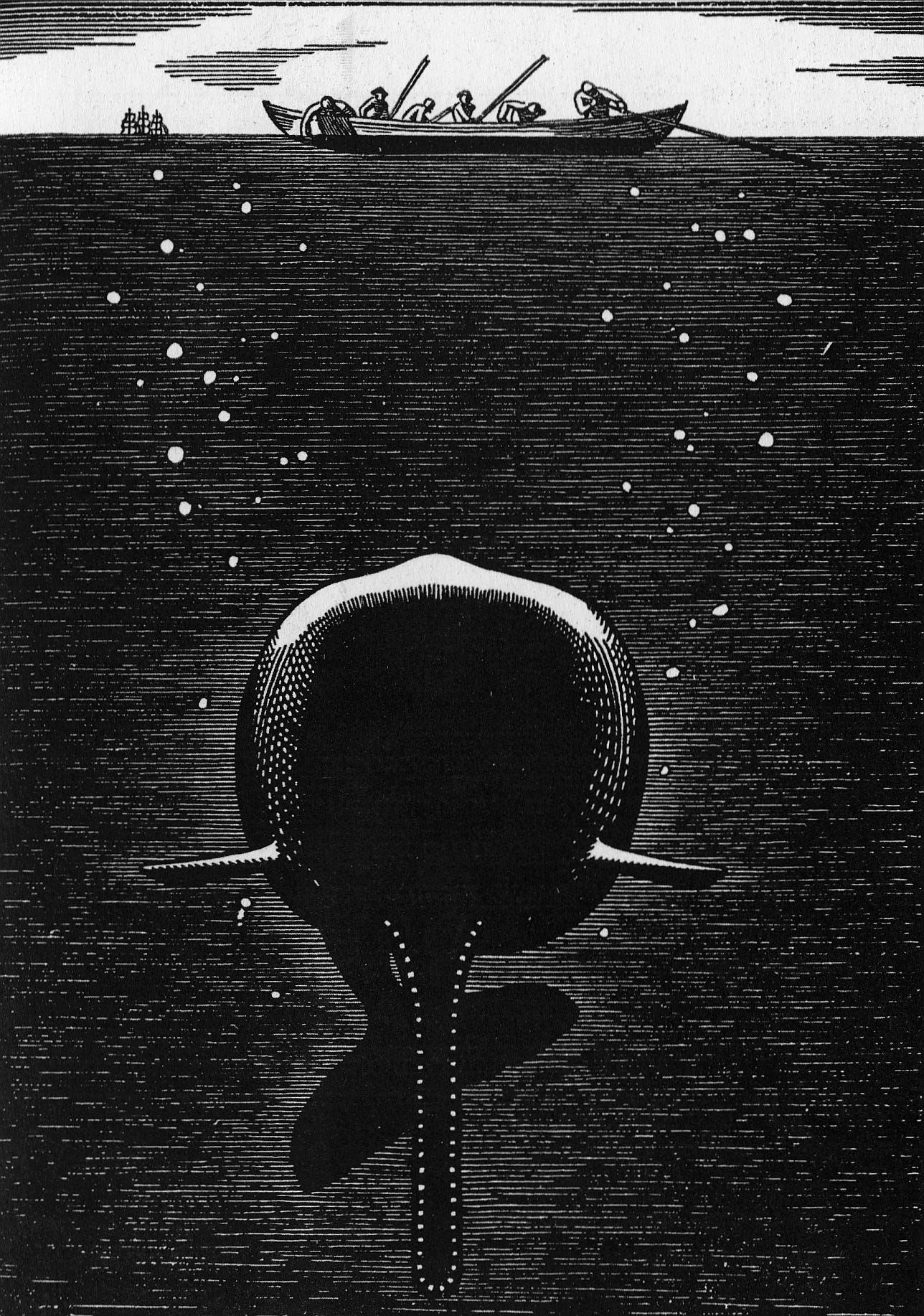
And yet as Chesterton writes in the passage quoted above, however free the true mystic may be to doubt his gods, he is also free to believe in them. In my own contribution to the course, I endeavoured to counterbalance Erik’s weird naturalism with a focus on the outright supernatural aspect of the book. For if the honest investigation of the non-human on its own terms dominates the documentary chapters, the narrative chapters exhibit an equally candid fascination with the magic, synchronicity, and myth at work in life and world. These two forces—nature and whatever lies beyond it—are not pitted against each other in Moby-Dick. The supernatural doesn’t go away as naturalism gains ground, though it does change, since it too begins to show its more-than-human facets.
In many cases, the supernatural elements in the book could arguably be put down to fanciful surmise on the part of Ishmael and his shipmates. But Melville made sure to include a few whose otherworldliness we can’t deny without showing our own prejudice. One of these is the character of Fedallah, the Persian fire-worshipper whom Ahab sneaks aboard to help him vanquish the white whale. Whereas Ishmael sympathizes with everyone in the novel (human or otherwise), he never extends his compassion to this objectively sinister figure, whom the crew pegs as a demon from the start. Don’t buy the Zoroastrian apparel of this interloper, Ishmael seems to say; the white-turbaned Fedallah’s appearance is a deception, “a tremulous shadow cast upon the deck by some unseen being’s body.” Several times, we are told how Fedallah and his mysterious henchmen “flit” and “glide” about the deck, moving at inhuman speed without making a sound, even when loosening the tackles and bands of Ahab’s whaleboat before a hunt. We are told that Fedallah never sleeps, that he spends all his time on deck, even climbing to the mast-head at sundown to watch the ocean throughout the night, “his turban and the moon, companions in one sky.” Even for Ahab, who retained his services through “private measures” never explained, Fedallah remains “a muffled mystery to the last.” Though at the beginning the captain appears to be in charge, increasingly, as the novel progresses, we get the sense that it is Fedallah who calls the shots. In later chapters we catch Ahab staring at his companion in consternation, at times seeming desperate to be free of this force he has conjured in his Satanic quest.2
Now, at this point, you might argue that all this is still in the realm of speculation, that Melville is simply flavouring his drama with a dash of Orientalist spice, the better to play perhaps on our preconceptions. I would agree if it weren’t for one crucial scene. Taking inspiration from Shakespeare’s Macbeth, that ultimate ode to indissoluble enchantment, Melville has Fedallah prophesy, to the last detail, the form that Ahab’s demise will take. The captain, he declares, cannot die until three conditions are fulfilled: first, he must behold two hearses upon the sea, the first not fashioned by human hands, the second made in America; second, Fedallah himself must die before Ahab, though even in death he will continue to be his pilot; third, that only hemp can kill the captain.
Like Macbeth before him, Ahab interprets these riddling assurances as proof of his invincibility and inevitable triumph. And like the Scottish murderer, he’s got it exactly backwards. The agent of darkness Ahab has summoned does not secure his victory but sets the unalterable terms of his defeat. The first hearse will be the whale itself, and the body it carries, none other than Fedallah’s; the second will be the Pequod, once staved by the furious whale. Ahab will see those prophecies fulfilled, but he will never learn the meaning of the last one. The hemp that kills him will be the whale line that wraps around his neck and pulls him under so fast and suddenly that only the omniscient Ishmael will notice.
We are never told to what destination Fedallah intends to pilot Ahab once all is accomplished; but when the Parsee’s corpse resurfaces on the third day of the chase, lashed to the white whale in a snarl of ropes and harpoons, the doomed Ahab observes that his diabolical eyes remain fixed upon him. The “unseen being” has surrendered its body, but it remains present—no longer as a crew-member, but as the preternatural guide who will conduct Ahab on the last stage of his true voyage.
All this is meant to press a simple point that the modernist sensibility has too long insisted on downplaying, and not always for the best of reasons: Moby-Dick is a supernatural tale. It affirms the ancestral dreams of premodern humanity alongside the ambitious, myth-busting visions of “modern man.” Today, in 2026, when we can clearly see how utterly scientific progress has failed to exorcise those forces, entities, and phenomena that its most vocal proselytes assured us would vanish if we only stopped believing in them, we are in a position to appreciate the book for the weird fiction it contains.
It’s true that Moby-Dick speaks to us at the level of ecology, psychology, and politics. But it also speaks to us metaphysically. And what it says, I think, is this: this Nature that the scientist investigates, and upon whose reliable causal structure we depend when we place our hopes in love, in the home, in society, is itself an utterly inexplicable, hence supernatural, gift. Astonished gratitude, rather than the assumption that we are entitled to such a world, would seem to be the proper attitude towards it. We might do worse, in any case, than to be thankful for all the sperm we get to squeeze.
Spermaceti is a waxy substance found in the heads of sperm whales. It was one of the most valuable resources to be extracted from the oceans from the 17th century to the end of the 19th, being used in the production of candles and makeup, among other commodities.
No hyperbole here: When Ahab “baptizes” his harpoon by dipping it in blood, he intones, “Ego non baptizo te in nomine patris, sed in nomine diaboli” (I do not baptize you in the name of the Father, but in the name of the Devil). Melville repeats this line in a letter to Hawthorne on the novel, though he leaves it unfinished, saying, “make out the rest yourself.”
No posts
Comments
Nothing yet. Say the first thing.
Sign in to join the conversation.