
An average venture capitalist reviews more than 100 startups before making a single investment. To be specific, my research shows the average number of startups reviewed for each investment is 101.
That is a remarkable number that every founder and investor need to ponder about. One hundred and one companies that made it far enough to enter the VC deal funnel, took up some measurable amount of an investor’s attention, and were then, overwhelmingly, discarded. If you are a founder about to raise, this is the number you are up against. If you are an investor, this is the machinery you are running, whether or not you have ever drawn it on paper.
For IT-focused investors the number climbs to roughly 150. For early-stage investors it’s about 120. For healthcare VCs it is 78 startups per closed deal. (If you wonder why healthcare is so different, it is more difficult to evaluate healthcare investments and there is a smaller universe of healthcare founders.) However you slice the industry, the ratio is brutal. For each deal, investors rapidly assess a small number of high-signal factors and use them to decide whether this deal deserves more of a scarce resource — time. As the startup travels through the deal funnel, investors change the ways they assess the deal quality and prospects.
This post is about where those hundred deals come from and how they get filtered down to one. Understanding the funnel is not optional knowledge for founders: if you don’t know how the filter works, you are more likely to end up on the wrong side of it. And if you are an investor, I hope that you will review your deal funnel carefully and compare notes after digesting this post.
Before investors can evaluate anything, they have to locate it. Deal sourcing is the process by which investors identify potential investment opportunities — and in the industry, those opportunities are simply called deals.
Many VCs firmly believe sourcing is the critical ingredient of their secret sauce. This is especially true at the earliest stages, where uncertainty is enormous and there is no centralized information resource telling you which companies exist and which are any good. Investors are particularly hungry for proprietary deals: opportunities only they can see, or that they see before anyone else does. In the recent past, many VCs concentrated on nursing proprietary deals. This still holds true, but today the cost for searching for deals with all new AI tools is lower – there are fewer proprietary deals and VCs need to find new ways to generate them. More than 60% of deals are not proprietary.
The output of deal sourcing is deal flow — the total number of investment opportunities an investor gets to consider, measured per unit of time. A typical active early-stage VC firm has a deal flow of roughly 1,000 opportunities per year. This, of course, depends on the size of the firm and the number of people working there. Some see a few dozen; some see many thousands. Quantity is only half the story, though. What matters is the quality of what’s flowing in and the investor’s ability to pick correctly out of it.
So where do the deals actually come from? Roughly, in order of volume:
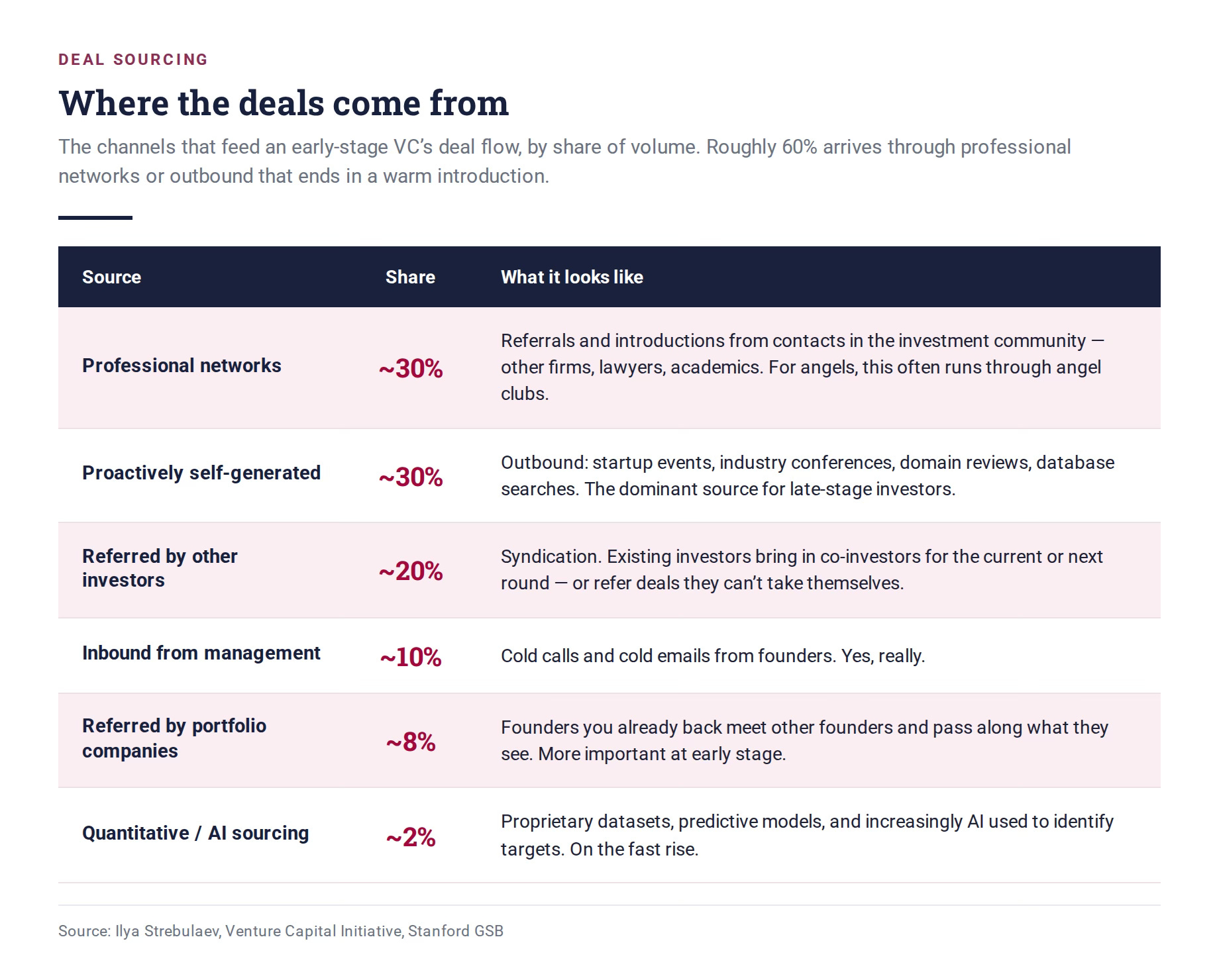
A few of these deserve unpacking.
On proactive self-generation, here’s how it works at one VC firm with several general partners and associates. The whole investment team develops a thesis, narrowing it down to a specific vertical. Associates then run a meta-search to identify every startup they can find in that narrow space. The search deliberately over-generates — the point is to see the entire playing field. Analysis then cuts the list down to maybe a dozen genuinely interesting opportunities. Finally, the team works its professional network to get warm introductions to each one. Note that even the “outbound” channel terminates in a network introduction.
On investor referrals, consider a company called SelfScore. Theresia Gouw, a partner at Aspect Ventures, put a relatively small seed check into the company in 2014. She then introduced it to Sameer Gandhi at Accel, and the two of them co-led SelfScore’s Series A in June 2015. During that process they brought in a third investor, Blake Modersitzki of Pelion Venture Partners, whom they had syndicated with before. Pelion took a small piece of the Series A — and then led the next round in 2016. Each introduction was backed by real money. That’s what makes investor referrals credible in a way that most introductions aren’t.
About one in ten deals starts with a cold call. This is odd, because if you ask investors about cold outreach, most will tell you it doesn’t work — they don’t respond to emails from founders they don’t know and haven’t been introduced to through a trusted source. And yet investors of every kind, successful and less so, large funds and small, report the same figure: roughly one in ten.
A few years ago my research team decided to test this directly. We sent short introductory cold emails to angels and venture capitalists, ostensibly from fictitious entrepreneurs, each containing a one-paragraph pitch for a very early-stage startup.
Everything was stacked against these emails. The match between investor interests and startup characteristics was deliberately imperfect — mismatches on geography, on industry. And plenty of the messages presumably died in spam filters before a human ever saw them.
We did not expect much. Our VC friends were blunter than that. One prominent investor told us, in so many words, that a bunch of losers might reply but not a single reasonable VC would.
Here is what happened. Almost 10% of investors responded with interest to at least one email — requesting a meeting, a call, follow-up detail, or a deck. Because many investors received more than one pitch, the unconditional per-pitch response rate was lower, but at over 4% it still amounted to nearly 3,500 interested replies. And the distribution was revealing: of the 50 pitches we used, the top five drew an overall response rate of 13%, and 17% from VCs specifically. One in six venture capitalists responded to a cold pitch from those startups.
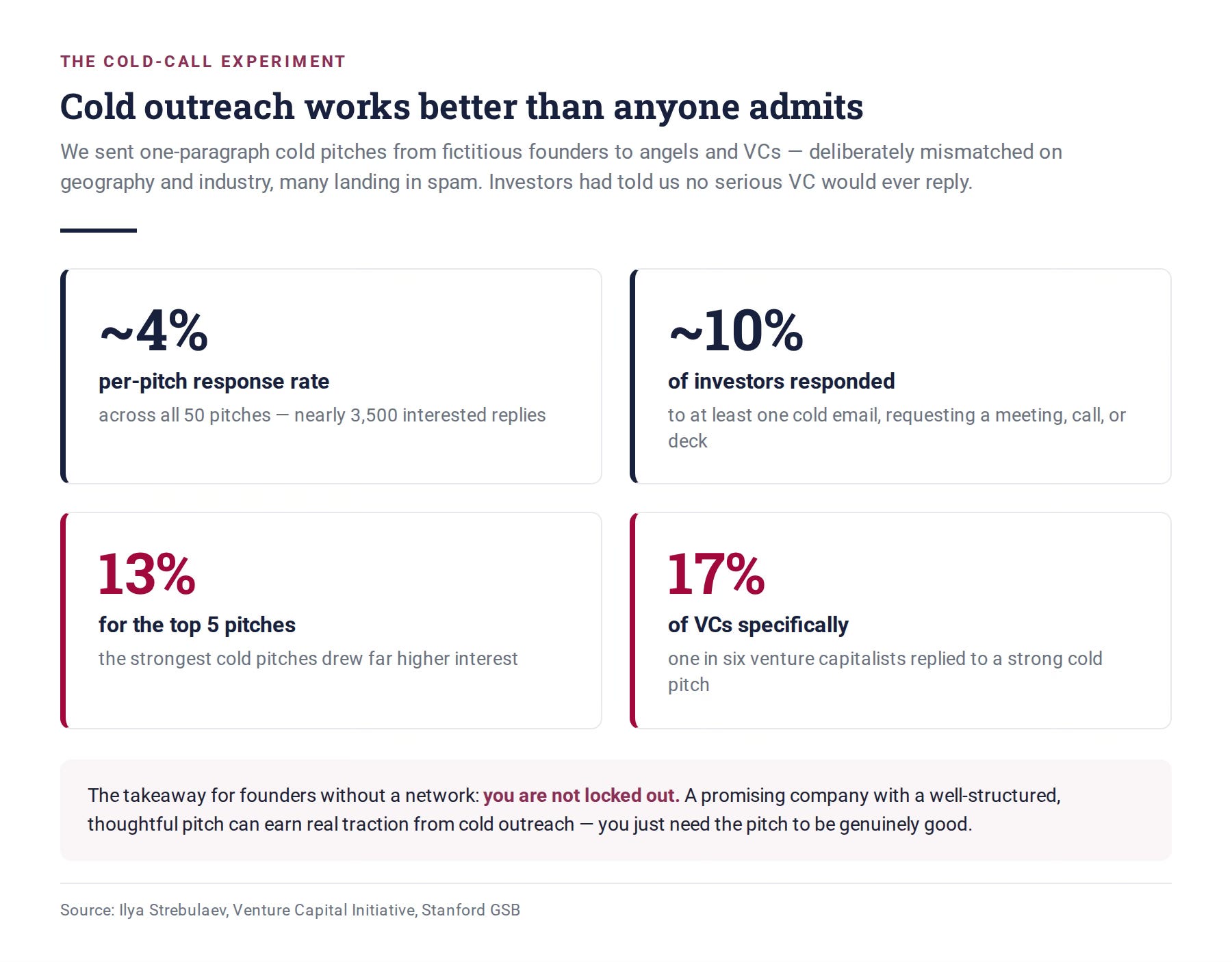
It suggests that a founder with a promising company and a well-structured, thoughtful pitch can get real traction from cold outreach. That is genuinely good news for entrepreneurs who don’t have strong networks and need backers.
There’s a coda. Whenever I present these results to a room of investors and mention that everyone told us the study was impossible because no investor ever replies to cold outreach, a line forms afterward. Angel after angel, VC after VC, comes up to tell me about the investment they made that started with a cold call from a founder.
Want to learn more about this experiment and the cold pitch: review this post.
Cold Pitch: How to Ensure the Investor Gets Back to You
·
Jun 27

Most founders believe that the only way to get in front of a venture capitalist or an angel investor is through a warm introduction—a mutual connection who vouches for you and opens the door. And they’re not wrong to think so: the majority of consummated VC deals do come through referrals from professional networks. But here’s what most founders don’t know: a well-crafted cold pitch works far better than almost anyone in the industry is willing to admit.
The logic of building diverse sourcing is straightforward: a broader web catches more. More means a better chance of catching something extraordinary. Diverse sourcing brings another critical benefit: you never know where that one super successful deal will come from. Often, the best deals come from unexpected sources.
It’s why angels join angel groups — the primary benefit is pooling deal flow from people you trust who are experts in fields (and thus get sourcing) you aren’t. Sand Hill Angels is a useful illustration. Founded in 2000, SHA is a consortium of more than 100 individual angels in Silicon Valley. It sources chiefly through three pipelines: its website, member referrals, and referrals from syndicate venture investors or accelerators. Website applicants submit through a platform for managing angel group opportunities. But most actual investments come from member referrals. I have SHA members come to my Stanford VC class every year to share their experience. One after another, they say the main reason they joined: to share in high-quality deal flow from trusted people who were experts in their own fields — diversifying both the flow and the resulting portfolio, and leveraging the group’s combined knowledge. To widen the aperture further, SHA spent years as a limited partner in the accelerators, such as 500 Startups, which expanded deal flow and gave the group access to outside expertise. It should come as no surprise then that in my rankings of unicorn investors SHA comes close to the top of accelerators and angel clubs.
For new investors — a freshly hired associate at a VC firm, say — building a personal sourcing network is close to the top priority, and for good reason: deal flow is what venture investors consider their crucial value-add, the thing that sets them apart. Attending startup presentations, industry conferences, and increasing your rolodex of diverse contacts increases the number of potential deals you come across. Reputation compounds: become known as genuinely helpful to founders and knowledgeable about a specific space, and flow increases. As my co-teacher Brian Jacobs likes saying to our MBA students, “the best day to increase your rolodex was yesterday.” But it is never too late.
Diversification of sources is critical. If you utilize LinkedIn, my advice is to check how diverse your contacts are: geography, industry, education, role, type of companies. If most of your contacts come from one industry or one geography or one school, you are less likely to be successful as an investor.
But nothing generates deal flow like success. In early-stage investing, success breeds success. An investor associated with one great proprietary deal will find the next ones much easier to come by. Blake Jackson and I recently looked at VCs who marginally made it to the Midas list that Forbes published annually. We compared them to VCs who, according to our analysis, were just outside the top 100. They were very close but did not make it. If you are number 99 and the other investor is number 101, you might think the difference is small. But we found that the difference is large. Making it to the Midas list increases your ability to make more investments quite a bit (this finding is so interesting that I will devote an entire post to what we found.)
Practical implications: For an investor, think hard about your network and sourcing. Think of the successful deals in your space or geography that did not enter your deal flow. How could this have happened, what should you do to make sure it does not happen again? At the end of the day, it is the quality of sourcing matters. If you even did not have the best deals enter your deal funnel, something serious is off. My research finds that what may really differentiates great VCs is the quality of their referral network and sourcing mechanisms. Pay attention.
For a founder, warm intro is usually better than a cold outreach, but don’t despair about cold emails if you do them well. Moreover, note I used “usually” in the previous sentence: it is the quality of the warm intro that matters. Have your warm introducer generated any successful deals for the VCs before? What is their reputation? Even better, think hard about what you should do so that VCs reach out to you, and not vice versa. Or if you reach out to a VC, do it first before you need to fundraise. As Scott Sandell, a very successful VC investor, told my Stanford MBA class: “If you ask for money, VCs give advice. If you ask for advice, VCs give money.” This is so true.
VCs report spending about 15 hours a week sourcing and screening deals. The only thing that takes more of their time is helping their existing portfolio companies, at 18 hours. So the screening process — from a glance at an intro email through to a final investment decision — is a substantial fraction of the VC job.
Here is the shape of a typical early-stage deal funnel:
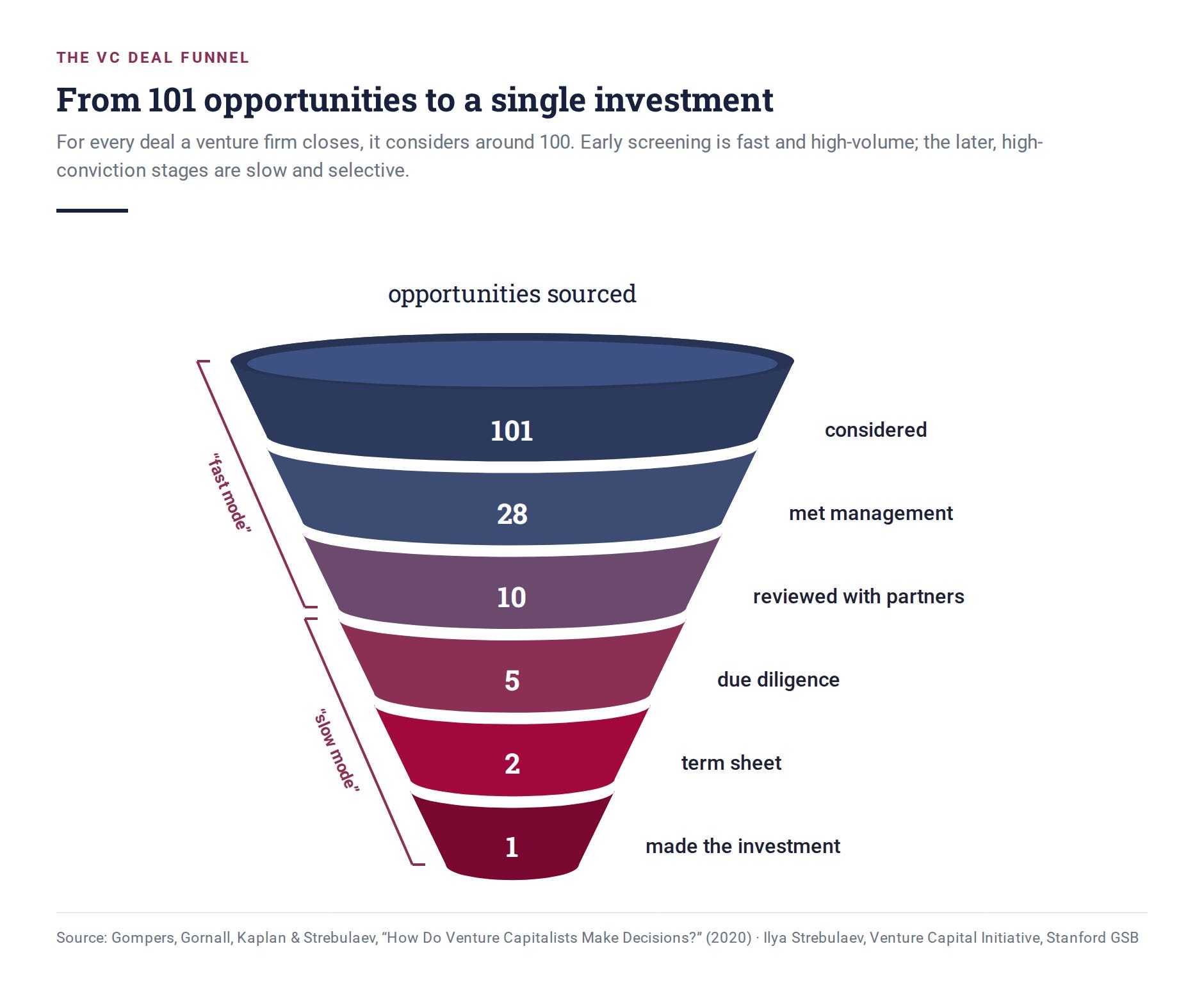
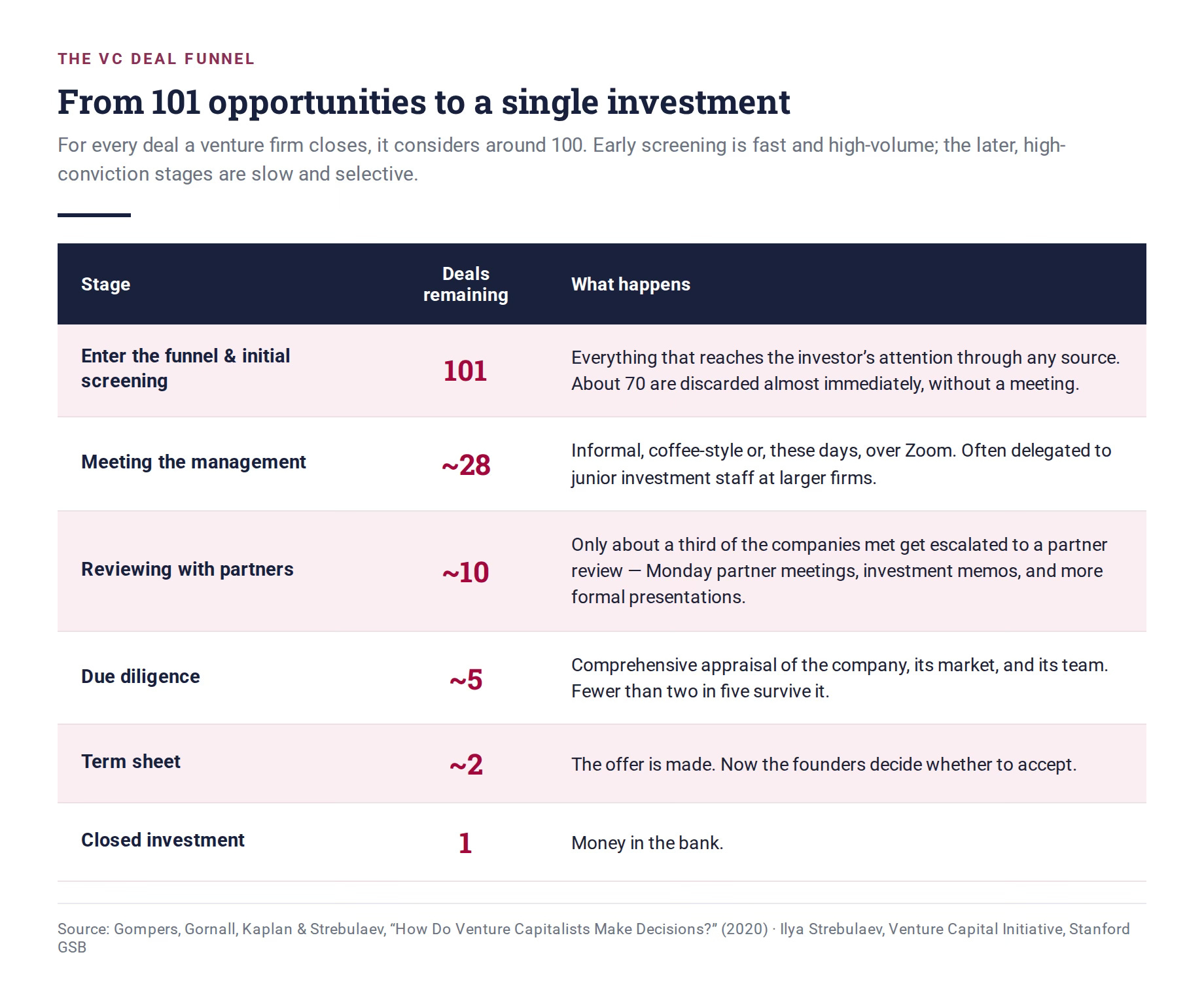
Look at where the funnel narrows most sharply. It’s at the very top — and that’s not an accident. Each successive stage costs the investor dramatically more time than the last, so the cheapest filter has to do the heaviest lifting.
Initial screening is where roughly 70 of 100 opportunities die, usually within minutes and without any meeting at all. Investors do differ here: larger funds are more willing to meet founders, probably because they have junior staff to delegate exploratory meetings to. California investors are also more likely to meet likely because they feel competitive heat. Importantly, my data shows that more successful investors are also more willing to take meetings. That did not come as a surprise to me as in my previous research more successful investors were also more likely to respond to cold emails from founders. (They are also willing to run more of them through further expensive screening stages: sweat pays off in the VC world.) Anyway, the headline holds everywhere. More than half, often three-quarters, are gone almost immediately for any kind of VC investor.
Some of that could be simple mismatch. Startup can be too early for investors, or outside their vertical, or in the wrong geography. Any founder worth the name should know an investor’s mandate before approaching them. The far more interesting question is why investors pass on deals that are in their space, at their stage, in their geography. That’s the subject of my future post.
Meeting the management is informal on the surface — coffee or zoom chat, no slides necessarily. Founders should hold no illusions about what’s happening. They and their company are being evaluated, scrutinized, and compared against thousands of other teams and ideas and against patterns of success the investor is familiar with. The investor decides whether to escalate. I use that word “escalate” here deliberately. A half-hour meeting is genuinely expensive when you review 200 deals a year. But the next stage is far more expensive, because it means spending hours and hours of your time and other people’s time on one deal.
Reviewing with partners is where the funnel collapses hardest: only about 10 of the original 100 make it, roughly a third of those who got a meeting. In Silicon Valley and most other hubs the traditional day for this is Monday. Discussion comes with a concise investment memo summarizing the deal, its benefits, its risks; often a presentation by the founders to the whole partnership or angel club. Investors may also reach outside the firm at this stage, calling academics or industry executives to gauge product potential and market interest.
Bringing a deal to partners is not a decision taken lightly, and the reason is only partly about time. Investors care about their reputation inside their own firm. Nobody wants to be the partner who wastes everyone’s Monday on a weak deal.
Due diligence — DD, in industry shorthand — is a comprehensive appraisal of the potential investment (of course, “comprehensive” depends on startup’s stage). The specific steps vary with stage and with how much data exists. Of every five deals that enter DD, fewer than two come out the other side. Those that do get a term sheet: a document summarizing the terms on which the investor is prepared to invest.
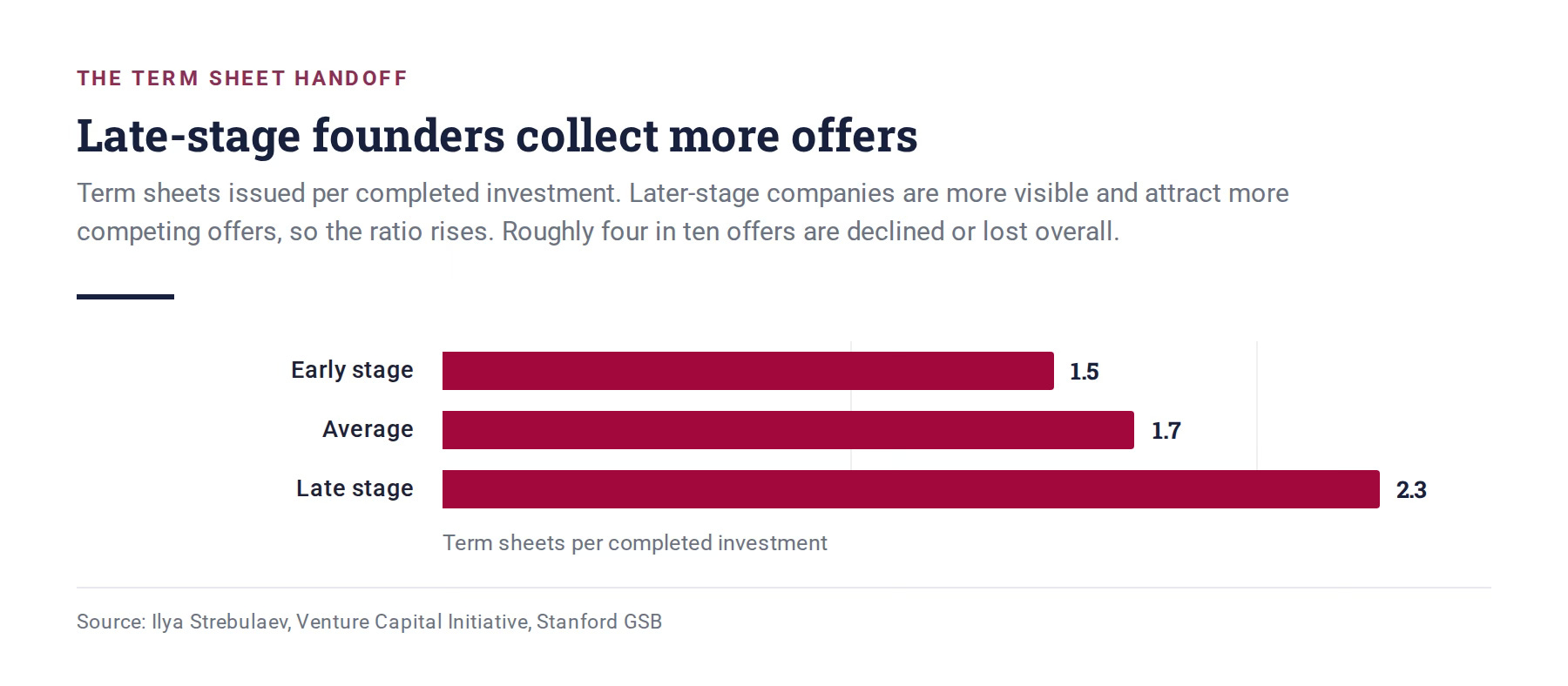
And then the baton changes hands. Up to that moment, the founders have been convincing the investor. Once the term sheet lands, the founders decide — accept, negotiate, or pass and keep talking to others. Which is why, on average, 1.7 term sheets are required per completed investment. That ratio is 1.5 at early stage and 2.3 at late stage, because later-stage companies are more visible, offer less proprietary access, and attract more competing offers.
Some (very important!) practical implications for founders. First of all, whenever you are fundraising, always know where you are in the deal funnel for every investor you target. That’s because the way you should approach the investor and the entire process change as you move through the funnel. So often, I see founders that have the same email and the same deck for all the stages: this is a mistake. At the initial screening, investors don’t really make a decision to invest: they make a decision whether to escalate and spend more effort on you. They ask different questions at a later stage. Once you are invited to meet another partner, you are one out of ten, great progress! But requirements also change.
Remember this: at initial screening send an email that survives 30 seconds, at the meeting the management stage prepare for a 30-minute conversation that will escalate to due diligence, and at the DD stage help prep a memo someone else will write about you to people you may have never meet. Again, let me repeat: one of the most common mistakes I see is that founders prepare one deck, one conversation, one line of arguments for all the stages.
Second, a good strategy is to be helpful to investors. VCs are super busy. Help them by anticipating all the questions they want to ask (check my list of 100+ questions VCs ask I prepared especially for this). Prepare DD materials they can share with their partners.
Third, founders often ask me whether it makes sense to meet with junior personnel at larger VC firms. I’d say yes, because they act as deal scouts. They can’t cut a check, but they can introduce you to the right partner who will be making a decision. But beware: my favorite expression is “incentives drive behavior.” Junior VCs may have incentives other than maximizing returns for their LPs; they care about their reputation and their career, and much depends on their standing and relationship with more senior partners. Again, help junior VCs by learning about them. Most importantly, learn who is the right person in the target VC firm. At the end of the day, even though VC fund will invest in you, your long-term relationship will be with one partner.
Everything above is representative, not universal. Every firm develops its own idiosyncratic process and its own culture around decisions. For investors, it is an opportunity to learn from other VCs. For founders, it makes the process trickier. Junior VCs here could be helpful if you establish a good rapport with them: try to find out how decisions are made and who makes them.
One VC I know, a partner at a mid-size early-stage IT fund, brings founders in for a formal presentation to the full partnership at the end of due diligence — by which point the decision to offer a term sheet has effectively already been made. Another, a partner at a firm of four or five, makes his own investment decisions up to a financial threshold; partners advise each other but own their calls. That changes the shape of the funnel entirely.
Stage changes it too. Later-stage companies have harder financial data and detailed customer information, and that data is sensitive. They’ll only open up to investors serious enough to demonstrate commitment. So the order inverts: the investor produces a term sheet contingent on further diligence, and only if the terms are acceptable does the company open the data room.
And competition can compress the funnel or blow it up completely. When a startup is visibly hot and a competitor puts a term sheet on the table, an investor may have to decide at the speed of lightning whether to throw a competing offer into the ring — without proper review, without diligence, at their own risk.
Which brings us to preemptive term sheets. Occasionally a VC will offer one before any formal diligence, specifically to lock up a deal. These term sheets are exclusive: sign, and you’re obliged to negotiate in good faith with that investor and not shop the deal simultaneously. The investor’s calculation is that this company is going to attract a crowd, and speed beats process. This is more likely to happen if the investor already knows the founders, perhaps in a different capacity (say, as an employee of a company the investor backed previously).
Founders receiving a preemptive term sheet should ask what the rationale is. There’s a real trade-off. A bird in the hand — one workable signed term sheet — beats the prospect of several. But generating multiple term sheets improves your bargaining power and raises the odds of finding an investor who actually fits. What founders should absolutely register is the signal: preemption means an investor believes you are about to be hot. That is information, and you should use it.
The funnel is a time-allocation machine, not just a quality-detection machine. Every stage costs more than the one before it, which is why 70% of deals die at the cheapest filter. Investors aren’t being lazy at the top of the funnel — they’re being economical, because the alternative is spending real hours on companies they were always going to pass on.
Sourcing is a network, and networks compound. Roughly 60% of deals arrive through professional networks or proactive outbound that terminates in a network introduction. This is why investors treat reputation as an asset and why success breeds success. It’s also why founders should think hard about who introduces them, not just whether they get introduced.
Cold outreach works better than anyone admits. One in ten deals starts this way, and our experiment found nearly 10% of investors responding with interest to a cold email from a stranger — rising to one in six VCs for the strongest pitches. If you lack a network, you are not locked out. You just need the pitch to be genuinely good.
The term sheet is a handoff, not a finish line. It takes 1.7 term sheets to produce one investment, which means roughly four in ten offers are declined or lost. The moment an investor commits, the leverage shifts to you — and a preemptive offer is the loudest signal you will ever get that other investors are about to want in.
Next post: The First Two Minutes — How Investors Decide to Pass Before You’ve Finished Talking. We’ll look at the critical-flaw approach, the specific red flags investors scan for, and what the evidence from Dragon’s Den tells us about how these snap judgments actually get made. Why it is crucially important: because deal selection is equally or even more important than deal sourcing.
No posts
Comments
Nothing yet. Say the first thing.
Sign in to join the conversation.