
Myths don't need to be literally true. That's not the point. Myths are the stories a society tells itself about what matters, what to aspire to, and what is worth sacrificing for.
Every culture has its version of the lone hero. The singular mind that changes everything, such as Prometheus stealing fire from the gods. (In our time, AI is that fire.)
Tech has been telling its own version of this myth for decades. In 1968, it was the “10x developer”: the one engineer who could out-think, out-build, and out-ship ten ordinary ones. Fred Brooks pushed back in 1975 with The Mythical Man Month, arguing that complex problems can’t be solved by one brilliant mind alone. But we didn’t let the myth go. We just kept finding new vessels for it — the genius founder of the 80s and 90s, the full-stack engineer of the 2010s, the AI-native solopreneur today.
This is mythology doing what mythology does: showing us what to aspire to. But the question is: have we been reading the story right?

Retellings of the hero’s journey often drift toward a single figure while ignoring the structural reality of the quest. Joseph Campbell was clear that the hero never succeeds alone. Every journey requires a cast because the challenges are too diverse for one mind.
The Mentor carries the knowledge and perspective the protagonist hasn’t earned yet. Gandalf or Dumbledore hold the map when the hero is still finding their footing. They provide the necessary context before the threshold is even crossed.
The Ally enters the story because the mission is more significant than the individual. Sam Gamgee carries Frodo when the climb becomes impossible, while Han Solo returns to the trench because he recognizes the weight of the moment. They are the fellowship that makes the destination reachable.
The Skeptic provides the friction that validates the path. Also known as the Threshold Guardian, this role tests the plan and forces the hero to prove their competence. Boromir’s hesitation in the council serves a purpose because it drives the group to find a stronger answer. This character is the weight that sharpens the blade before the battle begins.
The Herald signals that the environment has changed. They bring the call to adventure and the specific tools required for the road ahead. They represent the transition from the old world to a new, more demanding reality.
The hero claims the title, but the cast defines the outcome. A story without these supporting roles is simply a lesser narrative.
In early 2025, the reality check for AI productivity arrived. A controlled study by METR found that experienced developers using AI tools were actually 19% slower than those working without them. The revealing detail was the perception gap. Those same developers predicted a 24% speedup. They felt faster because the AI provides the Herald’s gear: immediate, polished-looking code that masks the time required for verification and cleanup.
The 2025 DORA Report frames this as the mirror and the multiplier. AI amplifies efficiency in cohesive teams, while it exposes and deepens structural weaknesses in fragmented ones. Because only 24% of developers fully trust AI outputs, the individual is often stuck in a cycle of oversight that researchers have dubbed “AI Brain Fry.”
Productivity effectively dips after a worker attempts to juggle more than 3 AI tools. The mental fatigue of constant monitoring and context switching creates a jagged technological frontier. When an individual pushes AI outside its narrow context window without a cast to cross-check the logic, error rates spike by 19 percentage points. The gain is individual speed; the cost is collective quality.
McKinsey reports that 92% of companies are investing in AI, yet only 1% achieve mature results. The gap involves people, process, and shared context. These are the same cast members the lone genius narrative told us to cut.
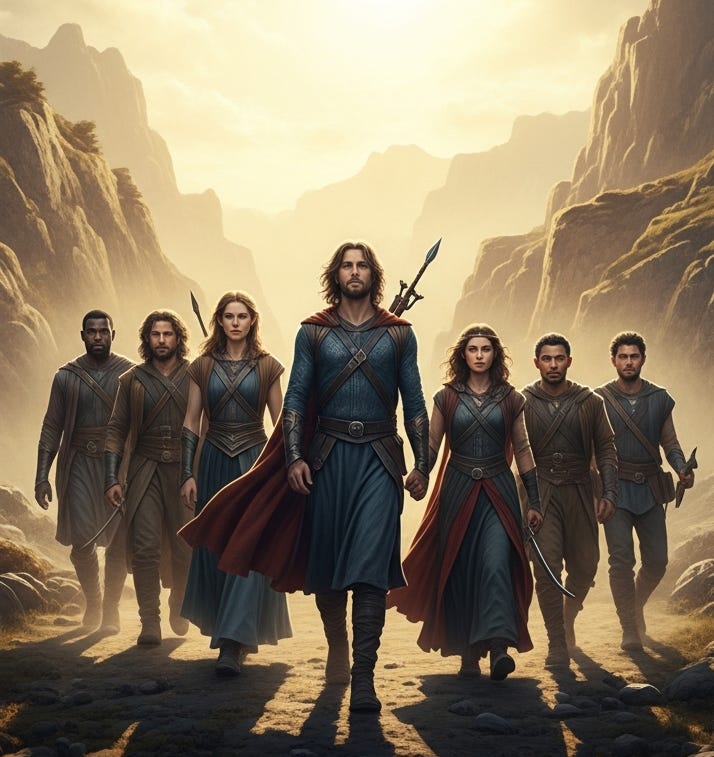
The useful question isn’t whether to use AI. It’s who’s in your story, and what they bring into the room.
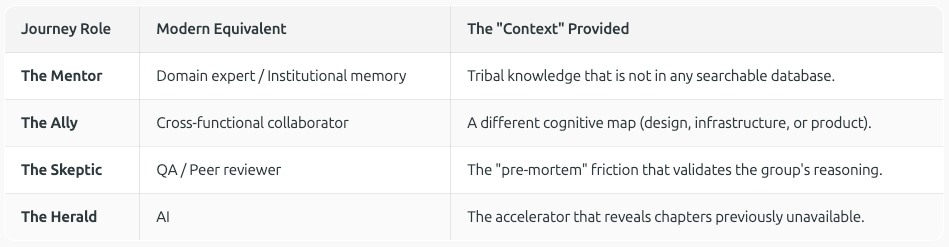
The Mentor is whoever holds your domain’s institutional memory: the PM who was there for the last three failed launches, the engineer who knows why that architectural decision was made, the customer success lead who’s heard this objection from every enterprise prospect. Their knowledge isn’t searchable. It lives in them. When AI generates without it, you get confident answers built on incomplete maps.
The Ally is your cross-functional counterpart: design thinking alongside engineering thinking, market perspective alongside product instinct. What they contribute isn’t just effort — it’s a different cognitive map of the same problem. This is exactly where the HBS finding lives: AI amplifies what’s in the room, and one perspective in the room means one range of outputs.
The Skeptic is QA, legal, the person on your team who asks “what are we missing” before it ships. In software, this is code review. In strategy, it’s the pre-mortem. Don’t suppress this character — they’re the reason the fellowship doesn’t walk into Moria unprepared.
AI is the Herald, and like any herald, what it can offer depends entirely on what context it arrives with: the brief, the constraints, the prior decisions, the customer data, the things that didn’t work last quarter. Without these, it announces a new chapter using someone else’s map.
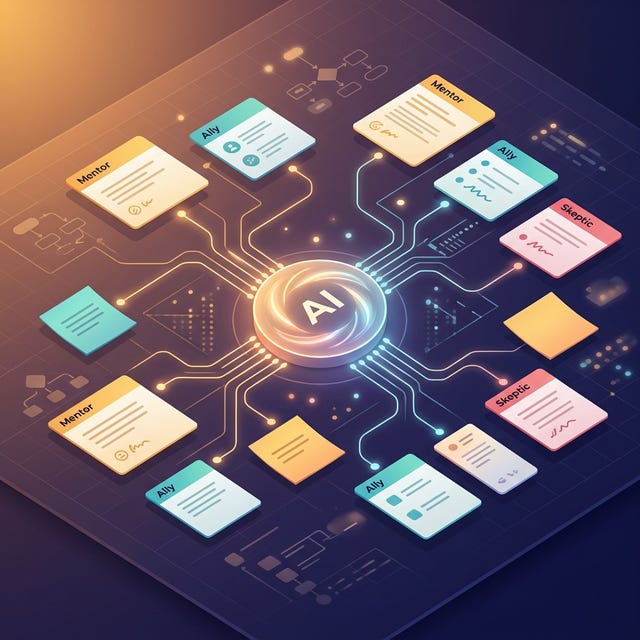
The thing that makes a team’s AI use different from an individual’s isn’t just the number of people in the room. It’s what they carry into the generation process together: the constraint from last quarter’s failed launch, the customer insight from a field call, the architectural decision nobody wrote down. That accumulated knowledge is the fellowship’s shared pack.
Most teams using AI individually are running each character’s inventory in isolation. Nobody’s sharing the map. Atlassian research found this in developer teams: time gained on individual tasks, time lost chasing context from teammates who were each running their own separate workflow.
At illumi, we built our canvas around exactly this problem. Teams build shared boards where decisions, constraints, requirements, and prior outputs live as cards that feed AI generation collectively. The context belongs to the fellowship, not to whoever has the longest chat history.
Great work has always been a collaborative story. We just got used to telling it badly — spotlighting the protagonist and leaving the rest of the cast out of the credits.
AI makes the hero faster, more capable, able to attempt things that used to require a room full of specialists. It doesn’t change what the story requires. The mentor who knows the terrain. The ally who stays when the work gets hard. The skeptic who makes you prove it before it ships.
The hero was never alone. The journey was never solo.
No posts
Comments
Nothing yet. Say the first thing.
Sign in to join the conversation.