
“The other thing that we’re really excited about that AI is going to give us the ability to do is to provide users of Disney+ with a much more engaged experience, including the ability for them to create user-generated content and to consume user-generated content, mostly short form, from others.”
CEO Bob Iger on Disney’s Q4 2025 earnings call
Well, that little unscripted aside on AI-enabled UGC had the internet—and even the creator of Disney Channel’s “Owl House”—seeing red:
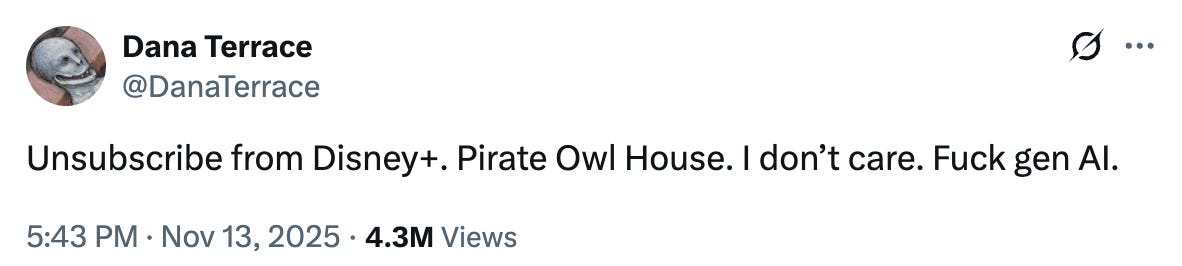
They’re not wrong to be horrified. The concerns about AI gutting the creative economy are valid and urgent—the world’s biggest companies are pouring billions into tools designed to automate or accelerate creative labor. On top of that, the idea of scrolling through incoherent AI-generated Moana clips while trying to watch The Mandalorian sounds like a UX nightmare dreamed up in a particularly grim corner of hell.
But maybe Disney’s seeing something the pitchfork-wielding masses aren’t. No one in their right mind should want to pay to watch that content… but what if they want to create that kind of content for themselves?
Disney understands that people don’t just want to consume their IP. They want to inhabit it, extend it, and make it their own. That’s why kids have been role-playing as Disney characters for generations. That’s why the toy aisle exists. That’s why people pay $6,000 to stand in line for four hours to hug a person in a Goofy costume.
We’ve always known a digital version was coming, and it turns out it’s almost here. A world where your kid creates a story where they team up with Elsa. Where your teenager ships their own alt-ending to Encanto. Where you make a “what if Darth Vader met Thanos” crossover that violates every canon rule and exactly zero copyright laws because you’re doing it in Disney’s walled garden.
Your Frozen spin-off might be garbage, but it’s your garbage, starring characters you’ve loved since you were five.
Ultimately, Disney has little choice: it either builds guardrails and attempts to own the experience or it spends the next decade playing endless whack-a-mole with takedown notices while the entire UGC economy around their IP thrives elsewhere.
So, with over 130M users on Disney+, the convenient thinking in Burbank goes like this: rather than spending billions reacquiring the same audience, let’s bolt UGC creation tools onto our streaming service and finally give people the bloated super-app they’ve always wished Disney+ would be.
The not-so-little problem is Disney+ was built for lean-back consumption. Actual content creation requires fundamentally different architecture, engagement patterns, and monetization. We’re happy to be proven wrong, but Frankensteining a creative studio onto a streaming service is a tall order.
Whether this “maker studio” lives in Disney+ or as a separate platform, Disney will do everything possible to keep creation on their turf. The value proposition is straightforward: play in our universe, get legitimacy, quality tools, and maybe even featured distribution. Every other studio (e.g. Warner Bros, Universal, Paramount) will build the same thing and hope their IP is valuable enough that creators stay exclusive.
The irony? The Great Unbundling™ could end up fragmenting consumption and creation. The walled garden approach forces zero-sum competition for engagement in a world where creators aren’t loyal to one IP. Today’s Frozen fanfic writer is tomorrow’s K-Pop Demon Hunters dance choreographer is next week’s Wicked mashup maker. They follow ideas and audiences over ecosystems.
The alternative approach treats this as an infrastructure problem instead of a destination problem. What if someone built the pipes that let IP-protected creation happen anywhere creators already are? Same guardrails, brand safety, and monetization but platform-agnostic.
The same creator tools and guardrails that enable brand-safe Disney UGC could work for any other IP, on any platform, whether that’s Discord, TikTok, or a standalone app. It’s why a company like Wide Worlds is interesting here—they’re tackling this the same way Stripe didn’t need to own stores to own payments infrastructure.
Regardless of who’s right or wrong, the AI-enabled creation economy is coming for IP owners faster than ever. The uncomfortable truth for Disney and others is that complete IP protection and cultural relevance are no longer compatible strategies. While studios convene brand guideline panels and tightly clutch their style guides, today’s creators are already shipping. Smart money is on whoever builds the infrastructure that makes those guidelines work at creator speed, not corporate speed.
Comments
Nothing yet. Say the first thing.
Sign in to join the conversation.