

Several years ago, Chris Guillebeau sold out a 3000 person event in Portland called The World Domination Summit (in its second year). It ran for several years - sponsor-free - and was one of the most beloved conferences out there among the more fringey, do-gooder business set. Long before there were Digital Nomad visas, there was Chris Guillebeau teaching the masses about the Art of Non-Conformity by visiting every country in the world and writing about how he did it.
That particular year, Chris announced his new book (The $100 Startup) with an envelope presented to every single attendee with a crisp $100 bill in it.
WDS was a $500 ticket for three days of premium speakers, events, and gatherings, and he gave one-fifth of that back to every single person, and asked nothing in return besides simply to do good things with it.
That is the definition of Generative Generosity. Chris gave away enough money to follow his advice, so people in attendance could have the means to generate restorative, creative, values-driven enterprises in the world. I know several people who, even more than a decade later, still have their $100 bill to commemorate being part of such an exceptional moment.
Then, a few days ago, Alex Hormozi launched his new book, “100 Million Money Models,” by selling $80m+ in total volume through a 10-hour live webinar. He did this by (using my rough math) convincing about fifteen thousand people to spend $6000 on 200 books each (with a $35k upsell for some mastermind or something). It was framed as a generous donation. A win-win for everyone. The lowly peons get free books, the people who can afford $6k get to gift their copies for more signups (with their own funnels and upsells - as outlined in the book). From the best I can tell, Hormozi spent an Everest-sized mountain of money on highly targeted ads based primarily on income level and business ownership. So a very skilled marketer targeted other very skilled marketers by convincing them he is a MORE skilled marketer, so they can collectively make more skilled marketers.
Put another way:
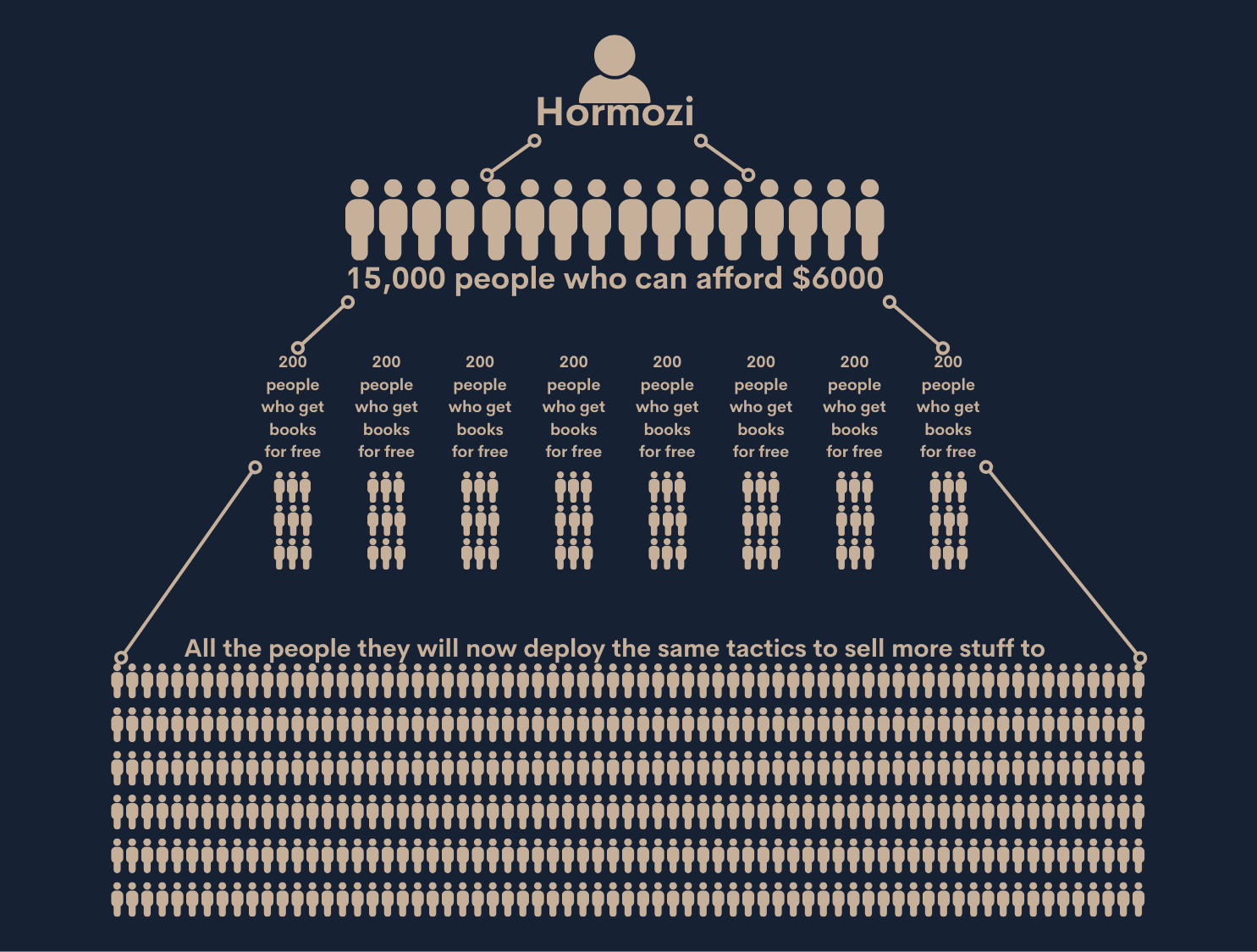
The only people who are making a ton of money here are those at the top.
Interestingly, both book launches employed similar methods. They leveraged mass, captive attention, and the concept of generosity. They also both aspired to set Guinness World Records (that year, WDS set a record for the most people gathered in dinosaur costumes, Hormozi set the record for most books sold in a single day). Both launches were all about buzz, press, and spectacle. Social media conversations around them were dominated by love/hate opinions.
One was all aggressive push. One was encouraging support. Same tactics, deployed differently.
At the end of the day, I have no idea which was more successful. Mostly because (clearly) these two people, and their respective followers, measure success quite differently. Alex certainly had more gross volume. No doubt. He also spent millions on ads to get there. How many millions? No idea. He said during his live stream that he had more than 2000 ads running, which I can barely comprehend from a purely logistical standpoint. Even leveraging AI, every single one of those has to be monitored, created, targeted, and tweaked in order to be effective. So labor and creative costs aside (because that’s nearly impossible to calculate), if the ad spend was said to be at least $4m (according to what he said during the launch). Add in all the other costs (staff, creative, tech production costs, actual hardback book production costs for approximately 2m books {average $10 per book, that’s $20m on publishing}, PR, etc…) and it gets a lot less clear on what the actual profit margin might look like.
To be fair, Hormozi doesn’t hide this. On the contrary, the amount he spends is his favorite flex. What he tends to leave off is the fact that to build his particular model, you need a LOT of capital (and a willingness to see other people as walking dollar bills).
Giving away books (which he completely did not do; he convinced approximately 15,000 other people to buy books at full price and give them away) absolutely does not help people start or grow businesses. Giving people the means to start and grow businesses is what helps people start and grow businesses.
Thirteen years ago, Chris Guillebeau gave people the means. Not to build empires overnight. But to build something, grow something, or support something.
I have had many conversations with colleagues and peers about Hormozi’s launch over the past week. The devotion of his fans is cult-like, and he clearly relishes it. Teaches it, in fact. He fosters an empire based on the financial aspirations and desperation of the many, paid for by the financial aspirations of the few who already have means, but who want MORE means.
One of his books has a tagline on it that reads, ‘create offers so good they will make people feel stupid for saying no’.
Personally, I want people who buy from me to feel smart for saying yes, not stupid for saying no. It’s a subtle distinction of intention, but an important one. Especially now. Especially in a world where the country(/world?) is tearing itself apart. Especially when leveraging desperation is the exact thing that has put eight people in control of half the planet’s wealth.
Especially when business owners are failing faster than any of us have ever seen.
It took me a while to parse out whether I was just triggered by the hyper-dude hype of it all, or if he really is doing real harm.
I decided both can be true.
At the end of the day, I find what he does to be offensive. Cruel. And deeply tone deaf.
I mean, for the love of all things that are not money, here’s what he actually did:
Created massive fear, urgency, and an adrenaline-flooded model that rewarded people who already have plenty of money with the promise of more money.
He did not give anything away.
There were no donations.
There was no generosity.
He also gave more than $4 million to Meta.
And then manipulated the public perception with yet more spending.
He bought stature.
He bought “respect”.
He bought a world record.
He bought success.
He also “created” a completely unsustainable, unrepeatable launch model that MANY people will try to replicate.
And that’s the part that makes me continue to give him airtime. He IS hurting people. Through noisy ‘results not typical’ disclaimers that overlay videos of him and his wife nonchalantly discussing their ‘$100 million launch’ (she is very unimpressed by it all), he has insulated himself from taking any responsibility for the fact that he is ABSOLUTELY selling the idea that ‘you too can have all THIS’. And beyond that, ‘you SHOULD want all this.’
What he teaches (hustle hard, work your ass off, grind grind grind) implies that if you just kill yourself and spend a fortune, you too can make $100 million. Which is (sadly) probably true. But he never bothers to ask if this is a good thing. Nor does he pave new roads towards a truly better model for everyone winning. It simply repaves the well-worn cobblestones set by Grant Cardone, Gary V, Marie Forleo, and before them, Zig Ziglar, Mary Kay Ash, and Ron Popiel.
Selling hope and hustle is not new. As far as I can tell (after watching a ton of his videos), nothing he teaches is new.
But for clarity, nothing I teach is new either.
I don’t care that it isn’t new. I care that he sells it like it is. I care that he took all this capital and charisma and knowledge and potential and instead of ACTUALLY helping people survive a culture that’s actively unravelling, he wasted a mountain of resources selling recycled marketing wizardry that will help no one do anything but maybe (and I really mean maybe) make more money. But only if they are willing to literally shut out everything else.
And only if they have significant financial resources.
And only if they are able-bodied, have infinite energy, and are willing to completely ignore everything about the ever-widening chasm between the haves and the have-nots that is literally burning everything good about our culture down to the bone.
It ignores all the reasons why the people at the bottom of that shit-rolls-downhill-sales-pyramid are desperate and hopeful in the first place. It ignores the fact that the very model he’s teaching is the EXACT cause of their suffering and desperation to begin with.
The divide between the very wealthy and the very not (and the corollary aspirations of the latter to become the former) is centrally responsible for our current cultural dumpster fire.
We have to stop being impressed by someone’s ability to make a lot of money in a short amount of time and start looking at what that actually means: they successfully leveraged psychological triggers and aspirations that most people think they are impervious to (but nearly everyone is susceptible to). And absolutely no one wins when the result of that is cultural and societal collapse.
I sincerely hope Alex Hormozi does something good with his 80 million dollars. Something that attempts to nourish our world.
Like maybe write a book called 100 Million Ways to Educate Children. Or 100 Million Ways to Save the Planet. Or 100 Million Investments in Small Business. Or 100 Million Ways to Help Other People.
That last one is my favorite.
For my own example of Generative Generosity, I offer a Pay It Forward Fund. Amazing people contribute, and I match their contributions. The funds are used to support scholarships for amazing people with good ideas and not a lot of resources.
If you’re interested in working with me to build a profitable, generative, generous business, learn more here.
Comments
Nothing yet. Say the first thing.
Sign in to join the conversation.