
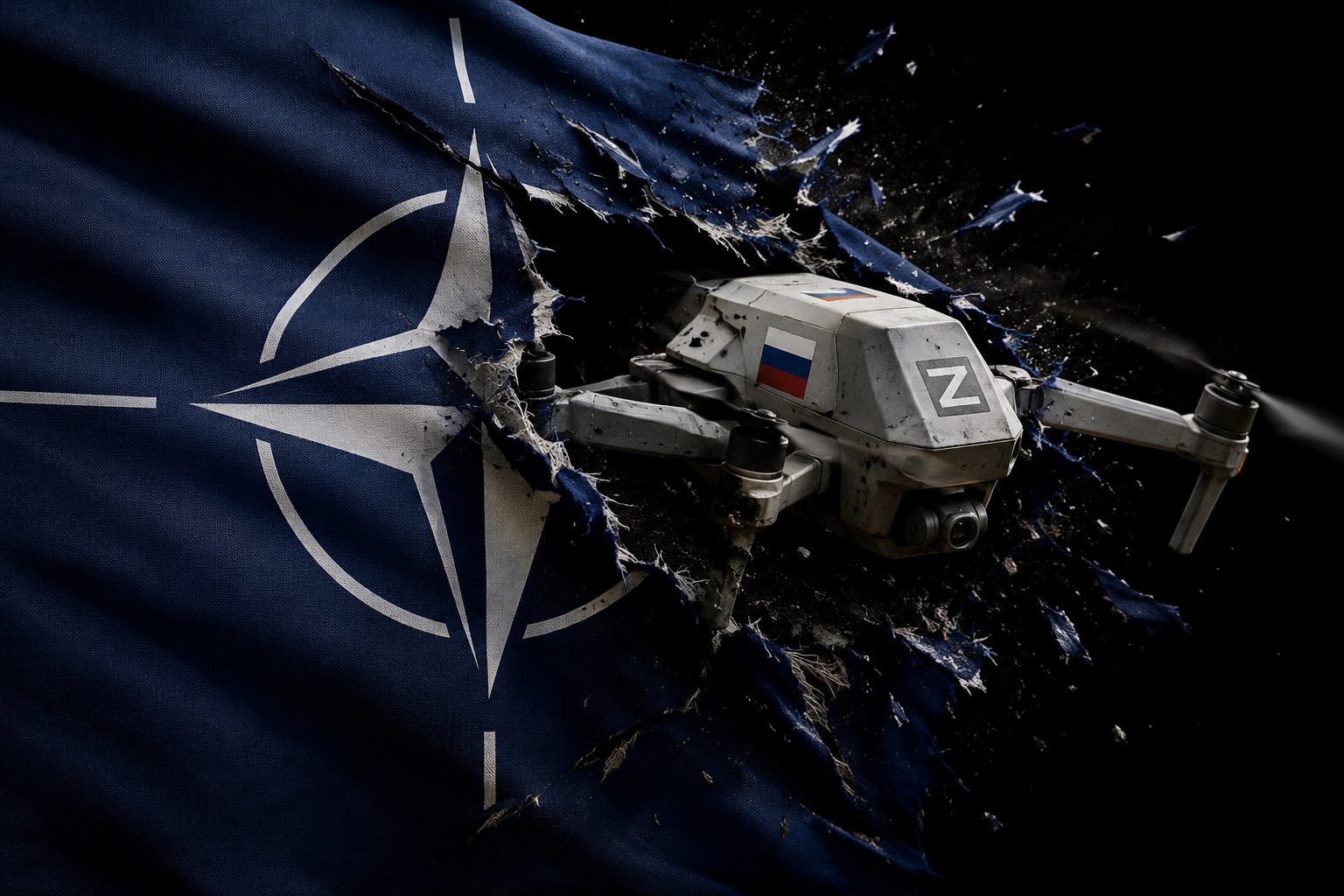
Whatever else might have worried them, Western officials have operated under at least one comforting assumption in the context of the Ukraine war: that Russian President Vladimir Putin would be reluctant to directly challenge NATO while his military was still bogged down in Ukraine. Now, though, officials in Washington are beginning to rethink that premise. The Wall Street Journal recently reported that, according to new assessments, America’s intelligence agencies now believe Moscow might imminently attempt a limited test of NATO’s resolve… that is, at any point between this Fall and 2029.
Why is such a scenario increasingly plausible? Quite simply, because Russia has steadily pushed the envelope vis-à-vis the Alliance, and learned all the wrong lessons in the process. Since the start of the Ukraine war, Russian cruise missiles have landed on Polish territory. Its fighter jets have flown over parts of Estonia. Its drones have repeatedly penetrated the airspace of countries like Romania and Denmark. The list goes on.
All this is, to put it mildly, extremely concerning. But beyond the predictable hand-wringing in European capitals, none of those incidents have triggered a forceful NATO response – and that failure has effectively normalized future Russian aggression.
So, what might a future Russian test look like? It wouldn’t necessarily entail a conventional military attack. Russia’s probe is more likely to come in the form of a cyberattack against an Alliance member or some other form of hybrid aggression. The goal would be to carry out a limited provocation that’s serious enough to demand a response, but not so blatant that NATO members automatically agree on one.
Which would be precisely the point. Russia doesn’t need to invade Poland or roll tanks into the Baltics in order to undermine NATO’s credibility. It just needs to create a crisis in which Alliance members hesitate and bicker over what actually happened. If and when that comes to pass, the Kremlin will learn something enormously important: that NATO’s red lines aren’t quite as red as advertised. And once Putin does, you can bet that he’ll test them again and again.
No posts
Comments
Nothing yet. Say the first thing.
Sign in to join the conversation.