
Africa’s sustainable finance market entered a new phase in June. The past five years were defined by proving that green bonds could be issued repeatedly across African markets. June suggests the next phase has begun. The market is no longer evolving through larger green bond volumes alone, but through the emergence of new financing structures—nature bonds, guarantee-backed sovereign issuance, biodiversity finance, and institutional risk-sharing mechanisms—that broaden the range of investable sustainable assets. Three developments define this transition:
Nature finance crossed into African capital markets, with landmark transactions demonstrating that biodiversity is becoming an investable asset class.
Execution overtook fundraising as Africa’s primary green finance challenge, highlighting that institutional capacity—not capital availability—is now the key constraint.
Global capital markets became more fragmented, increasing the importance of regulatory alignment.
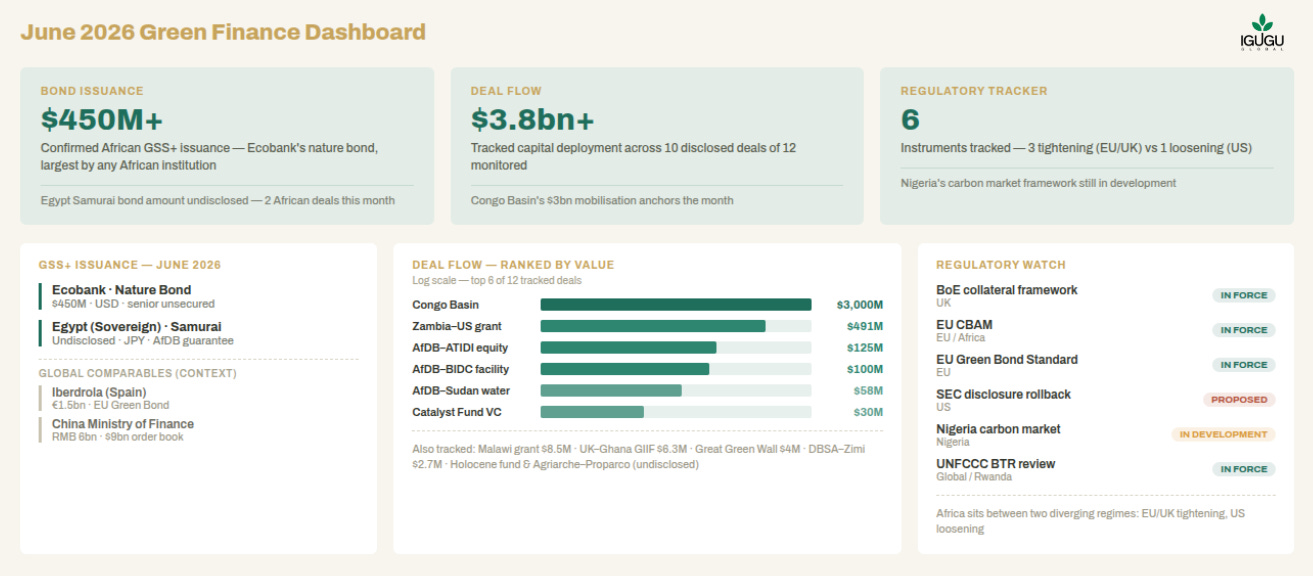
Africa’s Nature Finance Inflection Point For the first time, biodiversity is being priced and packaged by African institutions at scale, not just pledged by international conservation bodies. Two deals in June — Ecobank's $450M nature bond and the Congo Basin's $3bn mobilisation — mark the moment African nature finance crossed from niche to market. The strategic consequence: Nature as an Asset Class Requires New Due Diligence Frameworks Investors evaluating Africa's emerging nature bonds (Ecobank, Congo Basin) need biodiversity impact measurement standards that do not yet exist at scale.
Ecobank launched a landmark $450M nature bond — the largest by any African financial institution — to fund biodiversity, smallholder agriculture, agri-processing, and water infrastructure across the continent. The instrument directly links ecological outcomes to productive agricultural value chains — a design innovation that could become the template for nature finance across the continent.
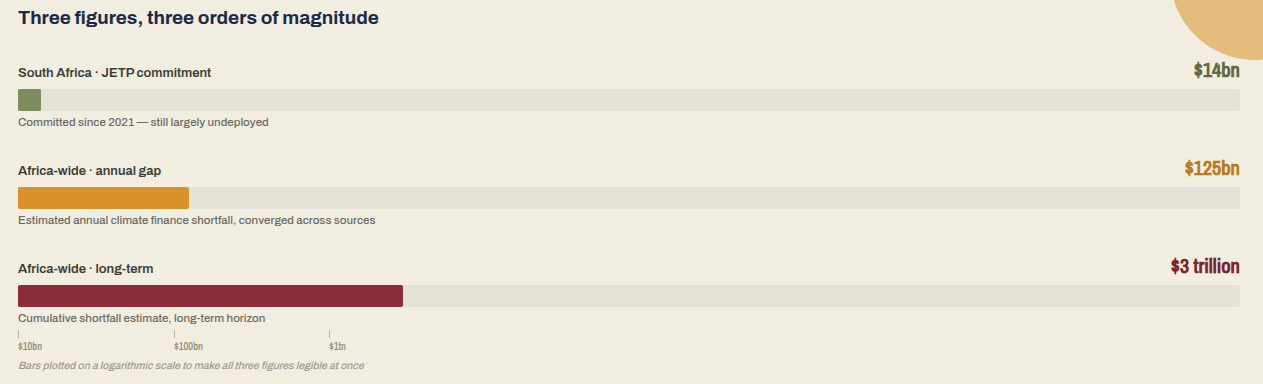
The Execution Crisis Is Now the Story June produced an unusual convergence. Independent institutions—from C40 and the African Group of Negotiators to South Africa's JETP implementation reports—arrived at essentially the same diagnosis: Africa's climate finance challenge is no longer raising capital, but deploying it. Multiple assessments this month reinforced the scale of the financing need—an estimated US$100–125 billion annually alongside a US$3 trillion long-term investment shortfall—while South Africa's JETP highlighted US$14 billion in committed finance that remains largely undeployed.
Market implication This convergence sharpens the structural conclusion: large, well-structured commitments are not automatically translating into deployed capital because the intermediary layer—local institutions, project preparation capacity, and deal structuring capability—remains underdeveloped. As a result, capital is effectively waiting on the sidelines, not for lack of intent or funding, but for a pipeline of bankable, execution-ready projects that can absorb it at scale.

The AfDB’s $125M equity investment in ATIDI is not a loan — it is a structural bet that risk insurance, not cheap debt, is the missing link for private climate capital in Africa. Combined with the $100M BIDC facility and the Malawi climate recovery grant, AfDB is operating across the full capital stack this month.
The AfDB $100M package consists of two parts: a $30M Equity Investment making the AfDB the first institutional shareholder in BIDC, granting it a seat on the bank’s board and a $70M Credit Facility targeted at financing renewable energy projects such as solar and hydroelectricity.
DBSA’s first significant EV charging infrastructure deal in South Africa. Small in absolute terms but catalytic as a signal — DBSA is now actively backing just transition infrastructure beyond its traditional infrastructure and housing mandate.
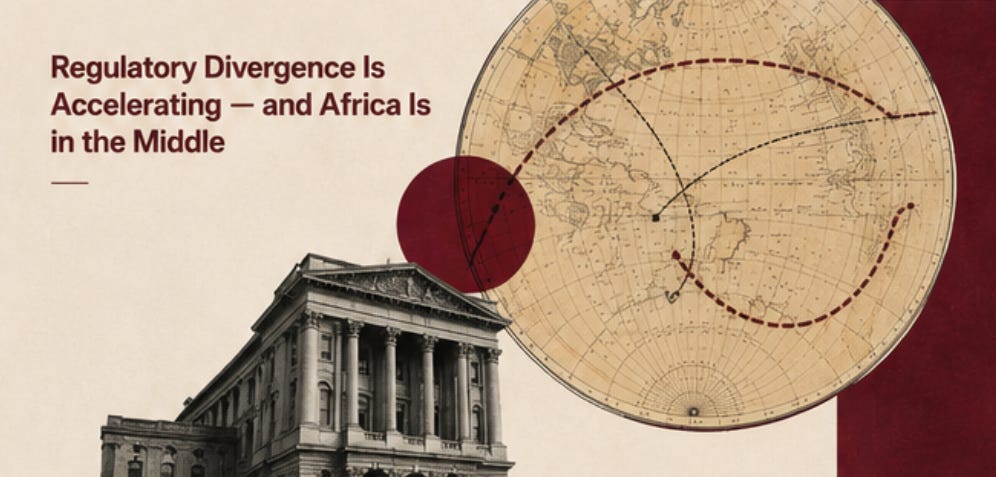
2026 is shaping up as a year of sharp global regulatory divergence in climate finance. African policymakers and issuers need to navigate simultaneously toward tighter EU standards and away from weakening US frameworks — these are pulling in opposite directions.
The Bank of England embedded transition risk into monetary policy. The EU’s Carbon Border Adjustment Mechanism is now an active competitiveness threat for South Africa. The US SEC is rolling back climate disclosure. These are not distant policy signals — they are live variables reshaping the cost of capital, market access, and trade economics for African issuers and exporters.
SARB follow-through on BoE precedent — Will South Africa’s central bank integrate transition risk into its own collateral framework? If yes, material implications for SA bank balance sheets.
Nigeria carbon market rules — Critical that a framework is published before the voluntary market matures further or credibility risks accumulating.
CBAM phase-in for Africa — Which African exporters are most exposed? Mining, steel, chemicals are the primary sectors.
Japanese Capital Is Available for African Sovereigns via Samurai Structure The AfDB-guaranteed Sustainability Samurai Bond is more than a single transaction. It is proof that African sovereigns can access Japanese institutional capital at scale through the right guarantee architecture — a replicable model for other African sovereigns with strong sovereign sustainable financing frameworks and an underutilised diversification lever for African debt management offices.
The question is no longer whether Africa can issue sustainable finance instruments. It is whether African institutions can build the market infrastructure required to scale them into a mature asset class.
No posts
Comments
Nothing yet. Say the first thing.
Sign in to join the conversation.