
I have spent the last 17 years at war with Putin. In all those years, I have never once seen Putin back down. I have never seen him compromise. I have never seen him do a single thing that looks like weakness
Bill Browder
IEP@BU does not express opinions of its own. The opinions expressed in this publication are those of the authors. Any errors or omissions are the responsibility of the authors
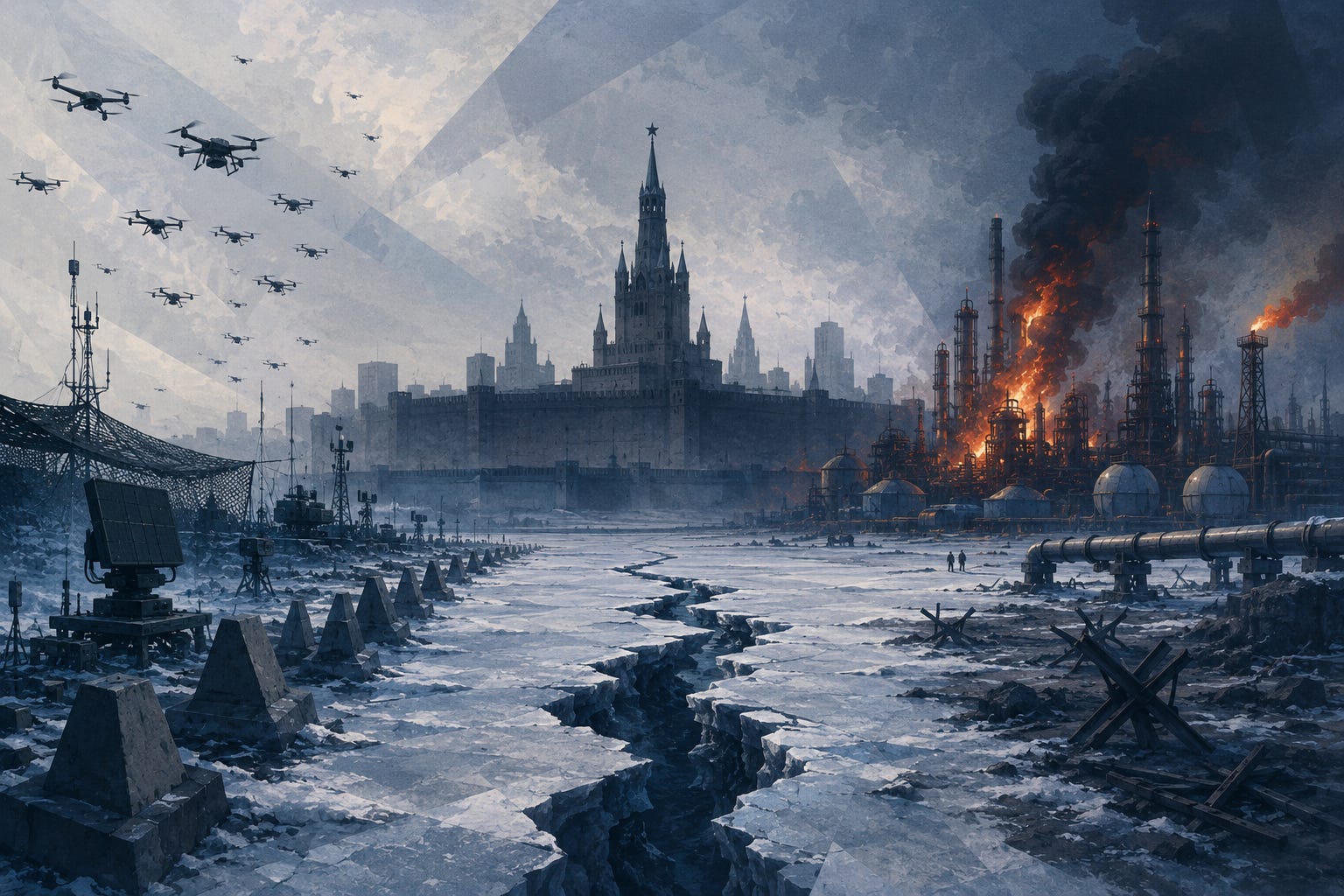
The internet is full of dramatic images right now. Russian oil refineries burning through the night. Long lines of traffic as people flee occupied Crimea. According to different intelligence sources, between 20 and 40 percent of Russia’s oil refining capacity has been disabled, and the country is now facing serious fuel shortages.
In Hungary, Viktor Orbán has lost his election. Peter Magyar is in charge, and he is no longer blocking EU funding or weapons for Ukraine.
And after that shameful meeting in the Oval Office, where Donald Trump told Volodymyr Zelensky that Ukraine “didn’t have any cards,” it now looks like Zelensky is holding a full house.
Vladimir Putin has admitted there are “problems” with his invasion, and warned of fuel shortages due to Ukraine’s growing attacks.
The historian Peter Frankopan notes that the average life expectancy of a new Russian recruit – from arrival at a training ground to death in a combat zone – now lies somewhere between 10 days and three weeks.
Once they are sent onto the battlefield, Russian fighters survive an average of 20 to 35 minutes. For the first time in a long while, Ukraine is on the front foot.
With all of this going on, a lot of clever people are saying the same thing. This is the perfect moment for Ukraine to negotiate. Strike while you have leverage. Even Zelensky is now framing his attacks as the path to a better deal at the table.
I want that to be true. Every friend of Ukraine wants it to be true. But I do not believe it will happen. And the reason has nothing to do with Ukraine. It has everything to do with Putin.
I have spent the last 17 years at war with Putin. It started when my lawyer, Sergei Magnitsky, was tortured and murdered in a Moscow prison for uncovering a massive fraud committed by Putin’s own officials.
I responded by campaigning for the Magnitsky sanctions, which now exist in more than 35 countries and freeze the dirty money of the people around him. In return, Putin has made me his number one foreign enemy.
In all those years, I have never once seen Putin back down. I have never seen him compromise. I have never seen him do a single thing that looks like weakness.
Here is why. Putin runs Russia like a prison yard. To survive in a prison yard, you have to be the most brutal, the most frightening, the most dangerous man in it.
The moment you show weakness, someone stronger takes your place. Putin knows that if that ever happens to him, he ends up in a cell or in a coffin.
So a man like that does not sue for peace because his refineries are on fire. He escalates.
That is what we should expect now. Not peace talks. Full escalation, even though it is a catastrophe for Russia and for ordinary Russians.
It will mean more massive attacks on Ukrainian civilians. It will probably mean a general mobilisation inside Russia, so that even more young men can be fed into the meat grinder.
None of it will change Putin’s position by an inch. It will simply kill more Ukrainians in their homes and more Russians on the battlefield.
So if there is going to be no real negotiation, how does this war actually end? In my view, it ends the way the Korean War ended. Which is to say, it doesn’t.
What I expect instead is an unspoken arrangement. Russia quietly stops bombing Ukrainian cities. In return, Ukraine quietly stops bombing Russian oil refineries and other economic targets.
There will be no summit. No handshake. No signed document. Just a practical decision on both sides, driven by necessity.
After that, the war becomes a war about the front line and nothing else. And here Ukraine has already changed the game. It has built a drone wall, a kill zone so dense that no Russian assault can break through it.
Over time, the fighting will get quieter. The attacks will become less frequent and less deadly. The front line will harden into a heavily fortified, demilitarised zone. The two countries will technically still be at war, but the war will fade into something close to silence.
Eventually it will look like the Korean peninsula. No fighting. No peace treaty either. Just a frozen line that holds for decades.
When will we reach that point? I cannot say. It depends on one thing above all: Ukraine’s ability to keep inflicting real economic pain on Russia. The more it costs Putin to keep this war going, the sooner the bombing stops.
And that is exactly where the West comes in.
We should stop waiting for a grand peace deal that Putin will never sign. We should stop treating a negotiated settlement as the goal.
The goal is simpler and harder than that – it is to make this war unaffordable for the Kremlin.
That means giving Ukraine the weapons to keep hitting Russia’s refineries and its war economy. It means keeping the sanctions in place and tightening them. It means the money and the patience to let Ukraine grind Russia down until the killing simply stops.
Putin will not be talked out of this war. He can only be worn out of it. The sooner we accept that, the sooner it ends.
A previous versions of this article were published by the British daily The Independent
IEP Bocconi Non-Resident Fellow
Sir William Browder, KCMG is a financier and political activist. He is the CEO and co-founder of Hermitage Capital Management, the investment adviser to the Hermitage Fund, formerly the largest foreign portfolio investor in Russia until he was declared “a threat to national security” in 2005 for exposing corruption in Russian state-owned companies.
He graduated in Economics from the University of Chicago and earned an MBA from the Stanford Graduate School of Business and received an honorary doctorate from Colgate University. He is also a Visiting Fellow at the Oxford Saïd School of Business (University of Oxford).
Browder began his career in the Eastern European practice of the Boston Consulting Group in London, then worked for Robert Maxwell’s Maxwell Communication Corporation, and subsequently managed the Russian proprietary investments desk at Salomon Brothers.
Browder and Edmond Safra (1932–1999) founded Hermitage Capital Management in 1996, investing an initial seed capital of $25 million in Russia during the mass privatization period following the fall of the Soviet Union.
In 2008, Browder’s lawyer, Sergei Magnitsky, uncovered a massive fraud committed by Russian government officials involving the theft of $230 million in state taxes. Magnitsky was subsequently arrested, imprisoned without trial, and systematically tortured.
Sergei Magnitsky died in prison on November 16, 2009. Ever since, Sir William has led the Global Magnitsky Campaign for governments around the world to impose targeted visa bans and asset freezes on human rights abusers and highly corrupt officials, introducing the passage of the Sergei Magnitsky Accountability Act in 2012 and the Global Magnitsky Human Rights Accountability Act in 2016. This legislation has since been adopted by 35 countries, including the USA, the UK, the EU, Canada and Australia.
For his exceptional service to the UK abroad and internationally, in recognition of his significant and sustained contribution to human rights and anti-corruption, he was appointed a Knight Commander of the Order of St Michael and St George (KCMG) by King Charles III in the 2024 Birthday Honours List.
Make Russia’s War Machine Collapse
·
Jun 2
The Russian war machine will stop only when it collapses.This is the strategic reality Europe has to absorb. The aim is not to design a new accommodation with Putin’s Russia. The aim is to ensure that Ukraine can keep holding the line, that Europe can keep financing and supporting that effort, and that Russia’s war economy is forced to bear the accumula…
Policy Brief - Towards a European Security Council
·
Mar 16
Multilateralism and European integration have taught us that the essential work of institutions occurs between summits and not simply during these. It is likely with this intuition in mind that several European leaders have called for the institutionalization of such groups. In particular, the idea of a European Security Council, first emerged in the af…
Founded by Bocconi University and the Institute Javotte Bocconi, the Institute for European Policymaking @ Bocconi University combines the analytic rigor of a research institute, the policy impact of a think tank, and the facts-based effort of raising public opinion’s awareness about Europe through outreach activities.
The Institute, fully interdisciplinary, intends to address the multi-fold obstacles that usually stand between the design of appropriate policies and their adoption, with particular attention to consensus-building and effective enforcement.
The Institute’s mission is to conduct, debate, and disseminate high-quality research on the major policy issues facing Europe, and the EU in particular, its Member States, and its citizens, in a rapidly changing world.
Marta Cartabia
President
Sylvie Goulard
Vice-President
Paloma Lopez-Garcia
Director
Silvia Colombo
Deputy Director
Carlo Altomonte
Arnstein Aassve
Valentina Bosetti
Elena Carletti
Daniel Gros
Eleanor Spaventa
Nathalie Tocci
Comments
Nothing yet. Say the first thing.
Sign in to join the conversation.