
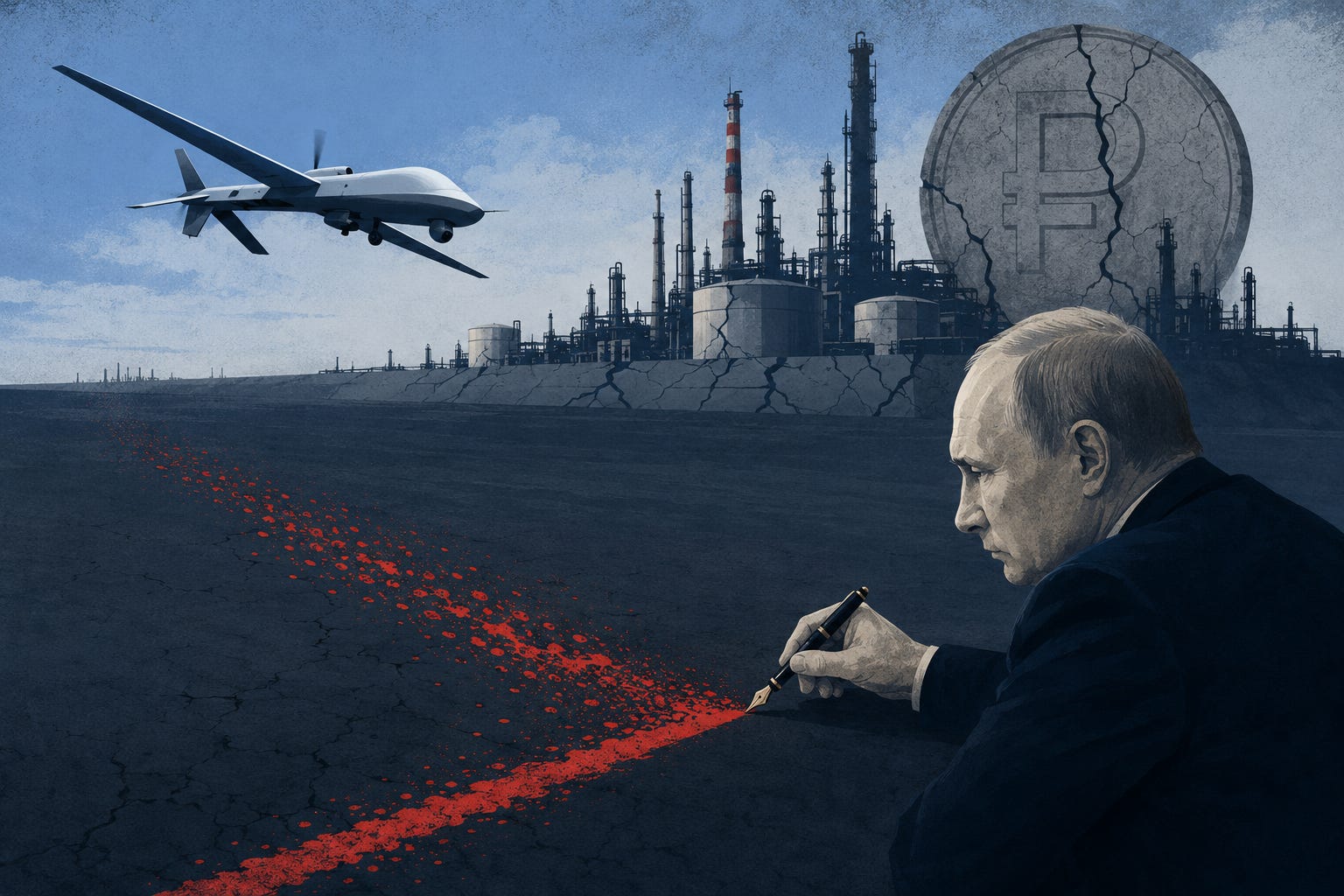
We should give Ukraine everything it needs. That means offensive weapons to strike the military machine Putin uses to wage this war. It also means air defences to protect Ukrainian civilians from the daily terror of Russian missiles and drones, and to shield the power stations, water plants and hospitals that Putin targets on purpose. Half measures do not calm Putin. They embolden him
Bill Browder
IEP@BU does not express opinions of its own. The opinions expressed in this publication are those of the authors. Any errors or omissions are the responsibility of the authors
Last weekend, Ukraine sent another wave of attack drones into the heart of Russia’s war economy. The targets were oil refineries, coal depots, military logistics and other critical sites.
Until now, the drones Ukraine sent deep into Russia were almost all home grown. This time was different. Among them were drones built in Britain.
According to The Sunday Times, they included the Nyan, a jet-powered strike drone made by Callen-Lenz, a subsidiary of BAE Systems, used against oil refineries in Volgograd and Yaroslavl. A second British-built drone was used too. Its manufacturer has not been named, for security reasons.
On Tuesday, the Russian embassy in London responded with a warning of “serious consequences” for Britain arming Ukraine with offensive weapons. Within minutes my phone lit up with messages from many people asking what I made of it.
The answer is simple. This is standard Russian bluster. The Kremlin feels it has to say something, so it does. It will lead to no consequences more serious than the ones we already live with.
We have been here many times before. Since the start of this war, Putin has threatened us over every weapon we have sent. First it was tanks. Then it was F-16s. Then it was Storm Shadow missiles. Each time he drew a red line. Each time we crossed it. And each time, nothing material changed. His red lines are drawn in disappearing ink.
That is not to say Russia is leaving us alone. It is already attacking us, and has been for years. Russian operatives have dragged anchors across undersea cables in the Baltic. They have posted incendiary devices to a DHL depot in Birmingham.
In the past fortnight alone, an explosive drone was flown into a Ukrainian cargo plane at Leipzig airport, and a fire tore through an ammunition plant near Rome that makes artillery shells for Ukraine. No one has been charged for the fire. But the pattern speaks for itself. These are not diplomatic protests. They are acts of war on European soil.
The difference is that Putin is more fragile than he has ever been.
Several of Russia’s richest people, including some close to Putin, have moved billions of dollars abroad in the past year after growing concerned about the country’s economy and the government budget.
By the end of May, the federal deficit had hit 6tn roubles ($83bn). That is 2.6 per cent of GDP, twice last year’s level and already past the Rbs3.8tn meant to cover the whole of 2026.
The economy really is in trouble. Emergency powers were granted to the finance ministry last month to spend more and borrow past the legal debt ceiling because, as the ministry put it, it needs to react to a worsening environment “not every month or every quarter, but every day”.
Indeed, this week, the chief economist at Russia’s second-largest bank was fired after a series of critical comments about the state of the economy, including warnings that Moscow would not win a prolonged economic war with Ukraine.
Andrei Klepach, who had served in the role at the state-controlled development bank VEB since 2014, said Russia was “falling behind” China and the US economically, and “in some respects, Ukraine”.
Putin needs a war. He needs it to deflect his own people’s anger away from himself and towards an invented enemy abroad. And in his own words, this is not only a war with Ukraine. It is a war with Nato. We should take him at his word.
So I was heartened to hear Prime Minister Burnham confirm that Britain will not waver in its support for Ukraine. I hope he means it.
I have watched too many leaders pledge solidarity with Ukraine in public while quietly panicking about Putin’s threats in private. That private panic carries a cost. It has slowed the delivery of weapons at every stage of this war. It has handed Putin the initiative. And by dragging the fighting out, it has cost Ukrainian lives that faster, braver decisions would have saved.
Nobody should be under any illusion about whose war this is. It is not only Ukraine’s. It is ours.
If we ever allow Putin to win in Ukraine, he will not stop at the border. His next target will be the Baltics, or Poland. At that point it will be British soldiers in harm’s way, fighting Russia directly, under our own treaty obligations. Right now it is Ukrainians doing the fighting and the dying. They are spilling their blood not only to defend their own homes, but to defend ours. That is the cheapest defence Britain will ever be offered.
If anything, these threats are a reason to do more, not less. We should give Ukraine everything it needs. That means offensive weapons to strike the military machine Putin uses to wage this war.
It also means air defences to protect Ukrainian civilians from the daily terror of Russian missiles and drones, and to shield the power stations, water plants and hospitals that Putin targets on purpose.
Half measures do not calm Putin. They embolden him.
Let me put it as plainly as I can. Every time Putin complains, he is telling us our support is working. The louder he complains, the more we should do.
A previous version of this article was published by the British daily The Independent
IEP Bocconi Non-Resident Fellow
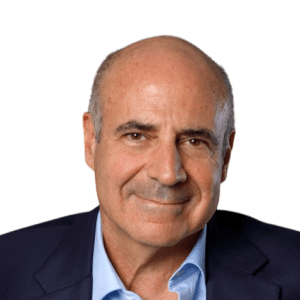
Sir William Browder, KCMG is a financier and political activist. He is the CEO and co-founder of Hermitage Capital Management, the investment adviser to the Hermitage Fund, formerly the largest foreign portfolio investor in Russia until he was declared “a threat to national security” in 2005 for exposing corruption in Russian state-owned companies.
He graduated in Economics from the University of Chicago and earned an MBA from the Stanford Graduate School of Business and received an honorary doctorate from Colgate University. He is also a Visiting Fellow at the Oxford Saïd School of Business (University of Oxford).
Browder began his career in the Eastern European practice of the Boston Consulting Group in London, then worked for Robert Maxwell’s Maxwell Communication Corporation, and subsequently managed the Russian proprietary investments desk at Salomon Brothers.
Browder and Edmond Safra (1932–1999) founded Hermitage Capital Management in 1996, investing an initial seed capital of $25 million in Russia during the mass privatization period following the fall of the Soviet Union.
In 2008, Browder’s lawyer, Sergei Magnitsky, uncovered a massive fraud committed by Russian government officials involving the theft of $230 million in state taxes. Magnitsky was subsequently arrested, imprisoned without trial, and systematically tortured.
Sergei Magnitsky died in prison on November 16, 2009. Ever since, Sir William has led the Global Magnitsky Campaign for governments around the world to impose targeted visa bans and asset freezes on human rights abusers and highly corrupt officials, introducing the passage of the Sergei Magnitsky Accountability Act in 2012 and the Global Magnitsky Human Rights Accountability Act in 2016. This legislation has since been adopted by 35 countries, including the USA, the UK, the EU, Canada and Australia.
For his exceptional service to the UK abroad and internationally, in recognition of his significant and sustained contribution to human rights and anti-corruption, he was appointed a Knight Commander of the Order of St Michael and St George (KCMG) by King Charles III in the 2024 Birthday Honours List.
Working Paper - Whither Stablecoins?
·
Aug 14
The future of Europe’s payment systems is open and the opportunities are significant. What is needed is pragmatism and a firm focus on Europe’s overriding priorities: strengthening competitiveness and upholding monetary sovereignty. Success on both fronts may also increase the attractiveness of the euro internationally
Make Russia’s War Machine Collapse
·
Jun 2
The Russian war machine will stop only when it collapses.This is the strategic reality Europe has to absorb. The aim is not to design a new accommodation with Putin’s Russia. The aim is to ensure that Ukraine can keep holding the line, that Europe can keep financing and supporting that effort, and that Russia’s war economy is forced to bear the accumula…
Policy Brief - Towards a European Security Council
·
Mar 16

Multilateralism and European integration have taught us that the essential work of institutions occurs between summits and not simply during these. It is likely with this intuition in mind that several European leaders have called for the institutionalization of such groups. In particular, the idea of a European Security Council, first emerged in the af…

Founded by Bocconi University and the Institute Javotte Bocconi, the Institute for European Policymaking @ Bocconi University combines the analytic rigor of a research institute, the policy impact of a think tank, and the facts-based effort of raising public opinion’s awareness about Europe through outreach activities.
The Institute, fully interdisciplinary, intends to address the multi-fold obstacles that usually stand between the design of appropriate policies and their adoption, with particular attention to consensus-building and effective enforcement.
The Institute’s mission is to conduct, debate, and disseminate high-quality research on the major policy issues facing Europe, and the EU in particular, its Member States, and its citizens, in a rapidly changing world.
Marta Cartabia
President
Sylvie Goulard
Vice-President
Paloma Lopez-Garcia
Director
Silvia Colombo
Deputy Director
Carlo Altomonte
Arnstein Aassve
Valentina Bosetti
Elena Carletti
Daniel Gros
Eleanor Spaventa
Nathalie Tocci
Comments
Nothing yet. Say the first thing.
Sign in to join the conversation.