
Commentary on the policy and conduct of the current occupants of the White House is not terribly useful or even meaningful at present. The administration is erratic and performative and its traction with reality is entirely unclear. What is an urgent topic of discussion, however, is the power dynamic within Washington.
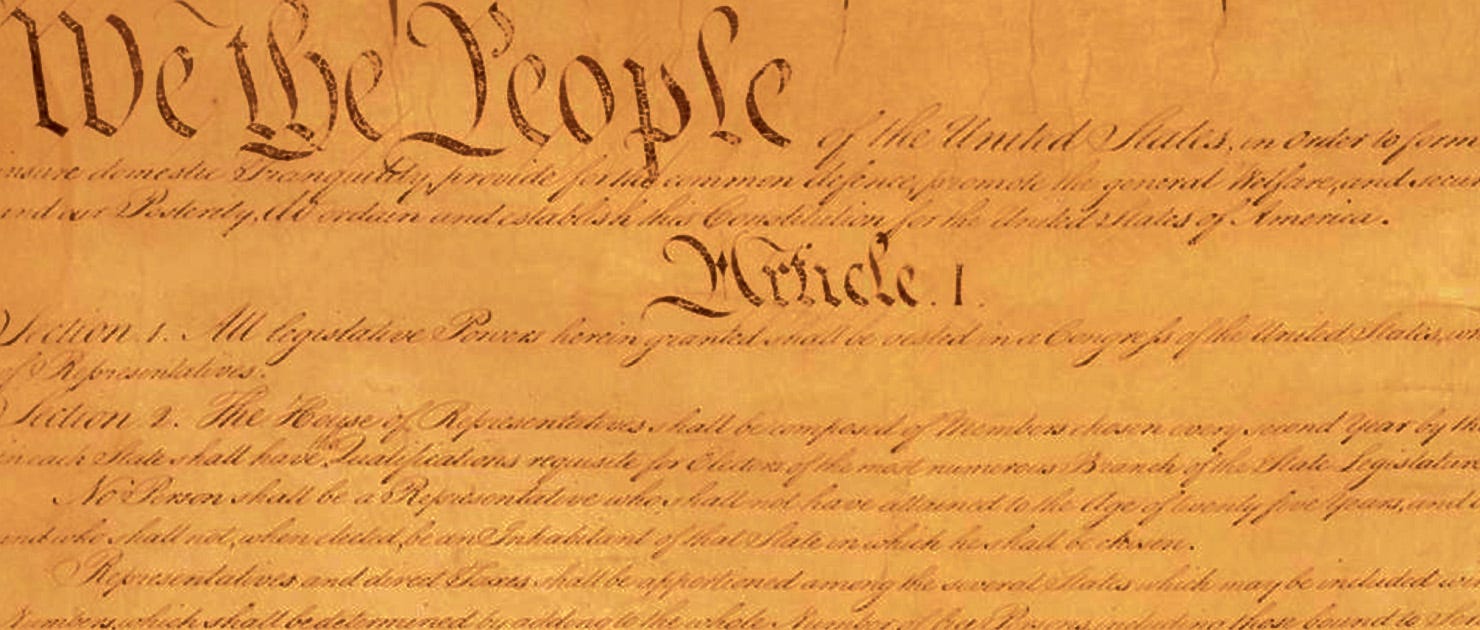
Currently, the Republican Conferences in both houses of Congress have adopted the commitment to the will of the President of the United States as their guiding principle. The First Branch of government has practically submitted itself to the Second Branch. If we are truly concerned about the constitutional order, then this is worrisome. There have been moments in the nation’s past when government was not only unified (one party in control of the White House and both houses of Congress), but united under devotion to the agenda of the chief executive.
This rare possibility itself seems problematic, insofar as the efficacy of the separation of powers is premised on thwarting power rather than intensifying it. What we have at present, however, seems to exceed even that type of rare and robust unity. Congress isn’t simply in line with the presidential agenda; Congress is held in thrall of the president himself, having bent the knee and sworn fidelity. Any Republican member of Congress who acts contrary to the wishes of this president runs the risk not only of losing all their prerogatives and appointments, but even their office.
Members are under routine threat of getting “primaried” if they step out of line. Further, members who have defied the president (or have contemplated doing so) report being anonymously threatened with personal violence; these threats extend to their families as well. Loyalty to Trump is now the overriding criterion for well-being and good standing within the modern GOP. This is new, and it exceeds mere “unity”; it is tantamount to an absorption of Congress into the executive branch.
Trump’s demagogically derived populist power now reaches around the constitution and intrudes into the mechanisms of the legislative branch. The president can now kill bills and end careers at will. In a very real sense, it can now be said that congressional Republicans serve at the pleasure of the president.
Though unprecedented in American politics, this phenomenon is not unprecedented simply. I will not be so gauche as to invoke the overstated and extreme examples of a strongman who managed to accomplish this subversion of liberal government. The strategy is also well-documented, and this we should observe: appeal to the working class, the nationalists, and the traditionalists; gather populist power; co-opt the other branches of government under cover of “existential” threats (internal and external) posed by “those who are not us,” and proceed to threaten and bully naysayers into submission or out of power.
Whether one agrees that these sorts of historical parallels are applicable, one still must confront the singular character of the current power arrangement within the U.S. federal government. It has been focused to a point, where a single individual operates with the reasonable expectation that his word is law, that his decrees and orders will smash through established laws and customs to the degree courts and states will tolerate them.
One might argue that these checks by courts and states are sufficient, that they represent the “guardrails” that will keep Trump on the straight and narrow. It remains to be seen if these impediments can hold without congressional action, and in any case, one must concede that this is not what the founders had in mind when they formulated the separation of powers. Congress was meant to be a check on presidential power, not an apologist and a shill for it.
It should also be remarked that contrary to the Right’s historical appeals to federalism, the modern GOP seems to revel in the spectacle of the president threatening state governments that do not bend to his will. When Trump speaks publicly about targeting states whose policies he does not like (for example, by withholding disaster relief), his supporters cheer and members of Congress nod their approval. If one insists that this is only bluster, we must at least acknowledge that this bluster is part of the music of the moment. No president, Republican or Democrat, has ever sung this tune. Prior to 2016, everyone would have agreed it was un-American.
The overwhelming takeaway is that power is being concentrated in a single figure, and that this power-holder is comfortable threatening state governments. This is a new phenomenon, which is arguably at odds with republican principles, and is certainly at odds with traditional Republican values.
Patriotism dictates that Republican members of Congress assert their constitutional authority and use their powers in their own names. There are still people of conscience within the party, and they should fulfill their constitutional role to stand up to a president who works to usurp their power.
It is the patriotic duty of members of the press to help the public see the degenerate character of the present moment. This is not normal and we should not act as though it is. It is not simply illiberal; it is unhealthy that we allow Congress to debase itself before a figure like Trump. Republican members should be ashamed. Until they are, they should be shamed.
Comments
Nothing yet. Say the first thing.
Sign in to join the conversation.