
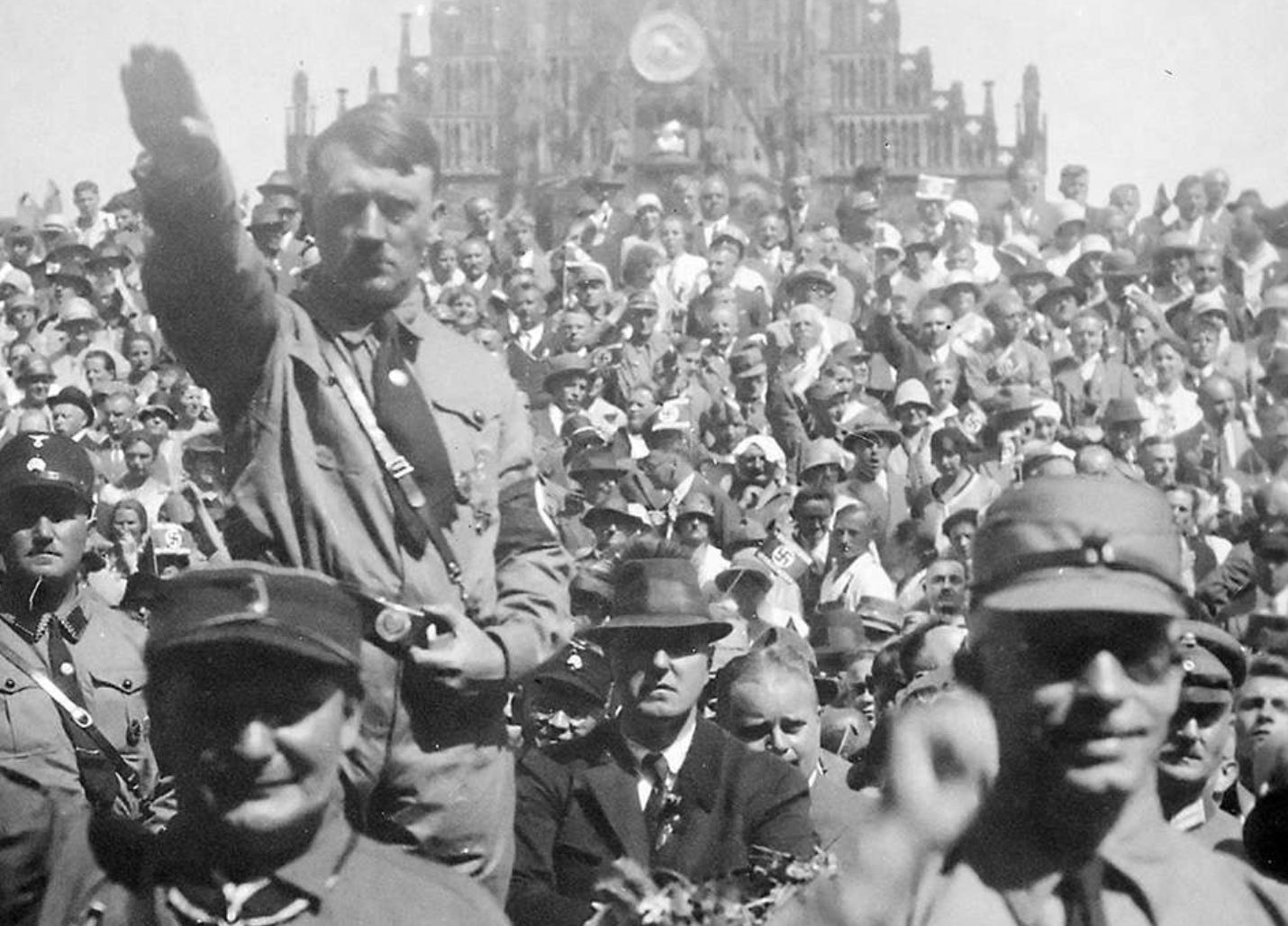
I would like to address a recurring sticking point I notice in discussions about the evolution of the American Right. The MAGA crowd seems to be quite sensitive to implicit or explicit comparisons of Trump to Hitler or of their movement to the Nazis. I suppose this is encouraging; there’s still some region of politics that we can all agree on. Nazis are bad. In less embarrassing times I might feel hope that this is something we could build on. I feel no such hope at present, but I digress.
Republicans rightly scoff at critics who call them Nazis and who lampoon Trump with a little mustache. The Nazi comparison is a lazy and imprecise characterization of Trump, of his fanbase, and of his frontline political defenders (congressional Republicans).
Let’s be very clear about this. Donald Trump is no Adolf Hitler, and the Republicans aren’t Nazis. Hitler was an artist and a man of ideas, loathsome as his ideas were. (His paintings and drawings actually weren’t that bad.) He and his party were highly disciplined and possessed a singleness of purpose. Profound evil of this sort requires a coherent vision beyond vanity, mischief, and avarice. Trump’s vanity and performative mischief make him chaotic, reckless, and incoherent. Also, Trump and his cronies are very, very stupid, or at least they routinely say comically stupid things that make them seem extremely stupid. Such is not a suitable vessel for world historical evil.
Trump and his quaffed goons bear little resemblance to the Third Reich. They are more like clowns with flamethrowers, wandering the halls of the administrative state: plenty dangerous — people will get hurt — but National Socialism is the wrong comparison. Still, it is true that an effectual power dynamic has developed in Washington that indeed suggests our regime is shifting away from traditional constitutional liberalism. This aspect of the MAGA movement tempts some of Trump’s most agitated critics to make the Nazi comparison.
What is a more precise way to characterize this regime shift?
There aren’t very many ways to describe regimes. Details can be novel, but there are only a small number of possible shapes political communities can take. Broadly speaking, for developed nations in the modern era there really are only three viable forms of regime: liberal democracy, militant theocracy, and authoritarian dictatorship.
Fascism is one version of authoritarian dictatorship, and Nazism is one version of fascism. Autocracy is another version of authoritarian rule. Russia and Hungary are examples of this version. Any chief executive who seeks persistently to drain power from other quarters of government into himself is manifestly demonstrating authoritarian aspirations.
There is a sense in which chief executives in a liberal democracy like the United States are always bumping up against the limits of constitutionally granted power. Joe Biden, for example, attempted to forgive hundreds of billions of dollars in federally sponsored student loans, and he also advanced policies that required federal workers to get vaccinated against Covid-19 (or else lose their jobs). In his overweening desire to help young adults saddled with debt, and in his zeal to save lives in the midst of a deadly pandemic, he stepped over the line. The Supreme Court called him out on this, and he backed down, acknowledging the Court’s judgment on the limits of his authority.
Strictly speaking, in a funny sort of way you could attempt to characterize Biden’s conduct as that of a “would-be autocrat.” It would be a peculiar sort of dictator, however, whose only authoritarian moves are ones designed to save the lives and improve the financial security of millions of citizens by means loan forgiveness and safe and effective medicine.
In any case, this critique of Biden stands in stark contrast to the situation with the Republicans in 2025, who seem to be aspiring to a more vivid version of autocratic rule. To be precise about this we have to acknowledge that the ground has been prepared for this for a long time, through the work of both Democrats and Republicans who have been unburdening Congress of power for several decades.
This has not been an intentional project, but the effect has been to make the government vulnerable by unbalancing power arrangements in ways that blur constitutional delineations. Vital administrative entities are funded by Congress but administered within the executive branch. There is now precious little Congress could do on short notice to reign in an out-of-control president bent on dismantling governmental functions created, authorized, and funded by Congress. This “precious little” shrinks to nothing once we factor in the fact that Congress is controlled by the Republican Party, which in turn is controlled by a single person, who also happens to be the chief executive. Vanishingly few Republican members of Congress dare thwart the Great Leader.
Trump rules with the sort of authority rarely, if ever, seen in the United States. This level of authority is already a departure from the spirit of the separation of powers required for liberal democracy. Trump effectively circumvents the constitution and manipulates Congress in an extra-constitutional fashion. He was even able to exert this control of Congress as a private citizen between 2021 and 2024. If our regime is moving away from liberal democracy, what is it moving towards? Since it does not seem to be presently heading toward a theocratic police state, what remains is some version of authoritarianism: it doesn’t take much imagination to see that this administration begins to resemble the autocratic version of authoritarianism.
This development is not unique to America. Russia succumbed to this fate in 2000 after a brief period of constitutional liberalism. Hungary transitioned away from constitutional democracy in 2010 under Viktor Orbán, who characterizes his own policies as “illiberal Christian democracy.” We currently see a similar development on the horizon in Germany where the far-right AfD party is now a close second to the liberal CDU.
Prime Minister Orbán is an object of enthusiastic admiration among Republican elite. Trump himself called him “a fantastic leader.” CPAC held a convention in Hungary in May of 2022, in which Republican leaders praised Orbán's administration as a model for American conservatism. Orbán visited Trump at his Bedminster golf course in August of 2022 before heading to Texas for another CPAC gathering. Popular Republican news commentators have offered doting coverage of Orbán on Republican outlets such as Fox News and Newsmax.
Donald Trump, of course, has frequently praised Vladimir Putin, and he famously sided with the Russian president over American intelligence agencies on a world stage during his first term in office. And let’s not forget Republican entertainer Tucker Carlson, who publicly debased himself before Putin, despite Putin smoothly humiliating Carlson on camera. Carlson went on to make out with a loaf of bread in a Moscow supermarket in his oddball effort to support Putin in his war against the people of Ukraine.
The Republican adoration of illiberal autocrats is strange, craven, and insufficiently acknowledged. It is relevant here insofar as we entertain the idea that the GOP is drifting toward autocracy.
We should also observe here that the administration is currently ignoring court orders to cease its freeze of billions of dollars in federal grants. Further, the vice president has publicly advised the president to ignore the Supreme Court if it blocks his efforts to eviscerate federal agencies, even invoking the apocryphal Jacksonian vaunt, “The chief justice has made his ruling. Now let him enforce it.”
If we hold these observations together — Republican infatuation with autocrats, the Trump administration’s attack on the administrative state, its domineering relationship with congressional Republicans, and its contempt for the judiciary — a distinct shape emerges.
There is a playbook for this sort of transition, which took place in both Russia and Hungary, and is now visible in the United States. I enunciated a basic outline of this strategy in a previous essay, but I’ll repeat it here:
The strategy is also well-documented . . . appeal to the working class, the nationalists, and the traditionalists; gather populist power; co-opt the other branches of government under cover of “existential” threats (internal and external) posed by “those who are not us,” and proceed to threaten and bully naysayers into submission or out of power.
Trump has done all this. The Republican Party is utterly in thrall to a single strongman and has been essentially purged of all resisting elements. Trump is no Hitler, but his Party is rapidly drifting away from liberal democracy toward autocracy. To deny this is to normalize key features of autocracy.
For those who seek to resist Trump and his Republicans, I would suggest avoiding calling them Nazis. It upsets them unnecessarily and gives them one more reason to tune you out, making it that much harder to get through to them on more legitimate bases. Also, it’s just incorrect. They’re too chaotic to be Nazis, and they’re too undisciplined and individualistic to maintain a coherent interest in any sort of fascist revolution, no matter how effective such a revolution might be in their fight against inclusive, secular, pluralistic, egalitarian modernity.
Let’s just be grateful they still take it for granted that Nazis are bad. They’ve jettisoned quite a few taboos in the past decade, but Nazis, thankfully, are still taboo for (almost) all of them.
Comments
Nothing yet. Say the first thing.
Sign in to join the conversation.