
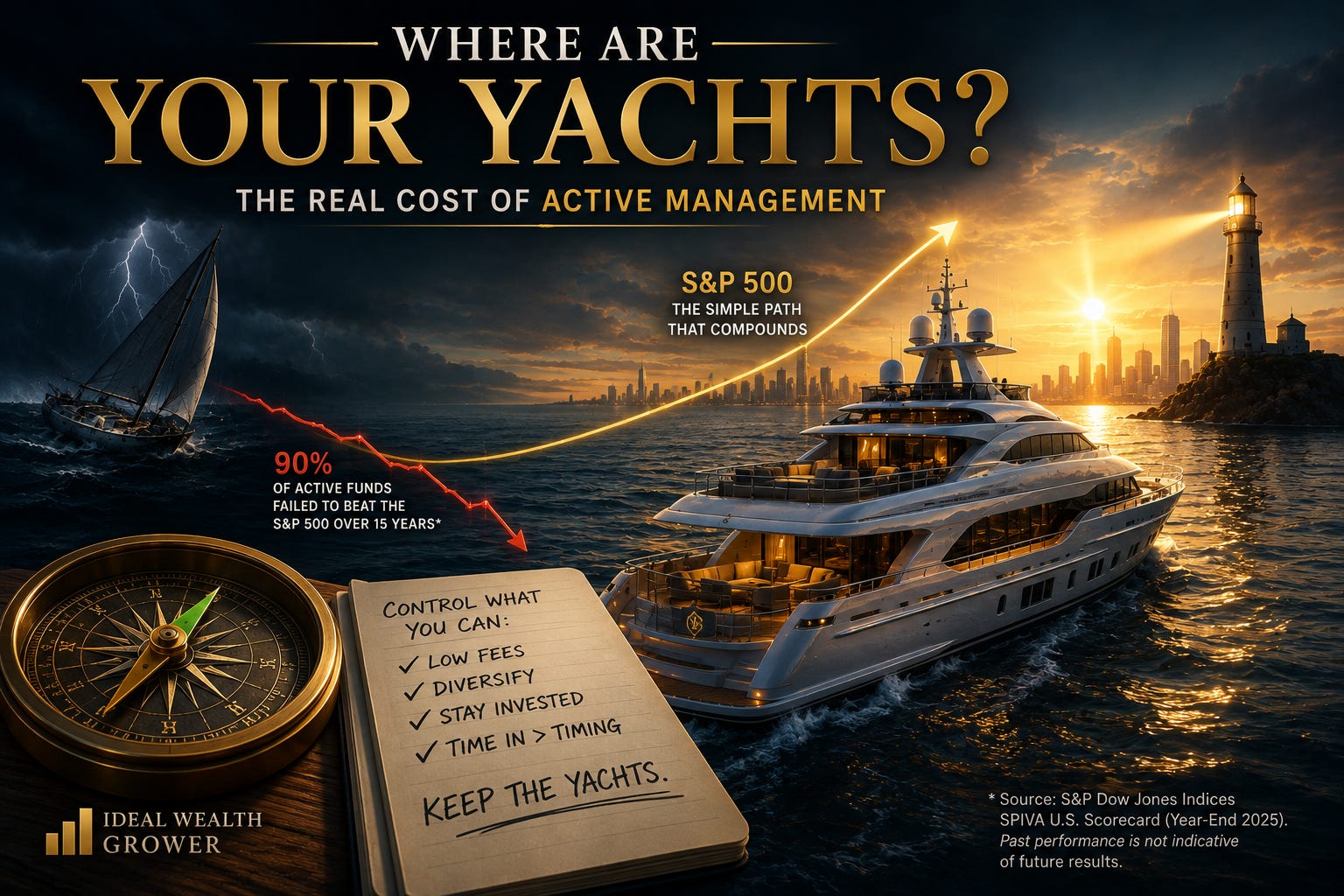
In 1940, a Wall Street trader named Fred Schwed wrote a book with one of the best titles in financial history.
The story behind it is older than the book itself. A visitor to New York, admiring the yachts moored near the brokers and bankers, asked an innocent question. Where are the customers’ yachts? Of course there weren’t any. The customers had paid for the yachts. They just didn’t get to keep any of them.
Eighty-six years later, I want to ask the same question about people whose names show up in your inbox and your YouTube feed every week. Because the joke never got old. It just got better dressed.
In 2012, a former JPMorgan executive named Simon Lack ran the actual numbers on the hedge fund industry and put them in a book called The Hedge Fund Mirage. He titled one chapter, straight up, “Where Are the Customers’ Yachts?”
His finding: since 1998, hedge fund managers have kept roughly 84 percent of the profits their funds generated. Investors kept 16. Not the other way around. The people whose money was actually at risk got the crumbs. The people managing it got rich, sometimes obscenely so, whether the fund did well or not.
If you think that was a 2012 problem, fixed by better regulation and smarter investors, I have a more recent case study for you.
The five-year promise
Cathie Wood, founder of ARK Invest, has one answer for every hard question about her fund’s performance. Judge us on a five-year horizon. She has said it in one form or another for years, on stage, on podcasts, in shareholder letters. It sounds patient and disciplined. It is neither, once you actually run for five years.
ARK’s flagship fund is now old enough that we can measure it against its own rule more than once.
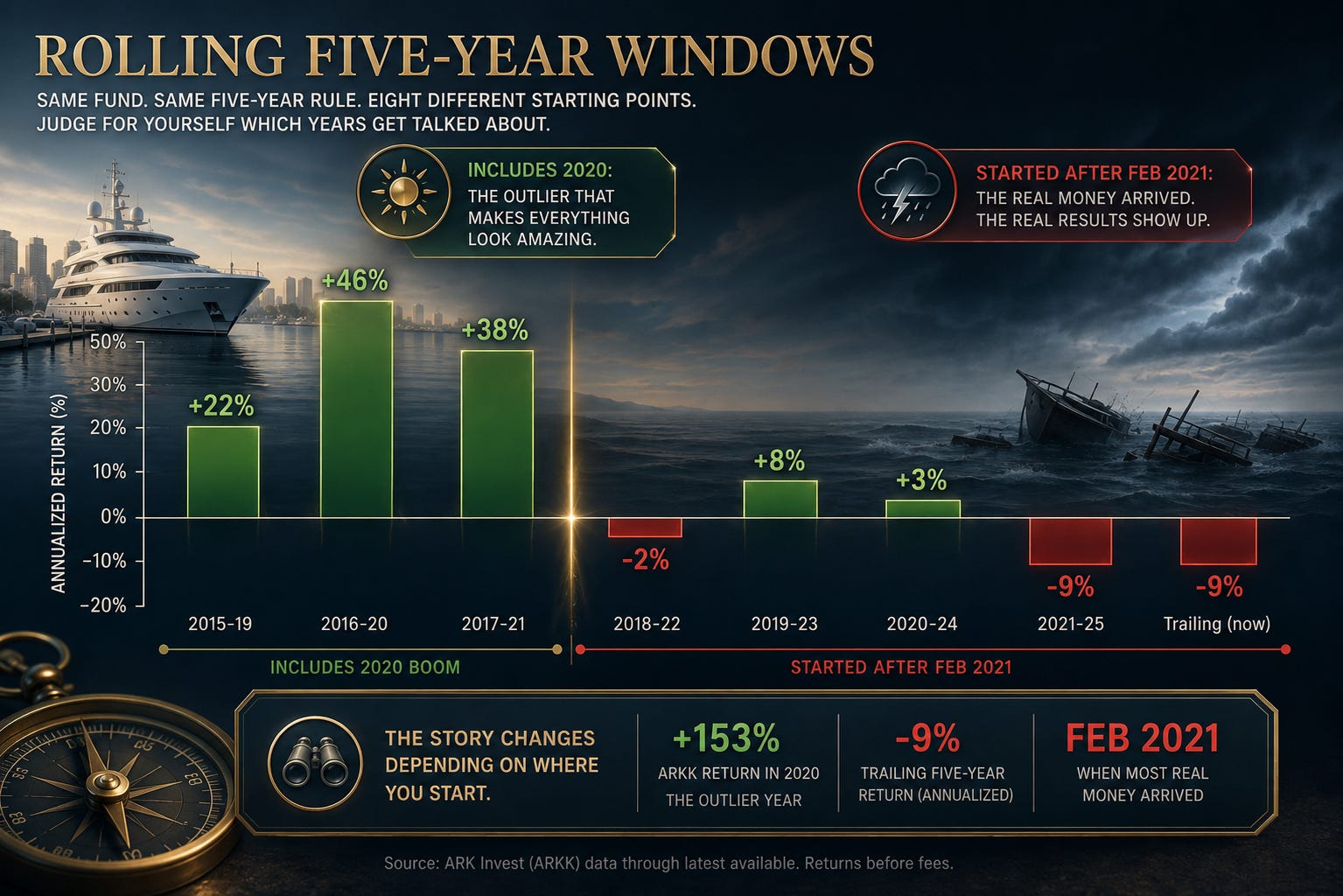
Every five-year window that happens to capture 2020, the year the fund returned 153 percent, looks brilliant. Every five-year window that starts after February 2021, when most of the real money actually arrived, looks like a disaster.
The most recent trailing five years sit somewhere around negative 9 percent annualized. Not underperformance. An outright loss, on her own chosen scoreboard, for the exact people who trusted the pitch and bought in near the top.
Here is the part I find almost admirable in its shamelessness. In December 2022, Wood made an actual, falsifiable prediction: 40 percent annualized returns over the following five years.
At the halfway mark, the fund was down 54 percent. To hit her own number now, it would need to return over 160 percent a year for what’s left of the window. Nobody in the financial press seems to be counting down the days.
And it isn’t only the fund. Track her public price targets for Tesla, one of ARK’s largest holdings, and you’ll find the same pattern, laid out plainly.
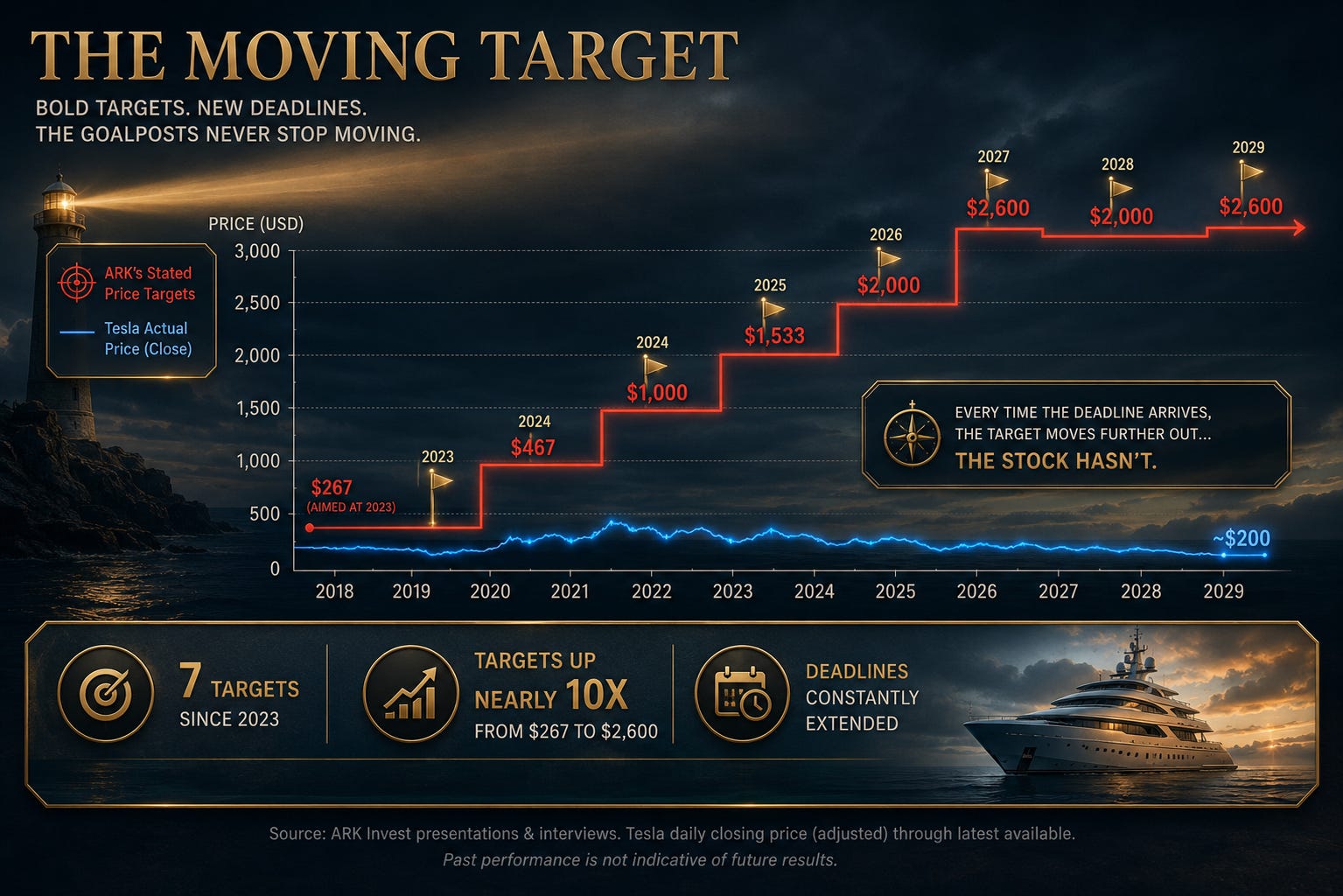
A bold target is set for a specific year. The year arrives. The stock isn’t close. Instead of revisiting the thesis, a new target gets issued, further out, usually bigger. That is not a long-term investment thesis. That is a moving goalpost with a five-year paint job.
The trick you’ve heard a hundred times
You know the video. Your favorite stock fell 8 percent today and is down 38 percent for the year. The host feels for you, genuinely, and then pivots. But if you’re a long-term investor, by 2030, maybe 2035, we’ll be looking at thousands of dollars a share.
I get angry every time I hear it, and I think you should too. I have been invested since the end of 2020. That is not short-term. That is not a YTD trader who panicked on a red day. By any honest definition, six years in is exactly the long term these people keep invoking.
The problem isn’t the concept of patience. Patience is real, and it works. The problem is that “long term” has become a phrase with no fixed endpoint, one that can always be pushed out exactly as far as needed to outrun whichever scorecard is currently embarrassing.
A real long-term thesis has a deadline you’re willing to be judged against. Everything else is just a delay tactic wearing a suit.
This isn’t a few bad names
I could stop at Cathie Wood, and you’d be forgiven for thinking I picked one convenient example. So let’s be honest about the base rate, because the data is not flattering to the entire profession, not just one manager.
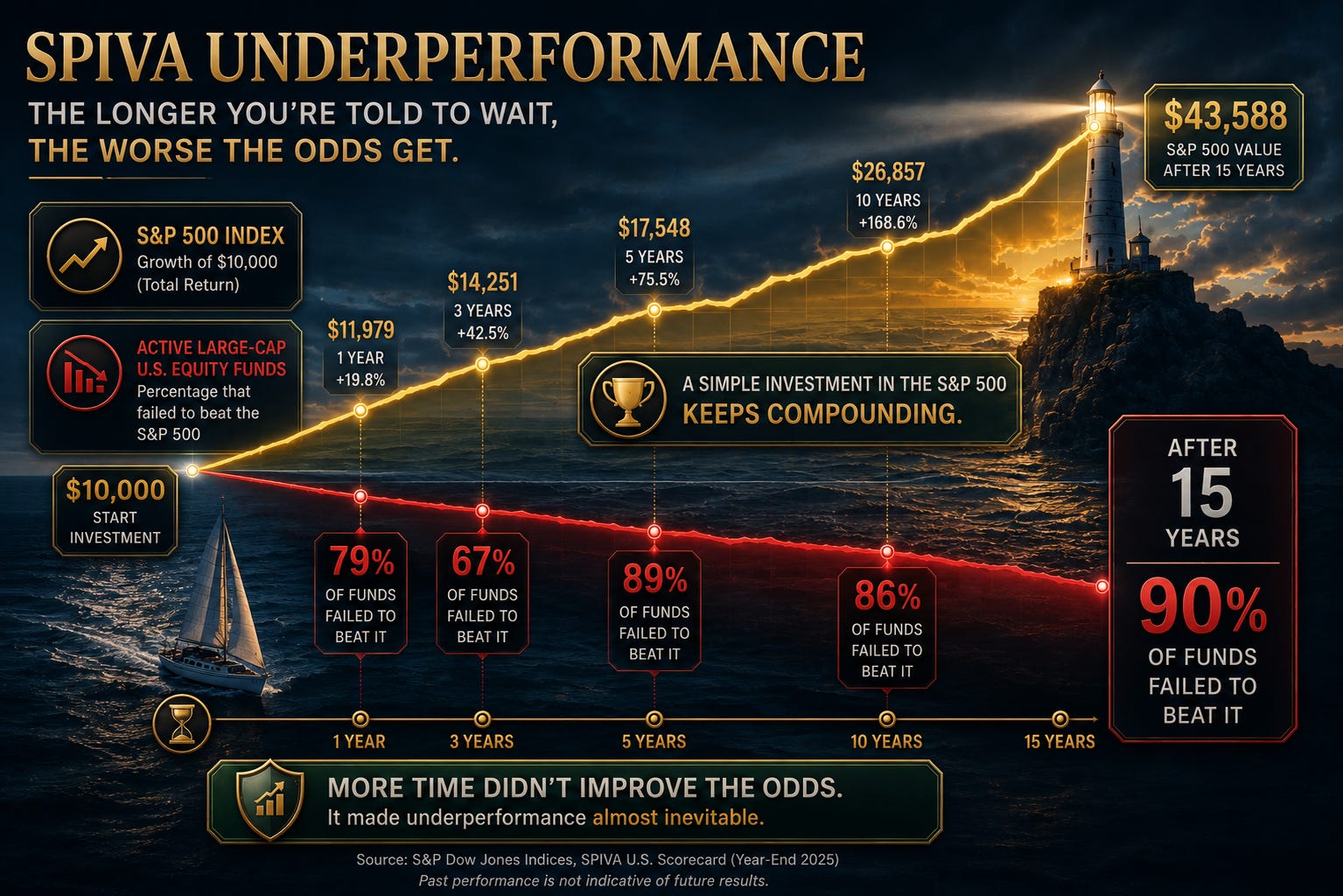
Zero out of 22 fund categories had a majority of managers beat their benchmark over 15 years. Zero. And notice the pattern gets worse, not better, the longer you measure, which is the exact opposite of what “give it time” is supposed to mean.
Cathie Wood has plenty of company in the yacht business. Jim Chanos ran one of the most respected short funds on Wall Street for nearly forty years, watched it shrink from six billion dollars to under two hundred million, and quietly closed the doors.
Neil Woodford, once Britain’s most trusted fund manager, saw his flagship fund collapse from over ten billion pounds to under four before it was suspended and wound down, leaving roughly 300,000 ordinary savers holding the loss.
And then there’s Eddie Lampert, who ran Sears into bankruptcy while collecting an estimated two billion dollars in performance fees along the way. When Sears finally cut three thousand jobs, one headline put it as plainly as anyone ever has. The CEO kept his yacht. Not a metaphor. An actual 288-foot yacht, named Fountainhead.
The math that actually settles it
Forget performance for a moment. Here’s the part that should bother you most, because it doesn’t even require the fund to do anything right.
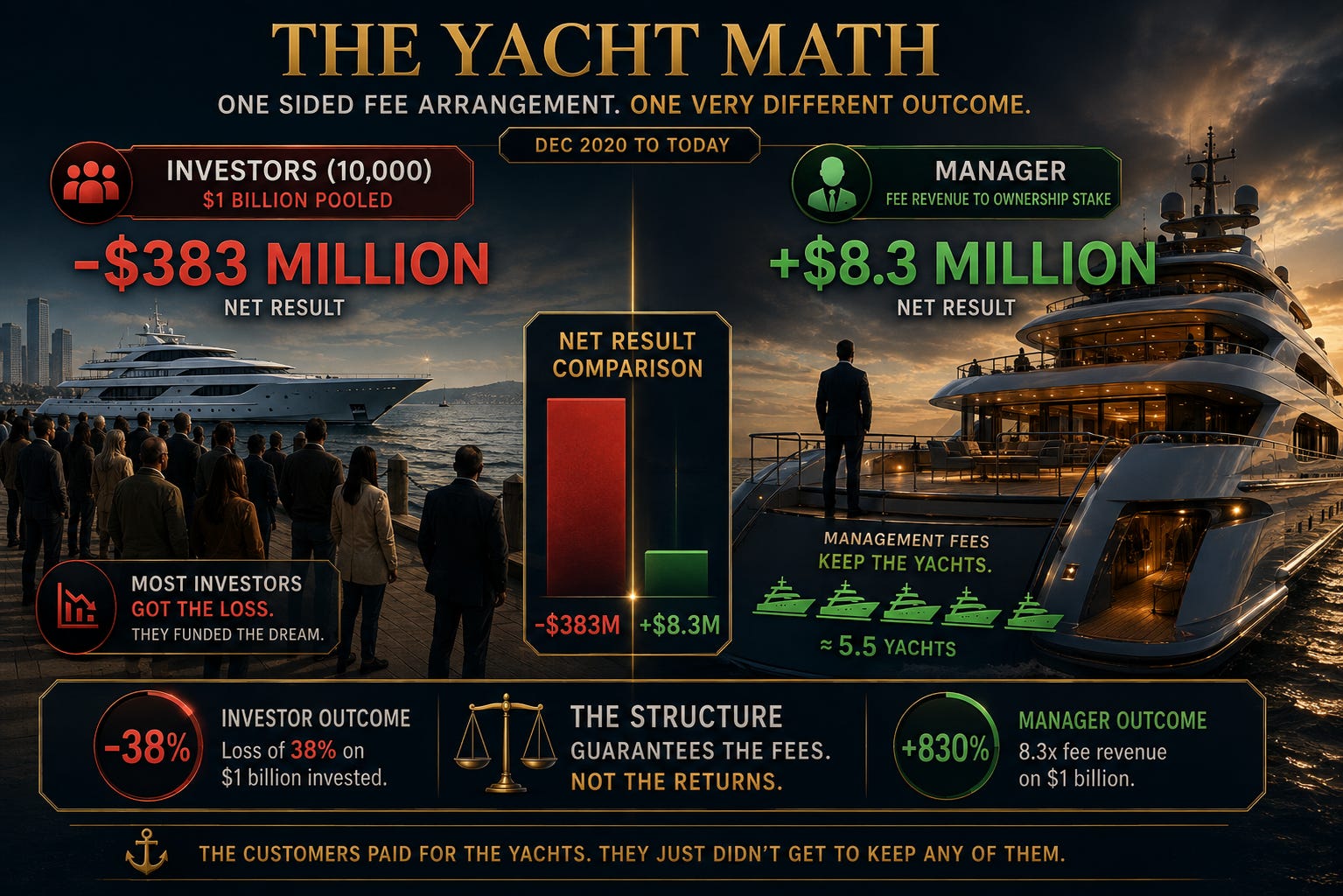
No individual investor in that pool, even the rare one who genuinely beat the market with smart, concentrated bets, gets remotely close to a yacht on a hundred-thousand-dollar stake. I’ve run this math on real outcomes, including some of my own, and the gap isn’t close. It isn’t even the same order of magnitude.
One side’s payday is guaranteed by the fee structure itself, decoupled entirely from whether anyone’s money grew. The other side’s payday depends on being right, being early, and being lucky, and even then rarely gets there.
So what actually works
Here’s the lesson underneath all of this, and it’s the same one I preach about real estate, applied to stocks. Control.
When I buy a rental property, I’m not handing my money to someone else’s fund and hoping their thesis plays out on their timeline. I own the deed. I set the rent. I choose when to sell. Nobody collects a fee for the privilege of managing my decision, because there is no middleman standing between me and the asset.
The same discipline works with stocks, if you’re honest about what it demands.
Don’t own a hundred names you can’t name. Own a small number of companies you actually understand and believe in, ones you don’t mind checking on, reading the earnings calls for, watching the leadership team closely enough to know whether they’re still driving toward the vision that made you buy in the first place.
Ten companies, maybe fewer, are plenty. If a management team stops earning your conviction, you sell. If they keep earning it, you hold on your own timeline, not a marketing department’s.
Do that, and two things disappear at once. The management fee disappears because there’s no fund standing between you and the company. And the moving goalposts disappear with it, because you’re not waiting on someone else’s five-year promise. You’re watching the business yourself, in real time, and making your own call.
You won’t get it right every time. Neither does anyone else, professional or not. But when you’re right, you keep all of it. Nobody’s ownership stake sits between you and the outcome, taking its cut whether you win or lose.
Own the houses. Own the handful of companies you actually believe in. Skip the fund. Skip the fee. And if it works, the yacht, however modest, is yours. Not because a professional built it for you. Because nobody was standing between you and the profit in the first place.
A Note on How I Write
I want to be upfront about something. I have never been a natural writer. English is not my first language. I never went to school to learn how to write, and for most of my career, the writing I actually did was reports, analysis, papers, the kind of writing that is logical and direct but not exactly warm. My partner Teri, from Abundant Money Mindset, told me early on, more than once, that this is exactly how my writing reads. Clear and correct, but not engaging, not connecting. She was right, and I knew it.
Over the last year, I have used Claude, Anthropic’s AI assistant, as a genuine writing partner to change that. Not to write for me, but to help me learn what actually makes writing land, and to shape the analysis, the stories, and the ideas that are already mine into something that reaches people the way I always meant it to.
The research behind these articles, the data, the numbers, the sources, is mine as well. I do that work myself and bring it to Claude as the starting point for everything we build together. Working together article after article, Claude has learned my voice: how I think, how I build an argument, the stories I reach for, and what I correct when something doesn’t sound like me. Every piece still starts with my ideas, my research, and my judgment about what’s worth saying. What has changed is that I now have a partner who helps me say it the way I always wanted to.
I’m sharing this because platforms like Substack have started asking writers to be transparent about how much AI is involved in their work. My honest answer is that AI has made me a substantially better writer, and it did that by learning from me, not by replacing me. I remain the source of every idea, every number, and every position in what you read here. Claude has simply helped me become the writer I always wanted to be but never had the training for.
Comments
Nothing yet. Say the first thing.
Sign in to join the conversation.