
My friend Amber Ramsey, who’s worked with plenty of residential investors as a buyer’s agent, asked me something a while back that I haven’t stopped thinking about.
She’d seen enough clients hit a certain point in their portfolios where buying another rental just didn’t move the needle the way it used to.
Her question was simple:
“What happens when a passive residential investor decides they want to build instead of just buy?”
We ended up working through it together, not as abstract theory, but by walking through what it would actually look like for a client of ours to make that jump, specifically into build-to-rent development. I want to share that thought experiment here, because I think a fair number of people in the IWG community are quietly asking themselves some version of the same question.
Picture someone who’s spent years, maybe decades, as a residential real estate investor. They bought properties, held them, let good tenants and patient appreciation do the quiet work of building wealth. That’s the passive model most of you know, and it works. But there’s a ceiling to it.
At some point the question stops being “should I buy one more property” and starts being “could I be the one creating the supply instead of just buying into it?”
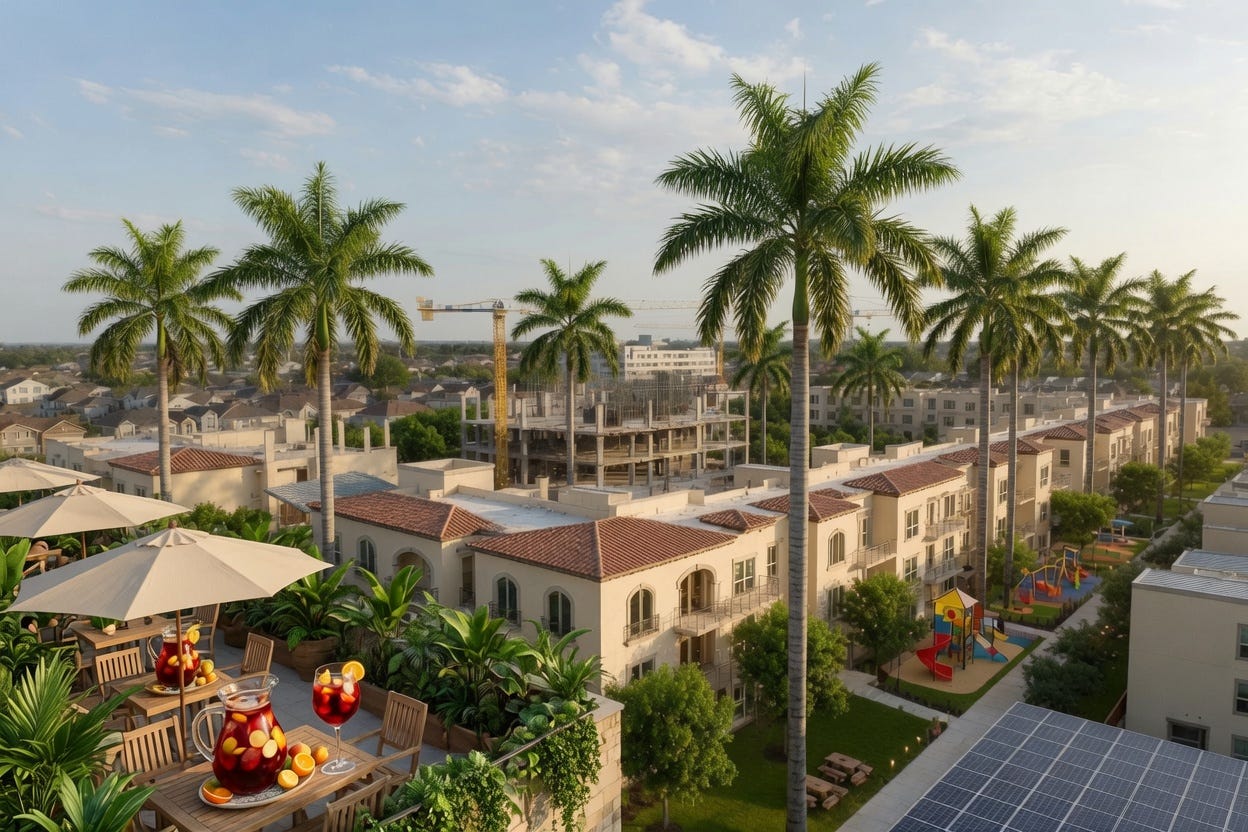
That’s the question that pulls someone toward commercial development, and specifically toward build-to-rent.
It is not a replacement for what they’ve already built, but as the next rung on the same ladder. The same IDEAL framework that’s guided their passive investing, income-producing assets, diversification, exposure to where housing demand is actually heading, an abundance mindset, and legacy still applies.
It just gets applied a level higher up the chain, where the investor becomes the one bringing the asset into existence rather than acquiring one that already exists.
There’s no license required to become a commercial developer, which surprises people who assume there’s some formal gatekeeping process. What there is instead is a body of knowledge earned the hard way. Developers typically come out of brokerage, construction, finance, architecture, or property management.
State licensing requirements may apply if someone also performs activities like brokerage or property management directly, so understanding your state’s rules is worth doing early. But a seasoned passive investor already carries more of the foundation than they’d think. Years of reading pro formas, negotiating with contractors on rehabs, and learning how zoning affects a property’s value isn’t nothing.
What they wouldn’t have automatically is the specific expertise development demands. Financial analysis that goes beyond a single property’s cash flow and into project-level feasibility. Negotiation that now touches land acquisition, construction contracts, and financing terms all at once.
Market research that identifies not just a good deal, but a location with real, durable demand behind it. Project management that keeps a multi-month or multi-year timeline, budget, and a dozen moving parties aligned. And communication, because a developer spends as much time coordinating lenders, architects, contractors, and local government as they do thinking about the asset itself.
Finding the right property is where a lot of aspiring developers get it wrong before they’ve even started. The instinct is to chase cheap land, but cheap land nobody wants to live near is just cheap land.
What matters is whether a site sits inside real, sustained demand. Local job growth, population trends, transportation access, nearby commercial activity, zoning that actually permits what you want to build, utility access, and environmental conditions all determine whether a project succeeds or quietly bleeds money for years.
Before any money goes into land, you’d want title work done, an environmental assessment completed, a survey in hand, and a clear picture of flood risk and permitting requirements. The obstacles you find before you buy are inconveniences. The ones you find after are expensive.
None of this happens alone, and that’s the part of the thought experiment Amber and I found most encouraging. A first-time developer isn’t expected to know everything. They’re expected to build the right team: a real estate attorney, an architect, a civil engineer, a surveyor, an environmental consultant, a general contractor, lenders and financial partners, an accountant, a broker, and eventually a property manager.
The relationships built with people who show up reliably and do good work become one of the most durable advantages a developer will ever have, not unlike the network of contractors and property managers any serious residential investor builds over time, just at a larger scale and with higher stakes.
Financing is where the biggest structural difference between passive investing and development shows up. A single-family rental (SFR) can often be financed conventionally. A development project almost never is.
Common funding sources typically mean combining personal equity with outside capital, whether that’s a bank, a private lender, an institutional investor, or a joint venture partner.
Lenders want to see project feasibility, a track record, market conditions, projected cash flow, and collateral before they commit, which is exactly why the financial projections and construction budgets need to be realistic, not optimistic. Credibility with lenders is earned in the numbers, not the pitch.
This is also where Amber and I think the IWG community sits on an opportunity most real estate investors never get offered. The typical path for someone who wants exposure to development without doing the development themselves is a REIT or a syndication, owning a share of a fund or a limited partnership interest in a deal they don’t control and often can’t fully see into.
That’s not the IWG philosophy, and it’s not what this thought experiment points toward either. Build-to-rent (BTR) development, structured the right way, lets an investor be the actual holder of the title or deed to a real property, not a slice of a fund. Same ownership principle that runs through everything we’ve written about residential investing, just applied to new construction instead of an existing home.
For anyone in this community who wants more real estate exposure but no interest in being a syndicate’s silent partner, this is worth understanding, even just as an exercise in how the pieces would fit together.
Once financing and permits are in place, development shifts from planning into execution, and this is the phase that tests patience more than anything else. Budgets get tracked daily, not quarterly.
Contractors need coordination, not just contracts. Delays happen, and how a developer responds determines whether a project stays profitable or starts eating its own margin.
Every site has to meet OSHA standards during construction, and every finished property needs to be built with occupant safety, accessibility, and long-term maintenance in mind, because a development that can’t be maintained affordably isn’t really finished; it’s just deferred.
Even a completed, well-built property doesn’t finish the job on its own. It needs a strategy to fill it, whether that’s leasing or selling, and that means brokerage partnerships, professional marketing, virtual tours, industry networking, and outreach that starts well before construction wraps up.
Development doesn’t end when the last inspection passes. It ends when the property is generating the income it was built to produce.
For anyone who wants a serious ongoing education in how this industry actually works, ULI, the Urban Land Institute, is one of the better resources available, with research, market reports, educational programs, and networking built specifically around commercial development trends and practices. It won’t replace direct experience, but it will shorten the learning curve considerably.
None of this is risk-free. Market shifts, financing that falls through, construction delays, and regulatory friction can all turn a promising project into a difficult one. But the same discipline that protects a good residential portfolio- real due diligence, a strong team, and honest financial projections- applies just as directly here.
Amber and I didn’t land on a conclusion so much as a question worth sitting with. Most of you reading this started exactly where our hypothetical client did, as a patient owner of a handful of properties, learning what income-producing real estate could do over time.
Development is simply where that same philosophy could go next, for the right person, with the right team, and the right reasons. Whether that’s you is a question only you can answer, but it’s one worth asking honestly.
A note on this piece: the scenario walked through above is a hypothetical exercise, developed in conversation with Amber Ramsey, and does not describe an investment Axel or Amber currently holds or is offering.
It's intended purely for educational purposes to illustrate how the IDEAL framework could extend into commercial development and build-to-rent, and should not be taken as investment, legal, tax, or financial advice, or as a solicitation to invest in any specific property, fund, or development project. Real estate development carries substantial risk, including the potential loss of principal, construction delays, financing risk, and market shifts, and requires its own independent due diligence, licensed professional guidance, and careful evaluation before anyone acts on it. Links to third-party resources are included for informational context only and do not constitute an endorsement of those organizations' products or services.
Comments
Nothing yet. Say the first thing.
Sign in to join the conversation.