
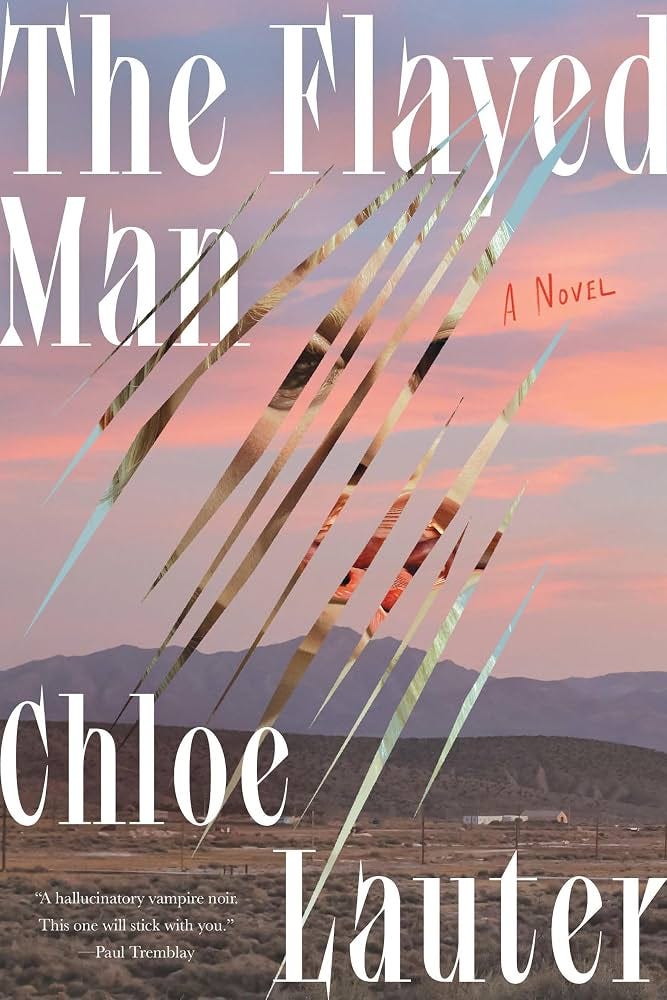
If you read as much genre fiction as I do, you can’t avoid stumbling across vampire fiction, even if you’re not actively looking for it. To say vampires are ubiquitous would be like saying there’s a decent amount of water in the ocean. In the past, I’ve groaned about this because, while I love horror and Salem’s Lot is one of my all-time favourite novels, I find (or found) vampires conceptually dull.
But. In recent years, although I haven’t deliberately sought out vampire and vampire-adjacent fiction, the books I’ve read have been great. Just this year, I’ve enjoyed books like Dead Collections by Isaac Fellman and Cabaret in Flames by Hache Pueyo, the latter of which received an enthusiastic Locus review from moi. Last year I read The Midnight Shift, which, despite its bloody-lipped cover, is an inventive and rather bloodless (in a good way) vampire novel.
The Flayed Man by Chloe Lauter is as good as all these novels. What it shares with them is an interesting take on a trope that somehow, beyond all reason, keeps being reinvented. The conceit is that the vampiric condition is hereditary, a curse passed on, depending on which myth or legend you believe in, through the sexual congress between a blood-sucking monster1 (the “v” word is never used) and a human woman. The concept of a genetic lineage is fascinating, but it isn’t the novel’s most interesting idea. Rather, it’s that (a) other than a need for blood, none of the usual vampire stuff applies when the individual is in human form; (b) it only takes a three- to four-millilitre vial of blood, injected directly into the vein, to satiate their appetite; (c) those afflicted with the curse still need to eat regular food, even if it doesn’t taste as good; and (d) if they don’t inject every twenty-four hours, they will transform into a monster in the most dramatic and violent way possible, with bones erupting through their skin. Nice.
But even that isn’t what’s so good about The Flayed Man. It’s the fact that this is such an intimate, small tale in which what’s at stake is a daughter’s ability to care for her mother. Our protagonist, Ellis Karsten, is a nurse who works the night shift. Not because she’s a vampire (as I first thought), but because it lets her care for her mother during the day—a nuanced and cleverbit of subversion that plays with our expectations about vampire lore.2
In fact, everything Ellis does is in aid of her mother. She has no life, no friends, no hobbies, no outlet. The only person Ellis regularly sees who isn’t a co-worker or her mother is Uncle Bill, her source of blood. (He snaffles discarded blood samples from the phlebotomy lab where he works.) It’s all the more miserable because Ellis’s mother treats her daughter like shit. Yes, it’s the dementia, causing abrupt shifts in her mother’s mood—one moment needy, the next paranoid—but it’s not like their relationship was ever peachy. Ellis genuinely believes she’s never been good enough for her mother.
What I found so beautifully layered about Ellis’s relationship with her mother is that she isn’t bitter. Lonely. Yes. Guilt-ridden. Maybe. But not bitter. She loves her mother. Ellis won’t countenance killing her, no matter how often Uncle Bill suggests it. He believes his sister is ruining Ellis’s life. But he also knows, just like Ellis, that eventually her mother will lose control and be consumed by hunger. And that does not end well.
The plot kicks into gear when Uncle Bill vanishes, taking the blood with him. Desperate for the red stuff, Ellis reaches out to one of her uncle’s shady associates who lives alone in the desert. But as her bloodlust grows and she becomes increasingly unable to trust herself, Ellis leans on Veer, a co-worker she trusts and has a thing for, to accompany her on a road trip deep into the Mojave. That’s right, in among everything else we also get a messy and intense queer love story.
The Flayed Man is an emotionally complex and whip-smart vampire novel. Because it’s short and the product of a small press3, it could get lost in the morass of fiction published every week. So, here I am, bringing it to your attention.
And look, every contemporary vampire novel does this. The vampire or vampire analogue blames Stoker and the media for spreading misinformation about vampires. There’s even something like that in The Flayed Man: “My mom and I used to laugh at the TV monsters with their cartoonish capes, the way they recoiled in the sun, the way they slept in dirt and never died.”
Shout out to Soft Skull. This is maybe the seventh novel of theirs I’ve read, and they’ve never let me down.
No posts
Comments
Nothing yet. Say the first thing.
Sign in to join the conversation.