
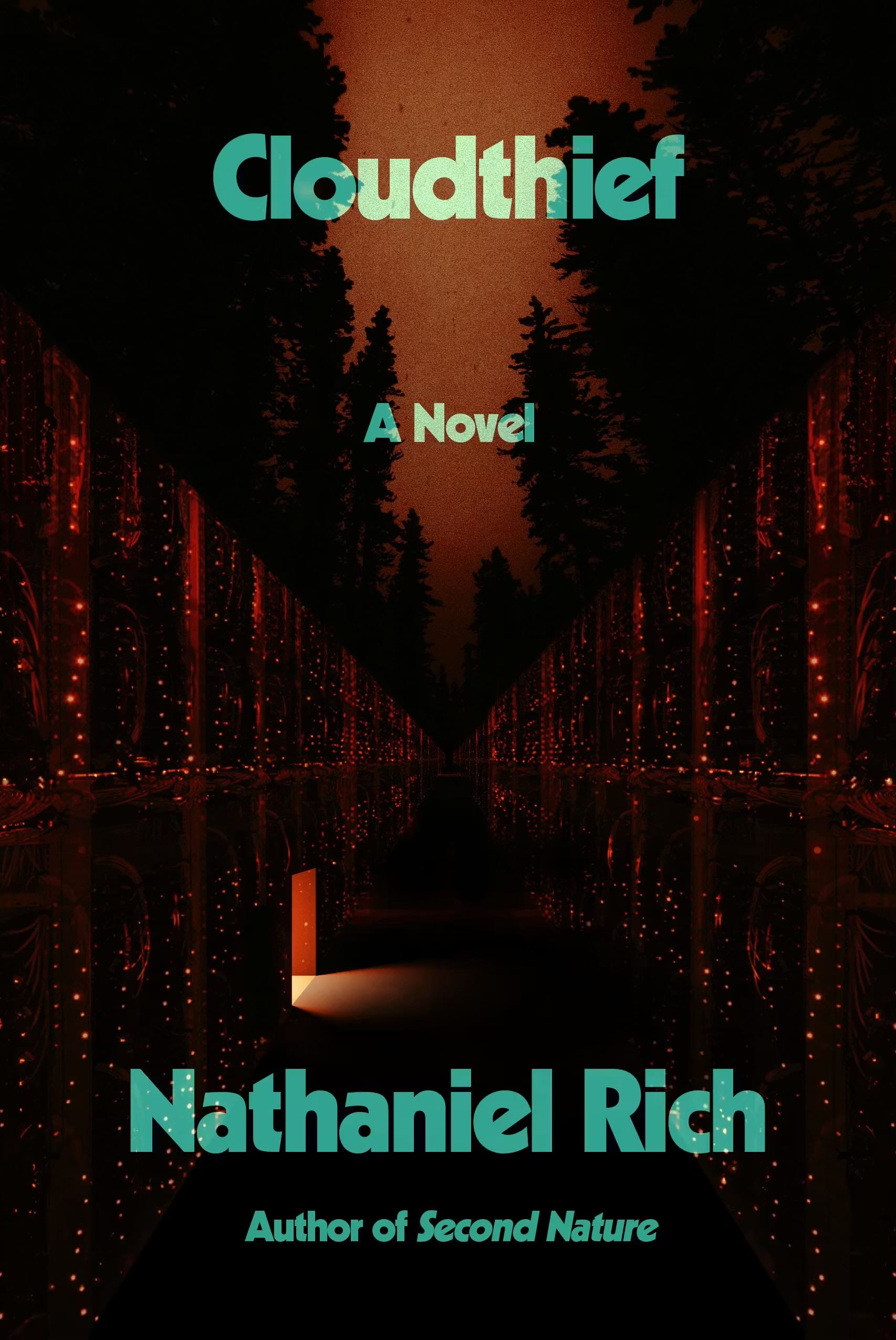
The funny thing about Nathaniel Rich, at least to me, is that I’ve read two of his novels (including this one) but have never got around to reading a book by his brother Simon Rich despite owning most (possibly all) of his collections. The thing is, I know I will love Simon’s surrealist, genre-inflected short fiction if I crack open a cover. I’ve enjoyed the couple of stories I’ve heard on This American Life and I adored Simon Rich’s TV series Man Seeking Woman. Yet, when it comes to the jottings of the Rich brothers, it’s only ever been Nathaniel—first King Zeno, which is awesome, and now Cloudthief, which is not as awesome but still pretty good.1
The novel is set (initially) in New York just over a decade ago, around the time when the phrase “cloud computing” was becoming ubiquitous, but before we2 really understood the massive, physical, resource-guzzling infrastructure that underpinned it. Our unnamed narrator is a freelance journalist known for his urgent sound-the-alarm work on the coming climate apocalypse. When we meet him, he’s with his mate Ces, a shady fellow who insists you can make easy money stealing shit from self-storage facilities. Although he initially dismisses the idea, Ces convinces him (though he doesn’t need to push that hard) that there might be a story in it—even if it means breaking the law. Anywho, they gain access to the facility, open a few storage units, find them (disappointingly) filled with people’s detritus, and decide to head home with a modest haul (that’s overstating things).
But before they leave, Ces shows the narrator a unit that’s locked from the inside. Living in said unit, as they’ll soon discover, is Virginia. The narrator’s first impression is not entirely positive: “Her teeth were snaggled to some minor degree that gave her face a serpentine cast, though her lips were full, red. She did not strike me as pretty, at least not in any conventional way… She was hard, like a crag, or shaved ice.” But when she smiles, “…the glacier melted, revealing a dancing girlish silliness.” Yes, our narrator can be a bit of an objectifying dick.
Anyway, it turns out that Virginia is not a crazy person but is instead living off the grid. She has spent the last several years erasing her digital identity. She makes money using crypto to bet on prediction markets. It’s Virginia who suggests to the narrator—who has promptly fallen in love with her—that they steal some servers from one of Google’s data centres.3
This is maybe the fiftieth contemporary book4 I’ve read this year featuring wounded, dysfunctional people. I’m blaming the 2016 wave of populism that hammered the last nail in the coffin of society.5 In this case, while our narrator can be an arse, and while Virginia is, at times, so opaque as to be impenetrable, Rich does a terrific job showing us glimpses of who they once were and what they might have been if they hadn’t endured difficult childhoods—traumatic ones in Virginia’s case.
The cloud computing, data-centre stuff is fine if you don’t know the history (which I do). The heist is hilariously basic—it’s no Ocean’s Eleven. But I liked it, especially the narrator leaning on fiction to research the typical pitfalls of heist-ery. (He’s constantly expecting Virginia to betray him. And she sort of does … but also, she sort of doesn’t.)
Cloudthief is also a book about books (copyright Andy Miller), or, specifically, one book: Véronique Le Guen’s Seule au fond du gouffre. It’s a memoir, never translated into English, about the months Le Guen spent alone in a cave. The book is about loneliness and isolation—a reflection of the narrator’s state of mind and, we start to realise, Virginia’s.
There’s more. I haven’t mentioned the narrator’s sister, who is suffering from Usher syndrome—an illness that becomes increasingly central to the story. There’s also a subplot involving classified Pentagon information regarding UFOs, or unidentified anomalous phenomena (UAP). It’s not as bonkers as it sounds; it’s just one of the quirky threads that weave their way through the novel.
While not every aspect of Cloudthief worked for me (the UAP stuff is an example, mostly because it feels like it’s going somewhere and then doesn’t), I was never not entertained and emotionally invested in this surprisingly slim novel. Good work, Nathaniel Rich. And again, sorry, Simon.
Simon, if you’re reading this, I promise to read one of your books before your bro writes another novel. PROMISE!
Your average punter, e.g. me.
To protect against lawsuits, Google is presented as G—. Same goes for M— and A—.
Slight exaggeration. But Yesteryear, Lost Lamb, and The Rouse, three novels that will never be mentioned again in the same sentence, all revolve around fucked-up people.
I know books involving broken people predate 2016. But there just feels like there’s more of it. I accept it might be recency bias, but fuck it. I’m calling it a trend.
No posts
Comments
Nothing yet. Say the first thing.
Sign in to join the conversation.