
Most analysts hit a ceiling somewhere between $60k and $80k and decide it’s a tools problem.
So they add Python. Then dbt. Then a Tableau cert, then a cloud cert, then a machine learning course they abandon at week three.
Two years later the skills section is twice as long and the number on the offer letter hasn’t moved.
I want you to look at this from the other side of the desk for a second.
Picture a director of analytics with four analysts. Same warehouse access, same BI tool, roughly the same SQL. Her intake board takes about 60 requests a quarter and all four of them close their tickets on time.
Three of those analysts she sends tickets to. The fourth one she pulls into the planning meeting before the tickets exist.
That fourth analyst is not better at window functions. He’s in the room because when someone asks him for a churn dashboard, he asks what they’re going to do differently depending on what the number says. Roughly half the time, that one question kills the dashboard and replaces it with a smaller piece of work that answers what the person actually wanted to know.
He saves her thirty hours a quarter of building things nobody opens. That’s why he’s in the meeting, and that’s why he got promoted twice while the other three got cost of living adjustments.
The gap between a $60k analyst and a $150k analyst is not technical. Both of them can write the query. One delivers a number, and the other changes a decision.
Everything a company pays a premium for lives in that space: taking a vague request, working out which decision it feeds, and answering the decision instead of the request.
That’s the whole game. Here’s what it actually looks like day to day.
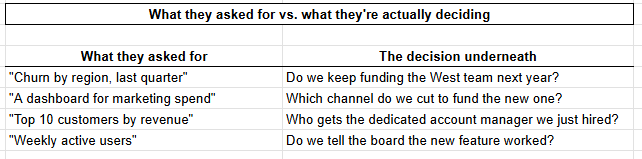
1. THEY FIND THE DECISION BEHIND THE REQUEST BEFORE THEY OPEN THEIR EDITOR.
“Can you pull churn by region for last quarter?” is never the real question. The real question is closer to “should I keep funding the West team?” or “do I have a product problem or a sales problem?”
Two questions get you there. What are you going to do with this? And what number would change your mind?
The second one is the one nobody asks. It tells you the threshold that matters, which tells you the precision you need, which usually tells you the four-hour version is fine and the two-week version was never necessary.
Junior analysts think this makes them look slow. It does the opposite. It’s the single fastest way to sound like the most senior person on the thread.
It also protects you from the worst outcome in this job, which is delivering exactly what was asked for and watching it get ignored. That happens when the request was a guess at what would help and you treated it as a spec.
2. THEY CONVERT EVERYTHING INTO DOLLARS.
“Conversion dropped 3%” gets a nod in a meeting. “Conversion dropped 3%, which is about $180k a quarter at current traffic” gets budget, headcount, and your name attached to the fix.
Nobody funds a percentage. Percentages are trivia until someone does the multiplication, and the person who does the multiplication is the person the room turns to next time.
You don’t need a finance background for this. You need the average order value, the traffic number, and a willingness to say “roughly” out loud. Directional and stated beats precise and unsaid, every time.
This is also the exact skill that fixes a resume, which is why almost nobody’s resume works. “Built dashboards in Tableau” is a percentage-level bullet. “Rebuilt the ops dashboard, cut weekly reporting time from 6 hours to 40 minutes across a 12-person team” is a dollar-level bullet, and it’s the same project. Month 1 of Analyst Hive has you rewriting every bullet you own this way, with a metrics bank so you’re not staring at a blank page trying to invent numbers you don’t have.
The fastest way to break into data no matter where you’re at (built by me!)
3. THEY LEAD WITH THE ANSWER AND BURY THE METHOD.
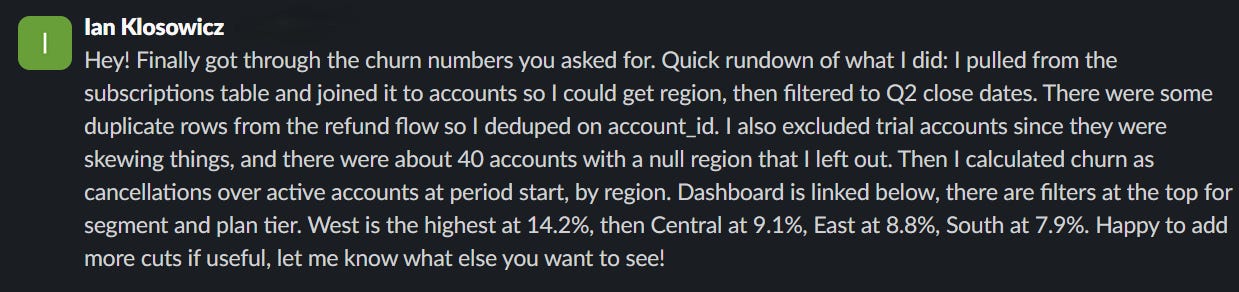
The $60k version of an update walks through the process. Where the data came from, what got cleaned, which joins were involved, what got excluded, then the finding at the bottom like a reveal.
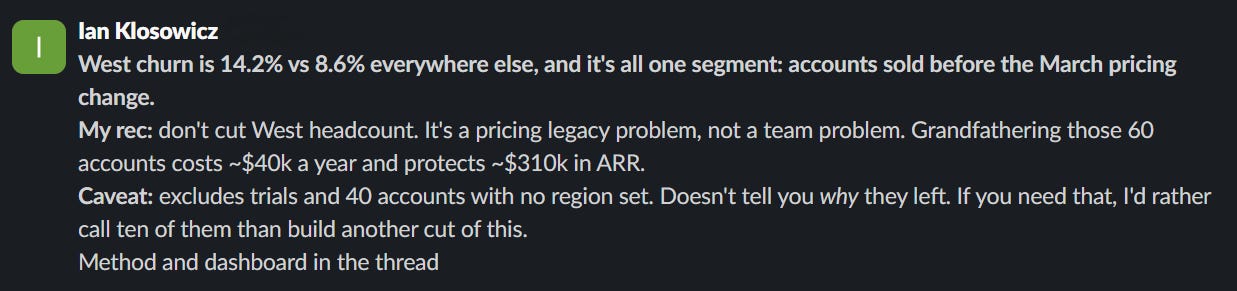
The $150k version is one line at the top: here’s what I found, here’s what I’d do, here’s what I’m not sure about. Everything else goes below, for the two people who’ll actually read it.
The tell is the first sentence. If it starts with “so I pulled” or “I joined the” or “after filtering out,” you’re writing for yourself. If it starts with a recommendation, you’re writing for the person who has to act.
Nobody skips your methodology because they don’t respect it. They skip it because they have nine minutes before their next meeting and they need to make a call. Structure for that and you start getting invited to the calls where decisions get made.
This is what I used to send
What I send now
4. THEY NAME THE HOLES IN THE DATA BEFORE ANYONE ELSE FINDS THEM.
Analysts hide caveats because they think a caveat looks like weakness. Then someone in the meeting spots the double-counted refunds, and now every number that analyst produces gets a second look forever.
Say it first. “Heads up, this excludes trial accounts, and if we counted them the number is closer to 8%.” Thirty seconds of admitting limits buys you months of people accepting your numbers without checking.
There’s a version of this that goes further and it’s the one that gets people promoted. Tell them what the data can’t answer at all. “This tells you where churn happened. It won’t tell you why, and if why is what you need, I’d rather call ten of these accounts than build you another cut of this.”
Trust compounds faster than skill does. An analyst everyone trusts at 80% accuracy gets pulled into strategy. An analyst nobody trusts at 99% accuracy gets sent tickets.
5. THEY GO BACK AND CHECK WHETHER THE DECISION ACTUALLY CHANGED.
Almost nobody does this. The analysis ships, the ticket closes, and everyone moves on with no idea whether the work mattered.
Two weeks later, ask. Did you end up shifting the budget? Did the West team change anything? What happened?
It costs you one message. It is also the only way you ever find out whether your instincts are good, because otherwise you’re guessing at your own accuracy for your entire career.
Half the time the answer is that nothing happened, which is genuinely useful information about which of your work is decorative. The other half, you now own a real outcome with a real number on it, and that outcome is what you say in your next interview, your next review, and your next negotiation.
That’s the difference between “I built dashboards for the sales org” and “my analysis moved $400k of spend out of a channel that wasn’t converting.” Same job. One of them is a story with an ending.
There is no salary band for producing numbers. There is a very large one for being the reason a decision was right.
The query is the cheap part. The question is the job. Every tool on your list is a way of executing an answer, and executing answers is the part that gets cheaper and more automated every year. Deciding which question was worth answering is the part that doesn’t.
If you’re stuck at the ticket-closing tier and you don’t know what to do next, that’s what Analyst Hive is for. It’s a 90-day sequence with a task for every single day: what to build, what to rewrite, who to message, how to talk about your work so it reads as decisions instead of dashboards. No course to binge and no curriculum to guess your way through. You open it, you see today’s task, you do it, you close it.
There’s nothing like this in the data world
Now I want one from you. Reply with the last request you got that you should have pushed back on. What did they ask for, and what did they actually need? I read every reply and the best ones usually turn into future issues.
P.S. Quick way to find out where you currently sit. Count how many of your last ten requests you asked a single follow-up question about before starting. That number is closer to your salary band than your skills section is.
Talk soon,
Ian
No posts
Comments
Nothing yet. Say the first thing.
Sign in to join the conversation.