
It’s been difficult to find the time to write, which probably makes it all the more important to. There’s something about the process of forcing ideas into clear sentences that settles the conceptual flotsam of the mind. And there’s so much to write about!
Below are 7 topics that could each be a full article. I will only write the full post on the topic if someone says they want it via a comment on Substack, or a response to this email. Depending on the success of this format I may keep it going forward. I want to provide interesting updates, and save deep-dives for the best topics.
As a teenager in the 2010s, it felt like not much had happened technologically in my lifetime, other than the smartphone. Apps progressed, but technological progress didn’t seem to bleed through to the material world.
Well, I no longer feel this way. Things are moving again. We’ve unlocked some big branches on the tech-tree that enable sci-fi changes to the physical world.
In order to decarbonize, we need to electrify things that currently consume fossil fuels. Airplanes are an especially difficult one because liquid fuels have so many advantages. They’re more energy dense than batteries by both weight and volume, and the weight of the fuel is lost as it’s used! The same is not true for batteries - you can’t exactly drop the battery out of the plane as it gets used.
Despite this, the performance of batteries continues to improve, as their prices continue to decline:
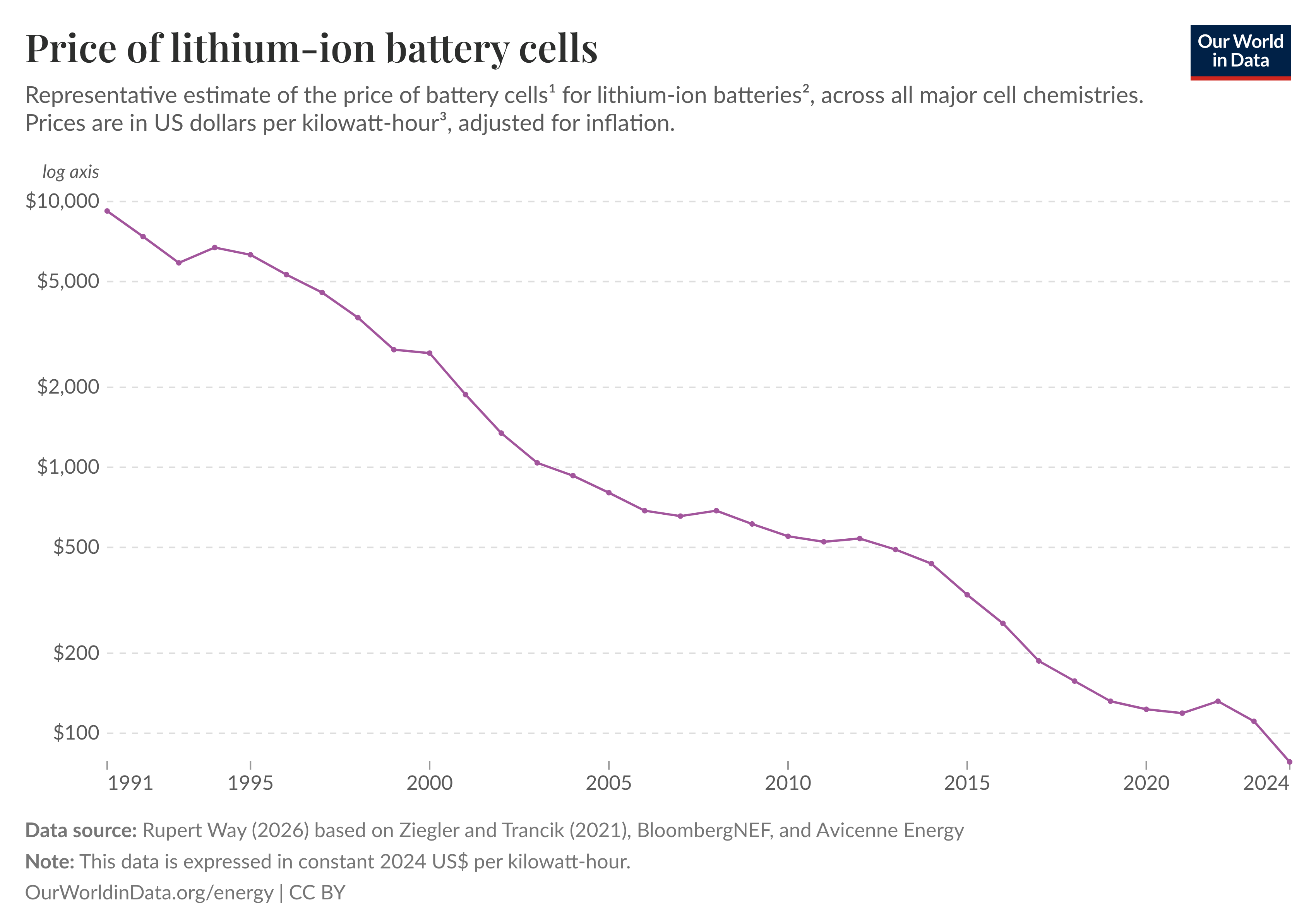
This has enabled some battery-powered short-haul flying vehicles!
China is starting to produce commercial eVTOLs (basically electric helicopters), which will act as airborne city taxis, including one that can carry 10 people.
The Royal Mail service of the UK tested small electric cargo planes for serving rural Scottish communities.
United Airlines has pre-ordered hybrid regional airplanes from a Swedish company.
Driverless cars are very sci-fi. It’s amazing how quickly we normalize to a new technology - my friend in SF calls them ‘Waymees’ and parties in them regularly. But the cars are driving themselves! And doing it better than humans!
Here are the most interesting datapoints to me:
Ridership is on an exponential, doubling every 6-12 months.
They are 90% safer than human drivers (and will only keep getting safer). Traffic fatalities are 1% of American deaths, so this is pretty sweet.
Tesla claims it will release autonomous driving in the next 12 months, and their cars are cheaper to produce than Waymo’s.
Driverless trucks are being tested on long freeway routes.
2-4% of the US labor force drives for a living.
Whatever their ultimate limits, large language models keep getting better at reasoning, which is cool in some ways, and of course, extremely scary.
The leader is Anthropic, with their Claude model. Whatever your stance on AI, it’s fortunate that the most safety-focused, ethical company of the bunch has the lead.
Anthropic has a “Long-Term Benefit Trust” made up of 5 people with no financial ties, who choose the CEO, and they’re tasked with ensuring Anthropic’s technology benefits humanity. I’ve met one of these 5 people, and he spent his career enabling low-income countries to get access to life saving medicines, like the recently approved 100% effective HIV vaccine. All that to say, Anthropic’s actions to date match their stated ethics, if them denying the DoD and $200M wasn’t convincing enough.
There’s far too much going on, with too many considerations to write about here, so in brief:
Anthropic’s Claude Opus 4.6 model arrived 3 months ago and blew everyone away. It codes entire applications.
Their newest model is so powerful they aren’t releasing it, because it found security vulnerabilities in every major operating system and browser, including security-focused ones that had been around for 27 years. They’re working with the internet security companies to make things more secure, before releasing such a powerful model.
AI is going to continue to make fast progress in any domain that is verifiable - where there’s a right answer you can check against. Code is like that, and so is math.
Skyrocketing AI company revenues are making the case for a bubble seem less likely.
I’ve previously written about the new Vera C Rubin observatory in Chile that is going to give us more data in one year than all telescopes have ever collected in human history.
Well, it’s fulfilling its promise! In just a few months of operation, and only part of our night sky scanned, it’s found 11,000 new asteroids!
What a great investment! We get both astronomy/physics advances, and we’re much more likely to see the once-in-a-century small asteroids that have the potential to hit Earth, and prevent them from doing so.
And now for a hard pivot to biology!
Everything in biology has an exception! One of the biggest exceptions ever was just found.
DNA is always created from a template - which is almost always other DNA. There are viruses that can create DNA from RNA, but that’s a rare exception.
Well, scientists just found that a protein that breaks this rule. It can create a DNA sequence, without any existing DNA or RNA template. It’s a very limited, repetitive DNA sequence of two letters, but it still violates this central rule of biology!
It’s used by bacteria to defend against viruses, and has created a ton of buzz because of the similarities to CRISPR - the bacterial defense mechanism that enabled modern genetic engineering. This may be another tool we can use to engineer at a fundamental level of biology.
More and more papers are being published about how the gut affects us in surprising ways. Again, here are a few bullet points:
Scientists found a gut bacteria that made mice more muscular.
Scientists found a group of gut bacteria correlated with good health (read: a lack of chronic disease). They’re thinking it could serve as a marker of overall gut health.
And most surprisingly - scientists found a gut bacteria that made mouse memory worse, and traced its effects to learn that when Vagus Nerve signaling from the gut to the brain gets disrupted, it’s much more difficult to make memories.
They actually think this is part of what happens as we age, and that reversing it could improve memories, as they did in the mice!
There’s evidence in humans that suggests this is true. For example, people who have their Vagus Nerve severed are more likely to get dementia.
I had known about cutting edge cancer treatments like CAR-T cells, which are amazing at killing blood cancers, but I hadn’t realized how many other cool ways we have to kill cancer. I think each of these could be their own newsletter, or they could be bundled into one long one:
We can engineer T-Cells to kill that person’s cancer cells, but they don’t do well in tumors, so it’s limited to blood cancers at the moment.
Scientists are working to make ‘cancer vaccines’ a thing, which are named because they use a similar principle as vaccines - introducing markers on the cancer cells to the patient’s immune system so it learns to attack the previously hidden cancer.
We are engineering viruses to kill cancer!
We are starting to engineer bacteria to kill tumors. The insides of tumors are weird, hostile places to our immune cells, but some bacteria can thrive in these low-oxygen wastelands.
There are cool ways we’re combining multiple of these treatments to make them more effective.
Let me know which of these 7 topics (if any!) you find interesting enough to want a longer write up on.
Thanks for reading! One more announcement:
I reached out to Waking Up - the best meditation resource I’ve found, which has had a profound impact on my life. And they agreed to partner with me!
I only want to spread things that I believe have a positive impact, and I strongly recommend Waking Up to anyone that’ll listen (again, I’m a bit of a weird conversation partner at parties).
Try it for free with my link! If you decide to move forward after the free month, I get a small amount of the subscription.
If you try it, do let me know your experience! It’s changed my understanding of myself, my ability to emotionally regulate, and my understanding of consciousness. I’m always game to chat about it.
Have a great week!
Ian
Edited by my wife, Minttu
No posts
Comments
Nothing yet. Say the first thing.
Sign in to join the conversation.