
I’m so excited about this newly published research!
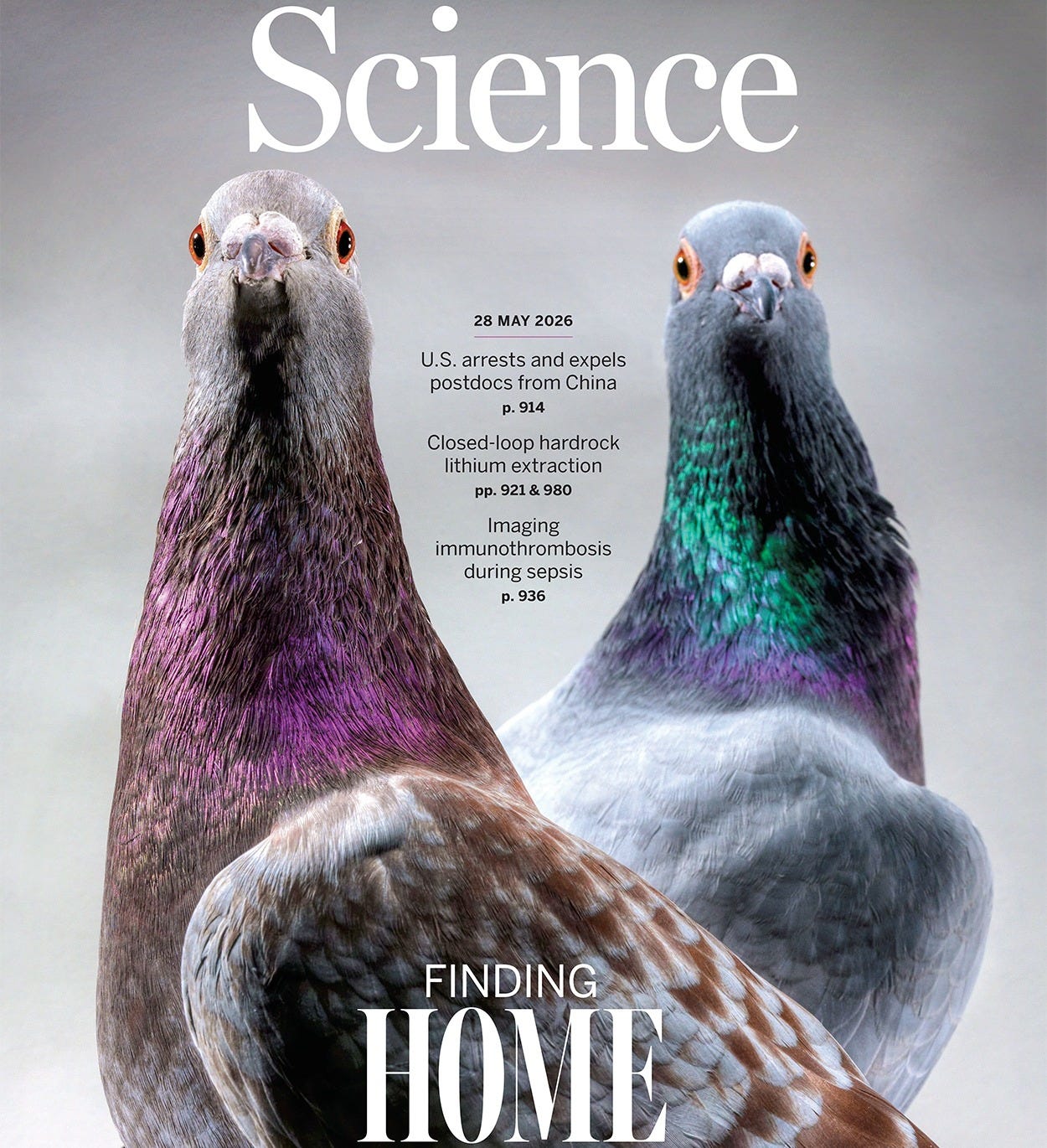
A few timely coincidences occurred to make these scientists’ recent paper, published in the journal Science, stand out to me.
I had been reading a book called Life on the Edge that details the quantum effects we think are important for certain biological processes. One of those processes is how we thought birds sense the Earth’s magnetic fields (“magnetoreception”) and use them to navigate.
For years, the leading hypothesis has been that a set of proteins (“cryptochromes”) in their eyes have paired electrons, and the spins of these electrons can be influenced by the Earth’s magnetic field, leading them to produce different ratios of downstream molecules, which are ultimately detected by the bird’s eyes, hypothetically painting a ‘picture’ of the magnetic fields. This leads to plenty of bad (AI generated) pop-science infographics like this:

It’s quite a complex theory that does have some mechanistic evidence, but importantly, zero experimental evidence showing that this is what birds are actually using to navigate via the Earth’s magnetic fields. So no, we definitely cannot say that birds “literally see magnetic north as a glowing overlay”.
While I’m reading this, Lisowski et al. drop this groundbreaking work in Science, proposing a new hypothesis, and critically, producing the first experiment that disrupts the birds’ ability to navigate using the Earth’s magnetic fields!
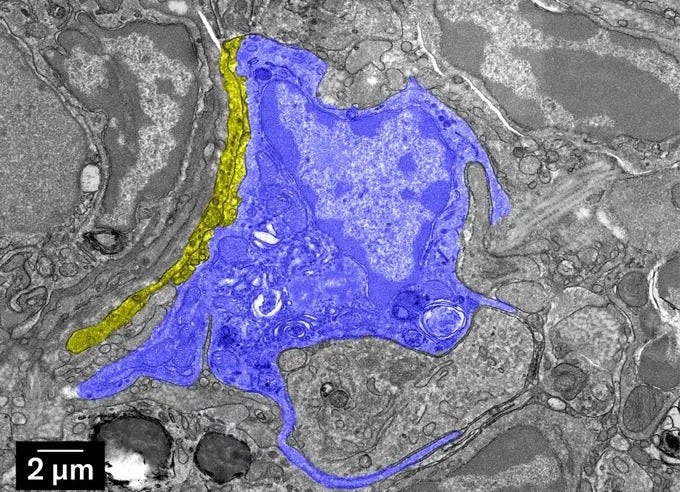
They found that immune cells in pigeon livers called macrophages (the same immune cells that keep tattoos in place!) are magnetic, since they break down old red blood cells and recycle the iron within them. These iron-containing macrophages exhibit a property called superparamagnetism, which as I understand it means they are not inherently magnetic, but become magnetic when there are enough of them in proximity, and an external magnetic field is applied to them. Without further evidence, this may have been interesting to ~five people.
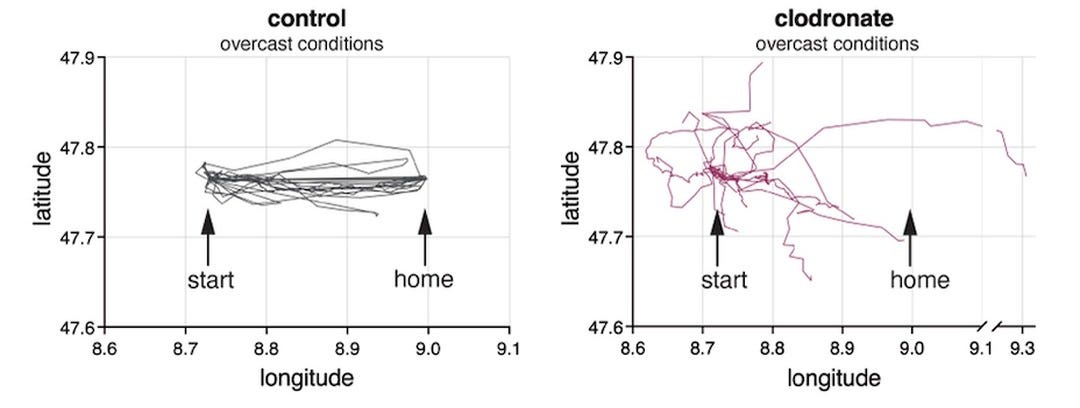
However! They went much further, and tested what happened to pigeons when these iron-containing macrophages were killed off with a targeted drug. The drugged pigeons exhibited no symptoms, and performed identically to control pigeons under normal conditions, where they did not have to rely on the Earth’s magnetic fields. But when these pigeons had to rely on magnetic fields to navigate, they couldn’t! Just look at them try:
The hypothesis is that these macrophages communicate the magnetic signal to the pigeon brain via the nearby vagus nerve. When these cells were killed off with the drug, no such signal reached the pigeon brains. Much work remains to examine this mechanism and prove it’s exactly what’s happening, but this does not diminish the evidence that this is the first time a hypothesis has been shown to prevent birds from navigating via magnetic fields.1
Listen to my conversation with them above, or read the transcript below. Many thanks to First Author Clivia Lisowski, and Senior Authors Martin Wikelski and Christian Kurts for taking the time to share their expertise and research with me!
Ian Slalander: Thanks for joining another episode of Imperfect But Improving, where we progress our understanding of the world by speaking to the experts pushing the frontier of scientific knowledge. I’m excited for today’s conversation with Clivia Lesowski, Martin Wikelski, and Christian Kurts, who have a new paper out in Science — one of the most reputable journals in all of academia — focusing on how pigeons achieve their remarkable ability of magnetoreception. Thank you all for taking the time to talk with me. I’m genuinely excited about this.
Martin Wikelski: Pleasure to be here.
Ian: Jumping right in — how do we know that pigeons and other birds have this ability of magnetoreception, the ability to sense Earth’s magnetic field in the first place?
Martin: I think the idea came about because a lot of songbirds migrate at night over long distances and keep a consistent direction. The best data we have on that is from Bill Cochran, working out of the Midwest in the ‘70s and ‘80s. He built small transmission devices — little radios — and tracked individual birds, one for six nights straight, showing that the magnetic direction it followed was always the same angle, and the same angle relative to the sun. It shifts a little from night to night.
Then the question became: is that real? So what we did with Bill Cochran was change the magnetic field — twist it by 90 degrees — and the birds, flying at night in clouds, in complete darkness, went 90 degrees off course. The next night they’d correct again. That really shows they’re following a magnetic field: you can fool them by calibrating it incorrectly at sunset. There are lab experiments showing similar systems, but in a lab setting you never know for sure what it means. So I think the experiments in the wild are key to really understanding that birds, at least sometimes, use a magnetic direction system.
Ian: So the evidence is that applying an external magnetic field disrupts their navigation, which rules out the possibility that they’re just using landmarks or other visual cues.
Martin: Yes — or an inertial system, a kind of gyroscope, that keeps you exactly on track. That’s impossible in a bird. So the only option at night, in clouds, with no visual cues, is a magnetic direction sense.
Ian: I’ll ask this now so we can circle back later — do we have an estimate of how widespread this ability is across migratory birds?
Martin: We don’t know, but since they all seem to behave the same way, everyone assumes they all have the same system.
One thing I think is absolutely critical: people always conflate a magnetic map with a magnetic direction. The magnetic direction sense is what we showed in the wild — it really exists, and you can disrupt it. But some people believe birds can navigate using a magnetic map, using crossing magnetic field lines to determine their exact position on Earth. For me, that doesn’t exist. I don’t see the evidence for it in the wild. So: magnetic direction-finding, yes. Magnetic map, no.
Ian: So to make sure I understand — birds can use magnetic direction as a compass, to know they need to fly, say, 30 degrees northeast. But if they’re transported to an unfamiliar location, they can’t pinpoint their exact latitude and longitude.
Martin: Exactly.
Ian: Part of my fascination with this topic comes from a puzzle: Earth’s magnetic field is quite weak relative to the thermal noise of molecules jostling around in any biological system. So it’s a real puzzle how biology could evolve a mechanism to detect such a weak force amid the chaos of a warm, noisy biological system. Could you walk through the leading explanations for magnetoreception?
Clivia Lesowski: There are basically two main schools of thought. One group of scientists believes there are cryptochromes — light-sensitive, UVA-sensitive proteins in the eyes of birds. The idea is that when cryptochromes sense light, this triggers a conformational change and changes in gene expression, which is somehow transmitted to the bird’s brain.
The second idea is magnetite-based. It’s known that tiny magnetite particles exist in several organs and in various cellular structures — endosomes, lysosomes, and so on. The idea is that as a bird moves through the magnetic field, these particles align like microscopic compass needles, triggering an intracellular signaling pathway that’s then transmitted via the nervous system to the brain, producing a change in flight direction.
Both cryptochromes and magnetite particles are known to exist. Which one is actually responsible for magnetoreception is still highly debated — there are a lot of competing theories and hypotheses.
Ian: And crucially, as I understand it, no experiment has shown that intervening with either mechanism causes birds to lose their ability to sense Earth’s magnetic field and navigate by it. Is that right?
Clivia: That’s correct, because it’s very difficult. How would you deplete or knock out cryptochromes? That’s not really possible. And it’s difficult to study this in a natural environment, as Martin explained — you can put birds in a magnetic cage, but that’s very artificial and doesn’t resemble the outside world. With our paper, since we targeted macrophages and showed that depleting them in a natural environment left birds unable to find their home loft, that’s a genuinely new method — and a new method reveals new results.
Ian: It’s such an intriguing finding. Before we get into the details, Martin, Christian — what was the genesis of this experiment? What led to the hypothesis that this was worth investigating?
Christian Kurts: This was pure serendipity. Martin and I met at a conference, and I mentioned that we’d found these strange magnetic macrophages. We use mice as our animal model, and these magnetic cells interfere with one of the most widely used cell-enrichment methods in immunology. When you have a mixture of immune cells and want to isolate a specific type, you label them with an antibody carrying a small magnet, then pass the mixture over a magnetic column. The labeled cells stick; the rest pass through. Then you switch off the magnet and elute the cells of interest.
We found that some contaminating macrophages always stuck to the column, even though they didn’t express the receptor for the antibody — and they stuck even without any antibody at all. So they had to be intrinsically magnetic. We found the answer: these are macrophages well known in immunology, part of whose job is to degrade old and damaged red blood cells. In the process, they accumulate iron and build tiny nanoparticles that turn out to have superparamagnetic properties.
When we published that finding ten years ago, it was just a technical curiosity relevant to experimental immunologists — hardly anyone else would care. The real implication came when I talked to Martin. He said he had a question for me, because for years they’d been searching for the sensor that lets birds detect the magnetic field, but no one knew of any magnetic sensor cells in the body. We looked at each other and had our “eureka” moment. Let’s try it. That’s the story in a nutshell.
Ian: That’s such a great origin story. Could you walk me through the experiment itself — the design and the results?
Christian: As experimental immunologists, the typical question we try to answer is: which part of the immune system is responsible for a given function, like defense against a microbe or a tumor? You remove that part — say, the macrophages — from a model organism, and ask whether the function still works.
The difficulty with pigeons is that most of our tools are species-specific — depleting antibodies, knockout mice — and we can’t use those on pigeons. But clodronate liposomes are species-independent, and we’ve used them for a long time. These are small nanoparticles containing clodronate, a drug that’s toxic to phagocytic cells — cells that “eat” material. Macrophages are like the vacuum cleaners of the immune system: they sit in every organ, removing debris that could otherwise become toxic. That’s what they do with old red blood cells. But they also take up these liposomes, and the toxic payload kills them.
That sounds dramatic, but it isn’t — mice and pigeons do fine without macrophages for a day or two, until the bone marrow produces new ones and everything returns to normal. We confirmed that after treatment, the pigeons were happy, healthy, and able to fly — that was one of our controls. They just couldn’t navigate anymore.
Ian: The graphs from this experiment, showing the pigeons attempting to navigate home, are fascinating. Before we get into the release conditions and controls — my wife insisted I ask: how do you even set a homing pigeon’s “home” location?
Martin: Well, they want to. You make their home as cozy as possible — good food, good company, and especially good mates — and then they want to return as quickly as they can.
The trick with the experiment is putting the pigeons in a situation where they can’t use anything but their magnetic sense. That’s actually very difficult, because you have to strip away every landmark and any information from the sun — no polarized light, nothing. To do that, we had to rely on really bad weather: low-lying clouds, usually with some wind and drizzle — conditions the birds don’t love flying in. So you have to make the home loft even cozier, so they really want to get back even in bad conditions. It’s a genuinely tricky experiment to run in the field, but the key requirement is complete overcast the entire time, with no sunlight and very low clouds. A lot of people don’t appreciate that distinction — a high ceiling of clouds is easy for the birds, because they can still use landmarks. There are very few conditions under which a pigeon actually needs its magnetic sense. Normally they navigate by landmarks, vision, and the sun. Those are the only conditions under which they fall back on the magnetic sense.
Ian: So it’s really a backup mechanism, used only when their other cues — vision, landmarks, familiarity — aren’t available.
Martin: Yes.
Ian: How exactly was it shown that pigeons treated with clodronate liposomes lose their ability to navigate home? How many pigeons, how far away, and how did you ensure they were really forced to rely on that ability?
Martin: You train them to fly home from due west, so they learn: every time I’m transported somewhere, I just fly east. They remember landmarks and, even after a second displacement, fly home immediately. Then you create conditions where none of those other cues are available — no sunlight, low clouds blanketing the landscape so the hills and valleys disappear. Under those conditions, either the cryptochrome system should guide them — which it didn’t, in our case — or another system does. When we depleted the macrophages, we looked at the flight tracks and they were completely different from what a bird relying on its magnetic sense would produce. The birds flew in all kinds of directions — they got lost. They were flying, but not really going anywhere. The most likely explanation is that these macrophages are responsible for keeping direction, and without them, the birds simply can’t.
Ian: Let me make sure I’m following. You take a group of pigeons, transport them roughly 20 kilometers west of home. Half have been treated with a drug that eliminates most of their iron-containing macrophages — the proposed mechanism being that these macrophages form a kind of directional compass. Under conditions where they can’t use the sun, the treated pigeons fail to fly home — while the untreated ones fly more or less directly east, and the treated ones fly essentially at random, failing to return within the roughly 70 minutes it takes the untreated birds.
Martin: Correct.
Ian: But when it’s sunny — when they can use visual cues — both treated and untreated pigeons make it home?
Martin: Yes. We don’t actually know whether they’re using landmarks or a sun compass in that case — probably both — but we haven’t separated those two out. They’re very difficult to disentangle.
Ian: That makes sense — turning the real world into a controlled lab condition, with all the variability of weather and location, sounds genuinely difficult. I read some of the skeptical responses to this result, and I’m hoping you can help me understand one objection: that maybe it isn’t specifically the iron-containing macrophages responsible for this ability — maybe the drug just makes the pigeons unwell in some other way. But the data looks so binary — essentially 100% success versus 100% failure — that it clearly seems to be doing something. Were there any observable differences in the treated pigeons’ behavior, energy levels, or homing time under sunny conditions — or was it essentially invisible which pigeons had been treated, until the cloudy-sky condition forced them to rely on their magnetic sense?
Martin: That might be the last thing I can add here — I didn’t see any differences in these pigeons at all. You treat them, and the next morning you pull them out of the aviary, put them in a box, transport them out to the release site. There’s no visible difference. You just grab one at random, check the number, note whether it’s clodronate-treated or a control, and release it. They fly off — no visible difference at that point. It’s only in the real-time tracking data afterward that a difference emerges: some birds take off and fly straight home, while others — sometimes leaving in the same initial direction — seem to drift, apparently unable to hold a course. Honestly, going into the experiment we mostly expected nothing to happen. Seeing an effect at all felt almost like a small miracle.
Ian: It’s fascinating. Doesn’t this seem like a blow to some of the other leading hypotheses — the cryptochrome explanation in particular? I couldn’t find anything in the literature suggesting clodronate interferes with anything related to the eye or cryptochromes. So since this abolished their ability to navigate, is that the hit against the cryptochrome explanation that I take it to be?
Martin: Maybe — but there could still be a cryptochrome system acting as a backup, and for whatever reason the birds didn’t use it in our case. We haven’t tested that directly. At minimum, it makes cryptochrome involvement somewhat less likely in this context, but I wouldn’t call it a complete blow. It just means something else is happening that’s worth investigating with a fresh approach.
Clivia: I want to add something important about clodronate. It isn’t specific to liver macrophages, and it isn’t specific to iron-containing macrophages — it’s a drug taken up broadly by phagocytic cells, mainly macrophages, which is exactly why it’s so widely used in immunology to study macrophage biology generally. It’s the administration route, dose, and timing that let us narrow its effect toward macrophages primarily located in the liver, and to some extent the spleen. Targeting alveolar macrophages, for instance, usually requires a different administration route. So we’re not claiming clodronate is specific to iron-containing hepatic macrophages — just that, given how we administered it, that’s where its effect is concentrated.
That brings me to your other question — whether clodronate would also affect cryptochromes. As far as I understand, cryptochromes aren’t phagocytic cells; they’re light-sensitive proteins in the eye, and when activated by light they’re thought to overlay some kind of magnetic pattern onto the bird’s normal vision. Clodronate shouldn’t touch them. So, as immunologists coming to this debate with fresh eyes — we depleted the macrophages, the birds needed to rely on Earth’s magnetic field, and navigation failed, without us having touched the cryptochromes at all. That suggests to me that cryptochromes didn’t play the major role in this situation, or at least weren’t able to compensate for the loss of magnetoreception. Maybe there are several redundant systems, which would actually make evolutionary sense.
Ian: But if they are redundant, it doesn’t seem the birds were able to fall back on the visual one, if it exists. To my lay understanding, it really does look like a blow to that explanation.
Clivia: Yes — but I don’t want to wade too deep into that particular debate.
Ian: Fair enough. Speaking of things you might not want to wade into — this next one is purely a speculative, “science communicator being cheeky” question, so treat it as pure imagination. You used the word “vision” when describing cryptochromes — that light hitting them influences downstream molecular pathways, potentially producing something like a visual sense of Earth’s magnetic field. If you had to speculate on how pigeons might subjectively experience magnetoreception arising from these iron-containing macrophages instead, what’s your intuition?
Clivia: It’s pure speculation, but as we describe in the paper, the macrophages and nerve fibers sit remarkably close together — within two to five micrometers of each other. We know from mammalian systems that macrophages and neurons communicate bidirectionally: macrophages send signals to nerves, and vice versa. Given that proximity in the pigeon liver as well, why shouldn’t there be a similar communication pathway? Exactly how it works is a question for future studies. But if it functions like any other signal transmitted from nerve to brain, that would be my guess — though again, we need real experiments to figure this out.
Ian: That direction for future work sounds genuinely exciting. My question was maybe even more speculative — what’s your intuition about the subjective experience of magnetoreception itself? I find myself wanting to compare it to something like our sense of balance, the way our inner ear informs us without us really “seeing” it.
Clivia: Maybe something like a gut feeling — well, not gut feeling exactly, more like a “liver feeling.” Maybe something like that. There’s a well-known gut-brain axis — a strong connection between the gut and the brain — and what people describe as a gut feeling is something you can’t articulate with clear facts, but it still guides your decisions. What’s your take, Christian?
Christian: I think it’s essentially impossible for us to imagine. Try explaining the difference between red and green to someone who’s colorblind — they simply won’t understand it, though they might grasp that the two things look different to others. This is a sensory quality entirely outside anything we experience. I understand why people ask, but I think it’s genuinely beyond our imagination.
Ian: That makes sense. Here’s another speculative one: it seems multiple, independent evolutionary lineages have converged on this magnetic-sensing ability — sharks, birds, turtles. Given how widespread it may be, and given that many animals already have these iron-containing macrophages as part of recycling iron from red blood cells, do you think it’s plausible this ability could eventually be engineered into species that never evolved it naturally?
Christian: First we’d need to fully understand what actually produces this property — what’s required to generate these superparamagnetic nanoparticles inside cells. If there’s a specific enzyme responsible for building them, genes could in principle be transferred. But would that be enough? I doubt it, because after the particles are present, the cell also has to activate in response to them and send the right signal to the nerves. It would likely require a great deal of engineering, and we’re far from being able to do that — or from being allowed to. Thank goodness.
Ian: Excellent. Well, thank you so much for doing this — I’m sure there are great questions I never got around to asking.
Christian: Plenty of questions still to answer. We’ll roll up our sleeves and keep at it.
Other experiments have messed with birds’ ability, but it was by applying external magnetic fields, not by messing with their internal biology, so they don’t provide evidence for or against any particular explanation of their magnetoreception ability.
Comments
Nothing yet. Say the first thing.
Sign in to join the conversation.