
I know we’re all getting a little overwhelmed by the content on The Odyssey, but I think it speaks to just how incredibly powerful the 3000 year old poem, the translations, the movie, and this moment really are. I cannot stop thinking about it, and asking people about it, so why not write about it.
Indulge me. Yes, this is a food blog, but sometimes I have to chew on these really big bones in life. It’s a part of who I am.
I was extremely fortunate to be given a humanities education from the time I was 13 years old. It has truly formed who I am as a person, but it has also as an adult made me lonely in these colossal thoughts. Right now, with all the strife and difficulty in the world, not many people are interested in thinking deep and asking hard questions. But the longer I’m on this planet, I’ve come to know that my design makes it even more powerful to be inside the stories of the classics both as a student and today.
I think many of us are trying to understand who we’re going to be in this next phase of humanity. Are we going to speak out, or are we just going to live our lives comfortably for as long as we can? Are we going to be givers, or are we going to be takers? I am at that crossroads.
I have really been in a place of self-discovery these last 18 months. Moving back to the place where I was born and raised has forced me to really look at who I am without the labels I gave myself when I lived in larger, more complex creative communities. I was a talent agent. I was a music supervisor. I was, and still am, a chef. But who am I without all of that? And am I just a person like Odysseus, simply trying to find my way home? Battling the gods left and right to get there? Coming to terms with the byproduct of my success, however that can be defined?
So, to say that I have related deeply with the book, the journey of Odysseus, the movie itself, and the power it’s having on our collective conscience really cannot be understated. That is why this month’s OBSESSED is rooted in this topic.
I’m the kind of person that, for no reason whatsoever, will bite down on an idea, a theory, a technique, or just something nerdy in the kitchen. That’s why I call this newsletter Obsessed. I’ve just come to learn that there’s an actual name for my condition. Epistemic curiosity.
This is literally how I both see the world and receive it; in systems. In my mind there is no one idea. Each idea is connected systematically to another, and once I find an idea, my mind builds a system around it. It’s how a white middle-aged housewife from Tennessee was able to figure out how to make authentic Japanese ramen. Systems. When it comes to cooking, this is why I’m more driven by frameworks than I am by recipes, and why, if I’m being honest, the joy of home cooking will always be my first love. In a professional kitchen, you are bound by law to that recipe, because you have to produce the food the same way every time. In home cooking, I truly believe the joy lies in the fact that it’ll never be the same twice.
I love building, not just systems, but new ones, which is deeply tied to my work here. I am not programmed to be a copycat, much to my own demise. I will break every rule I am handed and create a new system, hopefully teaching it in a way we can all use and understand.
So what do systems and The Odyssey have to do with each other? What are the systems around this moment? The power of the message between a poem from 3,000 years ago and the parallels of who we are as a society today?
There’s a culture war swirling around all of this, and those arguments are the lazy, boring version, if you ask me:
Can Helen of Troy be portrayed by a Black woman?
Can Elliot Page play a warrior?
Can Emily Wilson’s translation be called “feminist”?
Does a woman have the right to translate the Odyssey?
Every one of these are based on systems of power and control, wrapped in an ownership of history and who gets to tell a story, even if that story is fictional.
These are real bones to chew on and what I find phenomenal, both in timing and in interest. The movie has birthed incredible moment in the collective conscience that is a growing conversation in our society. And sure, not everybody’s going to get it, but I just want to put it out there for those of you who might be curious like me. And for my international readers, who are many, I would LOVE to hear how your communities are feeling this moment. As an American, it cuts deep and rife with irony.
Let me explain.
The poem, at its root, is about a man who wants to make it home and is battling the gods to do so. I think every person in this country feels this way right now figuratively or practically, regardless of what side of the aisle you are on. We are increasingly at the whim of the billionaires who believe they are gods. And we, the people, have empowered them.
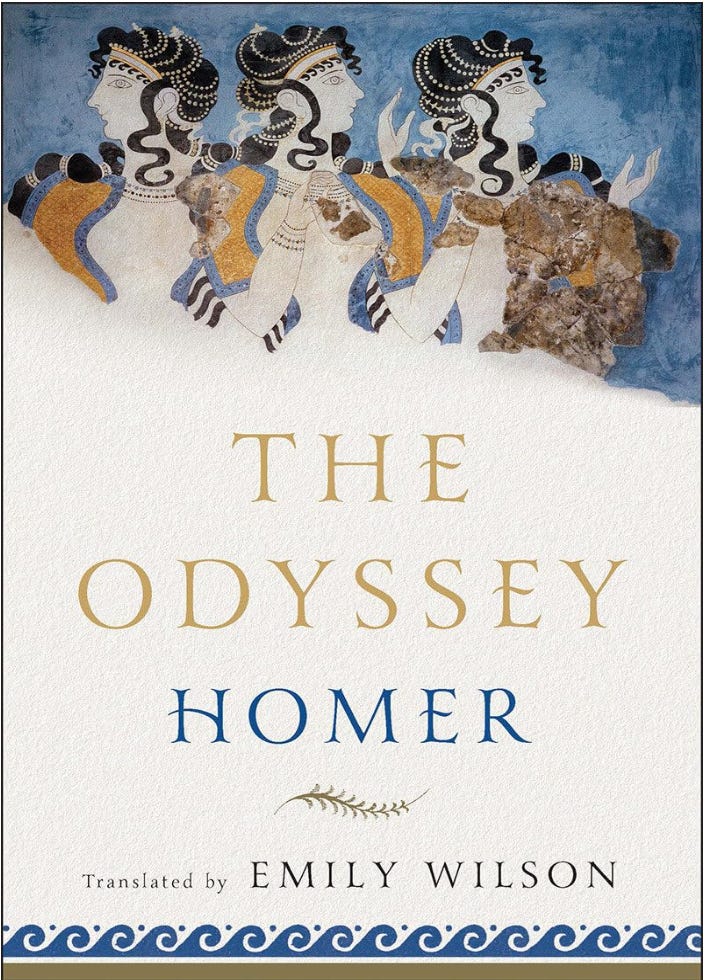
One of the academic battles right now is over Emily Wilson’s translation, the first English translation of the Odyssey by a woman and it starts in the very first line of the poem: “Tell me about a complicated man.” The translations before hers said something like, “Tell me, Muse, of the man of many ways.” The word “complicated” is not flattering, which is one of the reasons her translation is being called feminist. And it’s the word that split me right in half. “The man of many ways” tells you who the hero is. “A complicated man” sets you up to examine him. To travel alongside him in this epic journey to examine his own choices.
Here’s where it gets interesting to me. Nolan has said Wilson’s translation was an inspiration for the film, but he didn’t actually use it, and she wasn’t involved. In fact, she’s since panned the movie, saying Matt Damon’s Odysseus isn’t complicated at all, he’s just “constantly troubled by anxiety.” So the woman who gave us that word believes the film flattened the very thing that makes it powerful. I find that almost unbearably fitting. Because the parallel to the cunning warriors of our time is right there: do they have the consciousness to see that they may have won the battle for their side, and still ask what they’ve done to humanity? Or are they, like the film’s version, just anxious men who won? That’s the split. That’s the whole question.
And it drags in another one, maybe the loudest one being batted around right now: does a woman have the right to translate Homer, and why is her doing it being called “feminist” in the first place? I mean, didn’t Ayn Rand write one of the most iconic characters in all of fiction, Howard Roark, in The Fountainhead? Nobody questioned whether a woman could invent a man from nothing. They only started asking when one put her hands on a man in a 3000 year old poem.
Odysseus was the King of Ithaca, given no choice but to fight Agamemnon’s war over a beautiful woman. He was cunning, the best and smartest warrior of them all, the one who dreamed up the Trojan horse. Everyone followed him without question. And upon the seizing of Troy, he reflects, and knows he has just broken the ultimate law of Zeus: the law of hospitality. Does anyone else in his world see that? No. They see him as a hero, as a winner.
This reflection isn’t in the original poem. Homer doesn’t hang on Odysseus’s crisis of conscious. That reading is mine of the film, and it was Wilson’s “complicated man” that opened the door to it. Which is exactly why that one word matters so much to me, and why I believe Nolan’s film to be genius and fitting retelling of a 3000 year old story of a man.
This was the deepest cut for me. Everyone remembers the power of that bow being plucked when Odysseus returns as the beggar nobody believed in, the one man in the room who could string it and send an arrow clean through twelve axe heads. It’s an unforgettable moment. But what does it mean beyond the reveal, beyond “it’s me”?
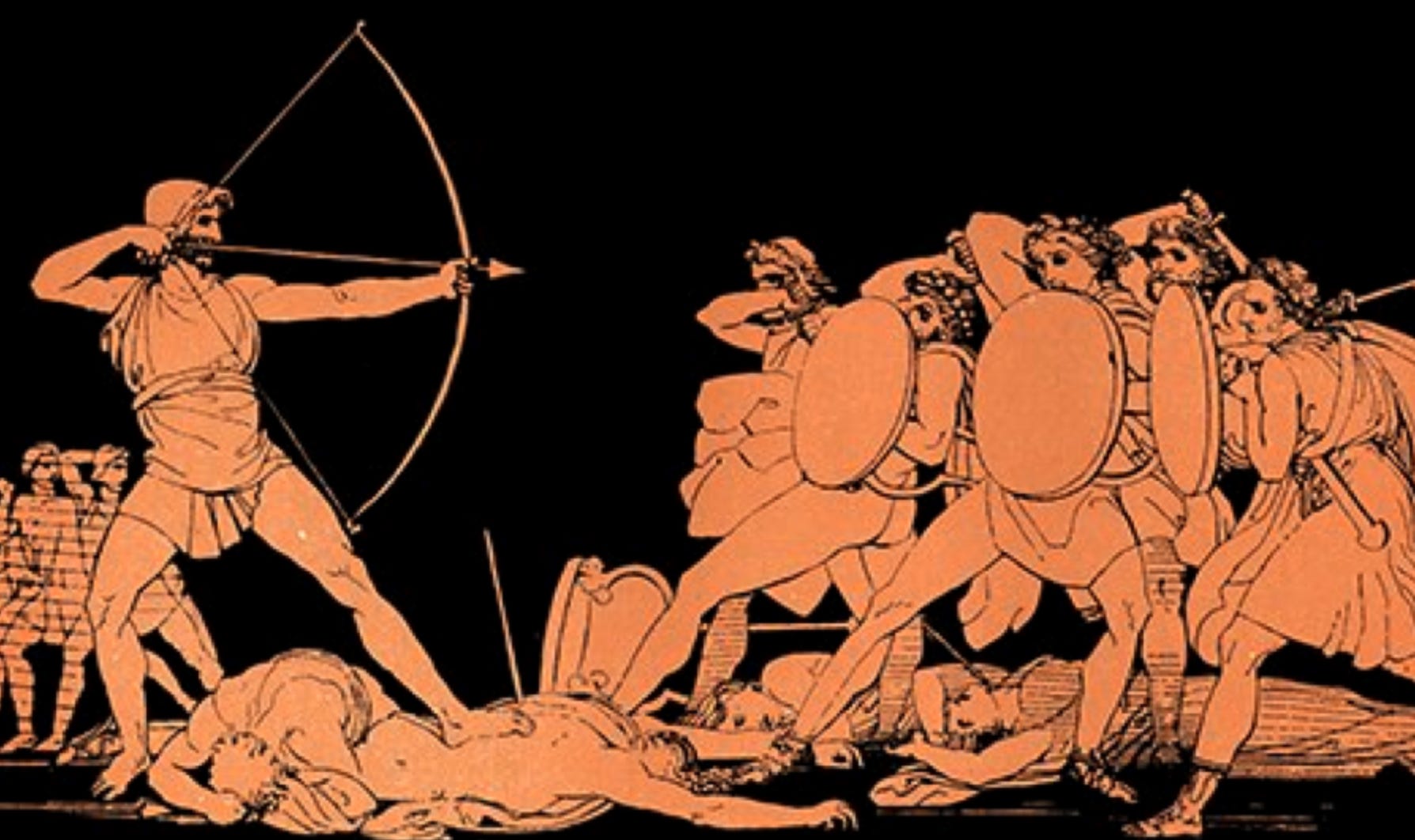
Here’s what I keep coming back to. Odysseus spent his entire arrival home as a nobody. Disguised as a beggar in his own house, absorbing insults from men eating his food and courting his wife, saying nothing. The strength was in him the whole time. He just carried it quietly. And when he finally strings that bow, effortlessly, in front of a room full of men who wrote him off, it isn’t a flex. It was a warning bell, exactly the way he meant it. One last chance for them to see what’s standing in front of them before the slaughter comes. That moment made me breathless in comparison to this moment in history we are living in today.
That’s the take away for me: real strength doesn’t announce itself. It’s earned quietly, carried without the labels, and it doesn’t need the room to know it’s there until the moment it does. I would like to believe Nolan is trying to show us. Have we not in 3000 years learned this lesson? I fear not.
And I’ll tell you why this cuts even deeper. I moved home. I am in the process of stripping off the titles of future and past; agent, supervisor, chef , and becoming, in a lot of eyes, just a middle-aged woman from Tennessee. A nobody in the room. But the strength I built over all those years didn’t leave when the labels did. It’s a complicated ache. This is the difference between the professional kitchen and the home kitchen all over again. The professional kitchen is the flex, the ego, the announcement, the same plate every single time. The home kitchen is the humility.
So why am I even writing about all of this? After all, this is a newsletter about food, and an article like this is truly my own indulgence. But if anyone out there has a young person’s future in their hands and is weighing the value of critical thinking and humanities based education, hopefully this article is your proof. And if anyone out there has been considering taking on the monumental task of reading and understanding the Odyssey, I hope this deepens your curiosity of the classics. It’s so much more than what it is on paper and the asking of these questions are imperative to the human race.
I was a C student all through my time in school. By all metrics, I was not a shining star. I did not attend an elite college. But these concepts, these big questions of life have stayed with me since I was a teenager studying the text. They have made such a deep impact on me no grade could have predicted, and have formed both who I am and how I see the world. My teacher Seamus, no matter how quirky he was, would I think be proud of this article. I would do nearly anything to read my high school paper on the Odyssey today. This education and my learning of the classics is what allows me to hold multiple truths at once, and to give myself over to constant exploration.
As my own daughter is on her path, finding her way into the world as an adult, her critical thinking and humanities education may not fit a standard stand out profile for a job in society today. But after the experience of this last week, and my conversations with her, I have more faith than ever that her education is one of the most powerful societal tools we have. After all, if we are going to survive, we must have humanity.
I wish this for all of us.
Can’t wait to hear what you all think. Todays post is free and if you feel the need to share it please do. Lets talk about it.
Sarah -
No posts
Comments
Nothing yet. Say the first thing.
Sign in to join the conversation.