
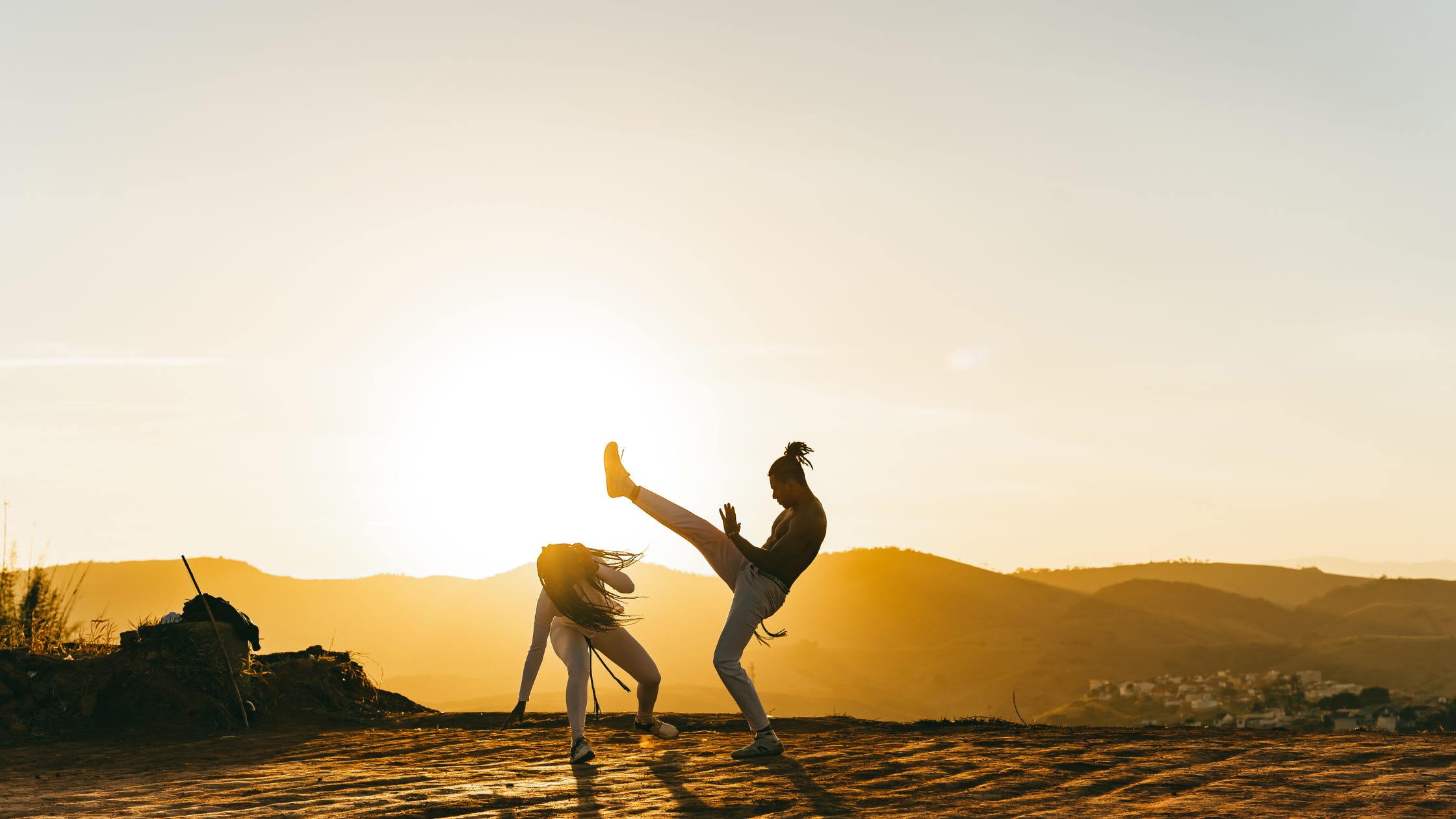
The sound hit me before I even understood what was happening. The berimbau played, people clapped in rhythm, Portuguese echoed around the room, and suddenly, I realized this wasn’t just a class; it felt like stepping into another world.
I am not a tourist in Salvador. I am in the process of slowly, deliberately building a life here part-time, the way you build any real relationship. I have been to forty countries.
I know the difference between visiting a place and entering it. Capoeira was not on a bucket list. It was a door I felt obligated to walk through. If I am going to be a student of Brazilian culture, I decided early that I would have to stop reading about it and start participating in it.
Two things surprised me, Yasmin spoke phenomenal English to the point I thought she was American. The second thing: when I finished, I could not believe how physically demanding Capoeira is for a beginner like myself.
I felt like a child on their first day of school. I had butterflies in my stomach because I was slightly intimidated and a little nervous from not knowing what to expect.
The only place to have an authentic Capoeira experience was in Salvador.
Associação de Capoeira Mestre Bimba has been a huge pillar in the community, which is why I wanted to be part of this experience.
I don’t see myself as just another fly-by-night tourist; I see myself as an outsider who is a student of many sides to Brazilian culture. This is why I wanted to try Capoeira.
I am someone who doesn’t do anything halfway. If I am to be a student of Brazilian culture, I am going to go all in.
Capoeira is taught all over the world and all over Brazil. I could have learned this anywhere, but I wanted to learn from its place of origin to fully understand the history and the roots. This is why I chose to learn it in Salvador, Bahia.
“You can read about culture, but there are some things you only understand when your body, mind, and soul participates.”
Capoeira at Associação de Capoeira Mestre Bimba is far more than learning kicks, escapes, and movement patterns. For many people who walk through its doors, especially in Salvador, it becomes an entry point into culture, history, identity, and human connection. What appears on the surface to be a martial art gradually reveals itself as an immersive experience rooted in something much deeper.
Unlike many combat sports where technique and competition dominate the experience, capoeira carries the weight of Afro-Brazilian history. Every movement, song, instrument, and ritual reflects a tradition shaped through resilience, survival, and cultural expression.
Training is not simply physical practice; it is participation in a living history. Students are not only learning how to move their bodies but also learning stories, traditions, and values passed down through generations.
Capoeira survived the conditions that were designed to destroy it. It was outlawed. It was driven underground. It was practiced in secret, encoded in music and rhythm so that what looked like a celebration was also preparation, resistance, survival. The movements I was struggling to execute in that room were not exercises someone invented for fitness. They were solutions to specific historical problems. The body in capoeira was once a body that had no other weapons.
For someone arriving in Salvador from another country, this can become especially powerful. Capoeira can provide access to a side of the city that tourists rarely experience.
My own experience reflected this. Learning under instructors like Gilmar and Yasmin showed me that capoeira instruction was never just about perfecting movement. There was patience, cultural guidance, and an understanding that what happens inside the roda extends far outside of it.
That is why capoeira at Associação de Capoeira Mestre Bimba is more than martial arts: it is culture in motion, history with rhythm, and community experienced through movement.
“I realized quickly that capoeira isn’t simply about learning kicks or movements. Every movement felt connected to a larger story.”
When I trained at Associação de Capoeira Mestre Bimba, Gilmar and Yasmin were my instructors, although I spent most of my time learning under Gilmar. Before coming to Brazil, I once met an Afro-Brazilian woman in Amsterdam who told me something that stayed with me: African Americans and Afro-Brazilians are not so different. That conversation planted a seed in me and sparked a curiosity I could not ignore. Part of what brought me to Brazil was a desire to understand that connection for myself.
So arriving in Salvador and seeing Brazilians who looked like me was a beautiful experience. It felt familiar and unfamiliar at the same time. There was something powerful about seeing reflections of myself in another part of the world, in a culture with its own deep history and identity.
Gilmar was a very experienced teacher. He carried himself with the quiet confidence of someone who had spent years living and breathing capoeira. He did more than teach movements, he taught with patience, presence, and an understanding that capoeira is not just about technique.
Through his instruction, I began learning that capoeira is culture, history, rhythm, and community all at once.
Yasmin explained the history of Capoeira and Associação de Capoeira Mestre Bimba and the culture behind it.
Gilmar challenged me in a positive way, physically.
I walked into Associação de Capoeira Mestre Bimba looking for an experience. I walked out carrying a question.
The question is this: what does it mean to really enter a culture, as opposed to passing through it? And is there a version of that entry available to someone like me, a Black American man who did not grow up here, who speaks some Portuguese still imperfectly, who comes from a different branch of the same African root, that is genuine rather than performed? I think the answer is yes.
But I think it requires exactly what capoeira required of me in that first session: willingness to be a beginner, tolerance for humility, and the patience to stay long enough that the door you are approaching begins to open from the other side.
Within capoeira spaces in Salvador, the mindset can become:
“How do I contribute to this circle?”
You gradually become part of something larger.
The Capoeira community overlaps with Salvador itself
Capoeira is deeply connected to the city’s social fabric. Through one association, you may gain access to parts of Salvador that many visitors never experience:
One person often leads to ten others.
“I thought I joined a capoeira school in Salvador. What I actually saw was a community. I originally walked into capoeira looking for an activity. I walked out feeling like I had found another doorway into Brazilian culture.”
To find more information on Associação de Capoeira Mestre Bimba in Salvador Bahia, follow them on IG at @acmbmestrebamba
No posts
Comments
Nothing yet. Say the first thing.
Sign in to join the conversation.