
Welcome back to the Bendy Bulletin! This week, I want to focus on one of the most heartbreaking conversations I have with patients:
“I can only eat a handful of foods.”
Sometimes it’s ten foods. Sometimes it’s five. Occasionally it’s only two or three.
If you’re living with mast cell activation syndrome (MCAS), Ehlers-Danlos Syndromes (EDS), POTS, Long COVID, or another complex chronic illness, it’s easy to fall into what I call the elimination spiral. Every time a food seems to trigger symptoms, it comes off the menu. Before long, your world feels smaller and smaller.
If that sounds familiar, I want you to hear something important:
The goal isn’t to create the perfect diet.
The goal is to build the most nourishing and least restrictive diet your body can tolerate.

I’m looking forward to joining the 2026 Global Learning Conference: Connecting the Stripes, hosted by The Ehlers-Danlos Society, July 24-26 in Allen, Texas, and online.
One of my favorite parts of this conference is bringing together patients, caregivers, advocates, researchers, and healthcare professionals from around the world to learn from one another. Whether you’re newly diagnosed or have been navigating EDS or HSD for years, there’s something incredibly valuable about connecting with people who truly understand these conditions.
If traveling isn’t possible, you can still participate virtually and access the educational sessions, workshops, and opportunities to connect with our community from wherever you are.
I hope you’ll join us for a weekend of learning, collaboration, and meaningful conversations. I’d love to see you there, whether in person or online!

Food reactions are real, and many people with MCAS experience symptoms like flushing, itching, hives, abdominal pain, nausea, diarrhea, brain fog, headaches, or lightheadedness after eating.
But here’s what many people don’t realize.
Sometimes the food isn’t the primary problem.
Highly reactive mast cells can make it seem as though almost everything is triggering symptoms. As mast cell activation worsens, more and more foods may appear problematic, even when they weren’t before.
That’s why I often encourage patients to shift the question.
Instead of asking:
“What food should I eliminate next?”
Ask:
“What can I do to help my mast cells become less reactive overall?”
That small shift in perspective can completely change the direction of your care.
One patient came to me eating only three foods.
Years of reactions had left her nutritionally depleted, afraid to eat, and facing increasingly invasive treatment options. Like many patients, she had spent years searching for the next food to eliminate.
Instead, we focused on stabilizing her mast cells and addressing other contributors to her symptoms.
Over time, something remarkable happened.
Her food tolerance expanded.
Then it expanded again.
Today, she eats essentially whatever she wants. Her quality of life has improved dramatically, and she ultimately never needed the neurosurgical intervention that once seemed increasingly likely.
Every patient is different, and I can’t promise every story will end this way.
But it illustrates an important principle: sometimes the path forward isn’t more restriction. Sometimes it’s creating more stability.
There are times when temporary dietary changes are appropriate. But long-term restriction without a clear plan can create new problems.
It may be time to reassess your approach if:
• Your list of “safe foods” keeps getting smaller.
• You’re losing weight unintentionally.
• You’re struggling to meet your protein or calorie needs.
• Meals have become a major source of anxiety.
• You’re avoiding social situations because of food.
• You’re afraid to try anything new.
Food should support your health, not become another source of fear.
Rather than asking what else needs to come off your plate, consider what you can safely add.
Can you improve your hydration?
Can you increase your protein intake?
Can you add one tolerated fruit or vegetable?
Can you gradually expand your food variety over time?
Can you focus on calming the overall mast cell response instead of chasing individual foods?
Small wins matter.
For many people, food tolerance isn’t fixed. A food that triggers symptoms during a significant flare may become much easier to tolerate once mast cells are more stable.
That’s why I encourage patients to think about progress rather than perfection.
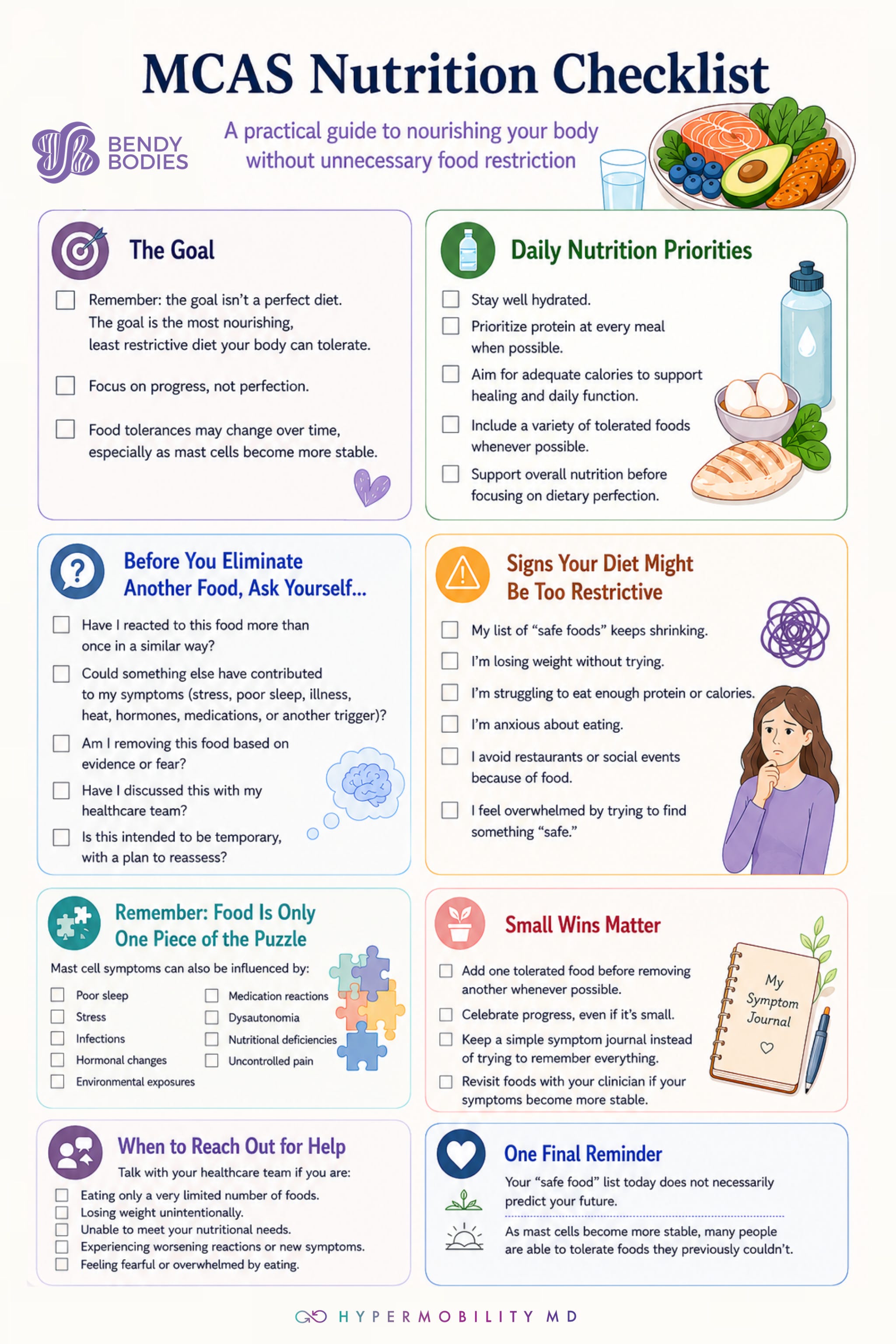
To make these ideas easier to put into practice, I’ve created a free printable MCAS Nutrition Checklist.
Inside you’ll find:
✓ Nutrition priorities to focus on first
✓ Signs your diet may be becoming overly restrictive
✓ Questions to ask before eliminating another food
✓ Protein reminders and practical nutrition tips
✓ Food reintroduction guidance
✓ When it’s time to seek additional support
Whether you’re newly diagnosed or have been living with MCAS for years, my hope is that this checklist helps you step away from the elimination spiral and toward a more sustainable, nourishing approach.
If your safe-food list keeps getting smaller, please don’t assume that’s your permanent future.
I’ve seen many patients regain foods they thought they’d lost forever as their mast cells became more stable and their overall health improved.
The goal isn’t perfection. The goal is stability.
And sometimes, when the mast cells become calmer, the world becomes bigger again.
I’d love to hear from you - has your list of “safe foods” ever gotten smaller over time? What helped you begin expanding your diet again?

A huge shoutout to The Bendy Bodies Boutique for supporting today’s newsletter. It’s the perfect place to find something special for the zebra in your life. Explore our newest designs and remember you can personalize any item with your favorite store artwork. From clothing to home goods, there’s something for everyone.
SALE CONTINUES! $14 Tees, $17 Extra Soft Tees + up to 35% Off Everything
Sale prices as marked. $14 price applies to select styles. Ends 7/7 at 5PM CDT.


We were so fortunate to welcome Dr. Dacre Knight to the podcast for an important conversation about the bigger picture of EDS and HSD. Using a simple house metaphor, Dr. Knight explains why connective tissue is much more than the body's "hinges" and how it influences nearly every system. We also discuss why validation is an essential part of treatment, the risks of polypharmacy, and why adding more medications doesn't always lead to better care. This is an episode full of practical insights for patients, caregivers, and clinicians alike.
This Thursday, join me and my producer, Aron, for another Office Hours episode where we answer your questions about EDS, HSD, and related conditions. From preparing for doctor's appointments and navigating complex symptoms to practical tips for advocating for yourself, we'll tackle some of the topics that matter most to our community. Whether you're newly diagnosed or have been living with these conditions for years, we hope you'll come away with helpful insights and actionable strategies.
SUBSCRIBE TO THE BENDY BODIES PODCAST

The information provided here is for educational purposes only and is not intended as a substitute for professional medical advice, diagnosis, or treatment. No physician-patient relationship is established by reviewing this material. Always consult your own healthcare provider or medical team before making any decisions about medications, supplements, or treatments. Dr. Bluestein is a licensed medical professional, but she is not your personal physician in this context and cannot provide individualized medical care, prescribe medications, order tests, or make referrals outside of a formal clinical relationship.
Some of the links shared are affiliate links. If you choose to purchase after clicking a link, I may receive a commission at no extra cost to you that helps support the mission of Bendy Bodies.
Well that’s all for this week; thank you so much for reading and supporting this newsletter. Talk to you soon, Bendy Buddies!
Yours in Health,
Dr. Bluestein
Comments
Nothing yet. Say the first thing.
Sign in to join the conversation.