
Welcome back to The Bendy Bulletin! A patient recently asked me: Can something as ordinary as a bad sunburn trigger an immune response?
The short answer is yes.
That does not mean every sunburn causes autoimmune disease, or that one day at the beach is the reason someone develops lupus, MCAS, dysautonomia, or chronic pain. But it does mean that the immune system pays attention to tissue damage, and a bad sunburn is not simply skin getting red. It is a tissue injury.
That distinction can help us understand not only what happens after a sunburn, but why some people notice significant flares after infections, surgery, medications, hormonal shifts, and other stressors.
At the end of today’s newsletter, I’m sharing a downloadable list of questions to ask yourself or your clinician if you notice your symptoms flaring after sun exposure, infections, procedures, medications, or other triggers.

We often think of the immune system as something that fights infections. Of course, that is an important part of its job. But the immune system is also constantly responding to signals from our own tissues.
When cells are injured, stressed, inflamed, or dying, they release signals that tell the immune system there is damage that needs attention. A severe infection can create those signals, but so can surgery, trauma, burns, and other forms of tissue injury.
A significant sunburn is one example. Ultraviolet radiation damages skin cells and can lead to DNA injury, oxidative stress, inflammation, and cell death. For most people, the resulting inflammatory response is temporary. The skin becomes red and painful, perhaps blisters, and then gradually heals.
For someone already predisposed to immune dysregulation, however, the response may be more complicated. UV exposure is a well-recognized trigger in certain autoimmune conditions, particularly lupus and dermatomyositis, and can contribute to both skin and systemic symptoms.
This does not mean sunlight is inherently bad. There is an important difference between ordinary light exposure and a significant UV injury. The point is simply that a bad sunburn is an inflammatory event, and the immune system responds accordingly.
This is where I think we need to be especially careful with language.
Patients often tell me, “My symptoms started after an infection,” “Everything changed after surgery,” or “I had a terrible flare after a sunburn.” Those timelines matter, and I think clinicians should listen carefully when patients notice them. But an event happening before the onset of symptoms does not necessarily mean that event caused the entire illness.
Most immune-mediated illnesses do not come from one thing. Genetics, prior infections, hormones, medications, the microbiome, environmental exposures, sleep, stress physiology, tissue injury, and other factors may all influence how the immune system behaves.
I often think of this using a threshold model. Someone may be functioning reasonably well while already carrying several physiologic stressors. Then an infection, surgery, medication reaction, significant hormonal shift, severe stress, trauma, or inflammatory injury adds another demand.
That event may be enough to push the body over a threshold.
It may not have created the underlying vulnerability,
but it may have helped reveal or amplify it.
This is an important distinction because it allows us to take a patient’s experience seriously without assuming that every association proves causation.
Two people can have the same infection, undergo a similar procedure, or experience a comparable sunburn and have completely different outcomes. One may recover within days, while another experiences symptoms for weeks or months.
Part of the reason is that the trigger itself is only one piece of the story. We also have to consider what was happening in the body when that trigger occurred.
Was the person already recovering from an illness? Were they sleeping poorly? Were POTS or mast cell symptoms already increasing? Had there been a recent medication change, injury, procedure, or hormonal shift? Were several stressors occurring at the same time?
This is why I think focusing exclusively on identifying the one thing that caused a flare can sometimes lead us in the wrong direction. Another useful question is: What affected my body’s ability to recover from this particular stressor?
That shift can give us much more useful information.
The same general framework can apply to many of the triggers patients tell me about. Infections can create substantial immune activation and tissue inflammation. Surgery, dental procedures, and injuries require an inflammatory response for healing. Medications can sometimes produce hypersensitivity or immune-mediated reactions. Hormonal changes can alter symptoms in certain inflammatory, autonomic, and mast cell conditions.
Sleep and stress physiology also interact with immune regulation. When I talk about stress, I do not mean that symptoms are imaginary or that a patient is causing their illness. The nervous, endocrine, and immune systems are constantly communicating with one another, and prolonged physiologic stress or inadequate sleep can influence that communication.
Mast cells add another layer. Mast cell activation is not the same as autoimmunity, but mast cells participate in inflammation and can contribute to symptoms including flushing, swelling, GI symptoms, headaches, pain, and dysautonomia. This may be one reason some people with complex multisystem illness describe such a broad range of apparent triggers.
None of this means that every exposure is dangerous or that we should spend our lives trying to eliminate potential triggers. It means that patterns can provide useful clinical information.
We cannot avoid every infection, stressful week, hormonal change, procedure, or sunny day, nor should that be the goal.
Instead, I encourage patients to pay attention to patterns
without becoming afraid of them.
If you consistently become systemically ill after significant sun exposure, tell your clinician. If procedures repeatedly lead to prolonged flares, that may be useful information when planning for the next one. If your symptoms changed dramatically after an infection or medication change, include that on your medical timeline.
You may also notice that your response is different depending on what else is happening. Perhaps you tolerate travel well most of the time but struggle when it follows an illness. Maybe a procedure that was manageable in the past becomes much harder when your POTS or mast cell symptoms are already poorly controlled.
The goal is not to prove that one event caused everything.
It is to better understand how your body responds to stressors and what seems to help it return to baseline.
If you notice that your symptoms seem to flare after particular events, these are some of the questions I think are worth asking:
Do I have a consistent pattern of flaring after specific triggers?
Are my symptoms local, systemic, or both?
Do I have features that could suggest photosensitivity, autoimmunity, mast cell activation, dysautonomia, or another inflammatory condition?
Would any labs, imaging studies, or specialist evaluations help clarify what is happening?
Are there modifiable triggers I can reduce without becoming unnecessarily restrictive?
What can I do before and after predictable stressors, such as travel, surgery, dental work, or vaccination, to support recovery?
Which symptoms should prompt urgent medical attention?
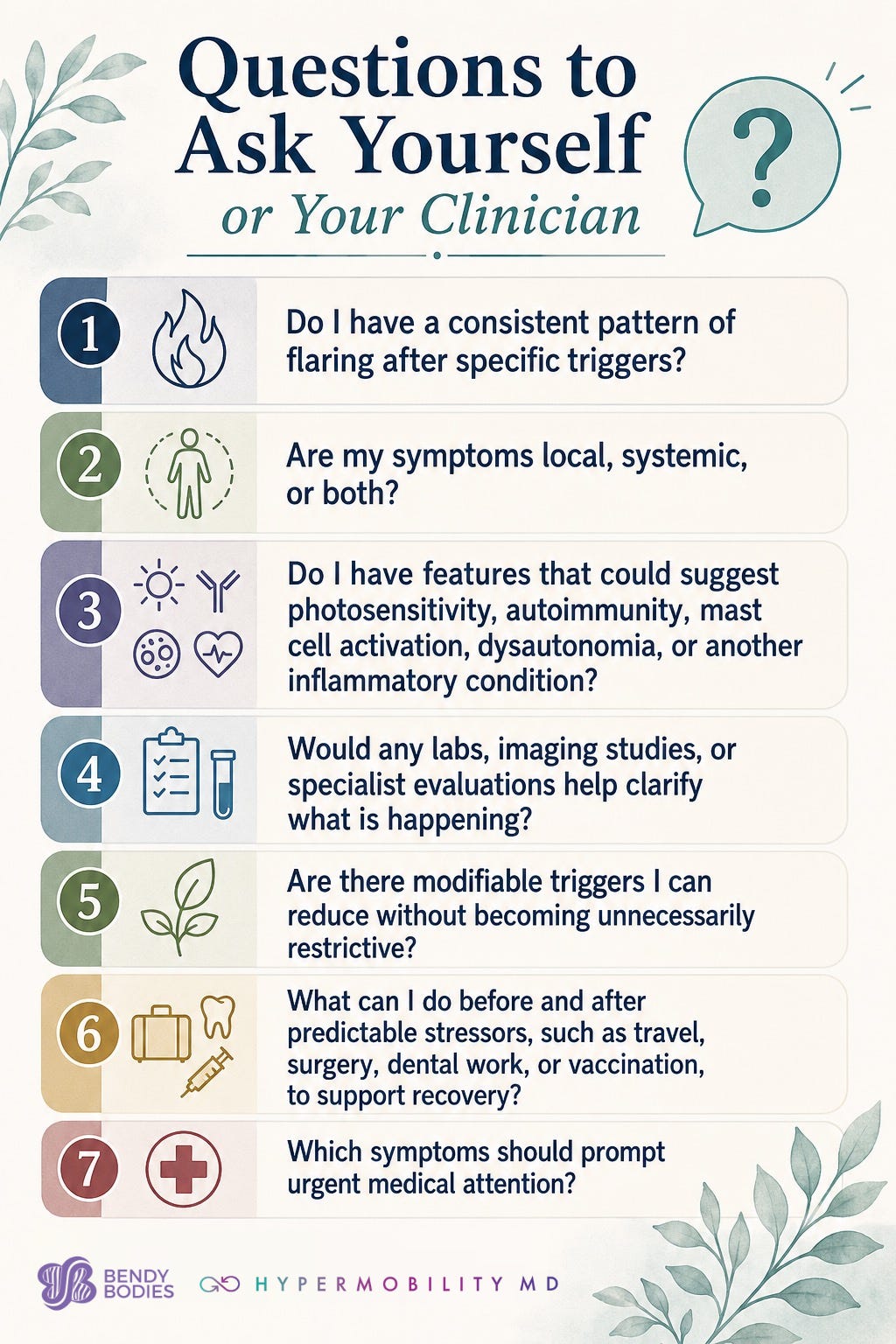
I’ve put these questions into a simple resource you can save to your phone, print before an appointment, or use when you’re trying to make sense of a pattern over time.
When patients tell me, “Something changed after that infection,” “I was never the same after surgery,” or “I had a terrible flare after a sunburn,” I think we should listen. That does not mean every association proves causation, but it also does not mean the timing is irrelevant.
The immune system is responsive to context. Tissue injury, infections, medications, hormonal changes, sleep, stress physiology, and other factors can all influence how the body responds and recovers.
So if you’re trying to understand a flare, instead of asking only “What triggered this?” it may be helpful to ask a second question:
“What does this pattern tell us about what my body needs to recover?”
That may be the more useful question to bring into your next appointment.
I’d love to hear from you… What is one pattern you’ve noticed about your flares that you wish your clinicians understood better?

A huge shoutout to The Bendy Bodies Boutique for supporting today’s newsletter. It’s the perfect place to find something special for the zebra in your life. Explore our newest designs and remember you can personalize any item with your favorite store artwork. From clothing to home goods, there’s something for everyone.


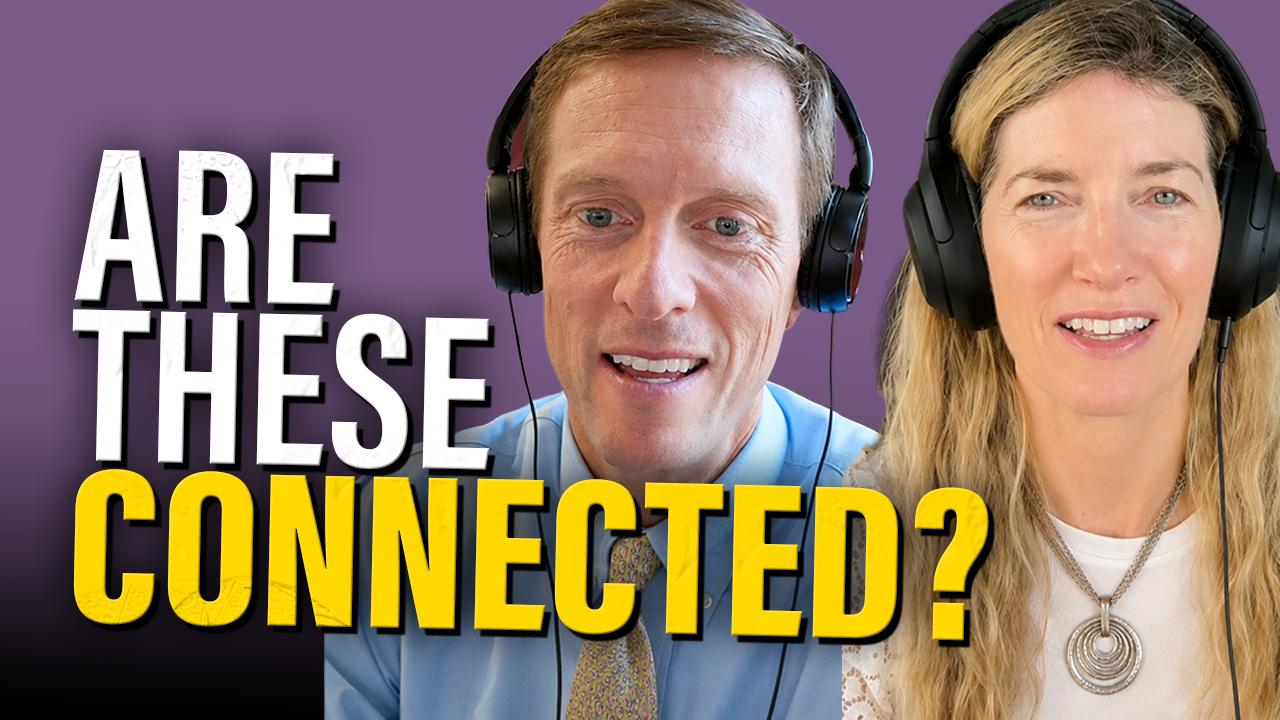
We were so lucky to have Dr. Dacre Knight of UVA Health back on the Bendy Bodies podcast. Dr. Knight shares practical guidance for people with hypermobility disorders who are planning a pregnancy or already expecting, why early recognition of Ehlers-Danlos Syndromes (EDS), Hypermobility Spectrum Disorders (HSD), and related conditions matters, and what people with EDS and joint hypermobility should know as they navigate menopause. You’ll hear practical insights for understanding and managing hypermobility through several important stages of life.
In just a few days, we have physical therapist Dr. Emily Scherb, PT, DPT (The Circus Doc), joining us to talk about strength training with a larger-than-average range of motion, common misconceptions about circus training, and practical advice for hypermobile people and circus performers alike.
SUBSCRIBE TO THE BENDY BODIES PODCAST

The information provided here is for educational purposes only and is not intended as a substitute for professional medical advice, diagnosis, or treatment. No physician-patient relationship is established by reviewing this material. Always consult your own healthcare provider or medical team before making any decisions about medications, supplements, or treatments. Dr. Bluestein is a licensed medical professional, but she is not your personal physician in this context and cannot provide individualized medical care, prescribe medications, order tests, or make referrals outside of a formal clinical relationship.
Some of the links shared are affiliate links. If you choose to purchase after clicking a link, I may receive a commission at no extra cost to you that helps support the mission of Bendy Bodies.
Well that’s all for this week; thank you so much for reading and supporting this newsletter. Talk to you soon, Bendy Buddies!
Yours in Health,
Dr. Bluestein
Comments
Nothing yet. Say the first thing.
Sign in to join the conversation.