
Not sure if this is the best example ever, but think of it in these terms: reforming a house theoretically seems faster than building a new one, but let’s imagine your house has mould or some kind of humidity problems. Doing a quick reform will probably be faster and more cost effective, but it might not solve the problem in the long run. And if you keep doing it multiple times, than it stops being cost effective and most likely affects your personal health as well as your family’s after a while.
My point is: if your house is rotten on the inside, isn’t it better to tear it down and start a new one?
Although reality is not the same for each individual, as a society I believe we truly want a better future for us and the following generations. But, we all have different expectations on how that can become.
If you’re part of the older generation (+60), statistically you’ll most likely have this view: “I’ve done my share and I don’t have enough time to change the world, so I’ll just enjoy it as it is and hope the next generation is able to do better.”
In case you’re part of the working class, with a family to maintain and support (30-60), this is most likely your view of the world: “I have bills to pay and I want to provide the best possible life for my kids, so I don’t have time to change the world. I just want to get my pay-check, some time to play with the kids, educate them and survive macro economic bumps.”
Unfortunately, I don’t have enough empirical data to know what the younger generation thinks, especially if they’re in their 20s, although I already met some incredible smart kids that at least haven’t lost the “I want to change the world” mentality. And they’re equipped with a key factor: infinite tech at their disposal.
Having this said, then this means that:
There are some 20-year-old kids brave enough to try it.
There are some 30-60 people that deviate from the standard line of thought (typically tech founders or enthusiasts, business owners, people that climbed the corporate ladder way to fast and that want more than just a salary, creative people in general that weren’t trapped by wokism, bright minds that have immigrated and got rich but are now returning to their home country).
Very few 60+ people still have that spark in them that might actively want to make a difference, but they still have valuable knowledge they’re willing to share.
In essence, there still a significant number of people that might want to be a part of change.
Tearing down a house might be harder than finding a new place to build home. Your house might be an apartment that is part of a larger building or you might have surrounding neighbours or buildings that make it harder to tear it down.
You get the point: changing the system by tearing it down is most likely impossible as it would mean to have everyone accepting your ideas and proposed change.
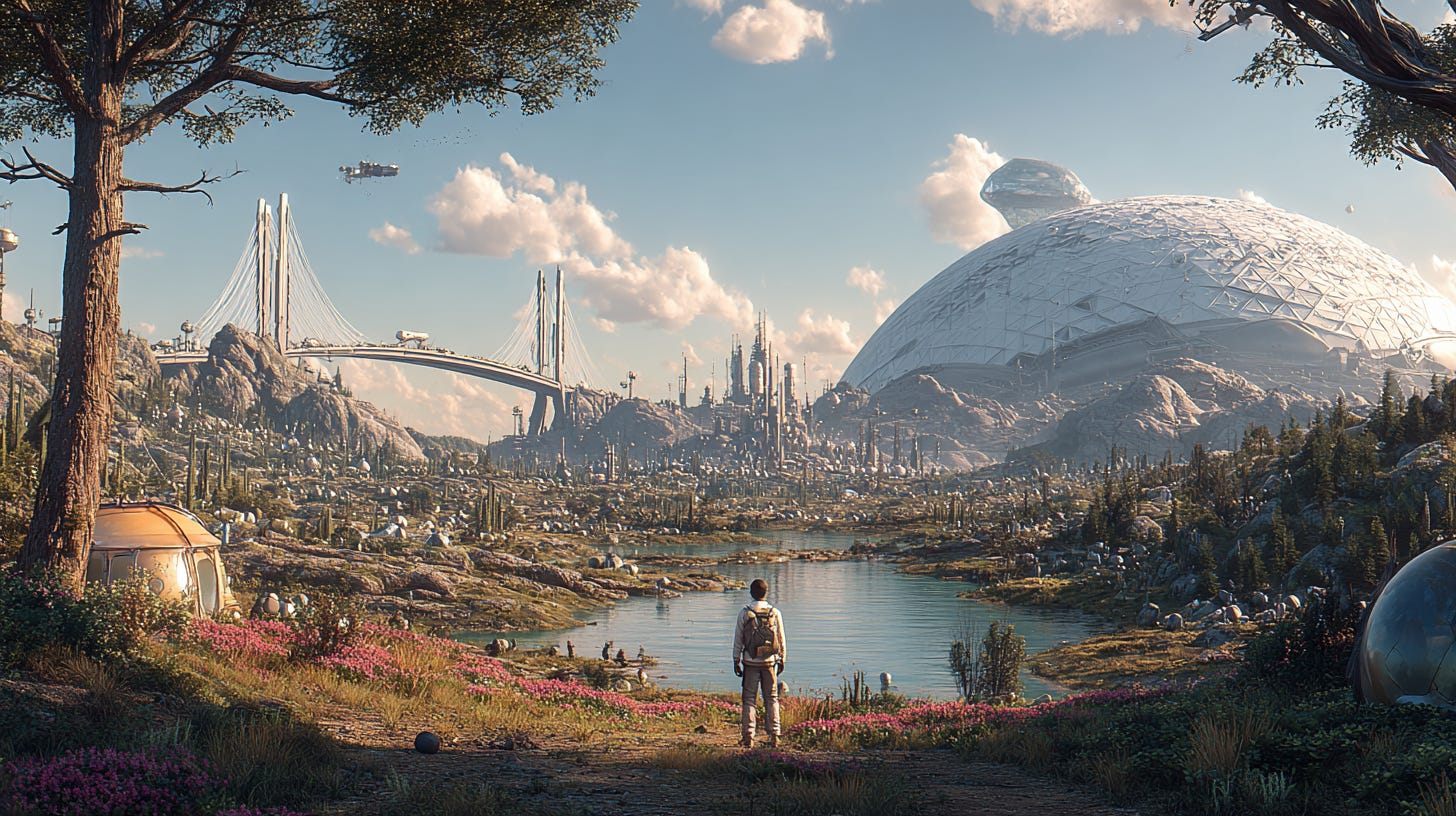
Instead, it might be easier to creating it from scratch without creating friction with the current system, i.e. building in parallel, in a complete new land.
Finding new land is actually easier than what one thinks. In all previous revolutions people needed a place to discuss and plan the revolution itself (meeting halls, clubs and public spaces in the case of the French Revolution, military meeting in secret using radio as signal in the case of the Portuguese Revolution of 1974).
We don’t need a place anymore, as that place is now digital!
Most of discussions now happen online, social and work related, so planning a new sort of society won’t be any different.
However, as discussions scale and community starts to gather, a physical place might not just be useful, but necessary to test different social experiments, types of governance, among many different things.
We’re humans after all… Being physically connected is in our nature.
Personally, I’d love to see this happen in Portugal. By having experience in building communities from scratch and being part of the creation of a crypto physical hub and coworking space in Porto (DeHouse), I know it is possible to make.
By going through it, I’ve also realized that community building and physical spaces have to go hand by hand and creating a binding manifesto and shared values is crucial to make this work properly.
Creating a coworking space might help, but is simply not enough to create a new type of society like a network society or network state.
Quoting Balaji on this:
WeWork, the coworking space. WeWork’s woes notwithstanding, they built a useful product. But it was more like a utility than a true community, more like a Starbucks than a small town. Think about it: in a coworking space, the couch might be leather and the coffee might be decent, but you don’t leave your laptop out of sight because you don’t know anyone there. You need to get a conference room to speak freely, you need to use a privacy screen; in general, it’s not a high-trust zone. That’s not a true community.
To summarize:
Building a strong community around shared values is critical to make this mission happen.
Starting online and moving into specific locations where the community is or wants to move.
Creating this in Portugal sounds hard, but doable, especially if someone is dedicated into make it his/her life mission.
The primary reason to move abroad and change country is to find better opportunities and living conditions. When you do it, you typically seek people with the same interests, living conditions, goals, etc. Which means, you seek other expats or expat communities. When those expat communities grow up to a point where they only interact with one another, you’ve created a “golden cage” effect. This means that you probably live better than the overall population of that country, you have zero connection with its culture or language and you might even be hated by the locals.
This happened in many countries I’ve known and visited. The first one I experienced this was Angola in 2013, where I went as a young business/tech consultant to work with Finance and Insurance companies that were booming there at the time. I felt there were tons of opportunities there, but Portuguese people and other foreigners were living in “golden cages”. In the case of Luanda, Angola, you just had to leave your luxury condominium or hotel to see the huge difference between your lifestyle and the locals.
In 2025, the same is happening in Portugal, especially in Lisbon, where expats are now “conquering” the city. I love having my country full of smart people that chose Portugal as their home due to all the awesome conditions we have (ranging from food to sun and our beautiful coast). Despite getting high-value people and external investment in the city and country, the problem remains: aren’t we building 2 societies in parallel? And what’s the nefarious effects of their co-existence?
I have no clear solution for this potential problem, but I have some ideas on how it can be fixed: diversity of people, backgrounds, industry, etc.
Instead of focusing just on digital nomads and tech/crypto people, the idea is to bring an eclectic group that can be the representation of its tribe. The idea would be to mimic Noah’s Ark selection criteria: a tech founder, a designer, a corporate person, an artist, etc. The only caveat is that each one of them has to share the community values and purpose. The goal here is not to build this for an elite or creating a new type of elite, but instead having a significant sample that allows this concept to scale if it works, as it is not just addressing one small segment of the population.
I don’t just hope for it to become the later. I will work for it to be the new motto.
I definitely feel Portugal and Europe as a whole is very undervalued and underestimated which makes this challenge even more interesting. Movements like eu/acc or Project Europe, as well as powerful European startups on the rise (not just in AI, but across sectors) might be the catalyst to accelerate this new type of society.
What do you feel about this? Do you believe we’re ready to make it become a reality?
Because I am.
No posts
Comments
Nothing yet. Say the first thing.
Sign in to join the conversation.