
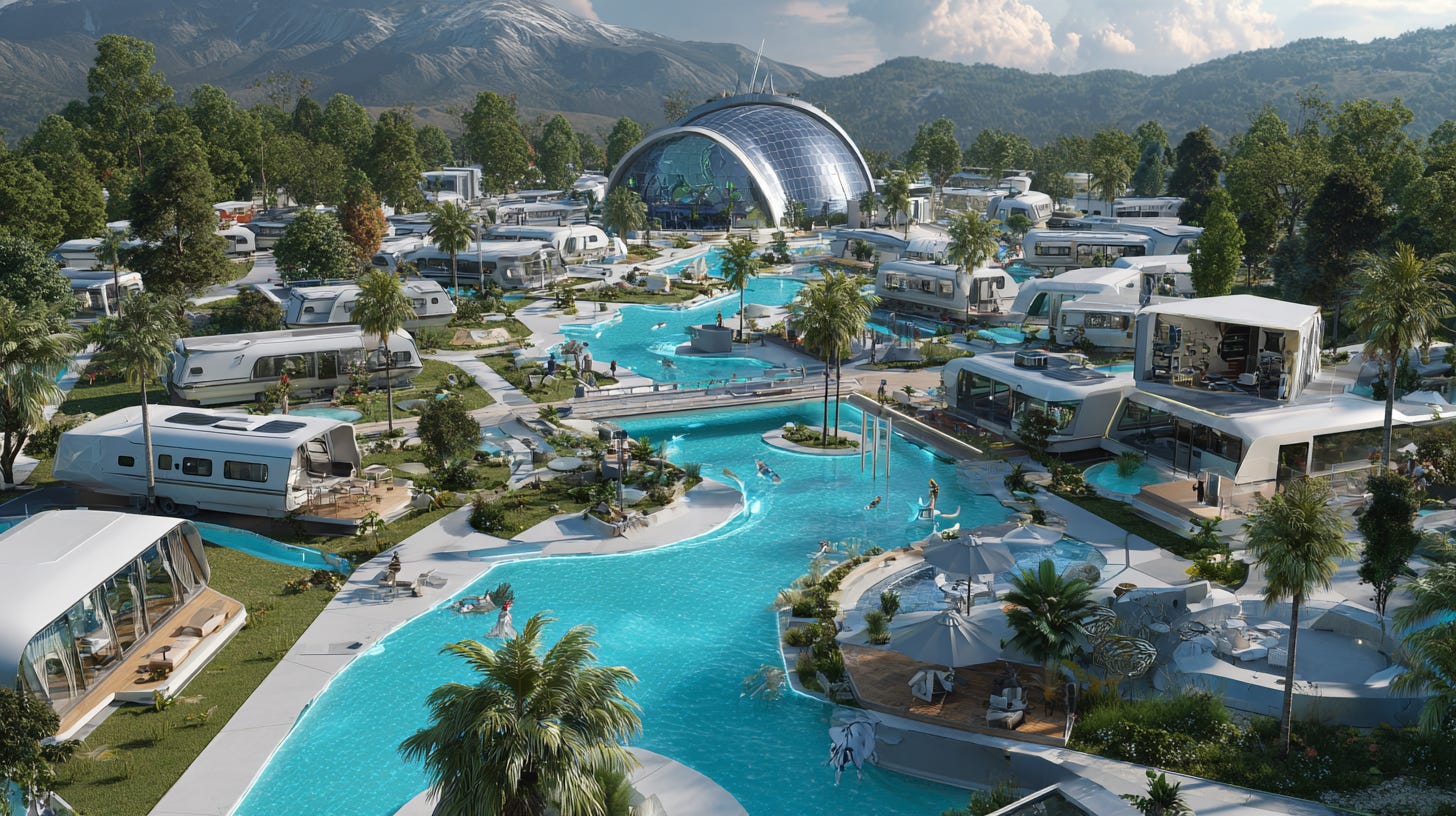
For almost ten years I’ve been traveling across Europe in a motorhome, spending time in campsites and camping resorts. On a recent trip through Spain, I started noticing something unusual: these places look a lot like small-scale experiments in how future societies could work.
In campsites, people naturally form communities—helping each other out with tools, sharing advice, or stepping in when something breaks down. Everyone lives under similar conditions, regardless of whether their motorhome is modest or luxurious. And the real magic happens in the communal spaces: the pool, the amphitheater, the restaurant—where people connect, share experiences, and create culture together.
My journey into camping life didn’t begin with a big motorhome. It started in a tiny van that once belonged to my mom. It barely fit a small mattress, a surfboard, and a couple of bags of clothes. With that little van, my wife and I decided to explore the Vicentina Coast in southwest Portugal, winding through Alentejo and Algarve.
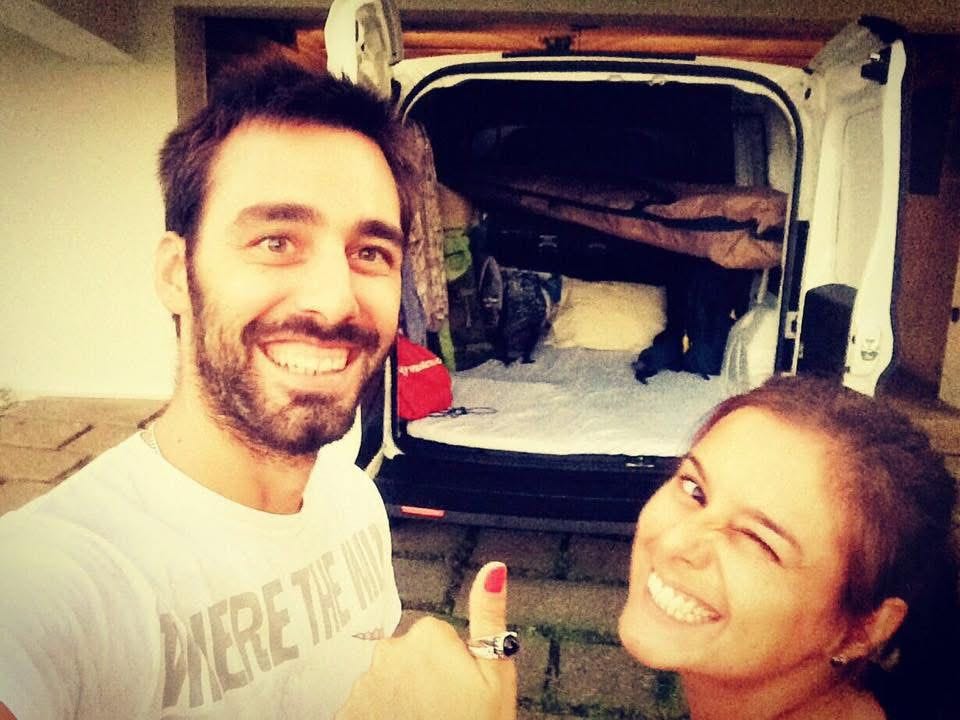
Halfway through the trip, in Vila Nova de Milfontes, the van blew a tire. To make things worse, the spare tire was stuck. Stranded on the side of the road, during a long weekend, we had no idea how we’d get back on track. That’s when two families from nearby motorhomes came over to help. They couldn’t get the spare tire themselves, but they tried everything they could for hours, helped us set camp and eventually gave us a ride to a tire shop on Monday. Thanks to them, what could have been a trip-ending disaster turned into a lesson about generosity and community. It was in that moment my wife and I knew we’d be doing these kinds of trips for a long time and that one day, we’d have a motorhome of our own.
Fast forward to today, and that same spirit still defines every campsite I stay in. Why do you think motorhomes and camper vans park next to each other? To protect one another. Whether it’s lending a tool, sharing local tips, or helping out a stranger in need, motorhome users live by an unspoken code: we look after each other. It’s this spontaneous, voluntary sense of community that makes camping so unique and it’s also what makes it feel like a living example of how network states could work.
When I finally bought my first motorhome, one of the things that struck me right away was how equalizing campsites feel. No matter how big or small your vehicle is, everyone parks in a similar spot, with the same access to water, electricity, and the shared facilities. You might pull in with a modest camper, while the neighbor next door has a shiny, brand-new motorhome worth ten times as much. But once you’re set up, those differences quickly fade into the background.
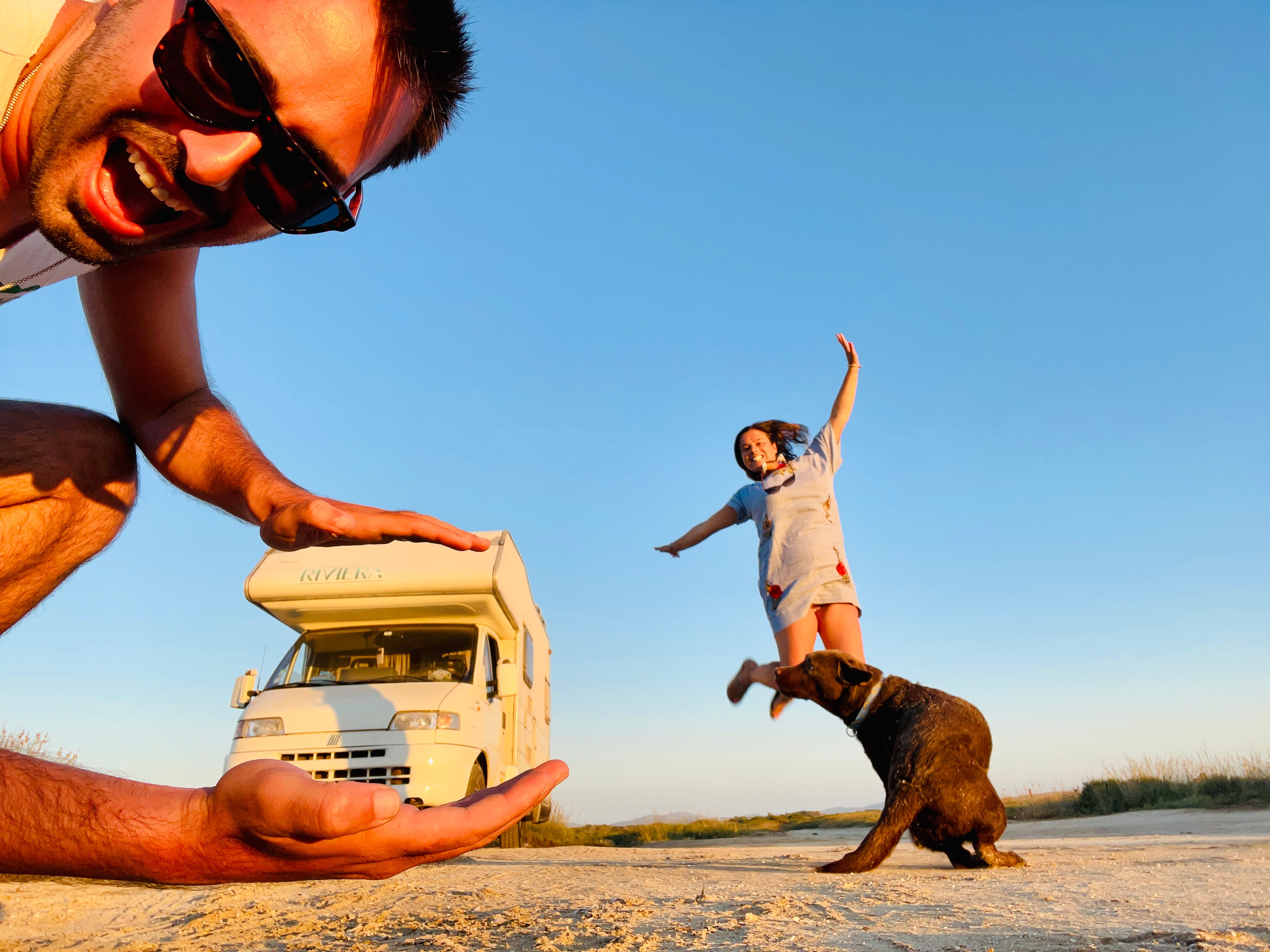
I remember arriving at a campsite in southern France after a long drive, tired and just looking forward to some rest. On my left was a retired German couple in a high-end motorhome, with all the latest gadgets. On my right was a young French family traveling in a van not much bigger than the one I had started with years ago. Nobody cared about the price tag of the vehicles. What mattered was that we were all living under the same conditions, following the same rules, and sharing the same space.
That sense of equality is what makes campsites so special. They strip away much of the status signaling that dominates daily life and create a baseline where people interact as neighbors, not as classes. It reminds me of how network states are imagined: not as places where wealth disappears, but where the structure of living creates a shared foundation that allows culture and community to thrive.
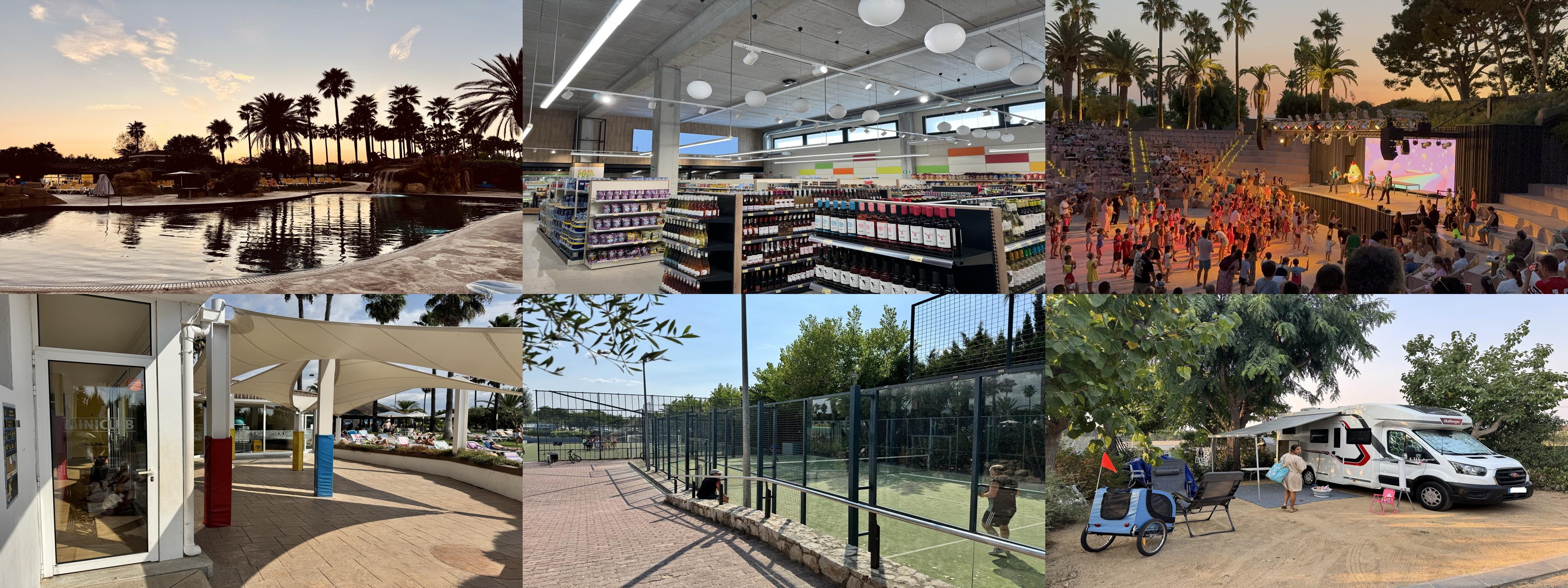
Last week I stayed at Sangulí Salou, one of the most complete campsites I have ever visited. The place had six pools (one just for dogs), daily shows for both kids and adults, several restaurants, direct beach access, playgrounds, supermarkets, shops, and countless restrooms spread across the park. During my stay, I realized I did not need to leave the campsite at all. Everything I could possibly need was inside its walls.
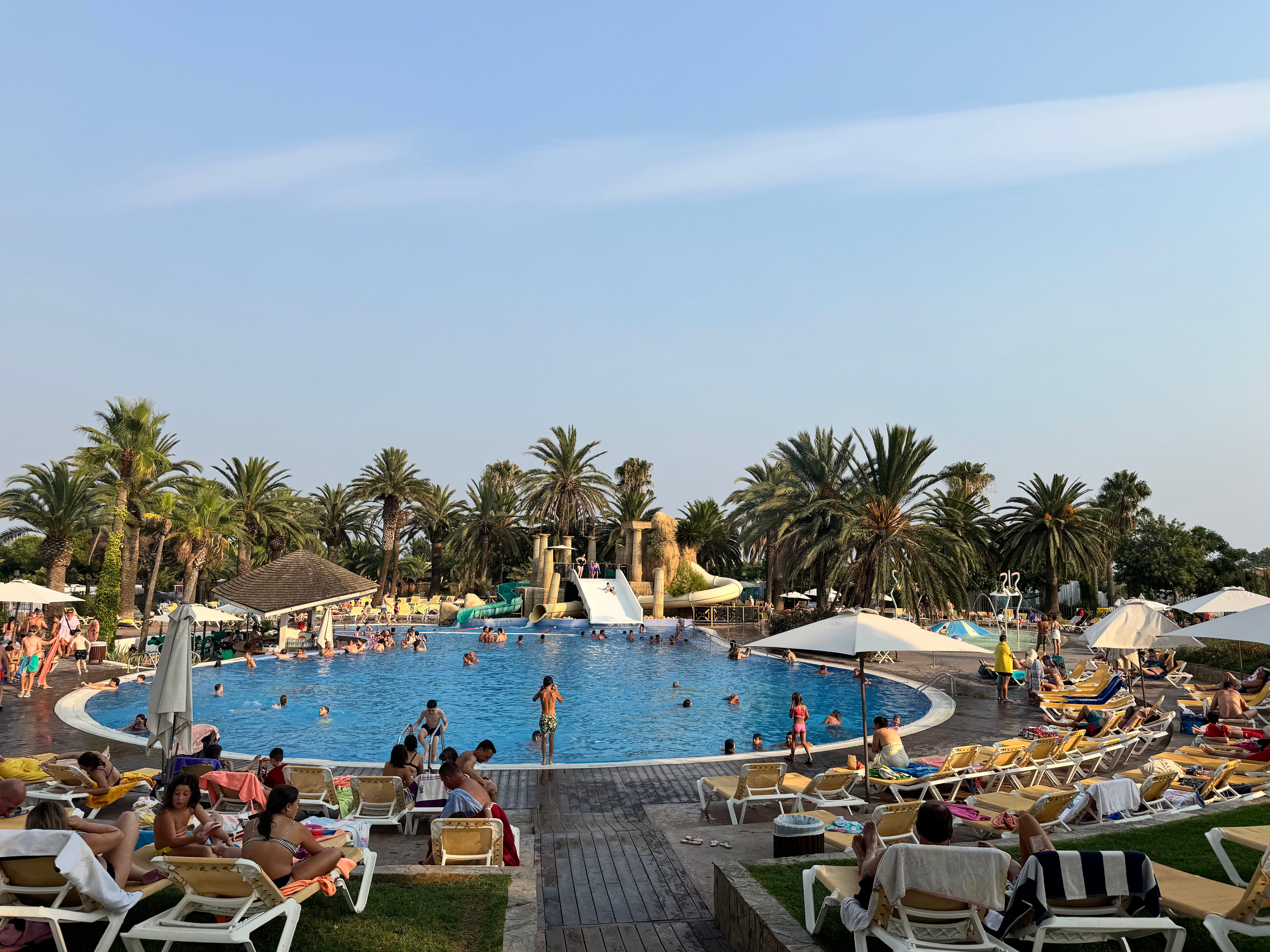
Walking around (or biking), it felt less like a simple camping resort and more like a small city. Families strolled to dinner in the restaurants, children ran from the pool to the playground, neighbors gathered for evening shows, and every corner seemed alive with activity. It struck me how naturally a sense of culture emerges in these spaces. People arrive as strangers, but the shared infrastructure brings them together, creating routines, traditions, and memories that feel bigger than just a vacation.
This is the magic of communal spaces: they transform a collection of individuals into a community. And isn’t that what cities and eventually network states are all about? When I looked around Sangulí Salou, with its self-contained ecosystem of entertainment, services, and culture, it felt like a prototype of a mini-society. A reminder that when the right spaces exist, people do not just live side by side, they build something larger together.
The more time I spend in campsites, the more I feel they are unintentional experiments in how societies can work. Nobody designed them to be political or cultural laboratories, yet when you look closely, they have all the ingredients of what some thinkers now call a network state.
Rules exist and they are respected: quiet hours, waste separation, pool schedules, security at the entrance. Everyone agrees to them because without these shared norms the whole experience would collapse. Services are provided fairly across the community, from electricity hookups to shared bathrooms, in a way that levels the playing field. Culture emerges naturally, shaped by the shows, the poolside gatherings, the kids making friends, and the shared rituals of setting up camp.
If you zoom out, a campsite looks like a small city. Sangulí Salou, for example, spans more than 70 acres (29 hectares) and hosts thousands of people at peak season. It has its own internal economy, with supermarkets, shops, and restaurants. It has governance through its management and rules. And it has culture, created by the animation team that creates shows and activities and the people who return year after year, often to the same spot, forming traditions and a sense of belonging.
Network states are described by Balaji as communities that start online, build shared values, and eventually manifest physically. Campsites are the reverse: they start physical, but through shared rules and culture, they create a living network of people that extends far beyond the gates. For me, after ten years of traveling in a motorhome, this is what makes campsites so fascinating. They are accidental prototypes of what the future of human organization might look like.
When I think back to that first trip along the Vicentina Coast in my mom’s tiny van, it feels worlds apart from staying at Sangulí Salou with its six pools, restaurants, and nightly shows. Yet both experiences taught me the same lesson: the real value of camping is not in the vehicle you drive or the amenities you enjoy, but in the way people come together to create a shared life, even if only for a few days or weeks.
Over the past ten years on the road, I have seen countless moments of generosity, equality, and cultural creation inside campsites. These are not accidents. They are the result of a system that provides a common baseline for everyone and builds opportunities for people to connect. It is the same recipe that thinkers imagine when they talk about network states: shared values, fair rules, and the spaces where culture can emerge.
Fun fact: did you know that when 2 motorhome drivers cross each other on the road, they salute one another? This is similar to leaving your house and saying hi to your neighbour.
Campsites remind me that societies do not need to be reinvented from scratch in Silicon Valley boardrooms or on Twitter threads. They are already being tested in places where families cook together under the stars, neighbors lend a hand when something breaks, and thousands of strangers turn into a temporary but real community.
Perhaps the future of how we live together is not some abstract theory. Perhaps it is already parked in the campsite next to us.
No posts
Comments
Nothing yet. Say the first thing.
Sign in to join the conversation.