
The best thing about having deleted your twitter account years ago is that people just send you the bad tweets anyway. The ones you quit social media to avoid, like this tweet by manospheric titan and alleged people-trafficker and sex offender Andrew Tate, which has been bombarding my inboxes ever since.
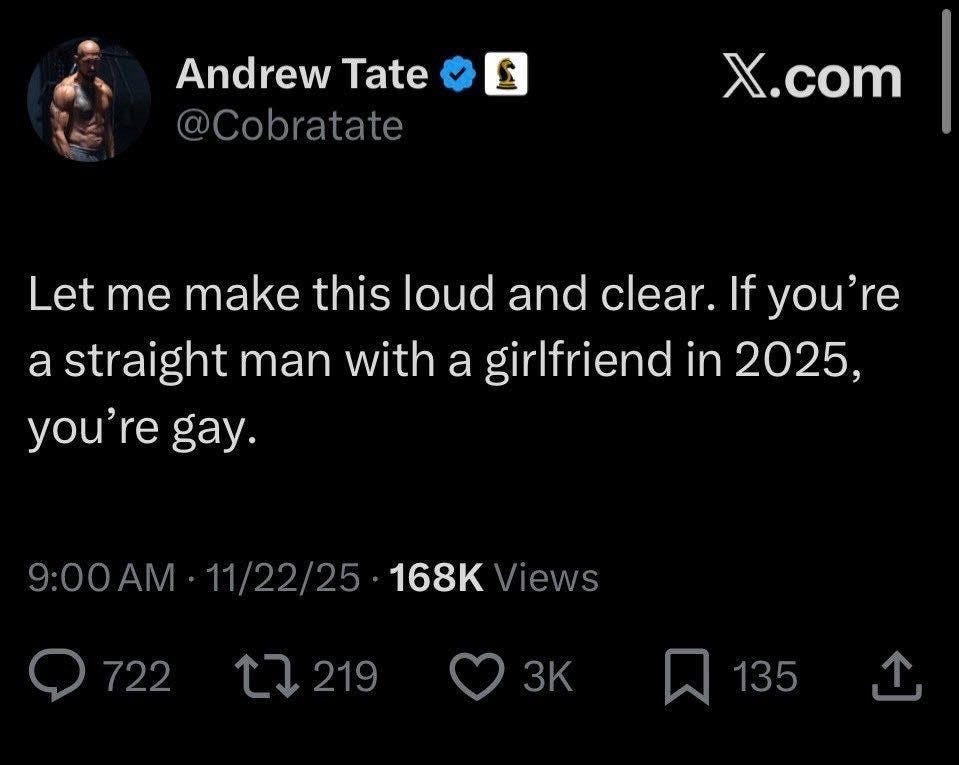
“Let me make this loud and clear,” Tate states, “If you’re a straight man with a girlfriend in 2025, you’re gay.” On its face, it is, of course, an absurd articulation: a man having a girlfriend is probably one of the most reliable indicators of heterosexuality we have, although by no means foolproof. But to people who aren’t poisoned by the manosphere, or who aren’t also terminally online, its absurdity is almost funny, and absolutely tragic. Having a girlfriend makes you gay? Ok bro. I sleep in a big bed with my wife.
Yet this absurd formulation of what makes a man gay or not is pretty instructive of Tate’s ideology, and the poisonous appeal it has upon a small but significant number of mostly young men. It also says a lot about how society often uses homosexuality as a shorthand for talking about gender, and perhaps to avoid asking the more difficult questions.
A common response to Tate’s twin obsessions of cartoonish masculinity and violent misogyny is to claim he’s a closet-case. In fact, that’s a common response to a lot of men when they express homophobic opinions, or a disgust with femininity or womanhood: they’re overcompensating, because they secretly nurture their own homosexual desires that they can’t handle. I just don’t think that’s true, however. To homosexuals and to women, the idea that hating gays and women is somehow mutually exclusive with male heterosexuality is almost as absurd as Tate’s tweet. I sometimes think it’s passing the buck, as though homophobia wasn’t in the realm of straight society at all, but rather a gay-on-gay crime.
But it’s not. It’s very much a product of straight fears and preoccupations, one of which is a fear of the transgression of norms of gender expression. That’s a destabilising thing if you live in a culture where those norms seem to be working pretty much ok for you, and where you can see there’s still a long way to fall. Likewise, I think it would be absurd to suggest that the primary driver of transphobia is closeted trans people. These are heterosexual and cis gender anxieties, and nothing new: straight anxiety around shifting sex-gender norms is very much the history of homosexuality. In her book ‘A Short History of Trans Misogyny’, the historian Jules Gill-Peterson writes how, at the turn of the 20th century “in burgeoning cities of Western Europe and the United States, sexuality and gender had no major distinction from each other.” She quotes the contemporary trans writer Jennie June, who wrote that “Androgynes are murdered every few months in New York merely because of intense hatred of effeminacy instilled by education in the breasts of full-fledged males.” The relationship between trans misogyny and gay bashing is an intimate one without always having clearly delineated borders. The course of that long century that has followed has seen many changes around our readings of sexuality and gender, but the relation between the gay man and his proximity to femininity, both socially and in terms of identity, still lingers in both homophobic and transphobic attitudes.
An anxiety around what the presence of trans and gay people mean for your own sex-gender system, however, is not the same as being closeted. Of course, those anxieties can include a fear of identification. My personal feelings are that sexual desire is much more complicated, changeable and fluid than the identities we might adopt for social recognition. I imagine the number of people, both straight and gay, who have felt sometimes significant erotic or emotional drives that might more accurately be described as “bisexual” or “biromantic” are probably very high. I don’t think being a heterosexual who has considered fucking your own sex, and fantasised about doing it, makes you closeted. There’s no reason to think that Andrew Tate isn’t human like the rest of us, and may have reacted badly to the confusing recurrence of one of his gym bros in his midnight reveries. I just don’t think it follows that this makes him any more closeted than the rest of us, or explains how deeply he has invested in the anxiety as the centre of his ideology.
So what does he mean, then, when he says having a girlfriend in 2025 makes you “gay”? I’m sure Tate hates gay guys quite sincerely, but I think he hates women more, and his use of “gay” is a shorthand for something, to him, much worse than sodomy: proximity to womanhood. When he says that having a girlfriend makes you gay, what he means, at its heart, is that you’re a traitor to masculinity. In this ideology, the liberation of women has reached such an extent that, if you are able to attract and form a lasting relationship with a modern woman, you have fatally compromised in yourself what it means to be a real man. A real man simply would not be able to tolerate the damage that a 2025 relationship with a woman does to one’s psyche. And if you are not a real man, then what are you? Gay, so the theory goes. “Gay” here means exactly what it did in the school playgrounds of mine and Tate’s youth. “Gay” means bad, pathetic, exterior, failed, dissolute, and “gay” means “nearly woman,” too.
The idea that women are sources of contamination for a solid masculinity has a long, noxious history. Perhaps some of the most similar ideological currents with which we might compare Tate’s belief are to be found in the fascist masculinities that emerged in Europe in the wake of the First World War, where a toxic combination of misogyny, trench-bound camaraderie, PTSD, post-war poverty, antisemitism and anti-communism led to new forms of intense masculinist ideology thriving in the rise of reactionary paramilitary movements, across Europe and especially in Weimar Germany. While this masculinism could trace some of its roots into the Wandervögel culture, a youth group movement that stressed nationalist, martial virtues and a return to nature, it found its most murderous expression in the Freikorps, the reactionary, fascist and neo-monarchist paramilitary organisations that emerged in the aftermath of the war. Within such organisations, women were often seen as at best distractions to the male warrior, and at worst contaminants, whose very presence might destroy the solidarity and brotherhood on which their war against modernity was founded. Hans Blüher, an early Wandervogel pioneer, would later write that “a Wandervogel seen with a girl would have been considered a decline in style, which would have spoiled the entire vagabond spirit in one fell swoop. It was as if the female sex did not exist for this youth; it was not even mentioned.”
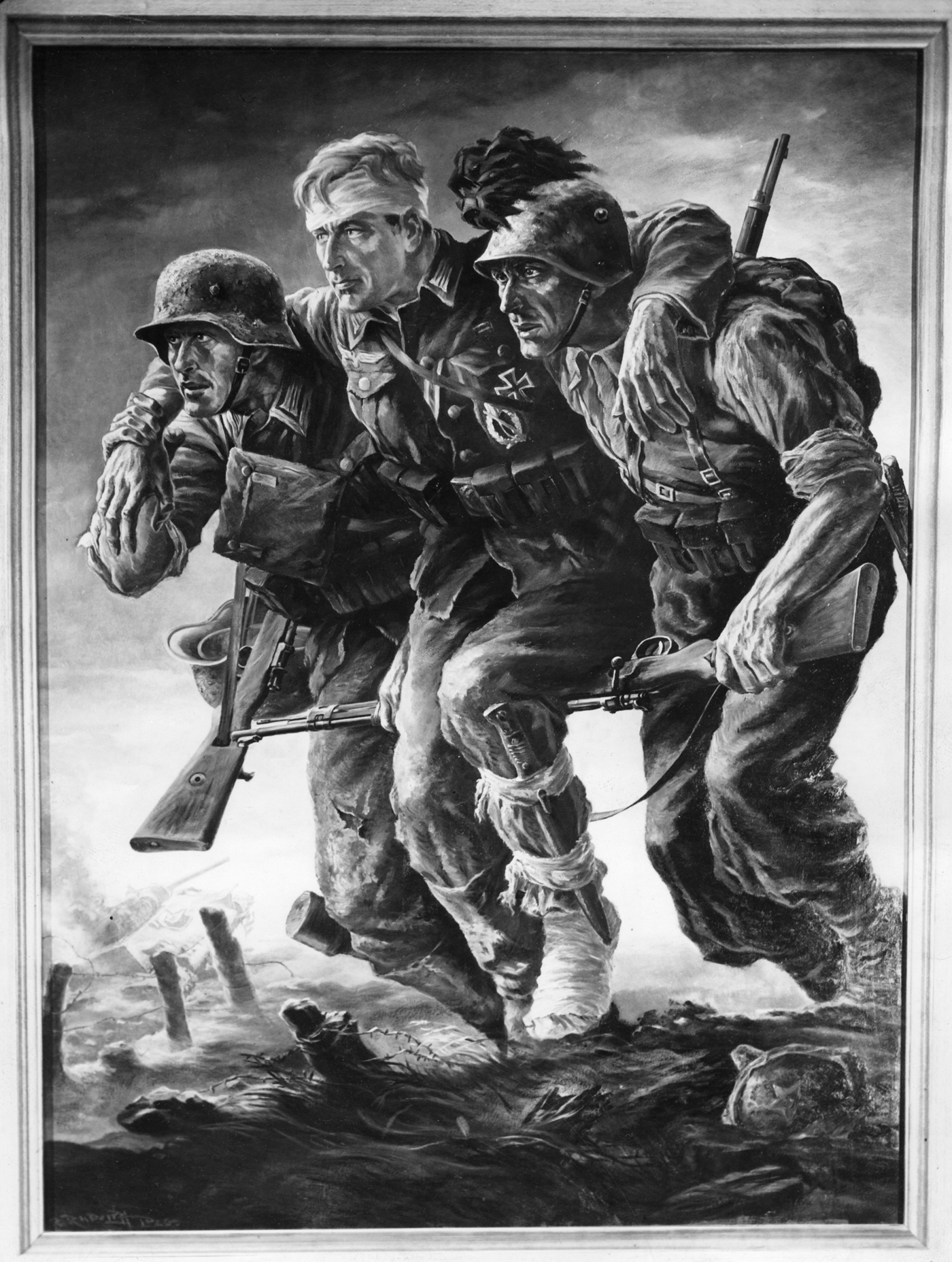
The German sociologist Klaus Theweleit, whose book ‘Male Fantasies’ critically explores the sexual and gender attitudes of the Freikorps through their fiction and literature, traces the same currents into the Freikorps, many of whose troops had been Wandervögel. In his examination of how the potentially lethal, choking mud of the trenches became a metaphor for the contaminating, destabilising influence of communists, miscegenists, and modernity, Theweleit writes how, for the nationalist author, soldier and former Wandervogel Ernst Jünger, “representing interests, making compromises, negotiating, reaching goals in roundabout ways, planning for the long run, or taking both sides into account: all these methods are contaminated, at once male and female, in short, mire.” That sounds like a mire, a sloppy, filthy mud bath, but it also sounds like the vital qualities of a healthy adult heterosexual relationship: exactly the thing Tate warns his boys of. Theweleit perhaps put their ideology more succinctly a little later in the book when he stated that, for the men of the Freikorp, “Real men lack nothing when women are lacking.”
Tate’s tweet may lack the punch of Theweleit’s prose, but the meaning is essentially the same. An attitude more similar in tone and temperament to Tate is that of Ernst Röhm, the co-founder and leader of the Nazi Party’s S.A., the Brownshirts, a paramilitary group who became the notorious footsoldiers of streetfighting fascism and antisemitism. In a (perhaps apocryphal) comment on the sexuality of Adolf Hitler, he mocked his boss by saying “when they stand in the fields and bend down at their work so you can see their behinds, that’s what he likes, especially when they’ve got big round ones. That’s Hitler’s sex life.” So Hitler loved women with big asses, and compared to the men-only barrack rooms of his shock troops, you have to admit that’s pretty gay. It’s a joke with a long half-life: in 2011, stand-up comedian Steven Hughes took exception to the idea that gay men aren’t real men, aren’t tough. “They fuck men. That’s hardly gay… ‘yeah, you go and play with your girly tits, you fucking gaylord.’”
I should mention here, as chance would have it, both Blüher and Röhm were homosexuals, although neither would claim such a medicalised identity. But masculinism as an ideology isn’t limited to any sexuality, really. Women can be regarded as degraded sexual subjects, or degraded contaminants of a sexual subject. The point is, for masculinists like Röhm and Tate, women degrade men’s ability to be real men. Tate hates women, and he encourages his boys to hate women, to treat and regard them as not human. But whereas Tate might come from a lineage of fascist masculinists, he has developed and altered the ideological programme.
For the fascist masculinists, male-only association and the hatred and disgust of women served to strengthen the bond of the male as a soldier, a defender of European and national identity, and build a brotherhood capable of massive, eventually genocidal, violence. For Tate, hatred and disgust of women serves to isolate the young man away from any sense of community or shared bond. Tate’s model man is not the soldier, but the hustler, the entrepreneur. Where Röhm’s men were only to trust their comrades, Tate’s boys must trust no-one but themselves (and him). He is a pioneer of a new, neoliberal form of masculinist identity in which the only value is financial value, and it is through the stripping of communal bonds that power can be won. Fascist masculinists encouraged brotherhood, even a ‘Sacred Band of Thebes’ sexual brotherhood, using womanhood as one of many enemies over which to bond. Tate demands his boys form a brotherhood of one, a lone wolf Freikorps, with the whole world as his enemy, and women as the seductress and contaminator who will ruin his historical mission.
The reason is obvious. Lonely, isolated, fragile males are his customers. One could look deeper into his motivations, but I think the obvious one is the correct one. He doesn’t want his subscribers to form lasting, meaningful, mutual relationships with women, because men in those relationships have no need to subscribe to his schemes and scams. Sometimes more apologetic writers regard Andrew Tate as merely a symptom of a male loneliness epidemic. Perhaps, but more than a symptom, he’s a cause of it. He needs young men to struggle in isolation, and destroying ties of mutual trust and dependence keeps them coming back. That’s where the money is, and Tate is nothing if not a groomer. He knows young straight men want to have sex with women: so he needs to figure out a way they can do that without the dreaded outcome of regarding women as humans. That’s why it makes perfect sense, in his ideology, to depict having a girlfriend as gay, but to use women transactionally as sex objects is hyper-masculine.
Having dragged you all here with a provocative piece of clickbait for a title, I would feel remiss for not at least attempting to answer it. But I can’t. Is Andrew Tate gay? I don’t know, and I don’t care. What’s significant, I think, is that, from a historical perspective, it would be possible for him to be gay and a violent masculinist without contradiction, and we gay people should bear that in mind. What matters is that, to quote Forster, we connect, only connect. “Live in fragments no longer. Only connect and the beast and the monk, robbed of the isolation that is life to either, will die.”
But the more significant question is “what is to be done?” Whenever I hear Tate’s name, it’s usually accompanied by a whole host of well-meaning questions about which models of masculinity are positive ones for the sort of young men Tate is currently grooming. I know the sort of men I would want — for me, John Berger has long embodied a way of being a man in the world, as well as a thinker and writer, whom I would hope to emulate — and the sort of men other people suggest that seem to work to me — Anthony Bourdain gets mentioned a lot. But I am a faggot, a gay man, the sort of man these boys are actively trying to not become, so my opinion is worse than meaningless. But perhaps if we look at the attributes Tate is trying to suppress in his boys when he says “having a girlfriend is gay,” we might find some answers. Tate thrives when his boys don’t experience the opportunity for mutuality, for responsibility, for obligations towards others, for sitting with the discomfort of being different or disagreed with, for taking the world as it comes. Are those actually essentially “masculine” or male traits? Absolutely not, but at this stage, I’m OK with pretending they are if it encourages young men to adopt them and aspire to them. I know I should aspire to them more, and sometimes I am found lacking.
Tate has only found such fertile ground because his ideology shares a huge chunk of its worldview with a wider neoliberal worldview in which obligations towards others are seen as oppressive, and maximising and asserting your rights to individual self-realisation, even at the expense of others, is seen as a real virtue. That’s one reason why today we have a manosphere, but not a Freikorps. Tate can slot his own masculinist, violent, women-hating ideology into this landscape because the ground has already been prepared for it with young men. If we are honest, this is a worldview that exists across society, regardless of political persuasion, and seeps into our brain with every algorithmic scroll. We are in the mire, without any easy answers, which I think makes it all the more important not to trust those who claim they exist.
If you enjoying reading this, why not share it with a friend?
If you’d like to read more of my work, please do subscribe to this newsletter. It’s been going for five years, so there are hundreds of essays to read. Paid subscribers get access to the whole archive, and subscribing to independent substacks helps writers like me not just produce essays like this one, but realise larger projects like new books (*cough cough*). Why not start with this one, about the hit gay media phenomenon, Heartstopper?
No posts
Comments
Nothing yet. Say the first thing.
Sign in to join the conversation.