
If you’ve noticed that my usual Health in Plain English newsletters have been quieter lately, there’s a reason.
For the past few weeks, I’ve been building and leading my first 5-day Procrastination Challenge.
Inside a private group, people from around the world each brought one real task they had been avoiding.
The challenge is officially over.
Here’s what happened:
Nobody fixed their entire life in 5 days.
Nobody became a productivity machine.
Thank God, because human spreadsheets make me nervous😄
But people started doing things they had been circling for weeks, months, and sometimes years.
Some examples:
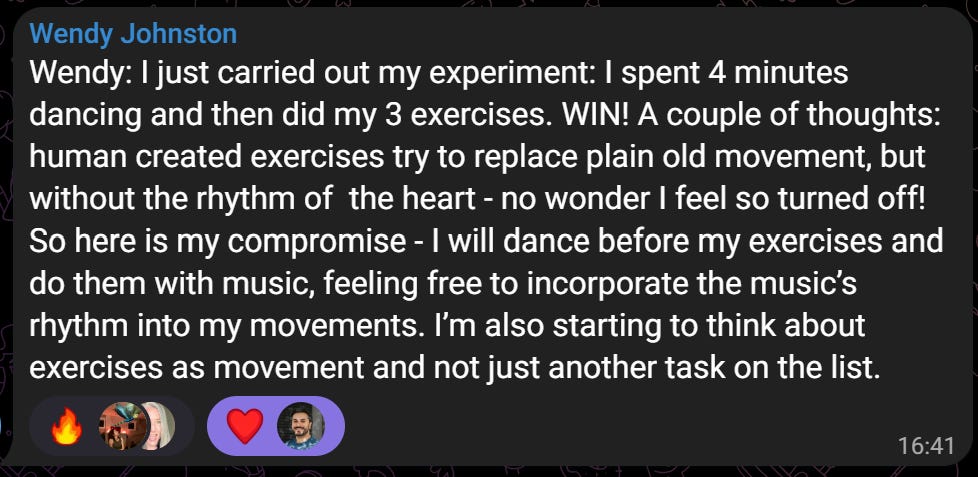
Wendy joined because she knew she needed to continue an exercise program but couldn’t make herself do it.
Exercise felt boring, repetitive, and like one more demand being imposed on her “for her own good.”
So instead of forcing herself straight into the exercises, she began with something she had loved since childhood:
Dancing. She danced for 4 minutes and then completed all 3 exercises.
By the end of the challenge, Wendy was beginning to see exercise as movement she had chosen rather than another self-improvement task she had been assigned.
She described the shift as increasing her agency and decreasing her fear.
Then there was Jane, who wanted to learn to play the Irish drum.
Practicing had become tangled up with perfectionism, shame, and the fear of embarrassing herself in front of people she cared about.
So instead of treating every session like an examination, she started practicing rhythms alongside familiar songs that made her smile.
Soon afterward, she posted this:
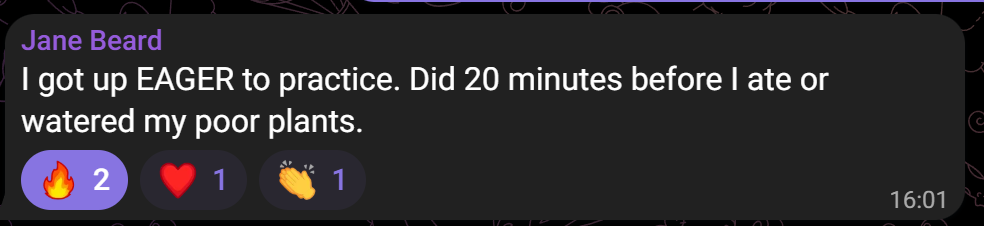
Her plants forgave her afterward.
The instrument hadn’t changed. What changed was the experience of approaching it.
These weren’t just isolated bursts of productivity. Participants began recognizing that the process could be reused, and that working alongside other people changed the experience too.
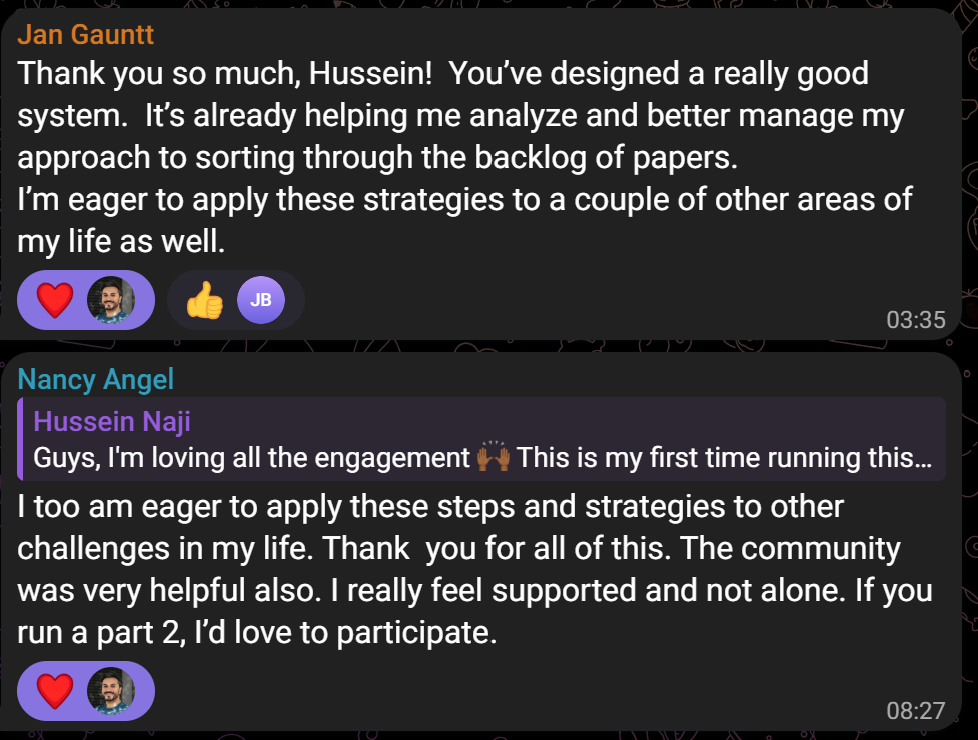
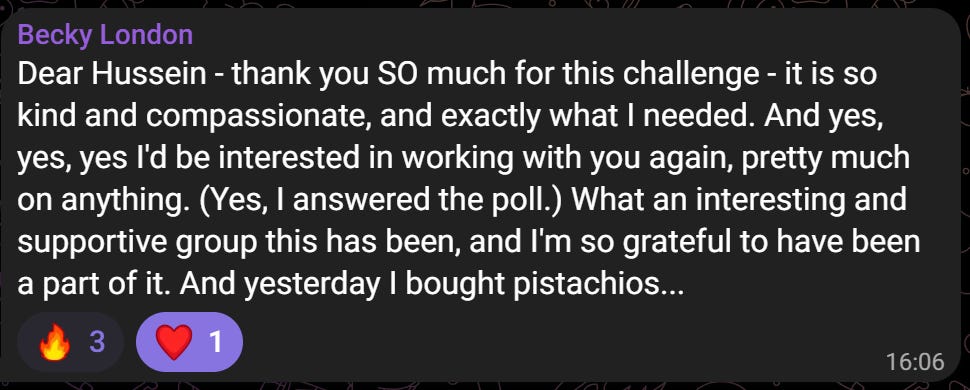
Becky even bought pistachios during the challenge. Scientifically, this may have been the most important result.
And these were not the only wins:
People returned to academic papers, made progress on rooms they had avoided for months, prepared their homes for visitors, started sorting years of paperwork, and left themselves clear instructions that made returning easier the following day.
None of this happened because everyone suddenly became more disciplined.
It happened because we stopped treating every kind of procrastination as the same problem.
Sometimes the next step was unclear. Sometimes the task secretly contained 42 smaller tasks. Sometimes it carried shame, grief, fear, boredom, or too many decisions. And sometimes the person was simply exhausted.
Different kinds of stuckness needed different next steps.
Instead of repeatedly yelling “just start” at ourselves, we practiced identifying the actual block and choosing a step that made sense for it.
This was my first time leading something like this, and I learned an enormous amount from it.
I’m now speaking with participants to understand what helped most and what kind of support would genuinely be useful next.
(I’ll come back with the results soon🙌🏾)
For now, the regular Health in Plain English newsletters are returning.
We’ll be getting back to health science, habits, ADHD, stress, food, sleep, and all the other things our brains enjoy turning into full emotional construction projects.
And if there’s something you’ve been avoiding today, don’t begin by asking: “How do I finish this?”
Ask: “What is making this difficult to start?”
Then choose one step that fits the answer.
Useful beats impressive.
Talk soon,
Hussein
Comments
Nothing yet. Say the first thing.
Sign in to join the conversation.