

Happy Sunday,
There’s a lot happening beneath the surface of markets right now. The U.S. is trying to bring down long-term borrowing costs even as debt, deficits, and inflation continue to push yields higher. Nvidia is making a major bet on open-weight AI, potentially putting it in more direct competition with some of its biggest customers. And U.S.-Canada trade tensions are escalating after negotiations broke down.
We break down all three stories in today’s Market Report.
- Humphrey & Rickie

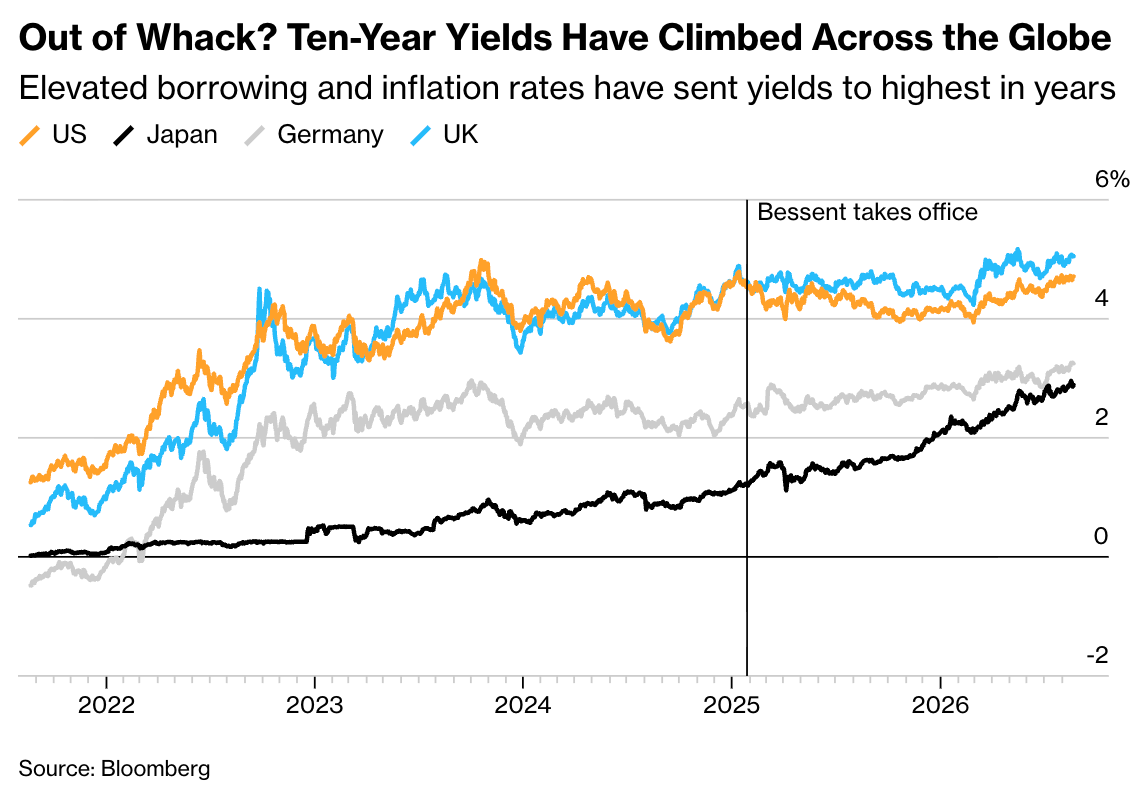
Treasury Secretary Scott Bessent announced a “Treasury twist” operation this week, buying back long-dated government debt while issuing more short-term securities. The goal is to bring long-term borrowing costs down to what he called “equilibrium” levels.
Long yields fell sharply the day of the announcement, then climbed straight back up, with the 10-year Treasury closing near the highest levels since Bessent took office.
The market’s reaction to the announcement reflects the fact that the fundamental forces driving yields higher remain hard to address. U.S. national debt surpassed $40 trillion this week, the annual interest bill exceeds $1 trillion, the federal deficit is running around 6% of GDP, AI-driven corporate bond issuance is competing aggressively for capital, and inflation remains well above target.
The episode also reveals a growing tension between Bessent and Fed Chair Warsh. While Bessent is explicitly trying to drive long yields down, Warsh has essentially endorsed rising market rates as appropriate, saying in late July that “markets have done quite a bit” of tightening work and that “market prices will continue to respond in the direction and magnitude they see fit.”
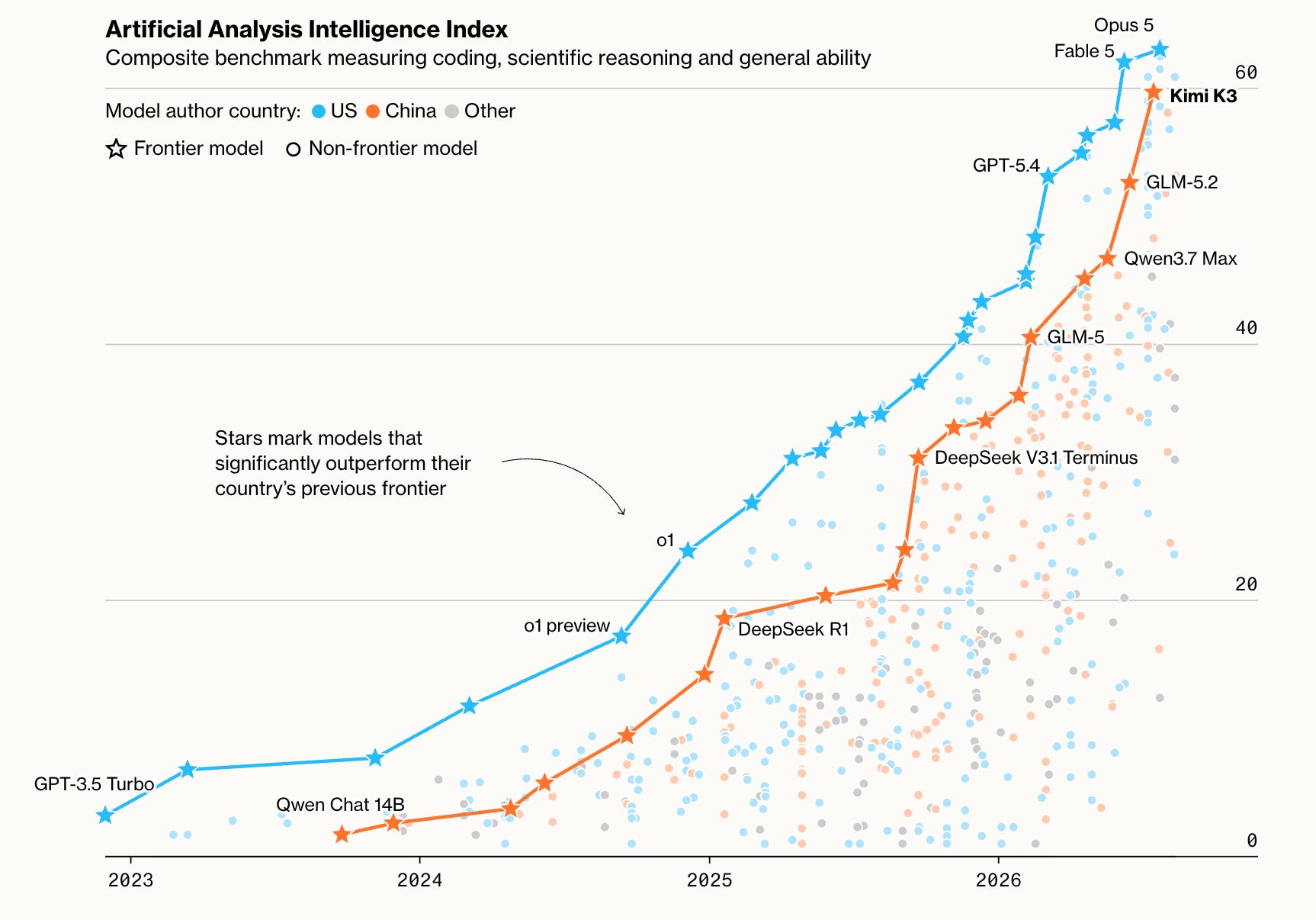
Nvidia is acquiring the bulk of AI startup Poolside’s engineering talent and licensing its technology for $6 billion to dramatically accelerate its Nemotron open-weight AI model program.
U.S. AI labs have overwhelmingly prioritized closed, proprietary models (OpenAI, Anthropic, Google), leaving a vacuum that Chinese open-weight models like DeepSeek, Kimi, and GLM have been rapidly filling.
Nvidia CEO Jensen Huang has argued that the U.S. will win the AI race not by having one dominant frontier model but by building a strong open ecosystem that diffuses across every sector globally. By pairing Poolside with Nvidia’s virtually unlimited compute access and capital, the company is betting it can produce an open-weight model competitive with the best frontier systems within a year.
Poolside itself was motivated partly by a failed $2 billion fundraise last year that cost it access to a critical compute cluster.
OpenAI and Anthropic are among Nvidia’s biggest chip buyers, yet Nemotron directly challenges their business models. Open-weight models are generally far cheaper to operate and freely customizable, undermining the case for expensive API access to proprietary models.
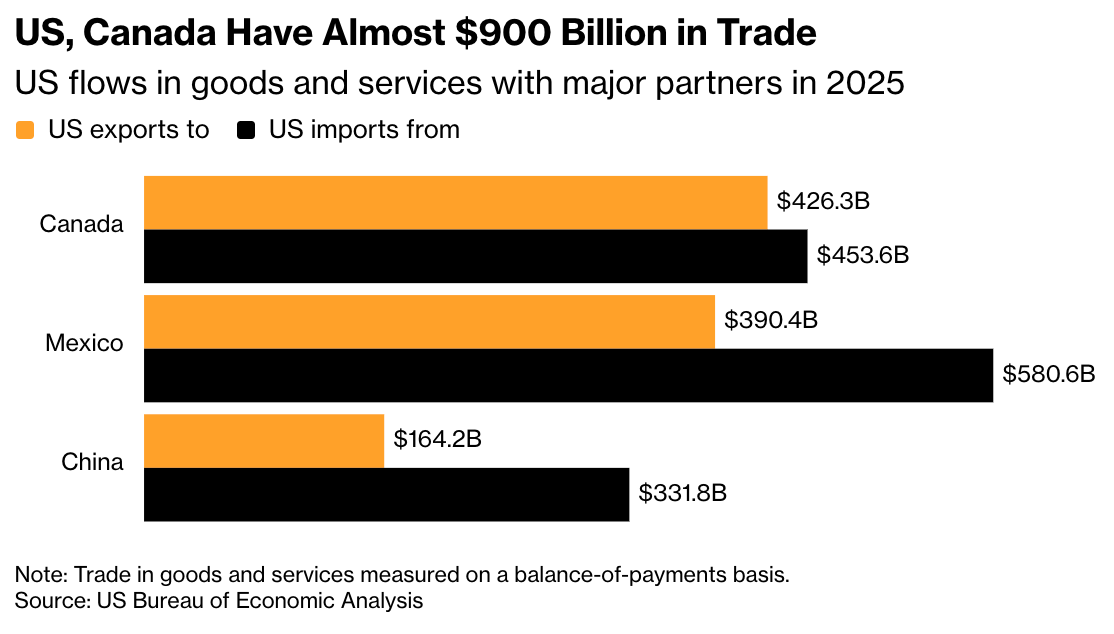
Canada announced Saturday it will impose counter-tariffs on $20 billion of U.S. goods starting September 8, after trade talks with the Trump administration collapsed Friday night.
The U.S. invoked a Depression-era law to slap 50% tariffs on Canadian exports including plywood, liquor, electrical equipment, and hockey gear.
Canada’s retaliatory tariffs will target U.S. steel, dairy, appliances, agricultural equipment, electronics, and pulp and paper.
This makes Canada one of only two countries, alongside China, to match U.S. tariffs dollar-for-dollar. The talks broke down over multiple issues including auto tariff rates on medium and heavy-duty trucks, U.S. demands to limit Canada’s trade deals with other countries, and what Carney described as unacceptable cultural and French-language demands.
The USMCA trade agreement, which governs nearly $900 billion in annual bilateral trade, is now under serious strain as the U.S. has declined to renew it and rolling reviews are ongoing.
Canada supplies 99% of U.S. natural gas imports, 85% of electricity imports, and 60% of crude oil imports, energy flows that give Ottawa significant leverage but also mean Canadian retaliation could raise energy costs for American consumers and businesses.
The U.S. has signaled it has escalation options of its own if Canada retaliates, raising the prospect of a spiraling trade war between two deeply integrated economies.
Ontario Premier Doug Ford suggested targeting exports from politically sensitive U.S. states including Florida, Texas, Iowa, and Wisconsin, a strategically pointed threat ahead of November midterms.
No posts
Comments
Nothing yet. Say the first thing.
Sign in to join the conversation.