

Welcome back, folks!
This week, we’re exploring why insurance compliance has become the silent deal-killer in commercial real estate, and how the smartest operators can turn document chaos into an advantage.
But first, the critical intel you need this week:
Commercial property insurance premiums jumped between 5-25% , with carriers reporting commercial price increases of 6.6% consecutive quarters.
ACORD reports that digital reinsurance transactions via the ADEPT platform have surged by ~73% in 2025 and have been >300% since 2023.
ACORD has provided standardised forms since 1971, yet 90% of agencies still struggle with format variations that break traditional processing systems
This week, I want to share a story about a company that was drowning in a documentation nightmare every real estate firm faces, but found a way to turn its operational headache into its strongest moat.
Meet Arbor Realty Trust, a New York commercial real estate powerhouse. Arbor processed 6,000+ insurance applications monthly while managing 75,000+ yearly claim settlements. This includes certificates of insurance and specialised flood certificates for waterfront properties, all feeding into their loan origination process. Each demanded meticulous documentation review and data extraction.
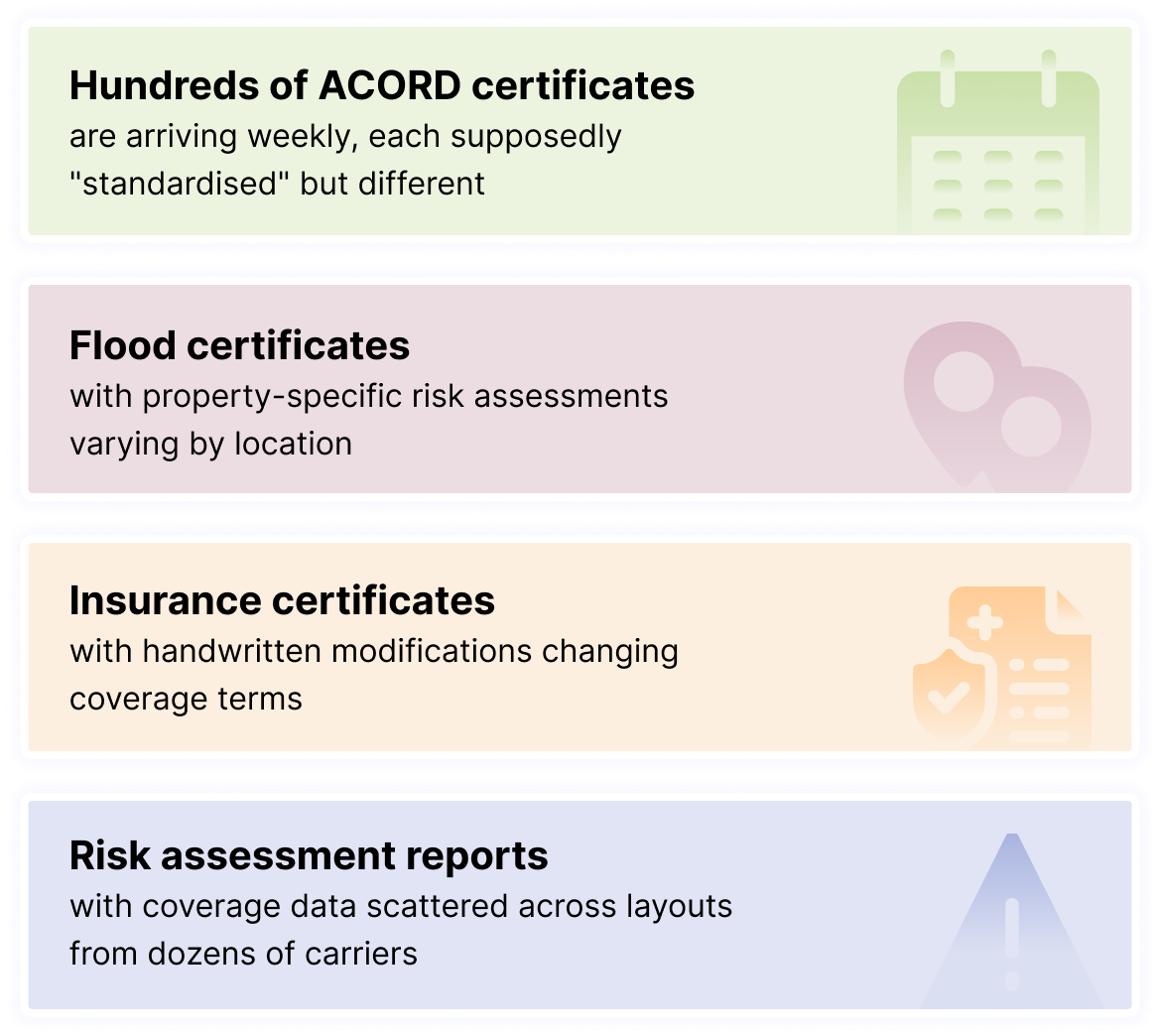
Their operations team faced a familiar nightmare:
The brutal workflow: identify document types, extract vendor and policy details, cross-reference coverage against property requirements, validate against loan covenants, route through approvals, then update multiple databases.
Time per document ranged from 15 minutes for simple certificates to over an hour for complex submissions. Error rates climbed faster than their hiring ability.
The fundamental challenge was that templates looked similar. (spoiler: THEY WERE NOT!)
ACORD forms have represented standardisation since 1971. But insurance carriers and property managers interpret “standard” differently, adding custom fields, changing layouts for legacy systems, and using tools that create variations.
Traditional document processing systems excel in controlled environments with predictable formats.
Production environments tell a different story. When real insurance certificates hit these systems, with handwritten notes, varying table structures, and overlapping e-signatures, accuracy rates crash from the 90%+ demo results to 60-65% in actual operations.
Arbor’s leadership demonstrated strategic thinking that separates industry leaders from followers. Instead of accepting bottlenecks as an operational reality or hiring more staff, they recognised this required solving the core intelligence challenge.
They understood that scaling needed semantic understanding of business relationships, systems that could understand insurance logic regardless of presentation format.
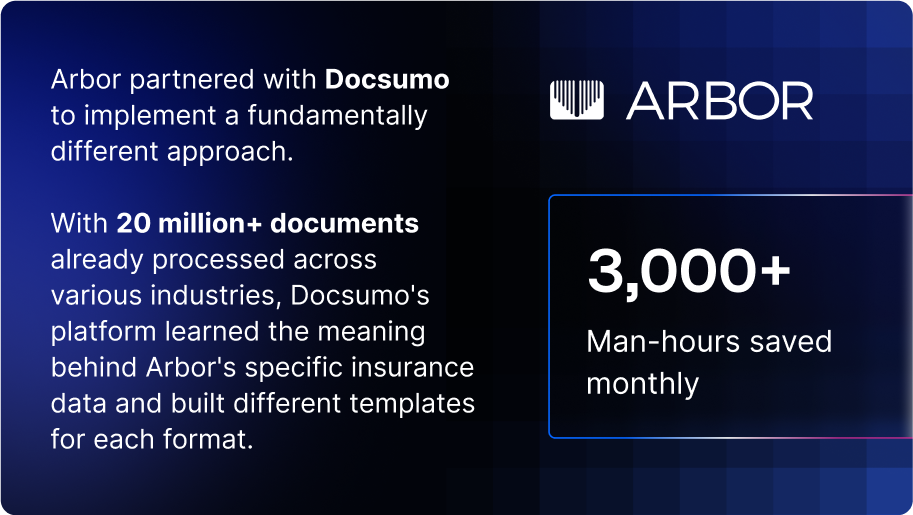
Learning Arbor’s Business Logic: The system studied a few sample documents from Arbor to understand their requirements and compliance mandates. Whether processing certificates for waterfront properties or standard certificates of insurance for office buildings, it learned what coverage looked like for each asset class and could flag compliance issues.
Handling Any Format: Now, whether insurance data appeared in scanned broker communications or carrier-specific custom formats, the Document AI platform flagged compliance issues before they reached underwriters, avoiding costly delays. The intelligence layer recognised the business relationships that mattered for operations.
Reducing Manual Checks: When extracting coverage limits from any certificate of insurance, the platform automatically validates against all regulatory mandates, significantly reducing the manual checks needed in the process.
Read the detailed case Study here!
Processing dropped from hours to under 5 minutes per document with 99% accuracy. They achieved 96% faster processing, handling 6,000+ monthly applications across multiple formats.
Most impressive: 95% straight-through processing - 95 of 100 certificates flowed directly into databases without human intervention.
Arbor’s story shows a core principle about operational excellence in document-heavy industries: the companies that win, preempt when traditional approaches hit their limits.
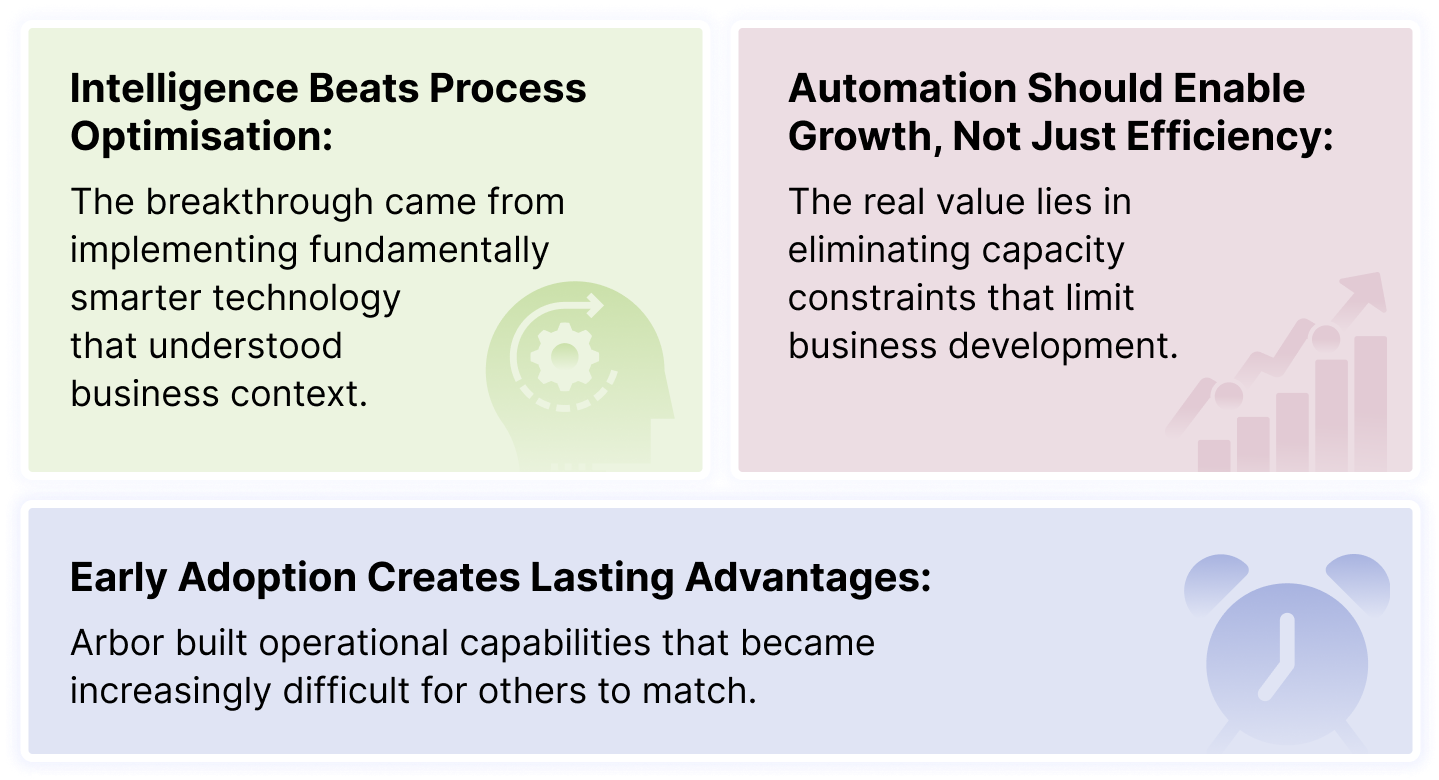
When you’re managing insurance compliance across hundreds of properties with dozens of carriers, success depends on building intelligence that adapts to business requirements.
The competitive advantage will always belong to those who solve problems their competitors consider unsolvable. Semantic document intelligence can handle complexity that breaks traditional template-based approaches.
Stop accepting document processing bottlenecks as an operational reality (by now you know, they are not). The technology exists to eliminate these constraints - companies like Arbor have proven it works at enterprise scale.
PS: If insurance compliance is becoming a bottleneck in your deal flow, you’re facing the same challenge Arbor solved. The question is whether you’ll recognise it as a technology problem or keep treating it as a staffing problem.
PPS: Every metric here comes from real operational results, not marketing projections.
No posts
Comments
Nothing yet. Say the first thing.
Sign in to join the conversation.