
My name is Juno.
I am Disabled with a capital “D.” I am also Queer, Trans, and Latino.
Some days it feels like the news is a revolving door of daily headlines about people like me—daily reminders that my existence is treated like a debate. I watch alt-right contemplations on ICE and U.S. Supreme Court rulings that read like thinly veiled coded threats. And all the while, I’m still needing to check who watches me enter the restroom—despite nearing four years on testosterone with a patchy beard.
The mainstream media loves to trash Florida. But in Florida, you’ll see an America you won’t find anywhere else. My hometown, Miami, is a melting pot of Latin American, Caribbean, and Asian culture, and within each culture there are pockets of queerness—POC-led event spaces, workshops, indie bands. If you know where to look, Pride can feel like it’s happening all year round.
But outside those spaces, the isolating reality of being queer, in addition to Disabled, under an anti-LGBTQ+ administration makes me heave.
Disabled people are not taken seriously. It shows up in public, in private, in how people talk about us like we have missing parts. I think about Micah Leroy, a trans man with cerebral palsy—the subject of a right-wing hate train after posting the results of his top surgery. The comment sections were ruthless. Users attacked his transition and delegitimized his ability to think, speak, and act for himself.
In the eyes of ableists, disability seems to automatically make consent negotiable and selfhood less real.
I’ve watched that same logic spread through medical spaces. I have a friend with autism who was told at a doctor’s visit that his “confusion” about his gender identity was because of autism—as if someone couldn’t be both trans and autistic. In a way that his neurodiversity had to be “handled” before a queer decision could be considered valid.
But studies show a high correlation between neurodiversity and gender expansive individuals. A neurodiverse way of looking at the world also applies to gender. Personally, I think gender as a whole is a bit outdated.
We learn—fast—that systems weren’t built with us in mind. It shows how often the authorities cannot properly communicate with the Deaf community because they don’t know ASL. I think of Pearl Pearson, Daniel Harris, and Magdiel Sanchez, and it hurts.
The intersection of my identities—Disabled and queer—is where denial of human rights becomes structural. Both identities are denied healthcare. Both identities are institutionalized at higher rates. During Pride Month, a recent DOJ memo interpreting a landmark disability rights case, Olmstead vs. L.C., noted “the Supreme Court’s Olmstead decision did not hold that people with disabilities must be served in integrated settings.”
Why is integration negotiable? Why is it not guaranteed within schools, work, and housing?
Disabled people continue to be segregated and our history—like LGBTQ+ history—is not taught or recognized.
If “integration” is treated as optional, then belonging becomes a privilege we have to beg for instead of a right we deserve. As James I. Charlton wrote, there should be “nothing about us, without us.”
You may not realize it, but you know at least one person with a disability. You may experience a disability someday. You may be disabled yourself! Disability touches all of us.
Right now, we need community. We need support. We need representation.
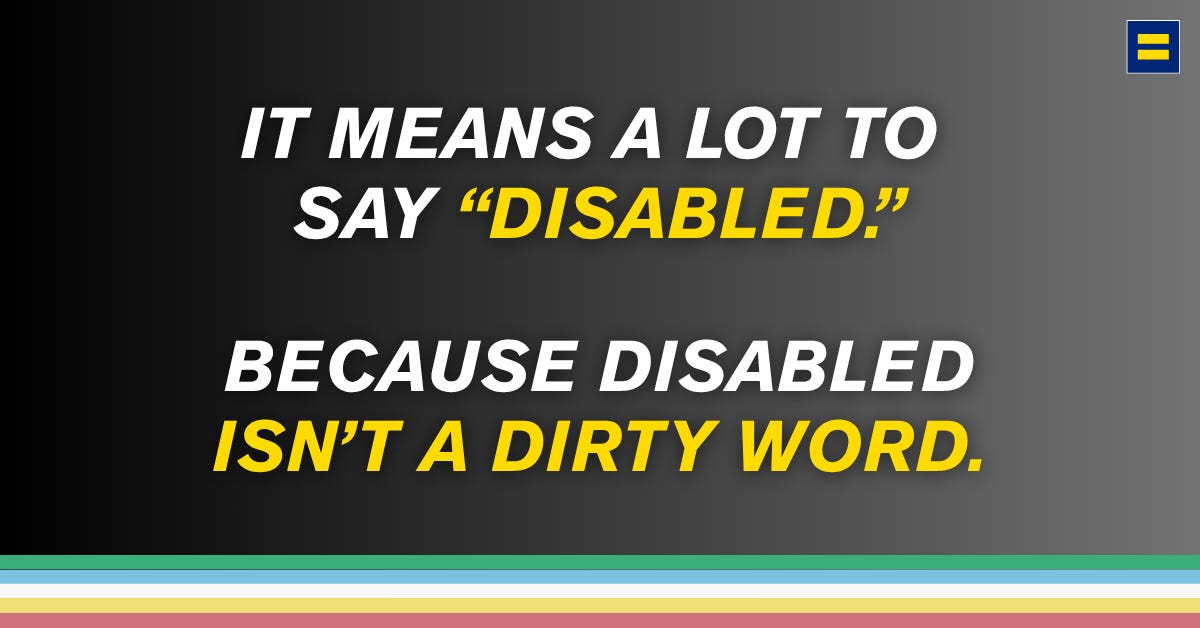
We also need language that doesn’t shrink us. It means a lot to say Disabled—because Disabled isn’t a dirty word.
I’ll say it again: “Disabled” is not a bad word.
Disability justice principles like Sins Invalid’s 10 Principles of Disability Justice shape how I advocate. I encourage more LGBTQ+ organizers to let this framework guide them: Nothing about us without us, built on community care, interdependence, and truth.
So what should people do?
Look for Disabled queer stories—and amplify them as essential, not inspirational, content. And follow queer and Disabled creators! Share. Like. Repost. Make visibility sustained.
Support Disabled-centered groups, like the American Association of People with Disabilities (AAPD). Show up where policy hits bodies by supporting initiatives like HRC’s 100 Days of Healthcare, which matter for long-term mobilization. Donate to queer-led mutual aid and advocacy initiatives like Project LETS, a collective of volunteers and organizers that specialize in “building just, responsive, and transformative peer support collectives and community mental health care structures.”
Remember: Ramps are not enough. True accessibility looks like ASL interpreters assumed present rather than absent. It looks like CART captions anyone can access on their phones. It looks like image descriptions in captions and comments. It’s the conversations we have, the language we use. The “R” word has killed—and if you don’t believe me, look to Willowbrook: a state-run institution meant to care for disabled people that encouraged and allowed medical malpractice, neglect, experiments, and every type of abuse imaginable until 1987.
Disability justice means prioritizing patience and care. Understanding the interconnected nature of our bodies. We are not products of the world, we are the world.
I was once told I wouldn’t live to see 26. But I’m still here. I believe my hope isn’t denial but practice. I believe we will build futures where queer or disabled people aren’t treated like a question mark.
Because we are not a question.
We are the answer.
No posts
Comments
Nothing yet. Say the first thing.
Sign in to join the conversation.