
Everything about Christopher Nolan’s The Odyssey is staggering in scale.
Shoots in 6 different countries. Over 2 million feet of IMAX film — not to mention the first feature film shot entirely on IMAX, with brand new IMAX camera systems to boot — cut and condensed into a nearly 3-hour epic. Thousands of extras. Gigantic props and sets built to scale. Meticulously constructed practical effects.
And a towering commitment to talent.
The Odyssey boasts some of the biggest names in the business. Between Academy Award-winning composer Ludwig Göransson’s magnificent score and frequent Nolan collaborator and cinematographer Hoyte van Hoytema’s stunning visuals, it goes without saying that there are some serious shoo-ins for awards season in 2027.
That’s not to mention the powerful performances we see from the likes of Matt Damon (Odysseus), Anne Hathaway (Penelope), Tom Holland (Telemachus), and Zendaya (Athena), to name a few.
Point is — it takes the best of the best to bring one of humankind’s oldest and most universal stories to the big screen.
And Elliot Page was up to the task.
Returning to the silver screen after nearly a decade away, Page steals many a scene as Sinon, a warrior who is used as a pawn in Odysseus’ Trojan horse ruse. In one scene, he delivers a powerful monologue lamenting Odysseus’ deceit and its impact on him and his fellow shades in the underworld that’s had audiences talking nonstop.
This is not Page’s first collaboration with Nolan. When asked about casting Page in The Odyssey, Nolan shared:
“It was really thrilling to work with Elliot again. We worked on ‘Inception’ some years ago. His character in ‘The Odyssey’ brings something really special to it. You’re looking to put a face on certain elements of what Odysseus has done, what that means for the world as a whole. You’re looking to put a face on the tragedy of war. And I think he did an incredible job.”
That’s no small assignment. And no small praise from one of Hollywood’s most influential directors working today.
When Page’s casting in Nolan’s latest epic was initially announced, pockets of social users erupted in a deeply transphobic outcry. So the success of The Odyssey — and the overwhelmingly positive response to Page’s performance — confirms what we already know to be true.
Transphobia has always been rooted in hatred and lies. Not facts. Not reality.
The facts are clear: LGBTQ+ people are facing increasing levels of discrimination and censorship, both on and off the screen.
Onscreen, GLAAD’s annual Where We Are in Film study finds that Gen Z makes up nearly 40% of American moviegoers — and over 23% of American adults under 30 identify as LGBTQ+. Yet, out of all the films released by 10 major distributors in 2025, only around 20% of them contained LGBTQ+ characters — a decrease from 2024.
And out of the 112 LGBTQ+ characters included in these films, zero of them were transgender.
We have a visibility problem. Not just when it comes to writing LGBTQ+ characters, but casting out LGBTQ+ actors.
Before Trump took office in 2021, visibility and representation among LGBTQ+ Americans was as high as it had ever been — including onscreen. A year into the second Trump administration, more than half of LGBTQ+ adults report being less visible than they were a year ago, according to research from the HRC Foundation.
And outness is fading. Nearly half of LGBTQ+ adults report being less out somewhere in their lives over the last 12 months. This retreat cuts across workplaces (26.5%), healthcare (25.4%), and public spaces (28.3%).
And alarmingly, more than half of LGBTQ+ adults report being less visible than a year ago.
What does it mean to be visible? To feel seen? For many people, that starts with the silver screen. The stories that directors and producers choose to tell — and the people with which they tell them — are major entry points for LGBTQ+ people to recognize parts of themselves in films and TV shows.
Cinema can be a major tool for self-actualization and investigation. Films give us the visual language with which to unpack our surroundings and tell our own stories. And if we’re not telling LGBTQ+ stories with LGBTQ+ people, we are robbing the next generation of the opportunity to come to know themselves through a beautiful artistic medium.
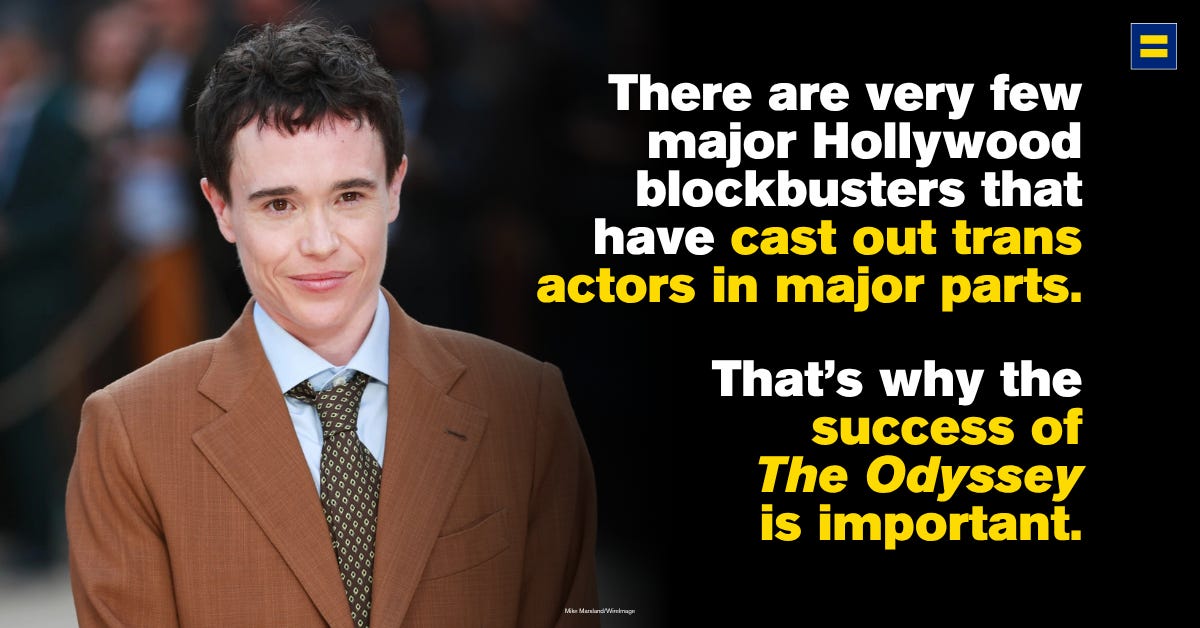
There are very few major Hollywood blockbusters that have cast out trans actors in major parts. That’s why The Odyssey is important. In its opening weekend, 7.5 million people hit theaters around the nation to take in the story of Odysseus and characters like Sinon. For young trans kids, seeing an out trans actor playing a role that aligns with their gender identity can be the difference between living authentically or retreating in their outness.
Let us hope that The Odyssey’s success — and Elliot Page’s superb performance — paves the way for the type of representation we all deserve.
No posts
Comments
Nothing yet. Say the first thing.
Sign in to join the conversation.