

One of the things I find most useful right now is talking to people who can remember the last version of the future.
Education has had a lot of them. The internet was going to democratize knowledge. Software was going to personalize learning. The app store was going to let teachers route around district bureaucracy. MOOCs were going to unbundle college. Then COVID made edtech feel suddenly inevitable, and the post-COVID period made much of it feel overbuilt.
Now AI has arrived, and the claims are bigger than ever.
That is what led me to Jennifer Carolan.
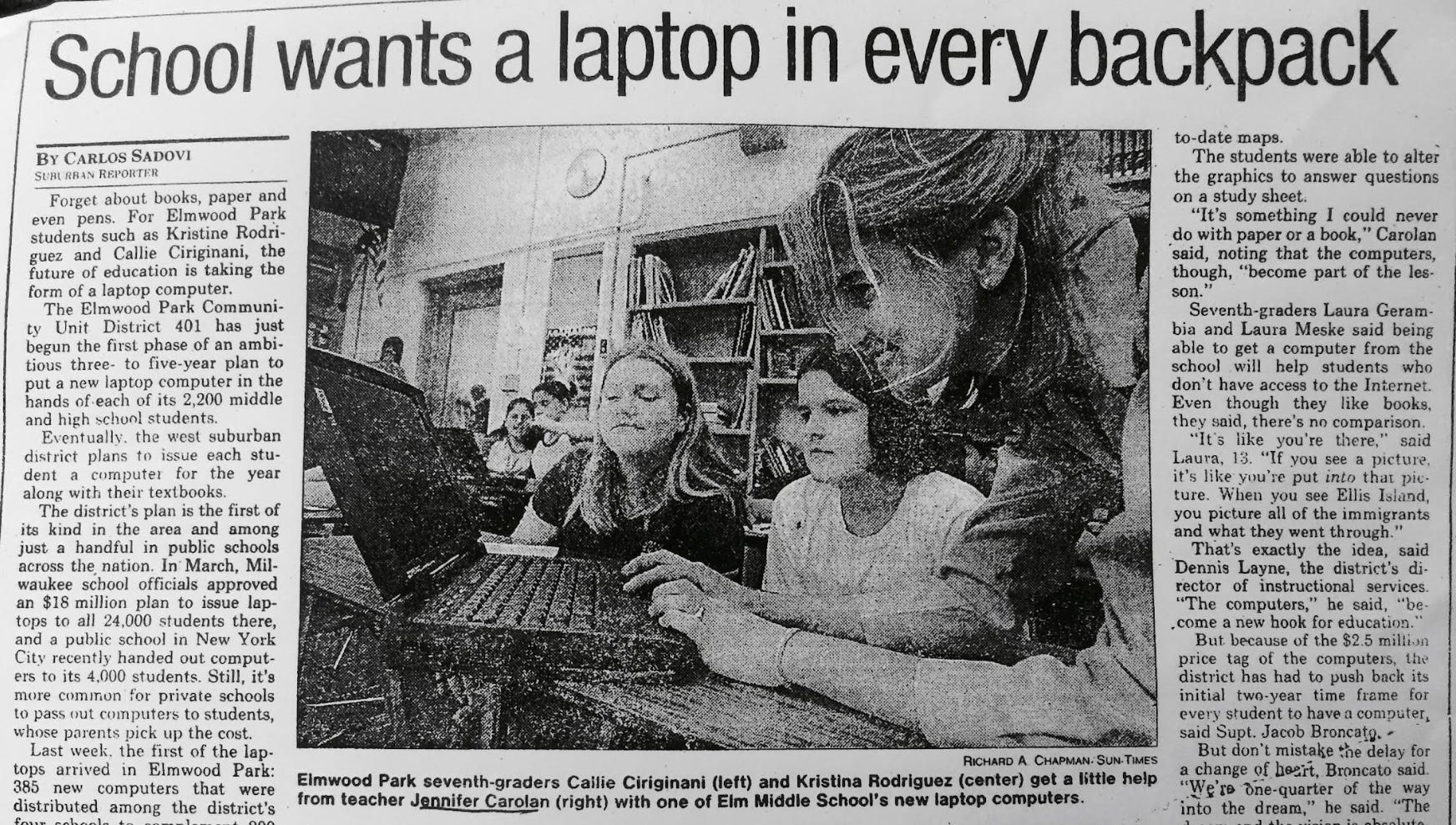
Jennifer has seen the education technology story from almost every angle. She started as a classroom teacher in the late 1990s, when a laptop in school still felt like a portal to another world. She later helped build REACH Capital, one of the first dedicated edtech venture firms, and has backed more than 120 education companies. At Stanford, where she teaches Lean Launchpad with Steve Blank, she is watching students build working AI tutors in a matter of weeks.
I wanted to talk to her because the story of edtech is especially hard to tell honestly right now. One version says venture got burned and the category never worked. Another says AI tutors are finally going to deliver the personalization software promised for decades. Another says schools are too broken to save. Another says the classroom is sacred and technology is mostly a distraction.
Jennifer’s answer is more interesting because she does not choose one of those stories. She sees AI arriving inside a system where the gatekeepers of knowledge were already losing power. Learning was already moving into homes, phones, workplaces, creator networks, group chats, and YouTube rabbit holes. AI did not start that shift. It is speeding it up, and making it harder for schools and colleges to pretend they still control the terms of learning.
But she also resists the idea that this makes school obsolete. Again and again, she came back to the parts of education that are not just about access to information. It’s about a teacher who notices a child, and how the classroom teaches you how to be around other people: the daily experience of being shaped by a community.
We ended on a piece of advice that she gives all education founders: Sit in a classroom, shadow a teacher, become a substitute teacher. Know what it means to teach and learn, in this system, right now.
I liked that as a closing challenge because it cuts through so much of the abstraction around AI and education.
Before you build the future of school, spend a few days inside the present one.
-Allison
ALLISON: What have you changed your mind about in the past year?
JENNIFER: I changed my mind about how useful AI tutors are becoming. The underlying technology is improving more quickly than I had ever imagined which is rapidly improving the quality of the AI tutors. Combined with the changes happening in society writ large, these AI tutors may become one of the primary drivers of change of our current formal education system.
I teach a class at Stanford with Steve Blank called Lean Launchpad, and we’ve been so blown away by how quickly students built working prototypes this year—like, Week Two. We’ve had a couple of education teams in this cohort, and it’s been fascinating to see how fast they created compelling AI tutors. In just a few weeks, one team made the leaderboard for Scale AI’s “TutorBench” evaluation—a benchmark for assessing AI tutor quality—so we’ve watched the speed at which these tutors improve in almost real time. Tutors are meeting a pivotal moment, as higher ed is getting pushed hard on ROI and K-12 is under tremendous pressure.
ALLISON: What do people systematically misunderstand about education’s current moment?
JENNIFER: For centuries, the traditional gatekeepers of knowledge—schools, Universities, clergy and the state—have steadily lost their monopoly. With each wave of technological progress, access to learning and opportunity has widened. Education now happens everywhere, all the time. As John Dewey observed more than a century ago, “knowledge is no longer an immobile solid; it has been liquified, flowing through the currents of society itself.” The latest wave of disruption has only accelerated this shift.
What people misunderstand is that this current disruption belongs to a long history of widening access and that our natural reflex to read it as decline is almost always wrong. Every new information technology from print to the internet arrived with predictions of ruin and brain rot that never came. This is not to say positive progress is inevitable, but that humans, guided by values (whether they be positive or negative), will drive the application of these new technologies as they always have.
ALLISON: Are you thinking mostly about declining enrollments in K12, the move to ESAs, and other alternative forms of school? Or are you also thinking about higher education and the cultural divestment from formal institutions? Or, all of the above?
JENNIFER: All the above. Formal institutions of all types are weakening and education is not exempt from this shift. You can see evidence in the decline in K-12 enrollment, the unprecedented growth of ESA’s and a sentiment shift regarding higher ed’s importance. A recent Pew/Gallup poll showed that only 35% of Americans still think it’s “very important” to go to college, down dramatically from 70% since 2010.1 That’s a significant shift in public opinion during a time when “college for all” was the rallying cry of the school reform movement.
Some like to blame politics or funding or even teachers for this phenomenon, but in reality our educational system was built for stability. It’s now struggling mightily under the current pace of technological and societal change. For example, parent tastes are changing– there is a greater demand now for more personalization of our educational system. If students are moving through courses more quickly, parents have less patience for a system that still primarily educates with a one-size-fits-all, lock-step approach. Learning difference diagnoses are rapidly accelerating and parents want a school system that is responsive to their children’s individual learning needs. Add in the capabilities of learning through technology anywhere and anytime, and it’s no wonder the system is struggling to stay afloat.
Teachers and administrators deserve our gratitude right now. They are bearing the brunt of this overwhelm, and yet continue to serve the children and young adults they teach despite a surprising lack of public support.
The weakening of our educational institutions (in the form of families voting with their feet) is symptomatic of underlying systemic issues. That’s where innovation enables us to batch-innovate with new structures and new approaches to learning.
ALLISON: You have a bird’s-eye view of edtech VC, in some ways since the category’s beginning. What’s the story of edtech VC over the last decade?
JENNIFER: I started teaching in 1997. I was 23, right out of college, teaching American History. Beyond textbooks, we had almost no tools to do a complex job—grades were kept by hand in that green grade book, papers filed in manila folders in the corner cabinet. In my first or second year of teaching, laptops were introduced and came with a subscription to National Geographic. That felt like a sea change. Broadband came later.
Over the last 25 years, so much has changed. IT budgets back then went primarily to hardware rather than software. Now the budgets are flipped: hardware is very cheap, and most IT spending goes to software. Broadband access is nearly universal in US K-12 schools. Materials have gone from print to digital, teacher tools have made the analog-to-digital transition, and instructional tools are now a category unto themselves. The internet has entered the classroom in so many forms; it’s been an incredible evolution.
With these changes came an interest in edtech venture capital. It was slow at first and the generalists began making the occasional edtech investment. My first boss at NSVF Joanne Weiss was CEO of one of those companies backed by Kleiner. Today, there’s well over a billion dollars in VC funding for edtech. That said, it’s still just one and a half percent of all VC funding, so the share flowing into edtech remains quite small overall. Despite the perceived large opportunity, edtech VC has always been a tiny allocation.
ALLISON: Roughly ten years ago, all at once, we saw the creation of new venture funds specifically focused on edtech. What was that moment like? What was the promise that allowed all of these firms to come into existence?
JENNIFER: The App Store, smartphones, and iPads made a D2C channel into education possible, putting new tools directly into teachers’ hands. Before that, direct sales was the only way in, knocking on doors to districts. AngelList came online about that time too which got many angel investors involved too. ImagineK12 was an early incubator that helped bring these people together too.
When we began investing, early rounds were a million dollars on four-to-six million caps, typically with 30+ investors. Wayee, Shauntel, and I spent a lot of time helping to bring these angel investors and small groups together.
Some of the foundations too were forward-thinking and helped ignite this movement including the Michael and Susan Dell Foundation, Emerson Collective, Sesame Street Ventures, and Valhalla.
There were so few of us that we gathered around small tables at each other’s homes and we talked about how to build investor interest, how to convince CS majors to build in edtech and how to expose teachers to these new products. Although it’s different, I still feel that same grassroots energy now.
ALLISON: COVID created a boom cycle for edtech, but since then generalist firms have divested, put off by long sales cycles and questions about TAM. Many verticalized edtech funds have either struggled to re-raise or dramatically expanded their thesis into health, family, and workforce. What’s going on from your vantage point? How are you making sense of the industry today?
JENNIFER: I have a different take. I don’t think we’re actually seeing a divestment from edtech at all.
It’s a challenging time for the venture industry more generally, with limited and concentrated DPI. LPs, without getting the returns back into their coffers, have to be picky about where they deploy their capital. So I see everyone is being affected, not just edtech. I’m still seeing generalists investing in education (ie PrimeFuture, Outsmart, CollegeVine, Oboe, Marker etc), but the velocity and size of venture capital transactions has increased so much that edtech investments are getting lost in the noise (and no more EdSurge sadly).
Money is flowing into the intersection of AI and learning. We’re in the early stages, but these opportunities are attracting a lot of investment interest.
In post-secondary, we’re seeing great opportunities in the career training sector. A number of companies are making that training more accessible and affordable, like Stepful, one of our portfolio companies, that trains allied health professionals and Workwhile which had hundreds of their workers sign up for Campus within days of announcing their partnership. Most Stepful grads are debt-free with a guaranteed job starting around $90k annually. These are all examples of vibrant, growing areas of opportunity in this space.
Honestly, the narrative in education is similar to other sectors—a before-and-after Gen AI story. The companies today look very different than they did ten, even five, years ago- things like profile, org chart, velocity, the way they design and build product.
ALLISON: What are the attributes of the next generation of companies that will work in our sector?
JENNIFER: I should start with not every company needs venture capital and this is especially true in education. VC biases toward scale and so much of formal education is local and human-centered.
But even with these constraints, many education technology companies and their customers benefit from accessing the global market. There is a real hunger for education all over the world– after healthcare it’s our greatest need and determinant of social mobility. These edtech companies that have the ambition and agility to operate in large, diverse markets can grow rapidly with venture capital.
Other attributes include very strong technological teams, deep understanding of child development, learning, pedagogy and an appreciation for efficacy that is built into metrics from the earliest stages.
ALLISON: How do you respond to the common critiques of the edtech space—that CAC is extraordinarily high, contract values too small, that TAM is not as large as people once thought, that products don’t move the needle on outcomes? And how does AI complicate this critique?
JENNIFER:
Many opportunities in edtech do have small TAMs, and that’s ok. You just shouldn’t try to fund them with venture capital. Many niche opportunities could be served quite well today by small teams that bootstrap and run to profitability. Venture is better suited to the small subset of opportunities that do have large TAMs.
As for outcomes, I’m still a huge believer in the power of the teacher to motivate, inspire, and model what’s possible for a child. I believe deeply in the classroom environment—particularly when kids with different learning profiles come together to support one another. It’s honestly quite magical. It’s an old idea: Dewey, for example, saw the work of the classroom as instilling the best of society—the most worthy and harmonious—in the next generation. I believe that’s still at the heart of the classroom experience. Products that elevate the impact of the teachers rather than trying to replace them will drive individual learning outcomes.
But I also reject the notion that education is markedly different from other sectors with regard to its investability. Venture capital is a power law business. There will be winners and losers—that’s not unique to our sector.
We’ve invested in over 120 education companies and seen great success in our portfolio, both in serving students, teachers, and parents well and in growing global high impact companies. It can absolutely be done and our portfolio is proof of having great impact while also having top quartile financial results in every fund we’ve deployed. But you have to understand the education system: it’s a complex, regulated sector.
ALLISON: Let’s talk about optimistic visions of the future, especially as we enter what I see as an entirely new era of technology in education and human capital development. Suppose REACH succeeds wildly—what will be the driving factors behind that success?
JENNIFER: While forecasting future visions can draw headlines, it’s not a particularly good way to make investments that drive change. I prefer to stay grounded by the problems I’m seeing and the needs of individual learners and teachers. I stay close to schools, students and teachers. Can technology solve some of these problems? And which opportunities are right for venture capital? That’s my focus.
We are just beginning to understand the impact of AI on learning and it’s changing weekly. We can learn more quickly with AI but at this time, most of the AI-driven learning is happening outside of our formal educational system.
Technology can certainly make inroads on personalized learning without eroding the magic of the classroom ecosystem. It can also help reduce teacher overwhelm and help find and place teachers where they’re needed most, especially in math and special education—disciplines with huge demand for qualified teachers.
I wonder if technology can help more people see the value in teaching as a career. Teaching was a great career for me, incredibly purposeful: just this year, we invested in one of my former students, who came through my seventh grade classroom. It’s sad that teaching has fallen out of favor so dramatically. Maybe technology can help inspire the next generation of teachers.
Schools have an outsized impact on a child’s sense of self, and we carry that identity into adulthood. I’d love to find tools that lift kids up and help them feel good about themselves as learners and contributors to society. How can technology help kids leave school with a positive vision of—and for—themselves?
Reach’s success is dependent on our ability to find, invest and support the most promising founders. There is no shortage of incredible entrepreneurs out there with great ideas, innovating at the frontier. We need to make sure we’re finding them and doing all that we can to improve their odds of success. It’s also important that our team deeply understands the problems that founders are trying to solve; we must come to each and every founder meeting with a prepared mind. We must also be sure we are the best possible partners to our founders who are the ones in the arena trying to make the impossible happen.
ALLISON: What do you think is the primary hurdle to achieving that vision?
JENNIFER: Without a doubt, teacher recruitment and training. Technology can help, but it won’t be the primary solution—that requires a shift in the zeitgeist, accompanied by some sweeping education policy reform. College recruitment on campuses are increasingly focused on finance, big tech, and consulting; these companies prey on students’ fears about employment. I wish education could organize in kind, with an equally compelling narrative around the value of the career. I really admire what Wendy Kopp is doing on this front.
ALLISON: Your course with Steve Blank is one of the most popular classes in the school. You have cohorts of future founders working on prototypes and companies. What advice would you give founders building for the education sector?
JENNIFER: Number one: get close to the problem. Our class motto is “Get out of the building.” We require students to do a hundred interviews over ten weeks—visiting schools, farms, factories, and conferences to get up close and personal with the problem they’re trying to solve. I’d tell every edtech builder to become a substitute teacher. Shadow a teacher. Sit in a classroom for three days in a row—spoiler: it’s boring and exhausting, and it isn’t the teacher’s fault, but the factory-like structure of it all. Learn as much as you can and develop real empathy for the people you’re building for.
ALLISON: Who in your portfolio does that particularly well?
JENNIFER: Curipod is constantly in classrooms. Lovevery—Jessica is always in parents’ homes watching them interact with their children. She used to call every person who unsubscribed personally to understand why. Snorkel is one of our newer investments; they’re so observant, literally watching how students and teachers use the product. I love the curious, beginner’s mindset they’ve adopted.
The great founders are maniacally obsessed with their customers and understanding their lives and problems. It’s true for every industry—we teach it across Lean Launchpad. Just the other week, I scheduled two half-days shadowing my founders, to remember what’s going on in their companies, what their lives are like. How many times per day are they context-switching? How many decisions are they making every hour, how do they make those decisions? How much time are they spending on talent? What does it feel like to be a founder today?
At Reach we are completely in service to our founders—and my investors are our customers too. I’ve never thought of this work as a glamorous post-MBA career. I’ve always thought of it as a service job, supporting founders.
ALLISON: What’s one small signal in the world right now to which we should be paying more attention?
JENNIFER: I’m paying close attention to how the gender gap is evolving. Nearly 60% of undergraduate students are now women. That’s significant, and it shows no signs of abating. Women still find value in college, and we need to understand their why. Men are increasingly opting out, for a variety of reasons, and we need to understand their reasoning just as urgently.
I’m also watching the data on student debt, specifically, what demographic populations still owe twenty years post-degree. The median Black student borrower still owes 95% of their original loan twenty years after starting college, while the median white borrower has paid off 94%. So many Americans have been sold the narrative that college is the path to social mobility, yet still carry debt they’ve barely dented twenty years later. That’s a glaring sign of a broken system.
Finally, I’m thinking about the pace of AI companion adoption. Julia Freeland Fisher is brilliant on this topic. One day soon we’ll recognize the full extent of AI’s reach into our lives—and I think we’ll be surprised by the scope and variety of its implications for how we work, learn, and live.
Comments
Nothing yet. Say the first thing.
Sign in to join the conversation.