

AI literacy has become one of the most important conversations in education. New frameworks, rubrics, and competency maps are appearing every month to help schools prepare students for an AI-enabled future.
Most discussions share a common assumption: AI literacy means learning to use AI. They emphasize prompting, evaluating outputs, understanding limitations, and using AI responsibly—worthwhile skills every learner should develop. But they’re also becoming easier to acquire as AI systems grow more capable and intuitive. Thousands of excellent tutorials can teach someone how to write better prompts or compare models.
I’ve become much more interested in a different question: What should learners be able to accomplish because AI exists? For me, that’s not so much a question of literacy, but fluency.
As routine and rules-based work become increasingly automated, the capabilities that remain valuable are the ones that help people learn quickly, build new ways of working, exercise good judgment, and decide what problems are worth solving. AI fluency should be anchored in developing the capabilities required for AI-enabled work.
The clearest example I’ve found comes from Zapier. The conversation below with Brandon Sammut, Chief People and AI Transformation Officer, explores how the company arrived at its AI Fluency Framework and how it uses it to hire and develop talent.
Rather than asking what employees should know about AI, the framework asks what capabilities help them do exceptional work in an AI-rich environment.
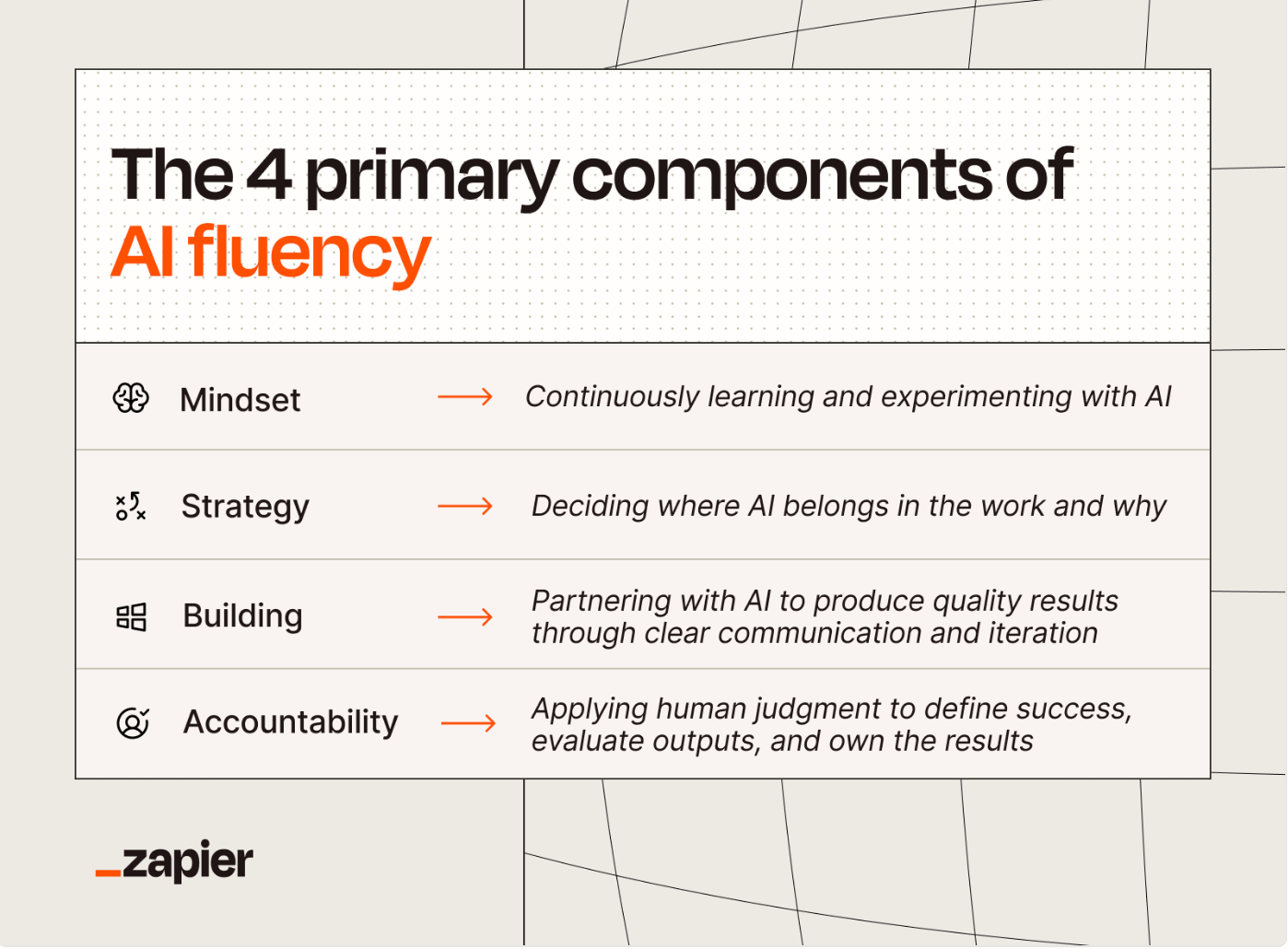
It centers on four competencies that Brandon describes as metacognitive capabilities rather than technical skills: mindset, strategy, building, and accountability.
Mindset is about learning quickly. One of my favorite ideas from our conversation was Zapier’s emphasis on “slope over snapshot.” Zapier cares less about what someone already knows than how rapidly they improve. In a world where AI capabilities are changing every few months, that makes a great deal of sense.
Strategy is about judgment. Before deciding how AI can help, do you know what’s worth doing in the first place? Can you identify the highest-value problems for AI application? Can you distinguish between work that should be automated and work that depends on human judgment?
Building may be the most misunderstood competency, since it doesn’t just apply to software engineers. Recruiters redesign hiring workflows, People operations teams build systems that improve work across the function, and customer support teams build prototypes and evaluate entirely new ways of serving customers. Every employee is expected to improve how work gets done.
Finally, there’s Accountability. AI can dramatically increase output, making it even more important to stay focused on outcomes rather than completion. As Brandon explained, AI helps you get more of whatever you’re trying to do. If you’re optimizing the wrong thing, AI simply gets you to the wrong thing faster.
The framework also recognizes that these capabilities develop over time.
Someone operating at the Capable level uses AI to improve their own work. At the Adoptive level, they’re building systems that improve work for an entire team. At the Transformative level, they’re redesigning how work happens across people and technology. Zapier’s role-specific examples make the progression tangible. A recruiter is expected to redesign hiring workflows. A customer support leader rethinks the operating model itself.
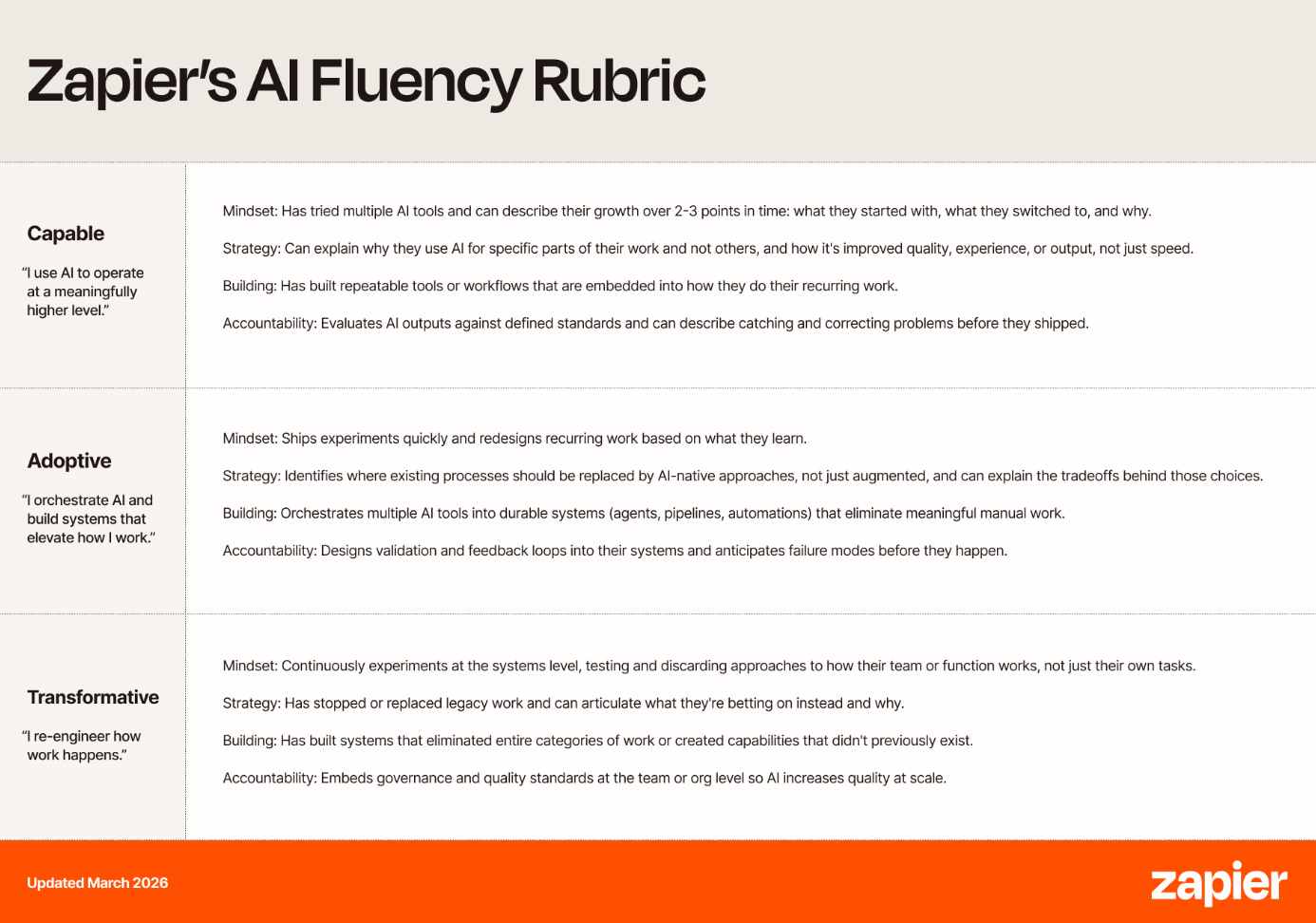
School leaders should read this framework with excitement and discomfort.
The excitement comes from recognizing that AI elevates many of education’s oldest ambitions. Learning how to learn. Exercising judgment. Solving unfamiliar problems. Taking initiative. These are the metacognitive capabilities schools have long hoped to develop, and AI makes them even more valuable.
The discomfort comes from recognizing how difficult these capabilities are to cultivate and measure. Much of K–12 and higher education still rewards demonstrating knowledge, following established processes, and producing the right answer. The competencies employers increasingly value are harder to observe and access, and often treated as secondary.
Does Zapier’s framework represent what every employer is optimizing for today? Probably not. They’re likely a few years ahead of the broader labor market. But if AI continues reducing the value of routine work while expanding what individuals can accomplish, it’s hard to imagine the rest of the market moving in a different direction.
For educators, that’s the opportunity. AI literacy should begin with the capabilities that allow people to learn, exercise judgment, build, and remain accountable in a world where AI changes what work looks like.
Zapier’s framework is one of the clearest attempts I’ve seen to make those capabilities visible.
— Allison
ALLISON: It’s been about a year and a half since you published your first AI fluency rubric. How has that framework played out?
BRANDON: We created the first version of the Zapier AI Fluency Framework to establish clarity within our organization. Our business is about enabling people to use technology to do the best work of their lives—to become the most elite version of their role. AI has raised the bar for what people can do. We thus needed clear standards around AI fluency to attract and develop top talent. That’s what version one was meant to do.
Most of the core competencies in our framework have little to do with the AI tactics of the day. They’re better described as metacognitive skills. For example, we don’t look for or develop prompting as an explicit skill. That’s not to say prompting isn’t important, just that other skills and competencies more consistently help people do their best work with AI.
We’ve carried over four metacognitive skills into version two of the fluency framework:
Growth is about continuously learning with AI. We’re interested in the tools and mindsets people use to scale their rate of learning. And I don’t mean AI tools. We’re looking for cognitive skills that signal how someone approaches learning.
Tracy St. Dic, our head of talent, made sure this value carried into the framework’s second version. Zapier has a long history of rewarding the slope of someone’s learning and skill over a snapshot of their performance. If a candidate’s skills take a big leap forward over the five to seven touch points in the interview process, for example, it can make a difference in whether we offer them a job.
So much about work and the future of work is up in the air right now. Entire business models are under pressure or being reinvented. We’re betting that being highly skilled in today’s job will matter less than a person’s rate of learning in the future.
The second competency is strategy, or deciding how AI fits into work, and why. Before we start talking about all the things you can do with AI, we want folks to know what’s worth doing in the first place. That requires a combination of business acumen, judgment, and context. We’re always looking for a sharp, strategic understanding of AI in hiring and onboarding.
Third: we want people who can build—partnering with AI to build quality results across prototyping, iterating, and quality control. Do you have a mental model for prototyping with AI and people and making it better over time? What do you do when you get stuck? How do you seek other perspectives when you need a lift?
Accountability is the fourth competency, and it’s the single most important change we made in version two of the framework. Can you apply human judgment to define success, evaluate outputs, and own the results?
AI makes this accountability critical because it scales outcomes. If you’re using AI, you get more of whatever you’ve chosen to do: customer outreach, lines of code, sales calls, support tickets—whatever it may be. AI might let us screen five times the number of candidates in an hour, but that’s not what we’re accountable for. We’re accountable for the efficacy of the screening process.
Accountability was implied in version one, but we made it explicit in version two because its importance became clearer over the last year. We need people rigorously committed to outcomes. We want them to have a point of view on process, but not treat their job like a checklist. If something unexpected happens, you’ll likely have to deviate from the process; how do you then adjust course to get to an excellent outcome?
ALLISON: How are you evaluating, hiring, and developing early career employees? I ask because the answer here is one of education’s best signals.
BRANDON: Takeaway one for educators: These metacognitive skills matter more, not less. Young people need practice applying them, especially when using technology. Otherwise, we’re just hoping they make those connections once they start working. Employers already expect entry-level employees to apply a growth mindset when building automations with AI, and to be accountable for the outcome of an AI-enabled process. They need reps before they get to work.
I personally wouldn’t suggest that AI’s presence in our world justifies overhauling the purpose of our education system. For me, AI is a means of getting something done, something we need to learn to use at work, like telephones and email. I know it seems wildly different because it’s so new and feels so powerful, but at the end of the day, AI is a means to an end. The ability to use it to accomplish work well is what we hope our employees can do with AI.
I have nine- and seven-year-olds, and I hope their education is grounded in timeless metacognitive development: asking big questions about the world they live in and the world they want to create, and using technology to deepen their understanding and experiment with the solutions they think matter. I would have said the same thing before AI.
ALLISON: Can you walk me through the three levels of competency in the framework—Capable, Adoptive, Transformative? What are the differences, and what are the stickiest skill gaps as people advance from one level to the next?
BRANDON: Sure thing. Someone Capable uses AI to elevate their individual work. That can look like understanding the work well enough to describe, in priority order, where AI can help most, where it might offer a marginal lift, and where it might be patently unhelpful. This, by the way, is the floor for many entry-level hires at Zapier. At this level, we’re less interested in whether candidates have the right answers, or think they do, than in how they think through a problem and understand work in relation to AI. Full stop.
Someone who is Adoptive creates scalable systems that entire teams use to get better outcomes. That requires understanding how different types of work fit together, and how the system’s stocks and flows operate—a higher-level grasp of how the organization works. Their building skills need to match the sophistication of the systems they create, and their accountability rises too, as it touches more of the business. Here, we’re mostly talking about building AI systems in ways that enhance work.
We rarely see Transformative competencies at Zapier, but we think we will see more folks working at this level over time. These folks are essentially re-engineering work across people, process, and technology. The team leading customer support at Zapier is transformative. They deeply understand how that work touches the customer and how it was conventionally done. They understand the outcomes we want to improve, and the messy human pieces of the work. As they redesigned the process, they accounted for not just new technology or retraining, but how roles and team composition needed to adapt too. And they know how to lead a team through that change. Because at the Transformative level, you have to get it right in practice, not just on paper. That takes leadership and trust.
ALLISON: Zapier has a rigorous hiring process with screenings, asynchronous exercises, live interviews, AI interviews, and human interviews. Do you have to generate all of your signals across these rubrics, or are there existing signals in candidates’ portfolios or credentials that you assess too?
BRANDON: We’re generating it all ourselves. I wish there were a badge or credential out there that could serve as a trustworthy source of signal on these competencies, but we haven’t seen it yet.
ALLISON: Do you think it’s possible?
BRANDON: Absolutely.
Comments
Nothing yet. Say the first thing.
Sign in to join the conversation.