
“Situations emerge in the process of creative destruction in which many firms may have to perish that nevertheless would be able to live on vigorously and usefully if they could weather a particular storm.” - Joseph A. Schumpeter
This is how the story is supposed to go: obsolete mills and assembly lines close or streamline, and displaced workers and capital naturally migrate to exciting new industries we’ve yet to conceive.
Except those miraculous new industries apparently got lost on their way to Youngstown, Flint, Gary, and Bethlehem. The Rust Belt has been waiting patiently for the creative component of Schumpeter's theory to kick in. Still waiting in fact, 50+ years later.
Do these formerly great cities offer a preview of an uncomfortable question we might face again with our AI overlords bearing down? Have we learned what happens when the destruction part of Schumpeter's theory arrives right on schedule, but creativity calls in sick?
And when something finally does emerge to fill the economic void, what if it employs one-twentieth the people at one-third the wages?
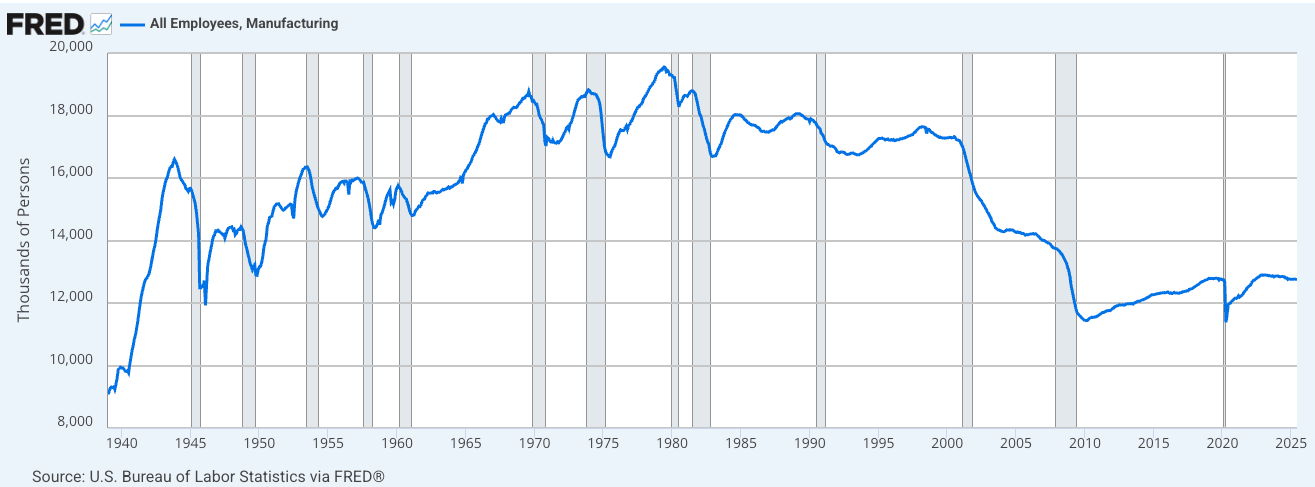
Manufacturing employment in the U.S. peaked in 1979, and it’s been in structural decline ever since. The twin forces of automation and offshoring hollowed out the sector, and despite decades of campaign-trail promises and economic development gimmicks, the data tells a blunt truth: those jobs haven’t come back and they’re not going to. Certainly not at a scale that reshapes the workforce.
But squint hard enough and you might spot progress, depending on your definition. In place of shuttered factories, “warehouse cities” now rise: boxy shrines to next-day delivery, rising where land is cheap, zoning is loose, and labor is both plentiful and eager.
In what reads as either vindication or refutation of Schumpeter's theory, one of Amazon's largest fulfillment centers now sits on the grounds of Baltimore's former Sparrows Point steel mill. Where 30,000 steelworkers once earned middle-class wages with full benefits, 1,500 warehouse workers now hustle for $17.78 an hour, according to Indeed.
Factory closures unfolded gradually over decades, but AI-driven job displacement operates at software speed. When artificial intelligence masters a capability, the transition happens instantly across entire organizations. Eliminating redundant knowledge workers is as simple as a management decree, which executives are starting to foreshadow.
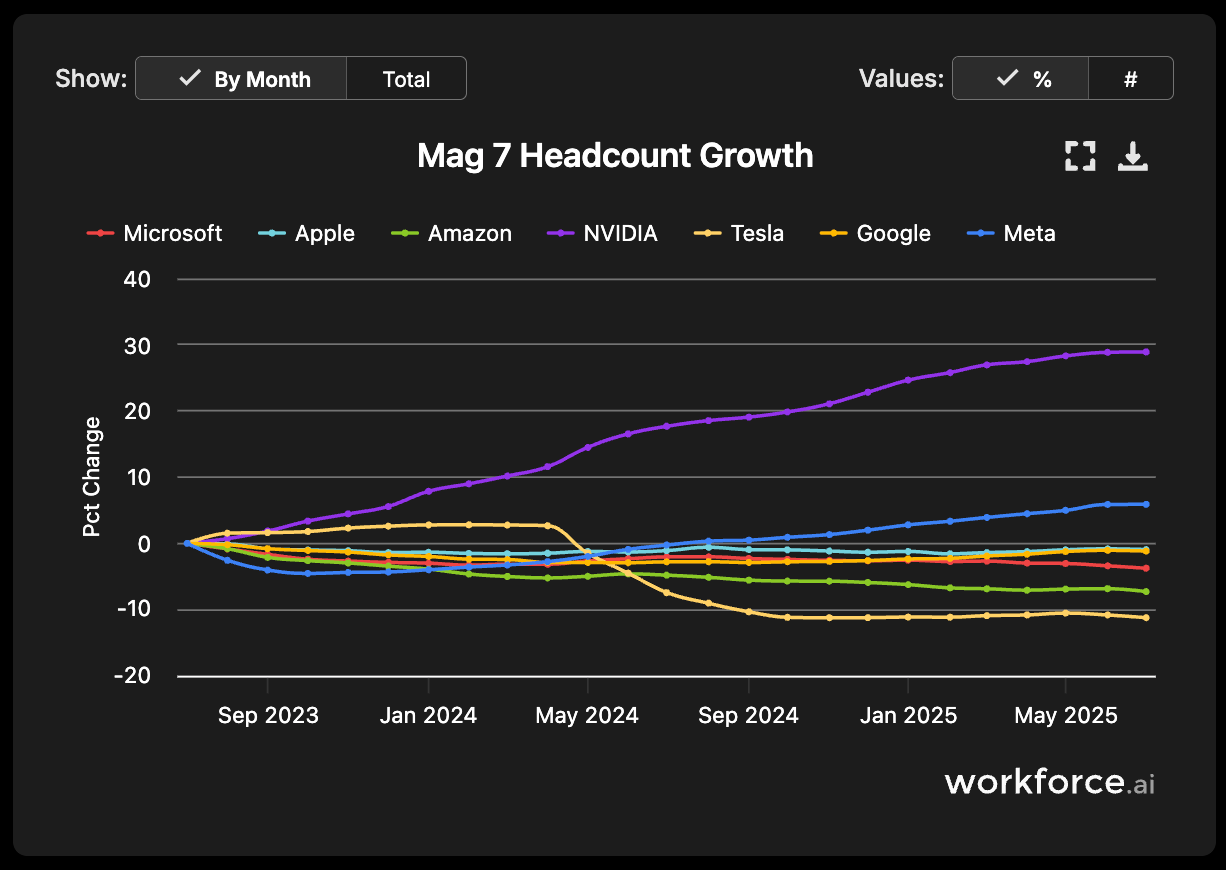
Live Data tracks the employment of 100 million professionals across North America and the EU. Our data shows workforce displacement is already underway throughout all white-collar sectors, roles, levels, and geographies. A prime example is the Magnificent Seven, the tech companies that represent 35% of S&P 500 market cap.
Over the past 2 years their combined value has doubled.
Their combined workforce? Down 5%.
We are so early in AI-related displacement that one makes forecasts at one’s peril. So here’s mine: AI-enabled productivity gains will drive market value, not job creation, fundamentally reshaping the nature and level of white-collar employment.
How boring. Yet another doomsday take on AI, heavy on drama and light on insight. Anything to add to the conversation other than loud opinions and recycled fear?
Yes. As you might imagine we have data.
Let’s move past speculation and take a firm-level look at AI’s likely effects. After previously analyzing AI’s impact on future employment at IBM, we now turn our attention to Microsoft, a cornerstone of the Mag7.
We analyzed AI displacement risk across Microsoft's workforce using a panel of 199,000 current employees. From this panel we identified 1,000 distinct roles that account for roughly 60% of MSFT’s global headcount.
Our analysis looks beyond job titles to the actual functions and tasks performed within each department. That distinction matters greatly as a software engineer managing internal IT systems faces far greater AI risk than one developing core product features. Grouping them together under a shared title ignores the critical differences that drive AI exposure.
Under 3 AI adoption scenarios, our analysis suggests that between 20-36% of roles could be eliminated or consolidated by 2029 through AI adoption. Highest-risk positions include IT support, financial operations, and basic QA. Lowest-risk roles encompass legal specialists and senior technical leaders. As with IBM’s analysis, engineering again showed bifurcation: junior individual contributors face high displacement risk while technical leads and architects were relatively safe.
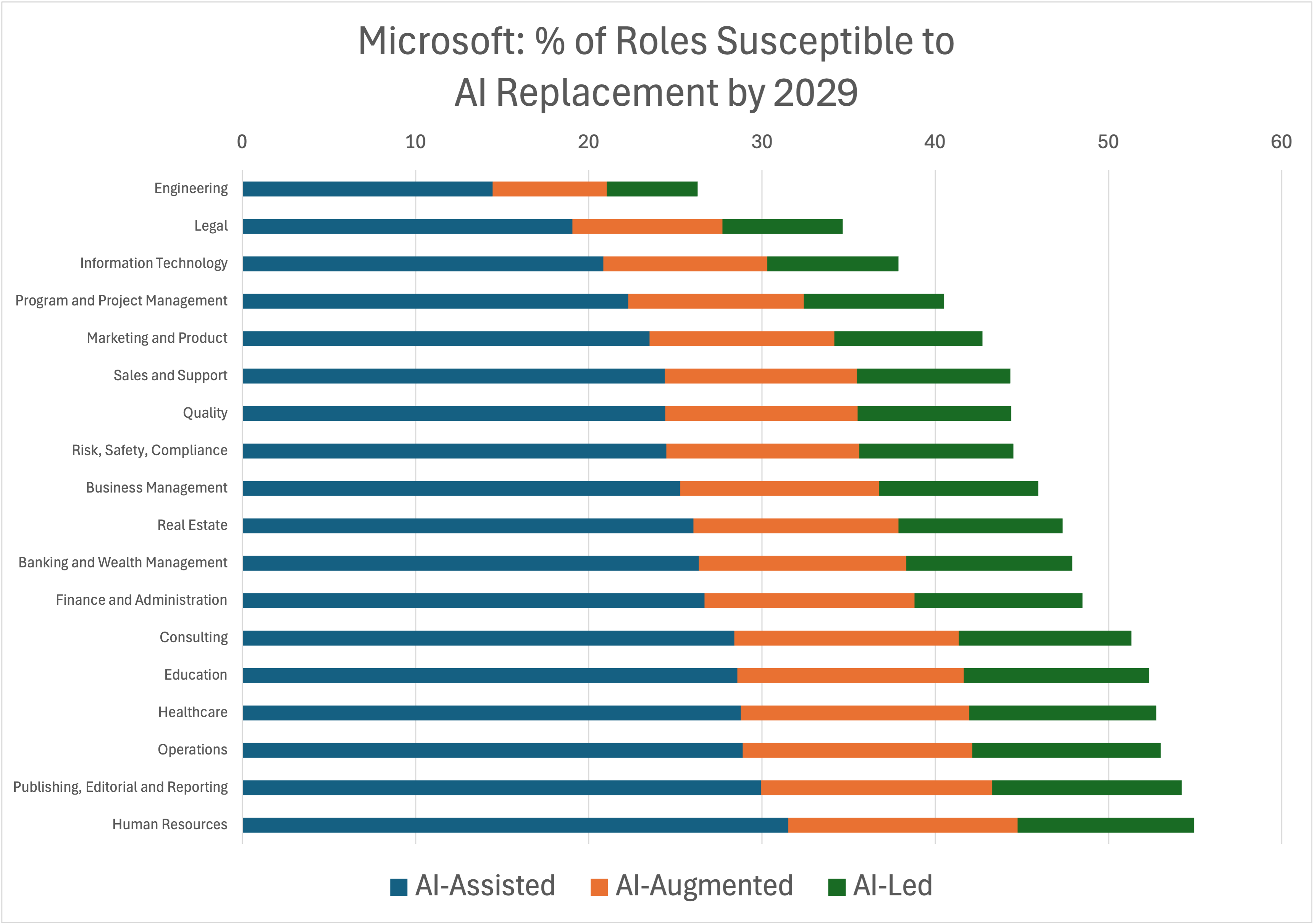
One caveat: our model reflects current AI capabilities, and if the past three years taught us anything, it's that AI advances will likely surpass what we can imagine today. This suggests our most aggressive replacement forecast (36%) may actually be conservative.
These projections also ignore potential organic growth in Microsoft employment from new markets and opportunities. But just as it seems unfair to anticipate the impact of unimagined AI on today's workforce, it's equally unfair to project job growth in markets we can't yet contemplate. In that sense, our analysis is static: a snapshot of current employment under threat from current AI efficiencies.
The math is brutal. When AI can draft contracts, analyze data, and write code at near-zero marginal cost, why employ armies of associates and analysts? So instead of 100 junior consultants McKinsey only needs 10 AI-augmented ones. That's 90% displacement even in this optimistic scenario.
Assuming surrender isn't an option, the only path is forward. But how do companies master this new reality? When radical downsizing becomes standard practice, executives require real-time intelligence on competitor strategies: which roles they're eliminating, how quickly, and what organizational structures emerge from the cuts.
Workforce planning was designed for growth. There’s no playbook for shrinking strategically while still moving forward. The companies that endure will be those tracking their own evolution while learning from how others confront the same hard choices.
That’s why we built Workforce.ai. With just a few clicks, you can see exactly how your organization compares to its peers. Now is not the time to be guessing, so I hope you’ll stop by and create a free account.
Comments
Nothing yet. Say the first thing.
Sign in to join the conversation.