
Measuring the health of America’s labor market has never been easy. The Bureau of Labor Statistics (BLS) monthly reports provide a headline number, but these are notoriously volatile and often heavily revised. In spring 2025, payroll gains reported for May and June were later cut by a combined 258,000 jobs, revisions that shake confidence in the Bureau and raise the ire of certain politicians.
While Live Data has no aspirations to offer a competing measure, we do believe there is another employment dynamic of equal significance. Through our Workforce.ai platform we track the employment status of ~80 million U.S. workers and capture roughly 1-2 million job changes every month. Unlike the BLS, which emphasizes aggregate job counts, our focus is on the flows of people moving from one employer to another.
Or, increasingly, moving to no employer.
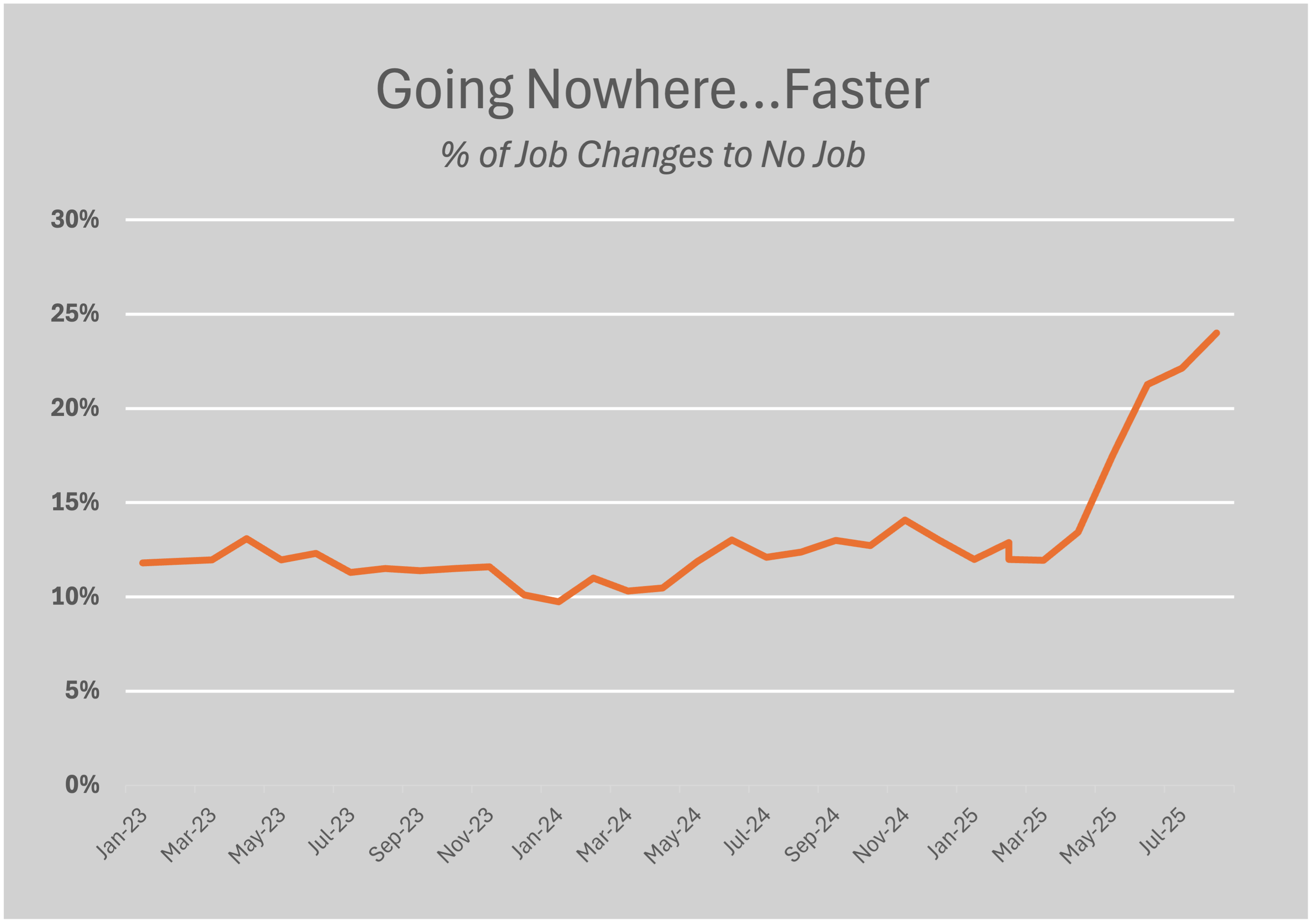
The NOPE Index is a forward-looking gauge of labor market health, measuring the share of job changes that end without re-employment within 45 days. Whether it’s a layoff, a voluntary departure without a next role, or a decision to leave the workforce, these exits reveal the economy’s momentum. In a strong market, the share stays low as workers are quickly reabsorbed; when conditions weaken, the rate climbs, making the NOPE Index a real-time barometer of job market dynamism.
The chart below tells the story clearly. Through 2023 and into early 2025, the share of separations ending without re-employment held steady, fluctuating within a narrow 10–15% band. But starting in the spring of 2025, the line turns sharply upward. By May, the rate had broken decisively above prior norms. We suggest this change is a strong signal that the labor market’s capacity to create jobs is deteriorating.
The BLS is up against an impossible challenge: sampling 12 million establishments in an economy that moves faster than surveys can capture. By the time results are collected and modeled, the picture is already outdated.
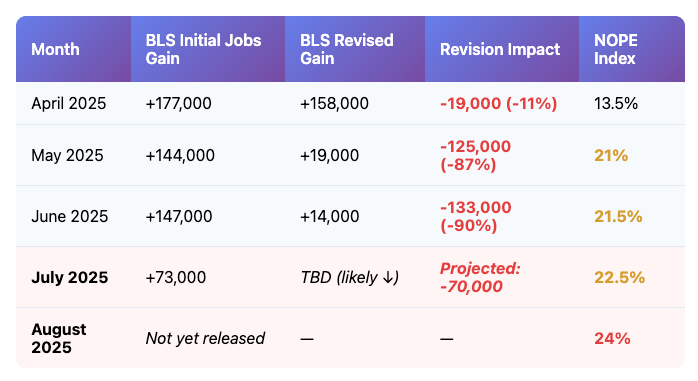
The table below illustrates how the NOPE Index aligns with subsequent BLS revisions. In April 2025, when the Index held steady, the revision was modest. But in May and June, the Index spiked to around 21%, even as the BLS initially reported job gains of 144,000 and 147,000. Once their data caught up, those gains were essentially erased.
Looking ahead, the NOPE Index points to July’s reported +73,000 being revised downward. And while August figures are still early, they suggest little to no growth.
The data suggests the US labor market is losing its vibrancy. Fewer job-to-job transitions, more exits to the sidelines, and a slow drip of workers into self-employment and out of the workforce altogether. However one characterizes it, the picture comes into sharper focus when we track the flows of the workforce rather than static net job counts.
That is the purpose of the NOPE Index. It is designed to capture the economy’s ability to reabsorb workers in near-real time, something the BLS can only hint at months later after sometimes painful revisions. And right now the measure is telling us the U.S. labor market is functioning but showing little signs of overall growth.
We’ll update the Index each month, and future editions will spotlight sectors, industries, or regions showing unusual trends.
Comments
Nothing yet. Say the first thing.
Sign in to join the conversation.