
“[N]othing, none of it belongs to you. You can only have it by letting it go. You can only take if you are prepared to give, and giving is not an investment. It is not a day at the bargain counter. It is a total risk of everything, of you and who you think you are, who you think you’d like to be, where you think you’d like to go — everything, and this forever, forever.”
—— James Baldwin, “The Artist’s Struggle for Integrity”
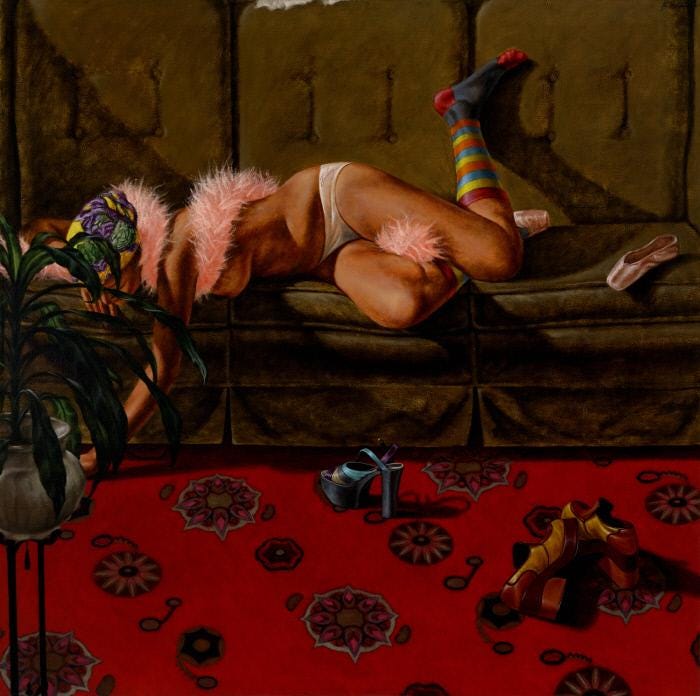
Barkley L. Hendricks, Take All the Time You Need (Adrienne Hawkins), 1975. Oil on linen canvas, 72 × 72 inches (182.9 × 182.9 cm). Gift of Kelsey and David Lamond. 2014.6.1. Courtesy of the artist and Jack Shainman Gallery, New York, New York. Photo by Peter Paul Geoffrion.
From the Nasher Museum of Art website.
For my partner Trin and I’s five month celebration, I planned a secret date to the Nasher Museum of Art. Our gallery guide, an older white woman who often volunteers at the Nasher, led us into the current exhibition: “Everything Now All at Once.” I had seen the exhibit before during a tour led by curator Xuxa Rodríguez, so I wasn’t really expecting to see or experience anything too new. Having started to come out of an ankle injury, I just wanted to be an attentive partner and show my love – a poet with a tender heart – some good art before my upcoming work trip to NYC. Or so I thought.
And yet the first painting we looked at together proved me wrong. The intimacy of a living room was palpable through the canvas. On a green couch, a Black woman is lounging half-naked. Wearing a colorful head wrap, her face is concealed behind the vibrant leaves of a house plant. She seems to be reaching for something – perhaps a trinket that had fallen on the floor. Or, she might just be gazing downward, deep in her own thoughts. She is wearing a pair of multi-colored striped socks, with only one pink ballet slipper on. The loose slipper is laying around on the couch, just like the other heeled shoes resting on the red, velvety floor carpet. A pink feather boa gently wraps around her body, almost like a lover’s embrace.
The sunlight from the window casts a warm hue and gentle shadows on the woman’s contours. Her stomach, one of the most vulnerable areas of the human body, is exposed to the tender gaze of the painter. The painter is out of the frame, and yet his presence was felt in relation to her ease at being herself. I couldn’t help but look at the label: “Barkley L. Hendricks, Take All the Time You Need (Adrienne Hawkins), 1975.” I curiously asked our guide if she knew any context of this painting.
She said in the most matter-of-fact fashion: “The woman in the painting is the painter’s then-girlfriend. A few years ago, he and his wife also visited the Nasher and saw this piece in person.”
But these plain words pounded against my chest. I wonder how Barkley Hendricks and his wife Susan both felt looking at this painting years later. I also wonder how Adrienne would’ve felt looking at herself, and how those feelings must have changed over the years. A painting seems to hold so much memory and tenderness.
Historically, portrait paintings were often used as a tool to immortalize, to enshrine, to capture and reinforce the glory of the privileged class. But an intimate moment like this continues to flow and change. In many ways, the pain and beauty of the mundane resists immortalization.
· · · · · ·
December 4, 2025
“Just because the roots bearing the fruits are rotting away doesn’t mean you can’t still keep the fruits; they belong to you,” someone said to me in a dream.
· · · · · · ·
I still remember that morning, a little more than two years ago, when I woke up next to my then-partner in my tiny sunroom-turned-bedroom. There must have been some eye crust on his short and stout lashes. If so, I must have playfully wiped it off his face and made fun of him. He tended to enjoy a lazy morning, so I’d often wake up to his face – a little puffy and droopy around his chin and neck – still sound asleep. His pajamas stained with drool that I couldn’t tell if it was mine or his. I had always been an anxious lover, constantly afraid we’d run out of time. So I relished that gentle slowness, listening to his steady breath.
By that point, we had been together for four and a half years. We were high school sweethearts. But because of COVID, we became long-distance a few months into our relationship even while we were still in China. Then, we both came to the US for school. The distance between us changed from an hour drive to an hour flight. We tried our best to spend a weekend together every month or two.
Without cars, we couldn’t really do much. We’d just scout for the best Chinese restaurants, get groceries from H-mart, make spicy dry pots with barely any vegetables, watch K-dramas or comedy, have sex, and repeat. Then, I’d make the same joke that I’ll change my flight to tomorrow. “Just one more day, pleaseeee.” Or I’d grab his phone and threaten to cancel his flight back to Atlanta. We both knew we had our own lives to get back to, but we indulged in the play every time. After saying “I’ll miss you” a million times, I’d cry before he/I got on the Uber, or wave him goodbye through the airport TSA windows. I couldn’t control the heartburns.
That morning seemed to be no different. He was in town for my birthday but he couldn’t stay for the actual day, so we just decided to combine the celebrations with the Mid-Autumn Festival. Mid-Autumn is often for family gatherings, but for international students, our friends and partners were our family. Looking back at my calendar from that weekend, I can’t even figure out what we were up to. It was that level of mundanity – not even a restaurant reservation or a walk in the forest. I’m an obsessive calendar user because I’d like to feel every moment of my life is not wasted. And yet with him, I didn’t feel guilty for pausing.
But that morning, I decided to pick up my camera. My partner was still half asleep, his eyes squinting at the stark sunlight shining through my white blinds that barely deflected any of it. He lifted his right arm to lightly cover his face, while stretching his left arm and yawned. In Chinese, we endearingly call it 伸懒腰 – stretching out your lazy back. I found so much beauty in the crisp shadowplay on his face. So much that I rolled out of bed and ran to grab my camera, fearing the light would shift quickly. I kneeled on the mattress and looked at him through the viewfinder. I was also looking at how he looked at me through the lens.
I asked him to just relax and be himself. Sometimes I’d move his arm to my liking and he’d simply let me. I clicked so many shots that my arms and fingers were sore. I’d show him what I had – both the more manly ones and the more cutesy ones, and we’d joke about his masculinity. My queen size mattress topper, which I bought one size too big by mistake, had shifted dangerously far from the edge of the bedframe overnight, so I almost slipped and fell. But none of it mattered to me: nothing other than documenting this moment with him.
· · · · · ·
Last week, I was in New York City for a performance project with my artist collective and creative partner Dudu. We also celebrated our collective’s belated third year anniversary at a friend’s apartment. In the damp afterglow of the first December snow, nine friends – mostly of the queer Asian diaspora – came to our dinner gathering. We all met each other in different stages of our personal and collective lives: from frequent collaborators to new community members, even childhood friends or high school classmates that reconnected later in life. Different circuits of connections were woven into our laughter, conversations, and mutual massages. The savoryness of the Xi’an noodles, sprinkled with Dudu’s fresh spring onions; the juiciness of the pork dumplings; and the sweet numbing effects of the Sichuan peppercorn from the strawberry shortcake lingered on our tastebuds and hearts. This is a night I’m sure we’ll remember for years to come.
After the majority of the guests left, Dudu, my high school friend Y and I ended up chatting until 5:30 the next morning. I resisted my drooping eyelids with the warm honey tea Dudu made and by keeping my mouth busy. Soon enough, I piled up husks of sunflower seeds into a small hill on the table. It felt like Chinese New Year from my childhood, when my relatives would gather to drink, gossip, play mahjong, and welcome the new spring’s arrival. At times, I’d close my eyes and hide under the blankets on the couch, while listening to the low voices of my friends. As if I was floating in a half-dream.
All of us had been in long-term relationships, except that I was the only one who had already left. Naturally, we ended up on this topic. Both of them had witnessed in person the latter half of my relationship with my ex. It felt refreshing to talk to friends who still knew him by name, not just a faceless ghost that only exists in past tense.
I even had one of the most explosive fights with him over the phone in Dudu’s old living room, across a 12-hour time difference. Likely, it was about the same problem that he never reached out to me or shared anything from his life. I felt neglected and resentful. He felt confused and suffocated. “You never saw how much I did for you,” he said at some point, his frustration palpable through the phone, “and you’re ashamed of dating a cis-het man.” I did not deny it. My memory is blurry other than the heartburns that were tearing me up from the inside.
I brought up the Barkley Hendricks painting that had been haunting my memory for over a week. How it reminded me so much of the photo I took of my ex. How special that it was one of the first images that I was proud of taking with my digital camera. How much it meant for me to explore in a safe space at such a beginning stage of my career. I handwrote the title of the image: “My partner W, just waking up.” Unlike some of the other images in that series with visual poetry or drawings, I decided to keep it short. “I still consider it one of my best works – if not the best,” I told Dudu and Y. “My technique did not make the image; our relationship did.”
Four months after the break-up, I published that body of work in a digital magazine. I changed the caption to “(then) partner” while preserving the original print without explaining the discrepancy. Six months after, when I showed this series at a local lesbian bar, I decided to remove the photo of W from the wall. What a quiet decision, a gradual goodbye. A ritual that only mattered to me. Suddenly, tears choked up my throat and my voice broke.
“I don’t know when I’ll ever show that photo again. Even if it were the only thing left from sharing six years of our life, I still don’t regret it.”
· · · · · · ·
Of course, it was complicated. Three years into our relationship, I cut my hair and dyed it bright red. I changed the preferred order of my pronouns from she/they to they/she. I began organizing and making art again and surrounded myself with new people. The more I stepped into my queerness and my calling, the farther we drifted from each other. He stopped asking questions. I stopped explaining. We only met up a few times a year. My friends witnessed how much I hesitated to end something that felt so familiar and yet so far away from my full being. It’s like my favorite line from the Arcane: “our roads diverged long ago; it was affection that held us together.”
Sometimes I struggle to remember why we stayed. Other times, I struggle to remember why we left. We spent almost every school break traveling across the US together. I remember sobbing in the Walmart parking lot with bags of foot warmers when I found out my late grandfather’s brother also died in a lockdown in Urumqi, him patiently waiting in the driver’s seat, the front window blurred by the heat colliding into Alaska’s December snowstorm. I remember one of the only times we cried together, squished into a twin-sized bunk bed, wishing there wasn’t a travel ban between us and our families struggling with COVID. I remember seeing the cherry blossoms in DC together when my nainai passed away. I remember how he’d wait outside the shower, arms open with a dry towel, so I could run into him, squealing at the warmth from a double embrace. I remember buying overpriced flowers for him at his college graduation ceremony, when his parents couldn’t make it. Perhaps, like two duckweeds floating in foreign waters, we bonded over our loneliness.
Over a year since our official break-up (and add five months of not having seen each other before that, plus 2.5 new break-ups), I’m no longer grieving for a specific person. More so, I’m grieving for a past version of myself that he got to witness and the safety that I once felt and built with him. The grief is ongoing. A kind of white noise, hardly detectable yet deeply felt. Like the recurring ulcer on the inside of my right cheek: my teeth would grind against the open wound with every breath, every word, every bite. Like my ankle pain flaring up after attending a friend’s birthday party.
Even in the most joyful moments, the pain is ever present.
· · · · · ·
In a dream a few months after we split up, W approached me with a knife he stole from the restaurant we were dining at, after I stormed off the door mid-argument. He wasn’t actively trying to stab me, but he was holding it, pointing towards me. He didn’t say anything. I returned to him. I returned the knife to the front desk as if nothing happened. No one asked any questions. Then we went back to a house where we had dinner with my grandmother whom he never met in real life. I went outside in the depth of the night and burned a circle on the grass. We cuddled and went back to sleep.
· · · · · ·
My partner has been saying they miss me a lot. I do also miss them, I think. Recently, my emotions have felt muted. I feel like a ghost in my own life, just watching everything unfold. Perhaps it’s because for too many times, I’ve shown my emotions to people who refused to hold them. So now, in someone’s loving presence, I am taking all the time I need to heal.
It has been a hard couple of months. We had just moved into a stable place in our relationship, but a bad ankle injury turned my life upside down. I couldn’t really hang out or be present in the ways I wanted to. Then, we had a hard moment due to miscommunications. Even though we were able to resolve it quickly and no one was at fault, my body was taking more time to rebuild trust with them. Then, I had to be away in NYC while Trin was having a hard time. I ended up coming back two days later than I had planned, but we couldn’t see each other because they caught a cold.
Our first interaction ended up being in their car, both masked, as they picked me up from the birthday party where I ran into a most recent ex for the first time. I told Trin about the heaviness that was arising in my chest even though I couldn’t actively feel any strong emotions.
But as soon as I was able to name it, my tears felt the permission to arrive again. “I have a lot of grief around not being able to show you my best side in the early stages of a relationship. Where I’m playful, attentive, passionate. I’m still grieving so much of what has happened before.” “You’re still really attentive and loving,” Trin affirmed me, “and I’m lucky I get to witness you wherever you are.” Even though we couldn’t hug each other, those words – and how they looked at me – landed on my shoulders like a warm blanket.
We’ve had many conversations like this in the car. When I first confessed my feelings for them, after I panicked when they said they were “shopping for a wife” at Dyke Night. When we learned to hold each other’s hands and make grounding touch during a difficult conversation. Even times when I thought it might be the end.
That night, we sat in silence for a while as my snot and tears dampened my mask.
· · · · · ·
Two mornings later, I woke up suddenly from the depth of a dream. In the dream, W and I had freshly broken up. I don’t remember what happened, other than the viscerality of grief and anger pouring out of me, scraping against my organs and skin from the inside. He was crying too but I couldn’t see his face. I realized that it’s been a while since I felt this intense rush of emotions while awake.
In real life, our break up was quite civil. We were on FaceTime, each working on our own things in silence like we’d always do. It wasn’t an awkward silence, though. It felt comforting to be able to call someone out of the blue and be in each other’s quiet presence. Sometimes I’d spam him with WeChat stickers when I was bored, and I could always count on his instant reply. I was surprised to find out he never muted our chat and routinely endured the endless buzz. Sometimes I’d implore him to stay on the phone until I had fallen asleep.
His love was mellow, steady, forgiving. With him, I could be quirky, bratty, annoying and willful. I could playfully stick my foot to his face and clasp my ankles around his neck like a monkey dangling from a tree, knowing acceptance was a given even between his frowned brows. And, he did not love me in ways I wanted him to. I sought love in action, in curiosity and understanding.
“So what do you think of me now?” I finally asked. I had noticed he recently changed the WeChat profile picture I drew for him. He had been using it since Valentine’s Day in 2020. “A friend,” he replied as he continued typing on whatever work document or research essay he had to finish; I didn’t bother to ask what it was.
“I think so too,” I said, “but it doesn’t mean I don’t care about you anymore. We can still call.” Then, we ended up co-working for sometime until one of us had to go to bed.
A week later, I finally dropped the “she” from my pronouns.
Of course, we never ended up calling again. A part of me wished our break up wasn’t that calm. We spent almost six years together after all. I wanted some proof that our time together meant something, that we were both in pain. That even though we stopped feeling loved, we both loved each other in ways we could. It felt unfair that I had to sit alone with the relational wounds that he contributed to, yet did not have the willingness or the ability to process together.
Still shaken by the dream, I took some time to breathe in bed before getting up. I reminded myself that I am my own witness. Only I can access the truths that are already in my inner knowing. Only I can give myself the permission to heal.
· · · · · ·
That same night, I told Trin about the dream when they pulled into the narrow gravel road next to my apartment. It was already almost midnight, and we weren’t planning on hanging out that evening. But a few hours before, when they pulled into the same road, I didn’t want them to leave. So I invited myself over for dinner and took a zoom meeting from their room. “You know I can never say no to you,” Trin turned the wheel with a light laugh. Even though it was already dark at 7:30pm, in my memory, their face was glowing under their bright pink hair we dyed together. “You know technically you can always say no to me, right?” I shrugged, “I won’t enable that, but I happily accept it.”
We both had a long work day, but our banter continued through the evening. I used my elbows to release the tight tensions in their shoulders. Then, I sat on the floor and asked them to massage mine. We listened to a Chinese song version of the Buddhist heart sutra that randomly popped into my YouTube. “Feels like we’re in a spa,” Trin sighed. We stretched together and cuddled in bed. We took turns being the big spoon and little spoon.
We joked about the possibility of queerness being penalized in the future and us getting locked up in gay horny jail for ten years. We debated if they’d get killed because they’re Black and me deported to Guatemala. “Depends on the prison guard’s mood, I guess. But you don’t even speak Spanish!” Trin exclaimed. “Maybe I’ll be deported to Japan and get free healthcare,” my laughter sounded like a horse’s neigh. Then I joked about being a “switch” as the ultimate middle class. “So what am I?” Trin asked. “I guess the ‘B’ in ‘BIPOC’ stands for ‘Bottom’ for you.” We bursted into laughter as I rolled over and grabbed my phone to frantically jot down notes for my emerging stand up comedy side hustle.
Humor is sexy. Joy and desire both make you tremble. I could feel their hands anxiously wandering on my waist, which made me laugh and want them even more. I knew that they were waiting for my explicit permission, but I wanted to play and keep them guessing. So I closed my eyes and hummed a random melody from my brain even when I felt their eyes caressing my face.
“You’re so evil you find my anxiety to be entertaining,” Trin complained begrudgingly, yet I could see the love overflowing from their eyes. I let out a string of devilish giggles before we finally melted under each other’s touch. My ulcer made it hurt to open my lips too wide, but I still enjoyed kissing them for the first time in two weeks. As responsible working adults, we tried to get up and leave before it was too late. But then we kept pulling each other back into our arms and kissing again, relishing this long-awaited reunion.
As we finally gathered the sanity to leave their door, the right side of my throat – close to my ulcer area – started to hurt. By the time we got back to the gravel path again, we must have said we missed each other at least five times. “Just one more minute and one more hug,” I wrapped my arms around them. It’s a request I learned not to make with my two recent short entanglements, but Trin makes me feel safe enough to indulge.
“My friends told me that when I was with my ex, my body seemed to be so relaxed around him. I was hanging on him like a sloth clinging onto a tree.” I broke into a quiet laugh and wiped off my snot and tears. “Despite all our incompatibilities and misunderstandings, it was such an embodied way to love someone. And I felt it again with you today. Even though of course there are things that only come with time, I felt something similar with you. I guess this is what ‘I love you so much it hurts’ feels like. It hurts because it’s fucking sad and layered. The joy of being able to melt into another person’s arm again brings up the grief of all the times I couldn’t be loved that way. And the sorrow of the times I was loved but did not cherish it.”
Trin also cried. In our simultaneous sniffling, they told me how much they missed being close to me, and I said I’m sorry it’s been so hard. “You show me what real love looks like,” they said while holding me closer. “I don’t think I’ll ever be able to love a partner as much as I love you.” “I hope you will be able to,” I said. “But let me be selfish for a little. Let me be special.”
We embraced for longer in a sweet silence until the night finally rushed us home. “I’ll be here until I see you walk into the door,” Trin assured me as I stepped out of the car and walked towards my building. I waved them goodbye after sharing one last goodnight kiss. When I turned around, even though I couldn’t see them, I knew they were laying their eyes softly on me. I realized the pain in my throat had already departed.
· · · · · ·
It’s a strange paradox to feel love-repulsed in the most loving and honest romantic relationship I’ve ever been in. Sometimes the more love I feel from Trin, or the more I love them, the more grief wells up. In dating discourse, not being “over” your ex is often seen as a red flag. But do we ever get “over” anything? Doesn’t everything we experience still live in us, just flowing in different forms, temperatures, velocities?
I used to find it hard to accept both things to be true – being in love again while still grieving. I attached moral values to how I showed up in relationships. So I ended up staying when I should’ve left, and leaving when I could’ve stayed. I got into too many entanglements before I gave myself the space to grieve all the small deaths that happened from my late teens to early adulthood, shared with someone who’s no longer in my life. At the same time, I held myself hostage to how I ought to feel, act, or think a certain way as someone’s partner. I was reaching towards an ideal version of me that could never arrive while feeling disconnected from the present.
In our late night tea session in NYC, Dudu shared an analogy of the moon. Maybe you’ll never reach that ideal state where you feel completely comfortable or content. Or even if you do, it’s not meant to stay. As soon as you get there, you’ve already started losing it. 月盈则亏 (As soon as the moon reaches its full, it begins to wane). However, the moon has always been full; only our perspective of it changes.
The wisdom of the moon feels similar to the symbiotic relationship of grief and love. I have always contained multitudes; the grief, love, joy, sadness, and rage have always co-existed. They just ebb and flow like tides and waves, pulled by gravity and what the heart desires.
Perhaps it’s most fitting that in Chinese, the character for love is 爱 (ài); for grief, it’s 哀 (āi). I always found it fascinating that they are homophones. In a hieroglyphic language, these characters are also action-oriented. 爱 contains friendship and heart in its form. In its earliest form, it looked like a person holding their heart with both hands. Their mouth is open, speaking the love in their heart. Han dynasty scholar Xu Shen 许慎 interprets it as “the look of someone walking” — you love and care for someone so much that you walk around and work hard for them. 哀 (āi) consists of a mouth and clothes. It used to denote exclusively the bereavement for a mother’s death. I imagine a person using their sleeves to cover their mouth while crying.
In Han Dynasty Gao You 高诱’s notation of Master Lü’s Spring and Autumn Annals 吕氏春秋, 哀 (grief) was explicitly noted as a feeling out of 爱 (love/care). It occurred to me that 暧 (ài) – denoting the ambiguous, dim state without ample sunlight, likely before sunrise or after sunset – also shares the same pronunciation and radical of 爱 (ài). Often, it appears in 暧昧 (ài mèi). In modern usage, it refers to the flirty talking stage in a budding romance. But in their origins, both 暧 (ài) and 昧 (mèi) mean ambiguity – in someone’s attitude, feelings, or the state of being.
暧 (ài) feels much aligned with how I feel. The ambiguity of it all – between love and grief, dusk and dawn, life and death, dreams and the version of reality I physically inhabit. 暧 (ài) is the process of becoming and being with what simply is.
That night in the car, I held Trin’s hand as I closed my eyes: “I accept whatever is arriving at my body. The feelings are coming back because I feel safe enough in my body to welcome them.”
To be honest, my emotions were muted not just because of the other people that refused to hold them. It was I who refused to see and hold all their complexity. In seeking validation of my pain from others, I forgot to build safety within myself. I hope to always be grateful for my body’s capacity to feel and experience life.
· · · · · · ·
“How do you know so many old Black people songs?!” Trin exclaimed with their eyes widened when they first showed me some Motown classics. “I don’t know why I just grew up listening to them in random places. Maybe they were quite popular in China,” I laughed, as the aroma of garlic and onions I was chopping began to fill their kitchen. We’d dance to the soulful music by Sam Cooke, Stevie Wonder, and Marvin Gaye or Mando/Cantopop stars like David Tao and Faye Wong, as we made lavishly homey dishes like stir-fried lamb, jjajangmyeon, and braised chicken wings. Or, we’d munch on fried chicken while watching F.D Signifier’s political analysis of Zohran Mumdani’s win and the Black Panther series.
Trin and I share our love for music. I started feeling attracted to them during a karaoke session, when we sang “Can’t Take My Eyes Off You” together. When I was going through a low period soon after we became partners, Trin made me a playlist called “Motown love songs for my love.” I felt guilty that I wasn’t really in the mood to listen to anything that’d cheer me up. I was afraid that I wasn’t in the mood for love at all. At one point, I felt undeserving of their growing love and understanding, when I felt stuck, stagnant, and frustrated. When we had one of the hardest conversations in the car at the LiMing Chinese market’s parking lot on my birthday, I told them I was even afraid to look them in the eyes. After that, we took a week-long break to think in our own space before we came back and decided to try again.
· · · · · · ·
For our first Christmas together, Trin showed me Dreamgirls – “a mandatory watch for dating a Black person.” When Beyoncé’s character Deena Jones started singing “Listen,” Trin was laughing rolling off the couch because I even knew the song enough to sing along. We speculated about the possibility of me being Black in one of my past lives. We laughed at the numerous comedy videos I sent them about how to become Chinese.
· · · · · ·
I showed Trin the song that was the namesake of Barkley Hendrick’s painting: “Take All the Time You Need” by the R&B duo Ashford and Simpson. I was expecting a mellow vibe, perhaps due to the tenderness I read from the painting. But the song struck me with its piano crescendo and passionate declaration of love and understanding:
“You’re always testing me;
Trying to get the best of me.
Through your changes I will not interfere;
I just wanna be around.
When you finally come down to the ground,
I’ll be around.
What you’re worried about,
There’s no need for doubt.
Take all the time you need.
Don’t worry, I’ll be there when you call me.
Don’t worry, I’ll be around.”
This song offers a reassuring message to a partner who may be struggling or need time to figure something out for themselves. The chimes embellished the height of emotions like raindrops, offering playful relief as the cymbal, drums, and vocals ramp up the affective depth – a mixture of love, confusion, uncertainty, change. The smooth saxophone enhances the sticky, elastic push and pull of love.
The narrator is willing to wait and give their partner the space they need. There’s so much patience, trust, and care for the other person even during a time of rupture and healing. They position themselves as a gentle witness of their partner’s transformations while serving as a soft landing place when they need it.
It turned out the duo also joined Motown and produced hit songs like “Ain’t No Mountain High Enough.” In many ways, the song reminds me of the love I’m building with Trin. How we’ve practiced discerning what’s for us to hold individually and what we hold together. How we’d quietly listen to each other budding through and shedding past stories, patterns, compulsions. Even when we notice how we mirror each other’s wounds, we keep reminding ourselves that we are building a new world.
It’s serendipitous how the most fitting song always arrives when I need it most. The other day I was on an Uber and heard sombr’s “back to friends” playing in the car:
“How can we go back to being friends
When we just shared a bed? (Yeah)
How can you look at me and pretend
I’m someone you’ve never met?”
That in-between space of grief after separation, where everything happened and yet it felt like nothing happened. Just like waking up from a dream, still floating between realities. My body is suspended in a time lag, riding on inertia from fragmented realities I struggle to make sense of. Like when I put my hands through a running rivulet, as much as I try to hold onto the water, it starts evaporating as soon as I retrieve my hand. After a short while, what remains is this damp feeling and wet residue on my skin. Like the leftover heat from the sticky summer rains, or the lingering chills of the snow having melted the night before.
爱,哀,暧,昧.
· · · · · ·
As Trin was driving back from a friend’s dinner in Greensboro, I read what I had written to them. Other than with my spiritual sibling Dudu, it’s the first time I’ve ever read out loud to a partner something I had just freshly written. I used to hate re-reading my writing – even published pieces that I knew were well received. Some of my ex-partners could not fathom the shame and rage I experienced when they implored repeatedly to access my writing, or ended up reading my words without my permission. Honestly, I couldn’t fully make sense of it either. There’s something about reading to someone who knew me in an intimate capacity that felt deeply frightening.
Yet somehow, Trin makes it easy. Their presence is my harbor, my soft landing place. Even when we were just friends, I had read to them an unsent letter I wrote to someone over FaceTime. They joked that I could always read break-up poems to them. But now, they make me want to write about love.
“That was your audio book service. I don’t know if you noticed but, I read really fast to hold myself from crying,” I told them as I finished the last sentence.
Trin was just settling back into their apartment, their keys clanking against the knob as they caught their breath. “I did notice you did that,” they said.
Hearing this, I smiled. I already knew they would.
2025/12/23-30
Durham, NC
No posts
Comments
Nothing yet. Say the first thing.
Sign in to join the conversation.