

Men’s ERGs are emerging across organisations, often centred on mental, physical and financial health rather than underrepresentation. Topics like male loneliness, first-time fatherhood and toxic masculinity are front and centre. What interests me is how this trend reopens the conversation about who ERGs are for and how they can support inclusion and wellbeing more broadly. When structured thoughtfully, these spaces can encourage self-reflection, reduce stigma and help teams discuss gendered expectations that often go unspoken.
MIT Sloan explores why some organisations are shifting from loud public statements to more deliberate, behind-the-scenes action. The authors argue this isn’t about fear but about strategy. For many organisations, quiet activism looks like strengthening internal policies, aligning investments with values or engaging communities in sustained ways rather than in the news cycle.
This piece reinforces what many of us already see in practice. Successful hybrid work rests on leadership capability: clarity, trust, communication and alignment. Attendance mandates rarely fix cultural issues.
A practical guide to recognising common defensive reactions and reframing them using simple behavioural science. The examples are relatable and the recommendations clear, making it useful for managers who want to build psychologically safe teams. It’s a good reminder that safety is not simply a feeling, but an outcome supported by environment, relationships and predictable responses.
Now that Black History Month has passed in the UK, this is an important reflection. The piece challenges the narrative that overachievement is the route to equity and calls out how the language of excellence can become burdensome, individualising and unrealistic.
Nanjala Nyabola’s essay is a powerful critique of the narrative that positions AI as a universal solution. She challenges us to examine who designs AI systems, who benefits from them and whose worldviews are embedded in their logic.
Her question, “If an African rural woman were designing AI what would it look like?” is a necessary provocation. It pushes us to consider inclusion not as a feature of innovation but as the foundation that shapes its purpose.

How senior leaders can continue to lead inclusion and lead inclusively in 8 practical steps:
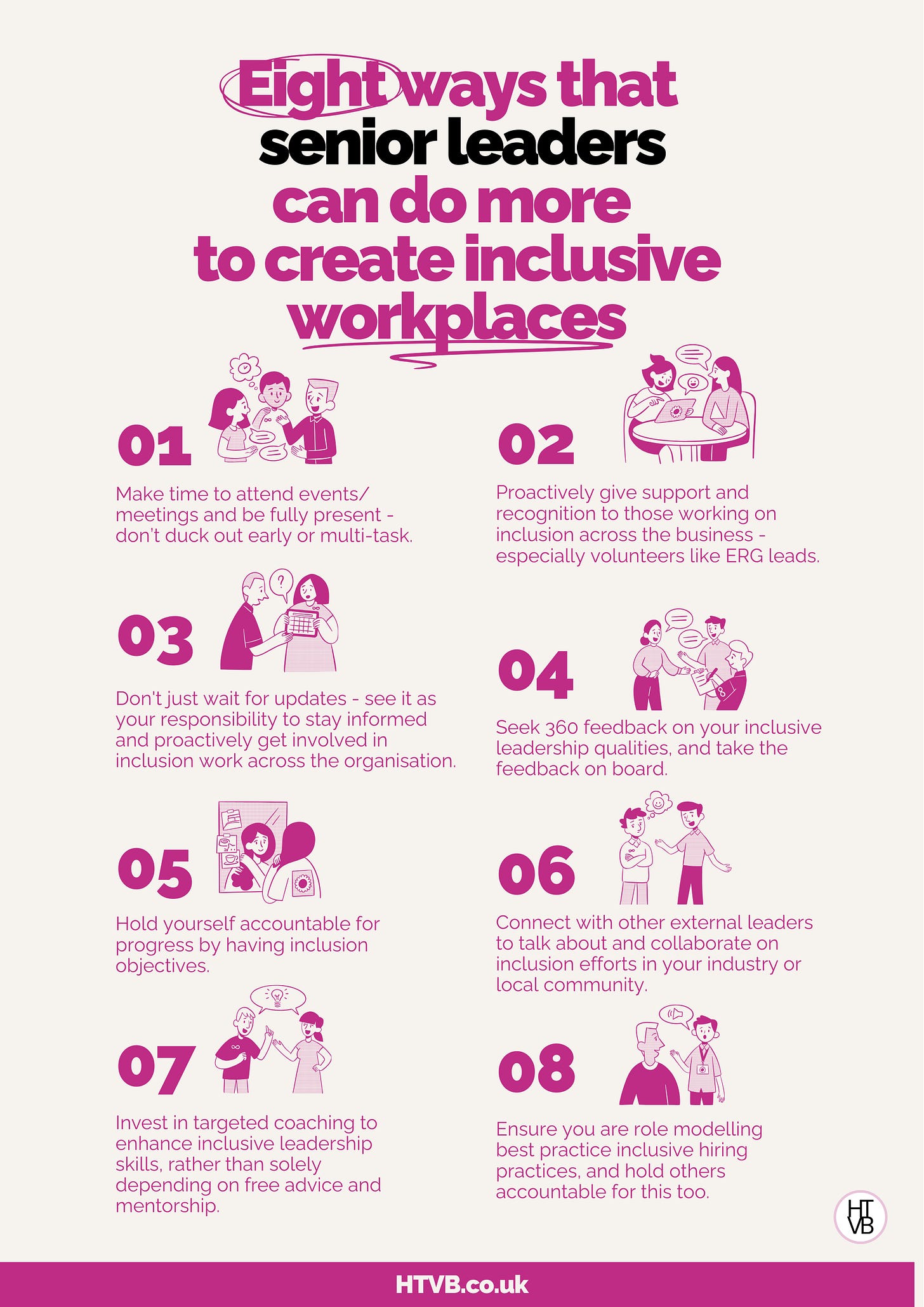
This refreshed and redesigned infographic builds on one of my most popular resources. It reflects the realities that aspiring inclusive leaders are facing today and how they can continue to lead inclusion efforts in their organisations. Send this to a leader who needs this reminder!


Linguistic racism refers to the discrimination people experience because of how they speak, whether through accent, dialect, vocabulary, tone or language. This form of discrimination sits at the intersection of race, class, culture and power more broadly.

In many workplaces, ideas about “professionalism” or “clear communication” are still rooted in narrow norms that favour particular accents and speech patterns. Colleagues who speak differently may be interrupted more often, mistaken for less competent or held to higher standards. Some begin to self-edit in ways that diminish confidence and suppress identity. Over time, these experiences shape progression routes, feedback quality, psychological safety and a sense of belonging.
Read more in this older piece by BBC.

This framework supports how you can build inclusion into training design from the outset. It presents five lenses that help you examine your programme through an inclusivity perspective, covering content, delivery, accessibility, representation and participant experience.
It’s a valuable resource for L&D teams who want to ensure their training is not only informative but truly accessible, equitable and reflective of diverse needs.
A practical tool designed to help VC firms identify and mitigate gender bias across their investment processes. It outlines five levers for action and offers examples from participating firms.
The guidance is particularly helpful for organisations that want to improve decision making, especially where investment choices carry long-term consequences.
Developed by Business in the Community with The Open University and The University of Bristol, this updated guide supports employers to normalise menopause at work. It offers clear, implementable steps for managers, HR teams and organisations.


Comments
Nothing yet. Say the first thing.
Sign in to join the conversation.