
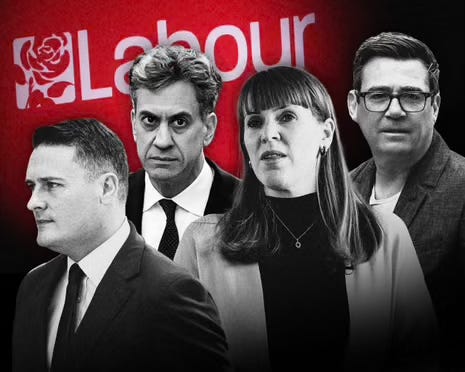
Suddenly everyone in the Labour Party is proposing an alternative to the policy they stood for election on in 2024. The Tribune group wants to tweak the fiscal rules, the Labour Growth Group wants to cut income tax, while Andy Burnham’s Mainstream Labour wants to renationalise the water industry and build council homes.
I want all of the above and more (and the LGG and Tribune reports do contain excellent proposals).
I want rapid rearmament, solar panels on every rooftop, and an end to the rip-off capitalism that shovels billions into the bank accounts of property developers and crypto-kings, while kids arrive at the school gate hungry.
But since joining the Labour Party in December 1979, armed with suitably socialist aspirations, I have learned two things.
First, as Nye Bevan told us, “the language of priorities is the religion of socialism”. Resources are finite, so is parliamentary time, so is focus in government, and so – as Labour found out on 7 May – is the patience of working class people.
Second, capitalism is a system. It has, since around the year 2000 when the Nasdaq crashed, been convulsed by crisis and surviving on credit. To manage it, let alone to supersede it with something else, you need to have a theory of it.
And what frustrates me most about the current debates within the Labour Party is the absence of theory: the vacuum of political concepts with which to understand what just happened, and the paucity of fundamental economic analysis.
So I am going to set out ten facts that those who want to rescue this government, and with it democracy – because after any collapse comes an authoritarian Reform regime – need to understand.
1. Capitalism has become financialised. Profits are generated from production, services and exchange, but they are packaged into financial instruments, and traded on deeply unsentimental markets. Financial, technological and commercial monopolies (think Blackrock, Palantir and Amazon) have near-unlimited power to extract rent from the worker, the consumer and the entrepreneur alike.
That’s why our society is dominated by rent-seekers: the buy-to-let empire builders, the commercial landlords who’ve filled our high streets with vape and barber shops, the property developers building empty mansions into the city skyline.
2. Financialised capitalism is in crisis. It blew up in 2008, forcing states all over the world to incur crippling debts that have refused to shrink, and mandating austerity to a level that has eroded public confidence in the state. Since then, the solution to everything has been cheap credit: to the consumer, the business and the state.
3. The crisis of capitalism is now the crisis of indebted states. Take a look at the now-famous chart showing the reversal of a 50-year trend in falling bond yields. Bond yields are the floor for capital accumulation: the safest way to make money on earth. With Covid, then the Ukraine war and now Trump/Netanyahu’s attack on Iran, it is likely that we’re on a long, upward trend in the cost of borrowing, in which individual states, companies and families will at some point crack.
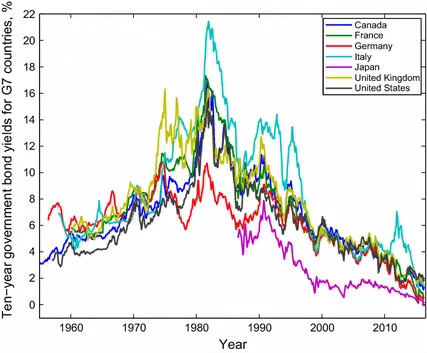
That is why, if you are sitting around in a Labour think tank seminar coming up with good ideas for the micro-economy, or for your local town, you should have this chart, and these facts, pasted to the whiteboard with a permanent flashing light taped next to it.
All social-democratic policymaking now needs to take place as crisis-management.
4. Global capitalism has become a zero-sum game. There is not enough growth in the world, so globalisation is over and states are trying to dump economic pain on rivals and seize advantages. China is growing, but not domestically: its growth depends entirely on exports to the West. America is growing by borrowing, exploiting the exorbitant privilege of the dollar to force the rest of us to finance its largesse, while choking our exports through tariffs.
Any government not prepared to fight dirty in this zero sum game will lose. And since the UK is geographically and economically part of Europe, and the world is disintegrating into competing blocs, we must enthusiastically engage with, join and build the European project.
Our security, our economy and our democratic culture are each entwined with the destiny of Europe in this new, fragmenting world.
5. The domestic economy has also become zero sum. Since the 1950s Labourism has been about “redistributing the proceeds of growth”. But growth is meagre. Rachel Reeves’ securonomics agenda achieved some turn-around, as the brief glimmer of GDP growth in Q1 2026 showed. But it is likely to be squashed by soaring energy and food prices over the summer.
So before we get into the phase of bright policy ideas, Labour needs to be in the phase of strategy for a zero sum world – a place it has not been in since the 1930s.
6. Zero sum plus identity politics is a recipe for political carnage. I know an entire generation of Labour politicians and activists has grown up in the world of identity politics; I’ve embraced it. I thought it was an irreducible kernel of resistance in the face of atomisation: if you can’t find class allies you can at least find allies among your religious, ethnic, sex, gender or sexuality affinity groups.
But politics has become a battle for resources, legislative time, voice, and position on the league table of human rights. One way to read the Green advance in places like Lambeth and Haringey is as a collective “fuck you” by identitarian voters to the majority – and the feeling is mutual among people in places like Wigan and Newcastle who voted overwhelmingly for Reform.
Labour’s massive advantage, as a party of workers with 120 years’ experience, is that we are the only force that can bestride these divisions and appeal for unity.
But we need to face up to a horrible fact: the divisions and enmities are logical. If you create a resources game that rewards oppressed groups with time, attention and voice, don’t be surprised if white working class people start playing it.
This, by the way, has nothing to do with embracing Blue Labour type solutions: it’s about recognising what’s gone wrong.
In response, before we come to any policy proposals, socialists have to adopt a strictly universalist language. What we are doing is for everyone, and we leave our identities at the door of politics.
7. The external threats are real. In my work with the Council on Geostrategy and with the University of Exeter I get to sit in seminars with people in global security and the “deep state”. I haven’t met one of them who believes we won’t be attacked. Most western armed forces are preparing themselves to fight a kinetic war before 2030. So rearmament, at a pace and intensity much faster than the one currently envisaged, is mandatory.
Any Labour politician who skirts around the issue, or relegates it to a niche issue, should have the question flung at them: how does your bright idea help us prepare to beat Russia in a war, stop Iran terrorising our Jewish communities, stop the far right – also manipulated by Russia – stoking civil war against British Muslims. That’s the #1 issue on the urgent/important grid.
8. The bond market cannot be ignored. For reasons I’ve written about before, the UK is an outlier in its cost of borrowing. I’ll list them so that pedants in left-wing academia don’t accuse me of being a bond market fetishist: our welfare commitments don’t match our future tax take; Liz Truss proved a British prime minister can try to scam their way out of that problem; our privatised utilities and monopolised consumer sector gives companies and landlords pricing power over consumers; the Bank of England is dumping bonds needlessly onto a glutted market; the structure of the pensions system has changed; the OBR is useless.
We have only one route out of this: investment led growth, investment led decarbonisation, investment led rearmament. And to invest you need to borrow, and to borrow you need to stabilise your borrowing costs.
Yet just like the war threat, this is relegated to a minor problem by people trying to wishful-think their way out of the crisis.
9. The risks are always greater than you think. But we can shut Reform and its right-wing Tory collaborators out of power forever if we want to, because there is a progressive majority. But we need political will to mobilise it and we have three years to erect democratic defences, against foreign money, disinformation and extremist destabilisation.
10. Here’s what Labour should do. Whether Keir Starmer stays in power, or is replaced by Andy Burnham (I don’t think Wes Streeting has a chance with the membership and unions), or whether someone else takes over.... If there’s going to be a leadership battle, let it take place on the basis outlined here – what’s your solution to these big problems? Not what’s your bright idea.
For certain, we need communicators at the top of politics. But we also need executors. Actions create their own narrative. And that means actions taken in the correct sequence.
I have to warn you that there is a non-negligible possibility that the sight of untested politicians, fighting each other with armfuls of policy papers, while ignoring the bond market and ignoring the threat of war and destabilisation, might of itself be enough to trigger a Liz Truss style bond-market convulsion.
But here are the non-negotiables:
Rearm Britain – laying out a costed path to the NATO 3.5/5% target by the Ankara Summit in July
Join the Customs Union – the terms are clear, it can be done tomorrow, and the uplift in fiscal sustainability will be clear to the markets.
An urgent programme to shore up democratic resilience – not just banning under-16s from social media but much tougher regulations on platforms, criminalise disinformation (not just for a foreign powers) and a new Public Order Act that tamps down the low-level disorder that’s become the weapon of choice by extremists.
Yes, alter the fiscal rules. Scrap the “debt falling in three years time” rule – extend it to five years or, as Lou Haigh says, ten. No rational actor in the bond market thinks PSNFL will inexorably fall. Keep the rule that says only borrow to invest, change the leadership and remit of the OBR and order the Bank of England to cease QT, under its mandate for macroprudiential stability.
As to the Andy Burnham agenda – nationalising water, transport, housing and energy to stabilise prices – I’m not against it but it needs an electoral mandate and will not, in any case, address the near-term inflation risks that the bond markets worry about.
So let the next generation of Labour leaders hash out a programme for 2030-2040 – of mass, green council housebuilding, nuclear power, and state owned utilities – but let this generation deal with what is coming down the track, which could be soaring food prices and massive global instability.
Price controls now, temporary food subsidies for those on welfare, and giving mayors the power to cap rents immediately – will be more effective than the structural reversal of Thatcherism.
Finally, to have any chance of regaining the narrative advantage, the entire Labour Party has to make enemies of the enemies of the British people. The fly tippers, the mobile phone thieves, the assholes dealing drugs from vape shops, the masked-up antisemites with their hand-scrawled placards, the racists yobs, the shoplifters, the kids on dirt bikes…
We, as socialists, need to understand that crime and nuisance are class issues. Beyond all the friction and unhappiness they bring to people’s lives individually, they are eroding belief in the state: it seems to many people that rulebreaking is allowed to become a lifestyle.
The police alone can’t deal with this. There has to be a moral rearmament, where ordinary people just refuse to tolerate it anymore.
We need wealth taxes: Much of what needs to be done is going to require investment by the state. And since we can’t tax growth, and profits are hard to come by, tax rent and wealth.
Piketty warned us. We treated it as a nice idea and ignored him. In a stagnating economy, in a zero sum game against offshore billionaires and China, wealth taxes are the only viable means of redistribution. Otherwise you’re just “redistributing” from white van man to pensioners.
Bottom line: I love the fact that Labour think tanks are churning out good ideas. But we’re in survival mode. Answer the big questions first.
Thank you for reading - this one is unpaywalled. Please share and subscribe…
Comments
Nothing yet. Say the first thing.
Sign in to join the conversation.