
It may seem unfair to focus on Labour MP Paula Barker for her off-the-cuff assertion that the bond market would have to “fall in line” with Andy Burnham, should he replace Keir Starmer as prime minister. But Burnham himself told the New Statesman that Labour had to “get beyond this thing of being in hock to the bond markets”.
And in truth, it’s an idea shared by many Labour MPs and voters: if only the party would stop being so fiscally conservative while in office, it could unleash the hope and vigour it came to power with.
Conflict & Democracy is written by an avowedly left-wing social democrat. There is nothing I want more than for Labour to find its socialist soul and transform Britain. But in this edition I am going to reprise an explainer thread I posted on X.com, to show why the left simply has to stop fantasising about “defying” bond market capitalism and start utilising its dynamics to achieve social justice.
Put simply, “defying the bond market” is like trying to defy gravity. But if you recognise the laws of gravity, and combine them with thermodynamics, you can fly from here to Australia without stopping.
To start with, let’s lay out some definitions and restate some facts.
A bond is an IOU, issued by the government, with special characteristics. The government guarantees to:
pay back the whole sum at the end of a fixed period (say, 10 years)
pay a fixed amount of interest every six months.
Because it’s issued by the state, and the state has never failed to meet these obligations, it’s the safest place to keep your money and the most predictable way to earn interest on it.
But once it’s been sold, it can be traded. And as its price moves up and down, so does the real interest rate the government has to pay people to get them to buy more bonds. There’s a more detailed explanation here.
British government bonds are traditionally called gilts because the certificates used to have golden edges. The real interest rate, created by market movements, is known as the yield.
So now look what has happened to the yield on a 10-year UK gilt during this decade, with the key events annotated…
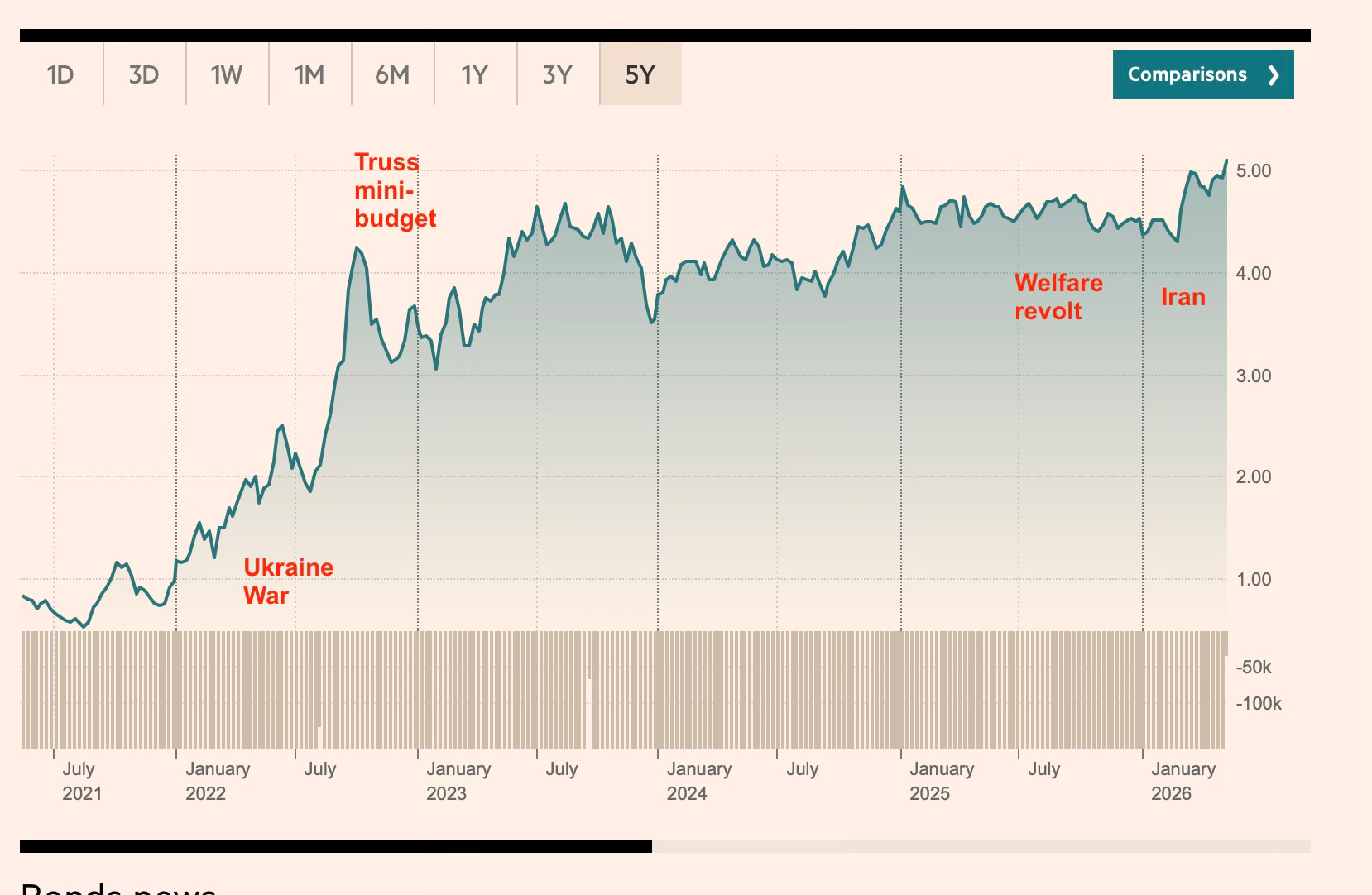
The government’s cost of borrowing has risen from <1% to 5%. And though the rising cost of borrowing has hit all developed countries, the UK has been hit the worst, as this chart of the UK vs other G7 yields shows.
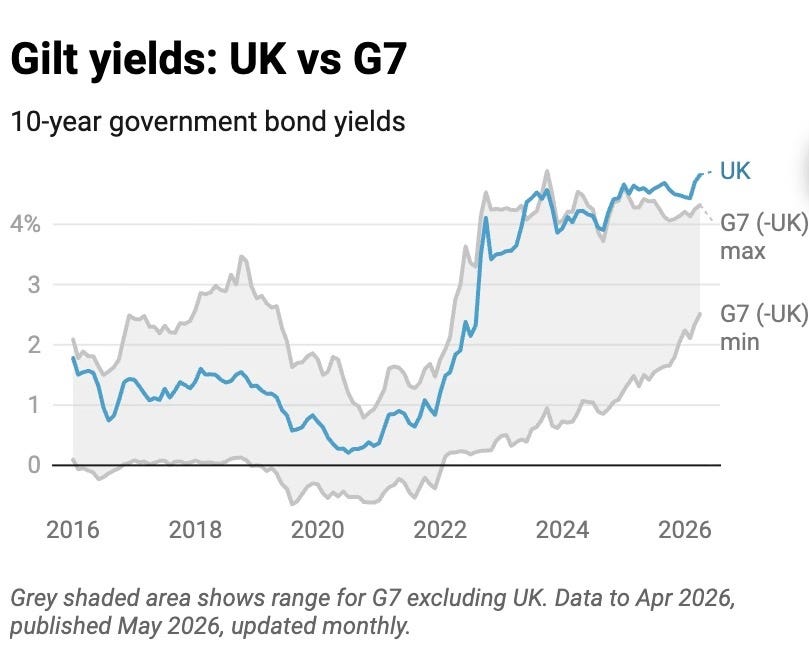
If you are in the business of delivering social justice, through growth, high wages and a generous welfare system, these two charts should be tattooed inside your eyelids.
Because in a capitalist system, the government’s cost of borrowing sets the floor for capital’s cost of borrowing. Sainsbury’s can go bust. The government can’t. Therefore when gilt yields rise, everyone else’s cost of borrowing does likewise.
Before we get into the politics and the economics, I want you to contemplate one more chart: the predicted difference between the UK’s tax take and what the state will need to spend, on services, pensions and welfare…
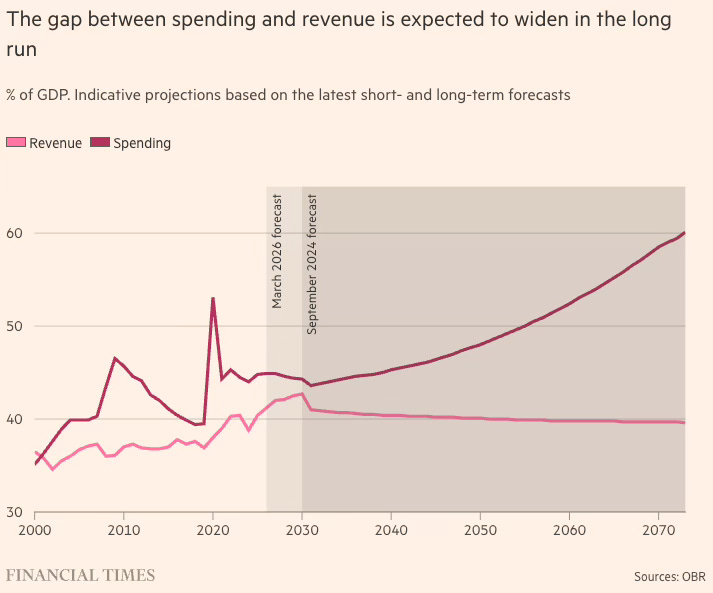
What you’re seeing, in these three charts, is a capitalist economy suffering from malaise: it can’t grow, it can’t borrow, it can’t meet rising demand for services due to ill health, ageing and other demographic factors.
It demands a socialist answer. But before we spell it out, we have to understand the causes, both systemic and local.
In the decade after the financial crisis, yields plummeted, because central banks were prepared to buy up bonds issued by governments (a.k.a. quantitative easing), boosting demand over supply and reducing the cost of borrowing.
In fact, the era of near-zero borrowing costs came at the end of a decades-long slide, as this chart shows. Throughout the entire neoliberal era, yields fell steadily, creating a mass psychology of cheap credit, not just for governments but for businesses and consumers. For Boomers like me, this has been going on for our entire adult lives, and its the same for all subsequent generations:
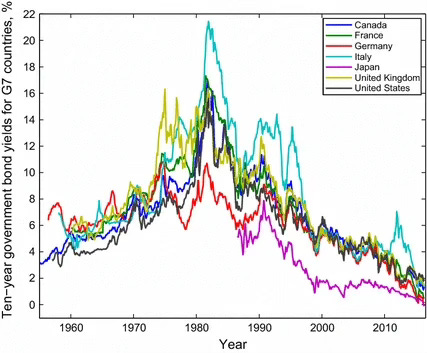
So what happened after the Covid pandemic is a massive economic and psychological shock. An era ended and a new relationship between the state, capital and people opened up:
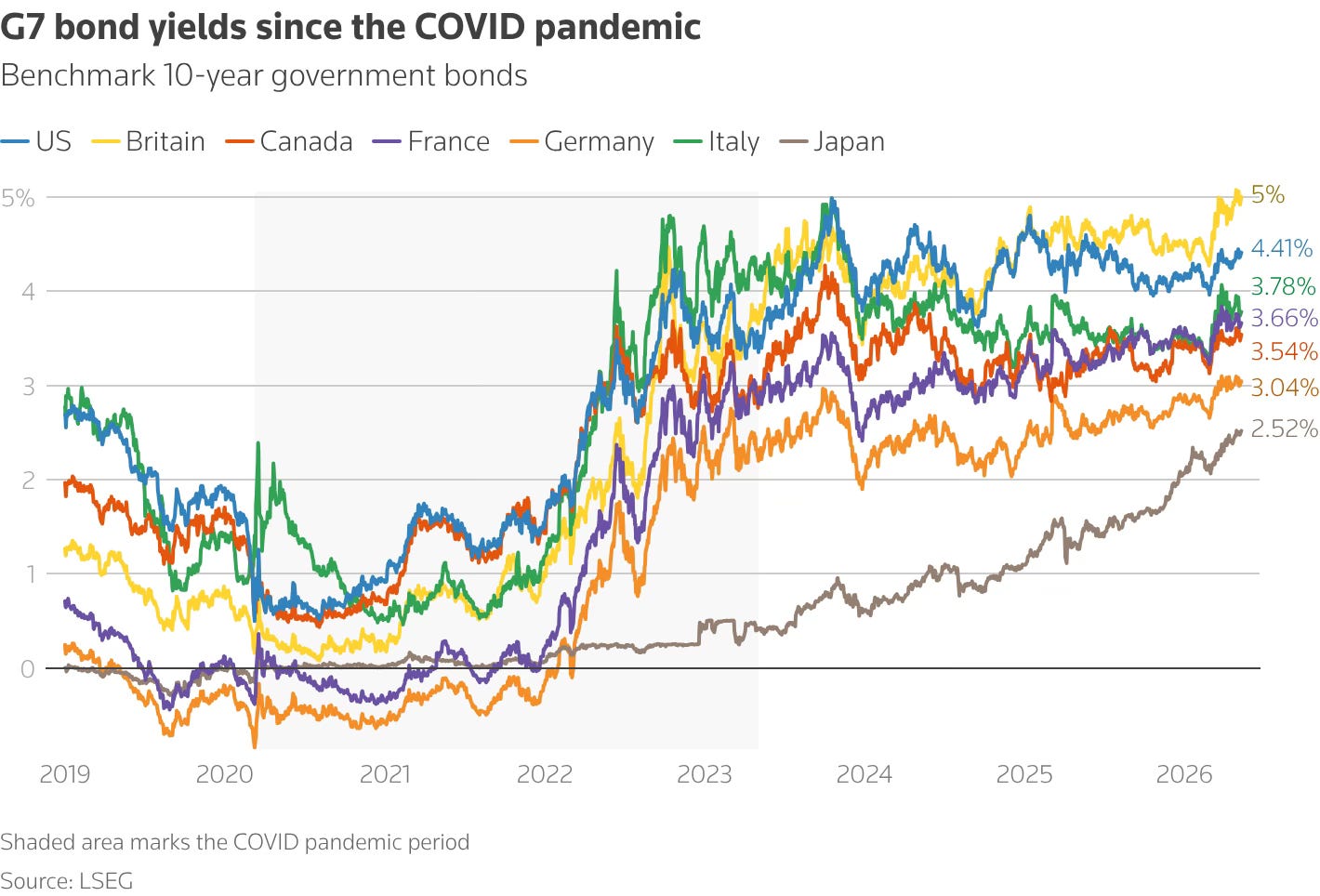
So what’s driving the new era? The main factors are
Supply vs demand
Inflation expectations
Fiscal credibility
If the government borrows more than savers and banks have to offer, it will have to pay higher interest (nominal and real).
If savers and banks expect central banks to allow higher inflation, which erodes the real value of the sum repaid after 10 years, they will look for higher real interest rates or switch to other forms of investment.
If those managing bond investments think a government is politically unstable, or prone to borrowing to cover its day to day costs, they will charge higher interest.
There are also secondary factors: the mix of long and short term bonds issued - with longer dated bonds demanding higher interest rates; and the behaviour of the USA, whose currency allows its to issued more or less unlimited debt.
So UK gilt yields have surged because:
a) it is borrowing more to fund investment
b) at the same time the Bank of England is selling the bonds it bought during quantitative easing (a.k.a quantitative tightening), boosting supply over demand
c) the UK is more prone to inflation, partly because it is dependent on external energy supplies, which are subject to shocks, partly because monopolies and landlords have pricing power, and can hike prices and rents more easily than consumers can switch to cheaper options. This is the root cause of the politically pervasive “cost of living crisis”.
d) and since the Liz Truss chaos, the UK is paying a permanent premium for having a government that tried to rip up its fiscal rules.
On top of this, there is an important change in the makeup of the institutions that lend to the UK government. Twenty-five years ago most gilts were bought by pension funds, which used the regular interest payments to guarantee payouts to people who have retired (aka defined benefit schemes).
Today, because many companies have moved to defined contribution schemes - where the final sum is not guaranteed and depends on what’s happened in the stock market - UK pension funds hold only about 1/5 of the government’s debt. The rest is held by foreign investors, and investors like hedge funds who are more concerned with price movement than price stability. Plus the Bank of England itself holds about 1/5 of all debt.
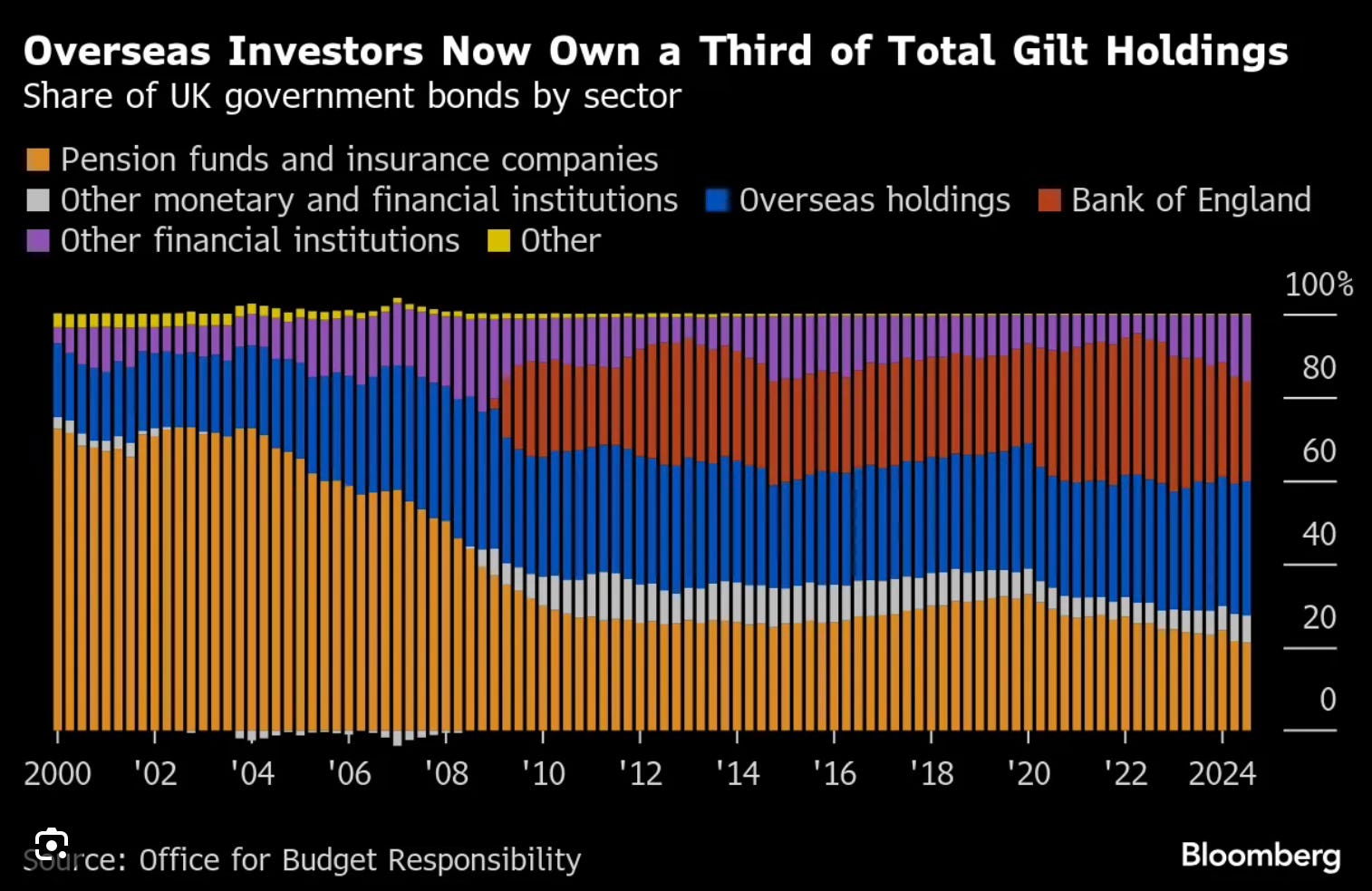
Now let’s think about what the people in these segments actually want from a government. The orange - the pension funds - want low inflation, so the value of their money is not eroded. The blue - foreign governments, banks, hedge funds and pension funds - want low inflation and exchange rate stability: if the pound falls, they lose out. The purple and the grey strands are quite interested in making money from the movement in yields and prices. The Bank just wants to get rid of its holdings so that, if capitalism is convulsed once again on the scale of 2008, it can start buying them again to save the system.
As we racked up debt, to bail out the banks, and as a result of low growth due to austerity, debt servicing costs remained low, at around 2% of GDP.
Today we’re spending £110bn a year on the interest payments on gilts alone, which is 3.6% of GDP and 8.1% of public spending. After the NHS and welfare, debt interest is the third highest item of government spending.
Rachel Reeves came to office determined, nevertheless, to follow an investment-driven growth strategy. The fiscal rules she imposed are threefold:
Borrow only to invest, not to fund day-to-day spending. This means running a small surplus on the “current budget” (day-to-day spend vs annual taxation) by FY 2029.
Debt should be falling as a proportion of GDP between FY 2028 and 2029 - to demonstrate to the markets that borrowing to invest can create a virtuous circle of growth and tax receipts - and be falling in the third year of every budget after that.
Spending on about half of welfare benefits - not including pensions and disability payments - is capped at £195 by FY 2029.
Fiscal rules are a good idea: they demonstrate a government’s understanding that fiscal credibility will drive its borrowing costs lower.
But for a left-wing government they are a pain in the ass. We do not want to borrow to fund day-to-day spending - except in an emergency like war or pandemic. But we do want to borrow to invest.
Rachel Reeves made a major and welcome change in the way debt is calculated, moving from Public Sector Net Debt - a crude measure - to Public Sector Net Financial Liabilities (PNSNFL - which economists call “persnuffle”), which measure income generating schemes as positive, and disregards “contingent liabilities” - potential losses that have not yet happened.
The problem is that most of the growth-oriented left-wing strategy advocated even by quite mild Labour think tanks demand higher borrowing and higher debt.
Meanwhile, because MPs spend every Friday morning acting as welfare advisors to desperate people whose benefits don’t cover their needs, they are acutely opposed to cutting the total amount spent on welfare.
I want Labour to come out of this crisis fighting. Voters are sick of services that don’t work, taxes that are eating into their wages at one end, while inflation (petrol, food, rent) eats the other end, the general decline of high streets and public infrastructure, and the rise of a scam-ridden culture where rule-breakers (money laundering vape shops, thieves, scammers, fly-tippers) prosper while they suffer.
Fixing all this costs money. But taxes on ordinary people and most businesses are maxed out.
But the fiscal rules contain a contradiction: borrow to invest in order to grow; but cap debt at an arbitrary limit (80% of GDP as measured by PSNFL).
For me, it’s the arbitrary limit that has to change. The Labour MP Louise Haigh this week called for the rolling 3-year debt ceiling (which kicks in in 2029) to be scrapped and replaced with a ten-year limit.
I agree with that. What the bond markets are most concerned about right now is not the absolute debts of the UK, but the danger of them being inflated away, and the danger of untested politicians taking over and - as with Truss - breaching UK fiscal credibility.
But there are five more things Labour could do to free itself up to start delivering the radical, positive effects voters are crying out for, and which it promised in 2024.
First, the Office for Budget Responsibility has been mis-designed and is badly led. It’s stuffed full of people who simply do not believe that the Labour formula for investment led growth can work. That’s why every Budget is preceded by an almighty private slanging match between Reeves’ officials and the OBR. Though their own economists believe “in principle” that investment can drive growth, the OBR rarely reflects this in its actual projections.
So either change the personnel or the remit. There are plenty of left-wing economists who would apply more realistic measures to Reeves’ budget projections, and installing them would actually improve market perceptions of the OBR’s function as a truth-teller and fiscal watchdog.
Second, it could change the mix of bonds issued, from long to short term. This raises the risk of having to pay more to borrow in a crisis, but it will reduce the premium paid to investors for asking them to hold our IOUs for 10, 20 and 30 years.
Third, it could instruct the Bank of England to stop selling bonds into a glutted market. Quantitative Tightening is supposed to be a technical excercise. If so, it is happening at the wrong time.
Fourth, Starmer - or his successor if he falls - has to grasp the knotweed of welfare reform. It is bizarre that, despite all mainstream parties claiming to favour work over welfare, the welfare bill has mushroomed since the financial crisis.
Fifth, Starmer could make good his proposal to align strategically with Europe by dropping the “red line” that prevents rejoining the Customs Union or the Single Market. Brexit has cost between 4% and 8% of GDP already, which will compound as the EU gets its act together under the Draghi Report project. Rejoining the market, even if not the Union, will alter the debt/gdp projections of any honest fiscal watchdog and even more importantly, send major geopolitical signals that the UK understands where its future lies.
It is this list of prosaic but vital measures that any candidate who wants to replace the Reeves-Starmer duo will have to face up to, otherwise they will be hit by further bond-market turbulence if they win - and indeed turbulence even if they don’t win, because every vote for a “defy the bond market” candidate is a danger signal to investors.
In the long-term, the socialist principle should be to attack the causes of our high welfare dependency; our inflation prone, rent-seeking economic model, our fossil-fuel dependency, and our pitifully low productivity and business investment.
Which is what makes me truly sick when I see lists of “demands” presented by trade union leaders and self-described left wingers in the Labour Party. Or calls from Unison leader Andrea Egan to “stand up to markets”.
If there is now a leadership challenge to Keir Starmer, based on fantasy economics and lists of demands drawn from Socialist Worker, I will oppose it. I want more spending on defence, more public investment in infrastructure, and to unlock the potential productivity gains of AI and automation.
I want to see everyone who can work, in work.
But I know from bitter experience there is a world of difference between “demands” and governing.
So the next time you hear a politician or union leader say: the markets must fall in line, or we don’t want to be in hock to the markets, or that we should take on the markets, just substitute the word “gravity” for markets.
Thanks for reading. This issue is free. If you want the detailed, specialist stuff, please subscribe. I post here about once a week. My other output is at The New World and occasionally the iPaper.
Comments
Nothing yet. Say the first thing.
Sign in to join the conversation.