
Most venture capital is a herd animal. It grazes where the other funds graze — the same zip codes, the same demo days, the same overpriced seed rounds where twelve firms are elbowing each other over the same deck. It’s a strange way to run a business built entirely on the premise of finding what others haven’t.
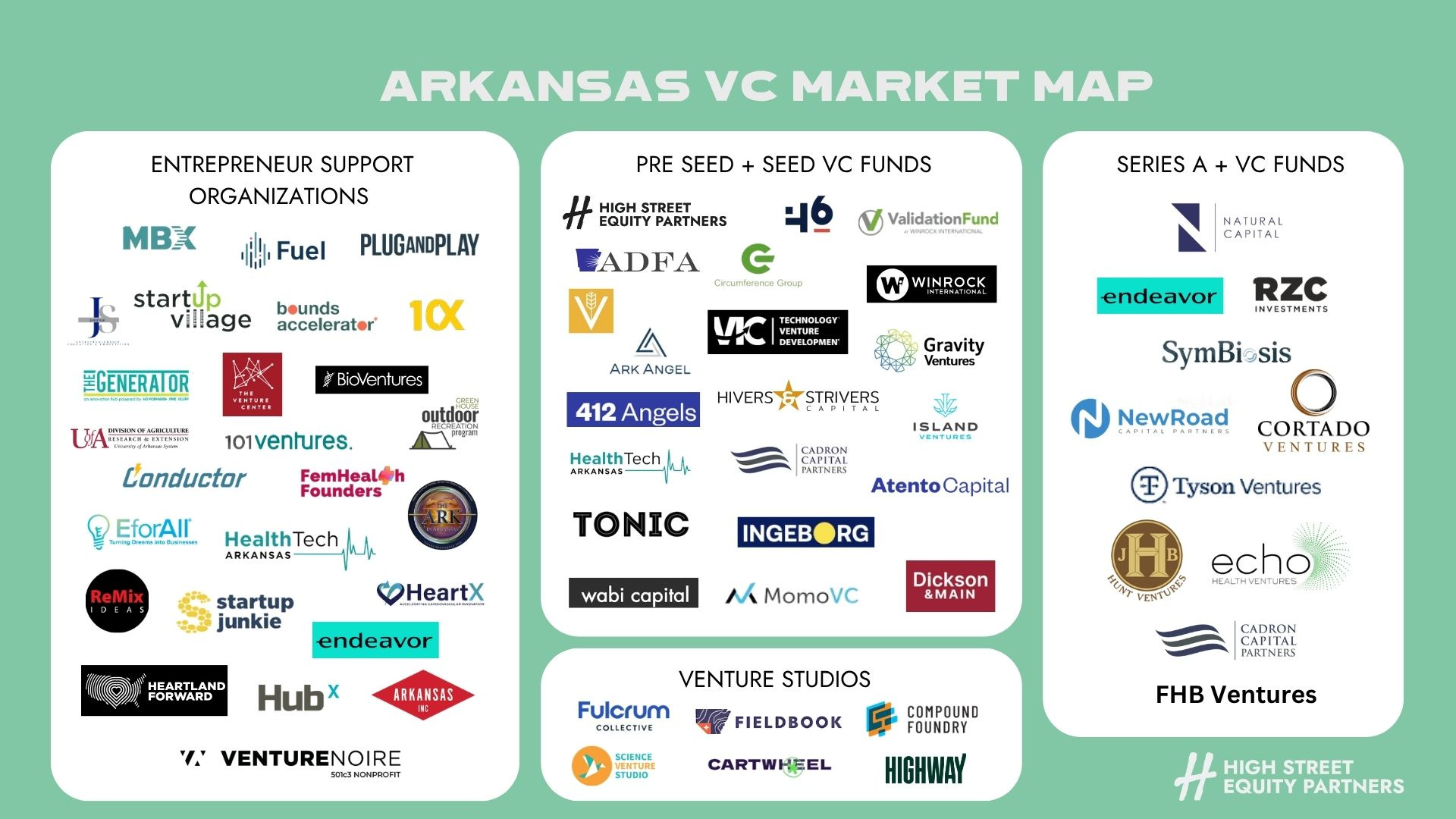
A couple of years ago we started spending real time in Arkansas — an emerging innovation hub that fit our thesis and happened to be home for one of our co-founders. We wanted specifics: how many companies, at what stages, in which sectors, funded by whom. So instead of guessing, we started keeping a list. That list turned into a map of 120+ startups, and then a second map of the investors and accelerators active across the state.
We’re sharing what we learned not because we’ve got it all figured out — we don’t — but because the picture that emerged is interesting.
We’ve catalogued more than 120 active startups across the state, sorted by stage and by sector, and we’ve built a companion map of every investor, accelerator, and venture studio that’s actually putting capital and support to work here. We did it the slow way — sitting with founders, showing up at accelerators, and having hundreds of conversations that don’t scale and aren’t supposed to. What came out the other end isn’t a hunch about Arkansas. It’s a dataset.
And the dataset says something the coasts are missing.
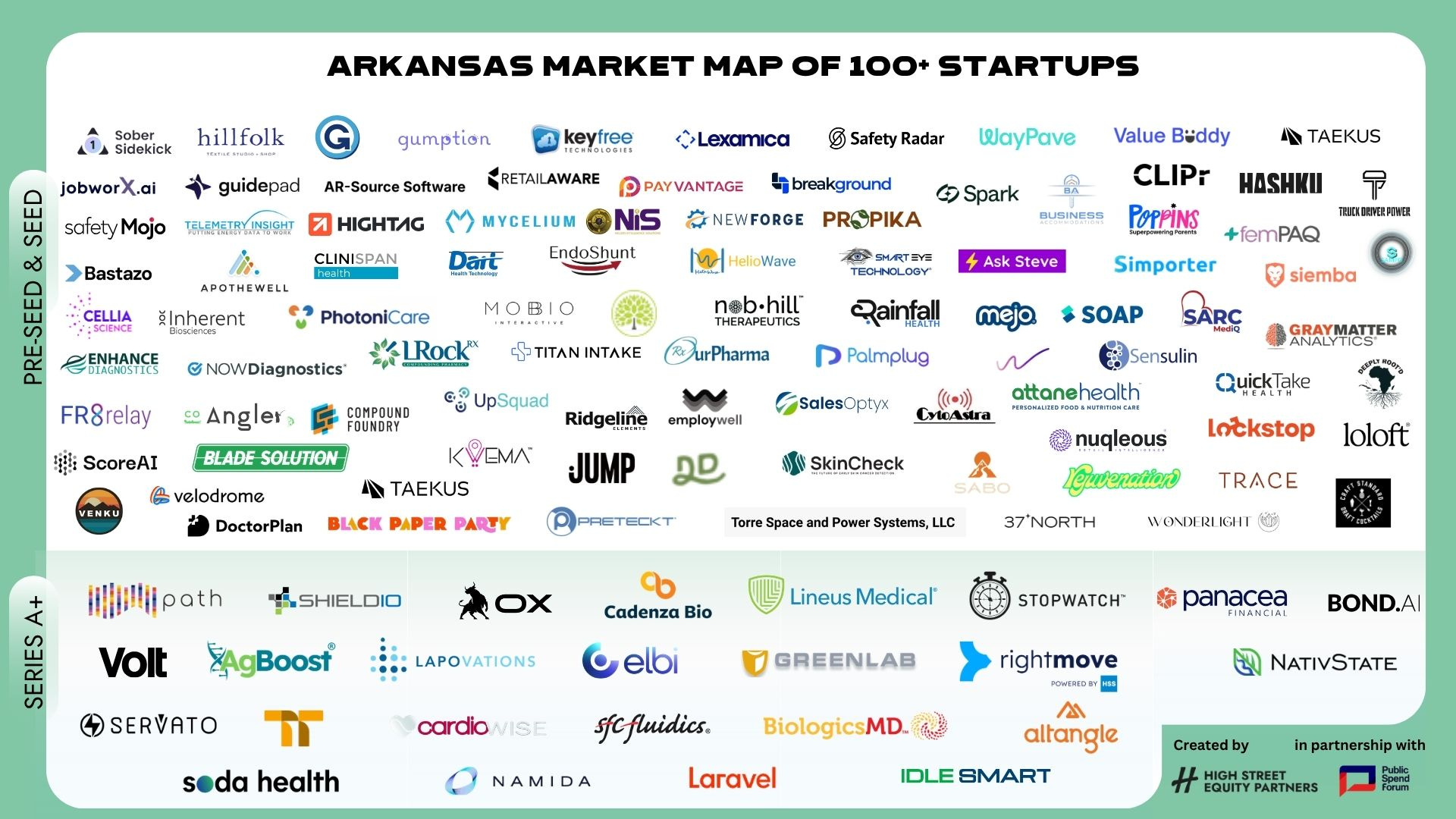
Two things jump out when you see the whole board laid out.
First, the shape of the market: roughly 70% of Arkansas startups are at pre-seed, and about 20% at seed. That’s an overwhelmingly early-stage ecosystem — which is exactly where patient, disciplined capital has the most leverage and the least competition. When you map the 100+ companies by our theses, they cluster cleanly into the areas we already have conviction in: Future of Work, Health (our Future of Care thesis), and Emerging Tech, with a healthy tail of everything else.
Second — and this is the part that quietly demolishes the biggest objection to investing here — the capital is real, and it’s growing. Arkansas went from $17M in total VC in 2015 to $288.5M in 2021 and $334.2M in 2022. In 2024, the state saw 13 deals at $177.2M, averaging $13.6M per deal. That’s not a nascent market anymore. That’s an investable one, and the lighter-volume years historically set up price-disciplined investors to compound.
We know this because we built the second map too: the one showing who’s actually here. Entrepreneur support organizations, pre-seed and seed funds, Series A+ funds, venture studios — the connective tissue of a functioning ecosystem. The picture it paints is a market with real infrastructure and real momentum, just without the valuation frenzy that infrastructure usually attracts everywhere else.
Whenever we talk about Arkansas, someone asks the same thing: “Sure, but is there enough follow-on capital? What happens when your company needs a Series A?”
Fair question. Here’s the data. In 2024, 20 investors participated in Arkansas deals — only 4 of them in-state. Louisiana had 54 (15 in-state). Oklahoma had 30 (13 in-state). Translation: syndicates form here even when the money is headquartered elsewhere. And just south of us sits Texas, the anchor of Southern venture (peaking at 1,125 deals and $13.56B in 2021) — a deep downstream pool of capital and talent we tap for our companies when their traction earns it.
So the follow-on story isn’t “hope someone shows up.” It’s “originate high-signal deals locally, then assemble the corridor syndicate when the numbers justify it.” The map tells us exactly who to call.
Here’s the part that makes Arkansas more than a valuation-arbitrage play. It’s not just cheaper — it’s customer-rich in a way that’s unusually good for the kind of companies we back.
Northwest Arkansas is home to Fortune-scale anchors. That concentration creates something most early-stage ecosystems desperately lack: real enterprise buyers, sitting right there, willing to run pilots. For a capital-efficient B2B company, that’s gold. It means a founder can land a pilot, get genuine buyer signal, and turn that pilot into paying revenue — all without relocating to a coast and burning eighteen months of runway on customer discovery.
For us, proximity to that dynamic is a sourcing edge. We get faster diligence backed by real buyer signal, early reads on founder quality, and the ability to make targeted introductions that shorten the distance from “interesting product” to “signed customer.” That’s not something you can do dialing in over Zoom from Sand Hill Road.
The difference between an investor who “covers” a region and one who’s actually part of it comes down to showing up. We have seven team members and advisors living and working in the state. Our Managing Partner is on the ground several times a quarter, and one of our main state partners allows us to have an active footprint at Onward HQ in Bentonville — a hub where founders and investors actually collide. Our advisors, partners, and team are embedded across the state.
To a local founder, that means we’re not a coastal fund parachuting in for a demo day and disappearing. We’re a neighbor — present before the round, during it, and after it. To our LPs, that presence is the whole point: it produces deal flow other funds simply can’t access, because you can’t access what you don’t show up for.
Take Sober Sidekick, one of our Arkansas bets in the behavioral-health space. We didn’t wire money off a pitch. We spent months as an early diligence partner — digging into product and retention, making warm introductions to regional providers and employers, and helping shape the go-to-market narrative and pricing. That’s the model: patience, proximity, precision.
There’s a lesson here that outlives any single geography, and it’s the thing we most want founders to take away.
The best opportunities in venture are rarely the obvious ones. They’re the ones hiding in plain sight, in markets everyone has decided in advance aren’t worth the flight. The edge doesn’t come from being smarter than the next fund on the same deal — it comes from doing the unglamorous work of actually mapping a market before you deploy into it. Research first, capital next.
Arkansas isn’t a side bet for us. It’s a cornerstone — the clearest proof of a thesis we’d apply anywhere: that discipline plus depth beats hype plus herd, and that the future gets built in the places everyone else overlooks.
We don’t chase the coasts. We map the overlooked, we show up, and we let the data do the convincing.
High Street Insights is where we share what we learn backing early-stage founders across the Future of Work, Future of Care, and Emerging Technologies. If you’re building in a market the coasts ignore — or investing in one — we’d love to compare maps.
Comments
Nothing yet. Say the first thing.
Sign in to join the conversation.