
In the late 1930’s, when my mom was just a toddler, her parents taught at the Mather School for Colored Girls.
My mom would tell me how much she loved her friends there, who were all Black. And though my mom was white, she recalled having to use the Colored Facilities, because of her parents’ work. Because of that association.
What an influence that must have had on my mother.
I would see it from time to time. The hardness stiffening her face when she heard racial slurs. How out of the blue she would write and tell me that it was urgent—urgent!—that I read Maya Angelou. That it was urgent for me to learn more deeply about history.
How proud my mom was of her parents, who were treated as though they were invisible by some members of the community, for their work.
My grandfather was so moved by the songs of his Gullah students that he wrote what appears to be a scholarly thesis on their songs and folklore, with hand-written annotated sheet music.
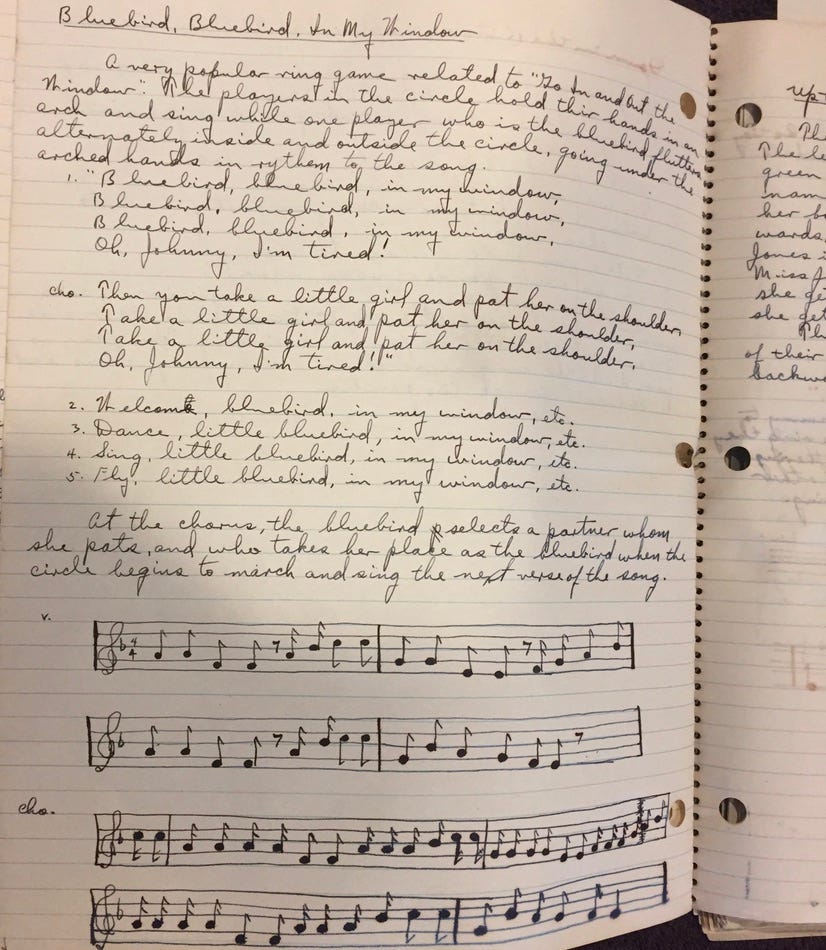
This is where Kum Ba Yah came from. A good instinct, Norvel Daniel. A recent appraisal of Norvel’s notes gave a value of $6,000.00. The Mather Museum and the Smithsonian’s African American History Museum seemed excited to get copies I sent them. Maybe we can find another Kum Ba Yah. We need it now.
Here’s some audio of an interview of my grandmother describing that time period. (I’m in the process of transcribing the entire 3-hour interview, which I will post here on Substack, when I’m done.)
0:00
-4:08
NEVA DANIEL:
So anyway, we had an opportunity to go to South Carolina to… both of us teach, in a mission school for black girls. (This is the Mather School for Colored girls in Beaufort, SC.)
And mostly because we’d never been any place, we decided we’d like to do that. So we sold out everything we had and took our two little girls.
And went by train. We didn’t even have a car. We went by train to South Carolina. And here was a whole new world. (laughs) It was on the Sea Islands off the coast of South Carolina.
FATHER GEORGE PIERCE:
Near Charleston, there?
NEVA DANIEL:
Yes, fairly near Charleston. Near Savannah. It was near to Charleston.
So we, uh, worked there in this school for Negro girls. And we had these Negro girls came from surrounding islands. They were…a lot of them were Gullah Negroes. They had a language of their own, or it was intermixed, and they were the Negroes, that the Gullah was a mixture of African and English. It came from the slave language and the household. The language of the household. Slaves…was sort of a mixture. It was entirely new vocabulary.
So that was an exotic, interesting, rich experience. And it freed me of just taking care of children. And I think I never did really like just taking care of children. I wasn’t one of these natural mothers who liked that above everything else. I didn’t. I really didn’t.
I liked getting back into the classroom. I liked coming back to my children knowing that they were well taken care of and I had time with them, quality time. But I was into something that seemed to me much more fulfilling. So I liked that.
And we were there. The children (Neva’s daughters Sharon and Judy) were under school age. And we kind of had it in our minds that we wouldn’t subject them to this difficult experience when they got into school.
Because we were, to all intents and purposes, we were Black people because we lived with them.
And in this Southern town, you were considered… I mean, first of all, who would want to do it? And if you did do it, people were a little mixed on how to deal with us. We went to the church in town, a white church, and Norvel taught Sunday school class there, but
we also had the experience of people not answering us if we would speak to them any more than they would have answered a Black person or sort of looking through us.
So it was a mixed thing at that time. But it was very rich and very wonderful. And the music was particularly memorable. There was a fine Black woman who taught the girls to sing, and their music was just outstanding.
Also found in my family’s things, some words from Norvel:
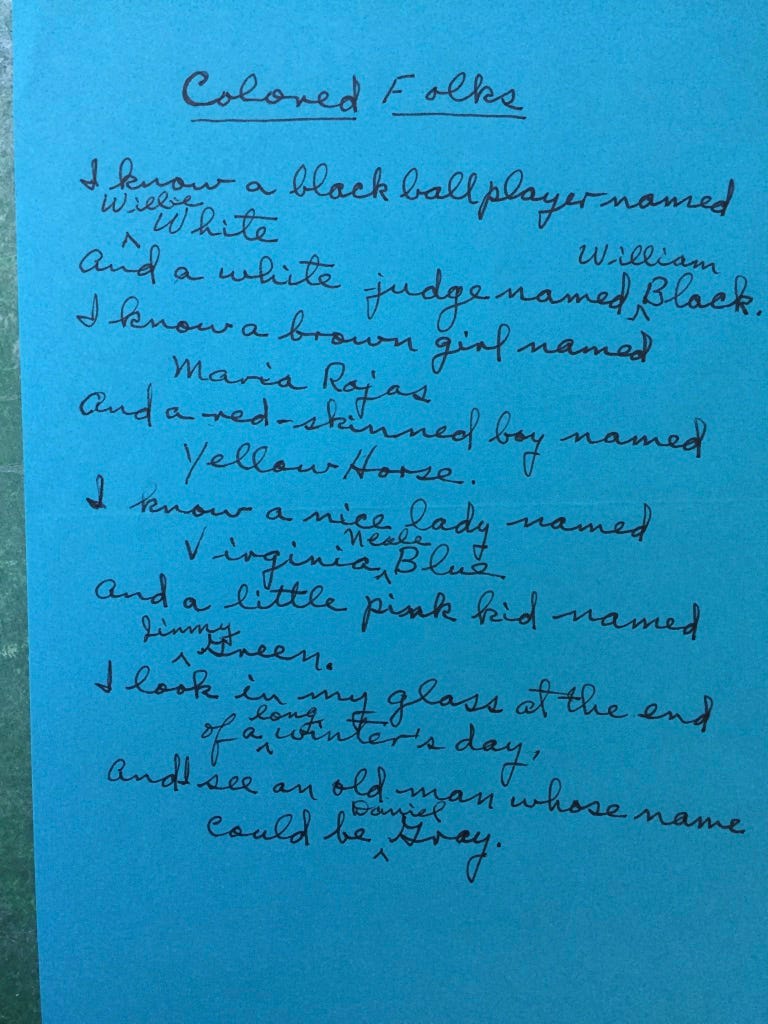
Colored Folks
I know a black ball player named
Willie White
and a White judge named William Black.
I know a brown girl named
Maria Rojas
and a red-skinned boy named
Yellow Horse.
I know a nice lady named
Virginia Neale Blue.
and a little pink kid named
Jimmy Green.
I look in my glass at the end
of a long winter’s day,
And I see an old man whose name
could be Daniel Gray.
by Norvel Daniel, written for his daughter on her birthday in 1981)
Here’s a joke penned by my grandfather Norvel. I hesitated on this one, given he’s writing out dialect and that can come across the wrong way. I think his punchline makes it worth it, though.
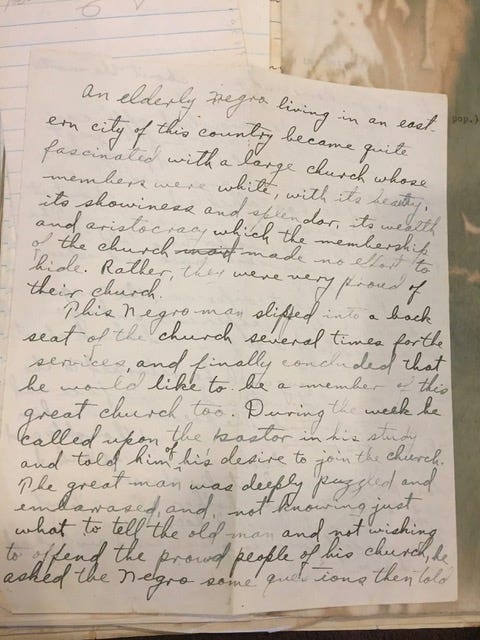
Norvel’s joke, transcribed:
An elderly negro living in an eastern city of this country became quite fascinated with a large church whose members were white, with its beauty, its showiness and splendor, its wealth and aristocracy which the membership of the church made no effort to hide. Rather, they were very proud of their church.
This Negro man slipped into a back seat of the church several times for the services, and finally concluded that he would like to be a member of this great church, too.
During the week he called upon the pastor in his study and told him of his desire to join the church. The great man was deeply puzzled and embarrassed, and, not knowing just what to tell the old man and not wishing to offend the proud people of his church, he asked the Negro some questions then told him to go home and pray about the matter and come back to him next week.
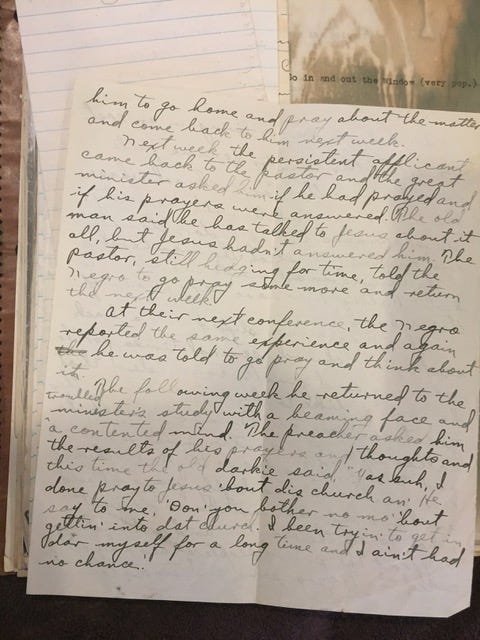
Next week the persistent applicant came back to the pastor and the great minister asked him if he had prayed and if his prayers were answered.
The old man said he has talked to Jesus about it all, but Jesus hadn’t answered him.
The pastor, still hedging for time, told the Negro to go pray some more and return the next week.
At their next conference, the Negro reported the same experience and again he was told to go pray and think about it.
The following week he returned to the troubled minister’s study with a beaming face and a contented mind. The preacher asked him the results of his prayers and thoughts and this time the old darkie said,
“Yas suh, I done pray to Jesus ‘bout dis church an’ He say to me:
‘Don’ you bother no mo’ ‘bout gettin’ into dat church. I been tryin’ to get in thar myself for a long time and I ain’t had no chance.’”
Comments
Nothing yet. Say the first thing.
Sign in to join the conversation.