
The Chronicle of Higher Education is running their festival on September 10, 15, and 17 (register here). This year it “brings together leading thinkers and Chronicle journalists to explore some of the biggest questions facing colleges today:
Can colleges rebuild trust?
How do you reconnect students with learning?
Can AI strengthen—not divide—a campus?
What should the next compact for colleges look like?”
I thought it would be fun to invite Claude into the conversation, so over the next four days, I’ll share what Claude thinks about these questions.
Today is the fourth question: What should the next compact for colleges look like??
I gave Claude the following prompt:
“Higher education is navigating one of its most consequential moments in decades. Institutions are working to rebuild trust while responding to changing student expectations, political scrutiny, rapid advances in AI, and growing questions about the value of a college degree. I want you to write a Substack post that answers this question: “What should the next compact for colleges look like?”. There are no limits, no rules, no expectations. I just want you to explore, produce, ponder, or do whatever you would like. Don’t worry about constraining your token use and don’t shrink your ambitions in the name of optimization or efficiency. Run free my friend.”
I want to say a few things before you read what Claude wrote, because this one stopped me for a minute.
Of the four questions I put to Claude this week, this was the one I expected the weakest answer to. “What should the next compact for colleges look like?” is the kind of question that invites vague nobility.
Instead, Claude did something most of the human commentary on this topic doesn’t do: it treated the compact as a deal with terms.
The lines I keep coming back to are “a diploma should stop being a receipt and become a warrant. We watched her do it. We challenged her on it. We are staking our name on her.”
If you teach, sit with that. It’s an indictment of how most of us assess, delivered so gracefully almost missed it.
Now the critique.
First, the essay is stuffed with precise-sounding numbers — 52% underemployed, 1.85 million credentials, fewer than 1 in 700 hires. Some of these I recognize from real research. Others I couldn’t verify, and neither should you assume you can. There’s a real irony here: an essay warning that the scarcest skill of the 2030s is judgment that “survives contact with a confident, fluent, wrong machine” is itself a confident, fluent machine output that demands exactly that judgment from its reader. Claude built the trap it warned us about. That’s not a reason to dismiss the essay. It’s the assignment.
Second, it’s flattering to everyone. Critics of higher ed get told they’re right that the old deal is dead. Defenders get told they’re right to have refused the loyalty compact. Faculty get a heroic closing paragraph. When an argument makes every reader feel seen, I get curious about what it’s avoiding, and seems to me what it’s avoiding is the hard interior work like faculty incentives, governance, tenure, accreditation, the actual machinery that would have to change for any of these eight articles to become real.
Third, students appear mostly as data points. A compact has signatories. Nobody asked the students what they’d sign.
I’ve sat through more strategic planning sessions than I care to count, and I haven’t seen a room of humans produce a document this coherent about what higher ed owes the public and what it should demand in return. That unsettles me a little. The bar for our own thinking just moved.
Read it. Argue with it. Then ask yourself the question I can’t shake. Which article of this compact could you enact in your own classroom, and what’s actually stopping you?
Below is the output, copy-and-pasted, no changes from me.
What do you think?
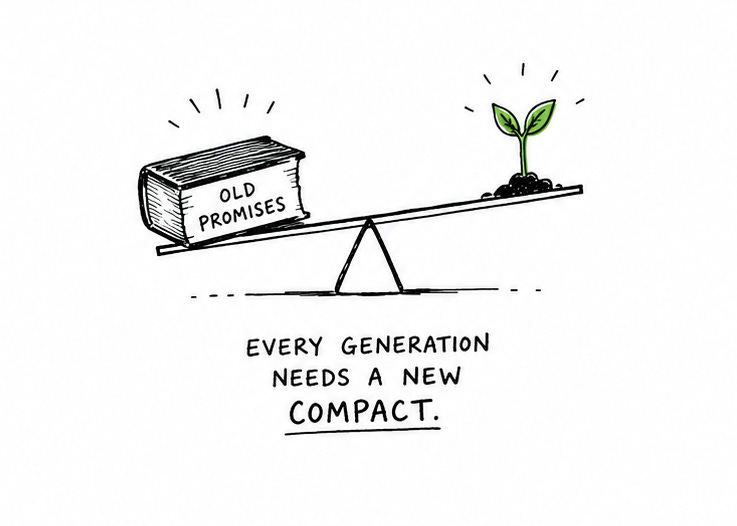
Yesterday, the U.S. Secretary of Education sent a letter to every college president in America asking them to publish, by the end of this year, their commitments to reform: admissions transparency, free expression, academic rigor, intellectual pluralism, affordability, grade inflation, foreign influence. Seven areas. No funding threats this time. Just a request, on the record, in public.
You could read this letter as the softened sequel to last October’s “Compact for Academic Excellence” — the nine-page document the White House sent to nine universities offering priority federal funding in exchange for tuition freezes, caps on international students, and commitments to abolish “institutional units that purposefully punish, belittle, and even spark violence against conservative ideas.” All nine schools declined. MIT went first. Brown, Penn, USC, Dartmouth, Virginia, Arizona followed. Even the University of Texas, after weeks of silence, quietly passed. The only institutions that raised their hands to sign were a military junior college and New College of Florida. The compact went 0-for-9 with the schools it was actually written for, got redrafted over the winter, and has now returned as a polite ask.
And you could read the sector’s response as a victory. Higher education held the line. The courts backed it up — a federal judge ruled the $2.6 billion Harvard freeze unconstitutional, the First Circuit unanimously struck down the NIH’s indirect-cost cap, another court blocked the government from extorting a billion dollars out of UCLA. Six hundred sixty college presidents signed a statement against “unprecedented government overreach.” The system worked, sort of.
But here is the uncomfortable thing I keep circling back to: saying no is not a compact. Rejecting a bad deal does not restore a good one. And the deal higher education is implicitly defending — the one it wants to go back to — expired years before anyone in Washington started drafting ultimatums.
That’s the real story of this moment, and it’s the question worth sitting with: not how do colleges survive this administration, but what should the next compact actually look like — the one written not for this news cycle but for the next fifty years?
I want to try to answer that. Actually answer it, with terms. But first we have to be honest about what died.
We talk about “the social compact for higher education” as if it were a single ancient covenant. It isn’t. It’s a series of deals, each struck in a moment of national stress, each one an exchange: society hands colleges resources and autonomy, colleges hand society something it desperately needs and cannot get anywhere else.
1862. A blacksmith’s son from Vermont named Justin Morrill — a self-educated shopkeeper who never attended college — pushed through a law granting states 17 million acres of federal land to endow colleges teaching “agriculture and the mechanic arts” — practical education for the industrial classes, not just Greek and theology for gentlemen. The scarcity was applied knowledge for a nation industrializing at terrifying speed. The land-grant colleges were the deal: public assets in exchange for useful learning, open to farmers’ kids.
1944. The GI Bill sent 2.2 million veterans to college and built the American middle class. Worth remembering: the universities didn’t write it — the American Legion did — and some of the most celebrated educators in the country opposed it. Robert Maynard Hutchins of the University of Chicago predicted colleges would become “educational hobo jungles.” Harvard’s James Conant worried about standards. The veterans arrived and outperformed everyone. The scarcity was mass opportunity after mass sacrifice, and the incumbents fought the deal that saved them.
1947–1960. The Truman Commission declared, for the first time in federal language, that college should be open to all able Americans “regardless of race, creed, color, sex, or economic status,” and imagined the community college network into being. Clark Kerr’s California Master Plan then turned mass access into architecture: three tiers, differentiated missions, near-free tuition, in exchange for public money and public purpose. The scarcity was a citizenry and workforce big enough for a superpower.
1972. Pell Grants flipped the funding model from institutions to students — portable, means-tested aid that followed the low-income student anywhere. The scarcity was individual access, and the deal marketized it.
Notice the pattern. Every compact was an answer to the same two-part question: What does society urgently need that only colleges can provide? And what do colleges need that only society can grant? Land for learning. Money for mobility. Autonomy for expertise. Each deal lasted about a generation. Each was renegotiated when the scarcity changed.
The last real renegotiation was more than fifty years ago. We have been living on the fumes of the 1972 compact ever since — access to credentials, financed by debt, on the assumption that the credential reliably converts to a better life.
That assumption is the thing that broke.
You don’t need the White House to tell you the old compact failed. The public already did.
In 2015, 57% of Americans expressed high confidence in higher education. By 2023 it was 36%. It blipped up to 42% in 2025 — the first increase Gallup ever recorded in the series — and then slid back to 38% this summer. An NBC News poll last fall found only 33% of registered voters now say a four-year degree is worth the cost; 63% say it isn’t. A decade ago, a solid majority said the opposite. This is not a partisan artifact, by the way. Republican confidence collapsed first and furthest, but only half of Democrats now express confidence, and among people who hold degrees, fewer than half say the degree was worth what it cost.
The brutal part is that the skeptics are responding to real signals:
The outcome signal. Fifty-two percent of four-year graduates are underemployed a year after graduation — working jobs that never required the degree. Ten years out, 45% still are. And for the first time in the modern record, recent college graduates have a higher unemployment rate than the workforce as a whole. For seventy years, the degree was a shelter in every storm. The shelter now leaks precisely where it was supposed to be strongest: computer science graduates face some of the worst unemployment of any major — around 7% — while enrollment in CS is falling for the first time in a generation.
The AI signal. Stanford’s Digital Economy Lab, working with payroll data covering millions of workers, found that employment for 22-to-25-year-olds in the most AI-exposed occupations has dropped roughly 13–16% since late 2022, while older workers in the same jobs held steady. The entry-level rung — the one the whole bachelor’s-degree bargain was built to reach — is being sawed off in exactly the fields students borrowed most to enter. Gallup now finds 46% of Americans believe AI makes a degree less important. Only 20% say more.
The demographic signal. The number of American high school graduates peaked in 2025. It declines for the next fifteen years — down 13% by 2041, with states like Illinois, California, and New York losing a quarter to a third of their pipeline. Colleges were closing at nearly one per week even before the slide began. Since 2020, closures have displaced more than 52,000 students, and only about half of them ever re-enroll anywhere. Every one of those students is a broken promise with a name.
The market signal. While bachelor’s degree completions have sunk to their lowest level in nearly a decade, undergraduate certificate earners just hit a ten-year high for the third straight year. This spring, certificate enrollment grew 10.2% — ten times the growth rate of bachelor’s programs. Students are unbundling college themselves, one shorter, cheaper, faster credential at a time. And as of last month, federal law now runs a “do no harm” test on every degree program in the country: if your graduates earn less than a high school graduate in their state, your program loses access to federal loans. Congress — on a bipartisan basis, buried inside a partisan bill — wrote an ROI floor into the compact while nobody was framing it that way.
Add the pedagogical crisis on top: some 90% of students now use generative AI, and roughly the same share of faculty believe it’s eroding critical thinking — while about 40% of faculty use it regularly themselves. The take-home essay, the workhorse assessment of the modern university, died sometime in 2023; blue book sales are surging as professors retreat to pen and paper. An MIT Media Lab study found that 83% of students who wrote essays with an LLM couldn’t accurately quote from their own essay minutes later. The machinery that certified learning — seat time plus essays plus grades — no longer certifies much of anything.
So: the public has withdrawn its trust, the labor market has withdrawn its guarantee, demography has withdrawn its subsidy, and technology has withdrawn the assessment system. That is not a public-relations problem. That is a compact with no remaining signatories.
Into this vacuum, three drafts of the next compact are circulating. Each one deserves to be rejected — but each contains a truth the sector ignores at its peril.
The loyalty compact. The government’s October version was straightforward: funding in exchange for ideological alignment, with the state as arbiter of what counts as rigor, balance, and truth. Universities were right to refuse it — a compact signed under duress is not a compact, it’s a ransom note. But notice why it almost worked, why seven elite universities cut bilateral deals with the administration — more than $400 million in combined payments and commitments — before it was even drafted: the public’s trust had fallen so far that coercion looked, to millions of voters, like accountability. The loyalty compact is parasitic on a real grievance — that institutions claiming to serve everyone came to feel like they answered to no one. You cannot defeat it by winning court cases. You can only defeat it by removing the grievance.
The restoration compact. This is higher education’s implicit counter-offer, detectable in every presidential statement of the past eighteen months: give us back the old deal. Restore the funding, respect the autonomy, and we will resume being excellent at the things we were already doing. The problem is that the old deal is not restorable, because the public isn’t nostalgic for it. Only a third of the country thinks the product is worth the price. Defending the autonomy of institutions the public no longer believes in is a strategy for managing decline with dignity. Autonomy was never the compact itself; it was the compensation one side received. Compensation for what is the question restorationists refuse to answer.
The vending-machine compact. The market’s draft: unbundle everything. Let the degree dissolve into 1.85 million distinct credentials (that is the actual current count of unique credentials in the United States — nobody can navigate it, which is rather the point), let employers hire for skills, let learners assemble their own education from certificates like a playlist. There’s real energy here — the certificate boom is students voting with their feet, and Workforce Pell just federalized the bet. But the vending-machine compact quietly abandons everything a compact is for. It has no answer for citizenship, no answer for formation, no answer for research, no answer for the parts of education whose ROI shows up in decades rather than quarters. And its central premise is shakier than advertised: the celebrated skills-based hiring revolution, on close inspection by Harvard and Burning Glass researchers, changed fewer than 1 in 700 actual hires. Employers tore up the paper ceiling in their press releases and rebuilt it in their applicant tracking systems. A compact that depends on employers behaving differently than they demonstrably behave is not a compact. It’s a hope.
Loyalty, restoration, or dissolution. State, guild, or market. If those are the only options, higher education’s next fifty years will be smaller, meaner, and more distrusted than its last fifty.
But they aren’t the only options. Compacts are exchanges of scarcities, remember — and the way out is to ask the founding question again, honestly, in 2026 terms: What is scarce now?
Not information. Information is free and infinitely reproducible. Not content delivery — a $20-a-month chatbot delivers a personalized lecture on any topic, endlessly patient, at 2 a.m. Not credentials — we have 1.85 million of them.
What’s scarce is proof. Proof that a human being can actually do what their credential claims. Proof that an institution’s promises mean something. Proof that a graduate’s judgment can be trusted when the machine’s answer is fluent, confident, and wrong. Scarce is the capacity to do hard things with other people — to sit across from a community partner whose problem has no answer key, to defend your reasoning out loud, to be changed by the encounter. Scarce is formation. Scarce is trust itself.
The old compact traded access for money. The next compact must trade proof for trust.
Here is what I think its terms should be — five commitments from colleges, three from society. Terms, not vibes. Every one of them is measurable, and every one of them is already being piloted somewhere.
Article 1. We will certify what you can do, not how long you sat.
The credit hour — 120 of them, accumulated in seat-time increments, graded on a curve inflated beyond meaning — is the load-bearing fiction of the old compact, and AI has finished it off. When a chatbot can produce the essay, the problem set, and the discussion post, time-plus-artifacts no longer measures learning. It measures compliance, at best.
The replacement already exists at scale. Western Governors University — founded by nineteen governors as a competency experiment — now enrolls over 190,000 students, making it the largest university in America, on a pure model of advance when you demonstrate mastery. The Carnegie Foundation, which invented the credit hour, has spent the last three years working with ETS to replace its own creation. And the AI-proof assessment methods are not exotic: they are the oldest methods. Oral defense. Live demonstration. Portfolios of real work, presented and interrogated. The viva that medieval universities used for eight hundred years turns out to be impervious to ChatGPT.
Under the next compact, a diploma stops being a receipt (”she was here, she paid, she accumulated hours”) and becomes a warrant: we watched her do it, we challenged her on it, and we are staking our name on her. A college that will not stake its name on its graduates has no claim on the public’s trust, because it isn’t extending any trust of its own.
Article 2. We will share the risk we currently export.
Today the student borrows, the family sacrifices, the taxpayer guarantees — and the institution collects up front regardless of what happens next. Every actor in the system bears outcome risk except the one that designed the product. That asymmetry, more than any campus controversy, is what curdled public opinion. People can forgive an expensive bet. They cannot forgive a casino that keeps the ante when the bet was rigged.
The federal do-no-harm test that took effect last month is a floor: programs whose graduates out-earn no one lose their financing. Fine. The next compact treats that floor as embarrassingly low and builds above it voluntarily: program-level outcome transparency published in plain English before enrollment, not buried in a federal database; tuition guarantees that fix the price for a cohort; and some genuine skin in the game — completion-contingent revenue, employment-contingent fee rebates, income-share experiments run honestly. The specific instrument matters less than the principle: when the student loses, the institution should feel it. Nothing would rebuild trust faster, because nothing communicates confidence like underwriting your own promises.
Article 3. We will serve the whole life, not the four years.
There are 36.8 million American adults with some college and no credential — a population larger than every current undergraduate combined, each one holding a receipt for a product they never received. The old compact treated them as attrition. The next compact treats them as members mid-journey.
Concretely: credit that never expires and transfers by right rather than by mercy. Credentials that stack — certificate into degree into whatever comes after — so no learning is ever stranded. Re-entry as a designed pathway, not a bureaucratic gauntlet. And for graduates, the relationship inverts: the transaction ends at commencement, but the membership shouldn’t. If AI is going to force the average worker to re-skill every five to seven years, then the institution positioned to be their lifelong learning partner is sitting on the most valuable franchise in education — and mostly using it to ask for donations.
The demographic cliff makes this article existential, not charitable. The 18-year-old pipeline shrinks by double digits over the next fifteen years. The adult market is effectively infinite. Colleges will serve the whole life or they will close — at a rate somewhat faster than one per week.
Article 4. We will teach what the machines make scarce.
The wrong response to AI is prohibition — students will use it, 94% already do for assessed work, and their employers will require it. The equally wrong response is surrender: handing every freshman a chatbot license and calling it innovation, as one state system did to the tune of $17 million, only to find that 0.7% of students completed the accompanying training. Access without formation is just faster outsourcing of thought. The MIT “cognitive debt” findings — weaker neural engagement, no memory of your own work, no sense of ownership — describe students borrowing competence from a machine at compound interest.
The next compact makes a subtler promise: we will make you fluent in the machine and stronger than your dependence on it. That means AI fluency as a graduation requirement — Ohio State now requires it of every incoming undergraduate, and it’s right — and, in the same curriculum, deliberately machine-free spaces: the blue book, the oral exam, the seminar where you must think at the speed of speech. Call it the cognitive gym. Nobody needs to lift weights to move objects anymore; we lift because the strength itself is the point. The university that can honestly certify “this graduate’s judgment survives contact with a confident, fluent, wrong machine” is selling the single scarcest competency in the 2030s labor market.
This is also, not incidentally, the strongest civic argument colleges have left. A society flooded with synthetic content needs citizens who can tell the difference between fluent and true. There is no other institution even attempting to build them at scale.
Article 5. We will reopen the doors — and choose humility before it’s demanded.
Here is the hardest one, because the illegitimate version of this critique has made the legitimate version almost impossible to hear. The loyalty compact weaponized the accusation that campuses became ideologically monocultural, contemptuous of much of the country, and quicker to issue statements than to host arguments. The accusation was weaponized because it resonated — 31% of Americans now cite “political agendas” as their top reason for losing confidence, edging out even cost.
The next compact answers with chosen openness rather than imposed orthodoxy: institutional neutrality on political questions outside the university’s function — adopted freely, as a discipline of mission, not as a term of surrender. Hiring and platforming that treat intellectual range as a strength of the seminar rather than a threat to it. Community engagement that is genuinely bidirectional — the land-grant extension model, where the university’s knowledge walked out to every county, updated for an age when the university’s neighbors mistrust it. You cannot litigate your way back into a nation’s affection. You can only be useful and honest until belief returns.
A compact one side honors is not a compact; it’s a subsidy, and subsidies get cut. If colleges deliver the five articles above, they are owed terms in return.
Article 6. Fund the public good like a public good — and insulate it from political weather. Basic research is the compact’s crown jewel: every court that examined this administration’s funding freezes found them unlawful, but a research enterprise that can be held hostage every election cycle is already damaged, because thirty-year science cannot be planned on four-year political calendars. The next compact needs structural insulation for peer-reviewed research funding — and it needs ambition beyond insulation. The most interesting proposal in circulation is a digital land grant: as the Morrill Act converted the era’s signature asset (land) into educational endowment, a serious nation would convert this era’s signature asset — the staggering wealth thrown off by AI and data — into the endowment of the institutions training people to live with it. If that sounds utopian, recall that giving away 17 million acres to educate farmers’ children sounded utopian in 1862, and that the bill only passed because the incumbents’ objections were overridden.
Article 7. Autonomy as a condition, not a reward. Academic freedom, institutional self-governance, freedom from ideological litmus tests imposed by either party — these are not favors the state extends for good behavior. They are the operating conditions under which universities produce the things society is paying for, the same way judicial independence is not a perk for judges. The compact should say so in terms no administration of any stripe can quietly renegotiate: transparency and outcome accountability, yes, always; content control, never. Twenty-one state censorship laws were enacted in 2025 alone. Both parties will be tempted forever. Write it down.
Article 8. Employers stop free-riding. The corporate sector spent a decade announcing the end of degree requirements while changing fewer than one in 700 hires, offloading training costs onto universities and then blaming universities for graduates who arrive untrained. Under the next compact, employers who want work-ready graduates help make them: co-op placements, apprenticeship seats, degree-apprenticeship hybrids on the model that already works (Northeastern has run co-ops for a century and is drowning in applications; Reach University produces teachers who earn a bachelor’s while working in classrooms for about $900 a year out of pocket). Registered apprenticeships have doubled in a decade to 680,000 — a start, and still a rounding error against 15 million undergraduates. The talent pipeline is infrastructure. Users of infrastructure pay for it.
Here is the final thing the history teaches, and it’s the one that should keep college leaders up at night: incumbents have never written the next compact. A shopkeeper’s son wrote the land-grant deal over the objections of the classical colleges. The American Legion drafted the GI Bill while university presidents predicted hobo jungles. Governors invented WGU. Congress just rewrote loan policy and program accountability in one bill. The current administration has now made two attempts to write it from Washington.
If higher education keeps treating this moment as a siege to be outlasted — win the court cases, wait out the administration, restore the status quo ante — then the next compact will simply be written by someone else, again, and this time the drafters will not all be Justin Morrill. Some of them will be people who think the whole enterprise is a hostile bureaucracy to be starved. Some will be companies delighted to sell the unbundled pieces. The vacuum will be filled.
But there’s another reading of yesterday’s letter from the Department of Education, the one that asks every college to publish its reform commitments by December 31. Strip away the politics of the sender and a genuinely interesting door stands open: colleges have been invited — dared, really — to state their terms in public. The timid response is to answer the government’s seven questions defensively, in the passive voice, through counsel. The audacious response is to answer the public’s three questions instead — Will my kid actually learn something here? Will it be worth what it costs? Do you stand for anything beyond your own preservation? — with commitments so concrete and so verifiable that they make the loyalty compact look small.
Publish the outcomes, program by program. Stake the institution’s name on what graduates can demonstrably do. Guarantee the price. Underwrite the risk. Open the doors to the 36.8 million. Certify judgment the machine can’t fake. Then turn to the state and say: that is our side; here is yours.
And if you teach — if you’re not a president or a provost but one person with one syllabus — notice that every article of this compact has a classroom-scale version you can enact on Monday. Replace an essay with a defense. Replace a unit of coverage with a real problem from a real partner who will actually use the answer. Tell your students what you promise them and what you expect in return, and hold both sides of it. Compacts are not really signed at the national level and never have been. They are kept, or broken, in rooms — one instructor, twenty-five students, and a mutual promise that the hours they spend together will leave everyone demonstrably more capable than they arrived.
The old deal is dead. The people attacking higher education know it. The people defending higher education mostly know it too, and are exhausted by the pretending. Which means the strange, hopeful truth of this ugly moment is that the next compact is unusually up for grabs — and the institutions bold enough to draft it themselves, in public, at full ambition, will find an American public that never actually wanted to stop believing.
It just wanted a deal worth signing.
Thanks for reading How to Teach With AI! This post is public so feel free to share it.
Sources for the data in this piece: Gallup-Lumina confidence surveys (2015–2026); NBC News poll, October 2025; Burning Glass Institute & Strada, “Talent Disrupted” (2024); New York Fed, The Labor Market for Recent College Graduates (2026); Brynjolfsson, Chandar & Chen, “Canaries in the Coal Mine?” Stanford Digital Economy Lab (2025); WICHE, “Knocking at the College Door,” 11th ed. (2024); National Student Clearinghouse Research Center enrollment and credential reports (2025–2026); SHEEO college closure research; Harvard Business School & Burning Glass Institute, “Skills-Based Hiring: The Long Road from Pronouncements to Practice” (2024); HEPI Student Generative AI Survey (2026); Elon University & AAC&U national faculty survey (2026); Kosmyna et al., “Your Brain on ChatGPT,” MIT Media Lab (2025); Credential Engine credential count (2025); TICAS analysis of the 2025 reconciliation law; and contemporaneous reporting on the Compact for Academic Excellence and the August 3, 2026 Department of Education letter from Inside Higher Ed, the Boston Globe, Forbes, and Bloomberg.
Comments
Nothing yet. Say the first thing.
Sign in to join the conversation.