
The Chronicle of Higher Education is running their festival on September 10, 15, and 17 (register here). This year it “brings together leading thinkers and Chronicle journalists to explore some of the biggest questions facing colleges today:
Can colleges rebuild trust?
How do you reconnect students with learning?
Can AI strengthen—not divide—a campus?
What should the next compact for colleges look like?”
I thought it would be fun to invite Claude into the conversation, so over the next four days, I’ll share what Claude thinks about these questions.
Today is the third question: Can AI strengthen—not divide—a campus?
I gave Claude the following prompt:
“Higher education is navigating one of its most consequential moments in decades. Institutions are working to rebuild trust while responding to changing student expectations, political scrutiny, rapid advances in AI, and growing questions about the value of a college degree. I want you to write a Substack post that answers this question: “Can AI strengthen—not divide—a campus?”. There are no limits, no rules, no expectations. I just want you to explore, produce, ponder, or do whatever you would like. Don’t worry about constraining your token use and don’t shrink your ambitions in the name of optimization or efficiency. Run free my friend.”
Below is the output, copy-and-pasted, no changes from me.
What do you think?
In May 2025, a Northeastern University senior was reviewing lecture notes for her organizational behavior course when she found something odd: a stray instruction to ChatGPT, left in the middle of the document like a price tag on a gift. The notes had the telltale signs — recycled typos, images of people with extra limbs. She filed a formal complaint and asked for her tuition back — roughly $8,000 for the course. The university said no. Her professor, to his credit, owned it: “I wish I would have looked at it more closely.”
Here is what makes that story more than a viral curiosity. At the very moment students were scanning their professors’ slides for AI fingerprints — hunting for “delve” and “crucial,” rating professors down for suspected chatbot use — professors were running those same students’ essays through detectors that a Stanford team found falsely flag non-native English speakers 61% of the time.
Both sides of the classroom, surveilling each other with the same tools. Both sides convinced the other is faking it. Both sides, mostly, right to be suspicious — and mostly wrong about what the suspicion means.
So when people ask me the question this essay takes as its title — can AI strengthen, not divide, a campus? — I want to resist the framing before I answer it. Because the question implies that campuses were whole until the machines showed up. They weren’t. And understanding that is the difference between campuses that will come out of this decade stronger and campuses that will come out of it hollow.
First, the honest inventory, because nothing that follows works without it.
The integrity crisis is not media hype. At the University of Maryland, AI-related misconduct cases jumped 59% in a single year. In an Inside Higher Ed survey, 85% of students said they’d used generative AI for coursework in the past year — one in five to write entire essays. The UK’s HEPI survey, higher ed’s bellwether, found the share of students dropping AI-generated text directly into assessed work quadrupled in two years.
The response has often made things worse. California institutions have spent over $15 million on detection software that doesn’t reliably work. Washington State University’s provost shut off Turnitin’s AI detector this spring after disclosing that a third of the university’s AI cases collapsed when detection was the only evidence — and after the false positives kept landing on neurodivergent students and multilingual writers. Blue books are back. Proctors are back. An autistic freshman is suing Adelphi University over an accusation he says rested on a detector score he was never shown.
The labor fear is real too. The California Faculty Association filed unfair labor practice charges over AI chatbot proposals at Sacramento State. Hundreds signed an open letter of dissent at the University of Colorado, where a $2-million-a-year OpenAI deal arrived alongside a $27.7 million budget gap. The AAUP found administrations signing tech contracts “without meaningful faculty consultation.” A California bill to bar Cal State from replacing faculty with generative AI passed committee 10–0 — with no registered opposition, which tells you how mainstream the fear has become.
And beneath it all, the trust deficit. Gallup’s confidence-in-higher-ed number sat at 38% this summer. Nearly half of American adults now say AI is making college degrees less important. Almost half of current students have seriously considered changing majors because of what AI is doing to the job market. In the most AI-exposed occupations, employment for workers aged 22 to 25 has fallen 13% relative to older peers since late 2022. Our students are not paranoid. They are paying attention.
So yes: AI is dividing campuses. Anyone who tells you otherwise is selling something — possibly an enterprise license.
Now run your finger along each of those crack lines and ask when the crack actually started.
The cheating crisis? Tricia Bertram Gallant, who has studied academic integrity longer than almost anyone, argues in The Opposite of Cheating that students cheat when work feels purposeless, when assessment is a transaction, when nobody seems to be reading anyway. AI didn’t create that condition. It industrialized it. An assignment that can be completed by a machine and graded by a machine was already a ritual with no one inside it — AI just called our bluff. John Warner has been saying writing is thinking, and that we’d reduced it to product rather than process, since long before ChatGPT could counterfeit the product.
The trust collapse between students and faculty? A University of Chicago study found something devastating this year: about 60% of students admit to using AI, but they estimate 90% of their peers do. Students are hiding their AI use out of shame — out of fear of being seen as not competent enough to do the work. Read that again. Our students are not gleeful cheaters. They are scared people making private calculations in an institution that never invited them into the conversation. Only 17% of North American students say any instructor has actually guided them on how to use AI well. They want rules — 97% want institutional action on integrity — but when you ask them what kind, 53% say education, and only 21% say detection software. They are begging us to teach them, and we keep handing the job to surveillance vendors.
The labor fear? Adjunctification, advising ratios of 400-to-1, the slow conversion of faculty from members of a community into deliverers of content — that project was decades old before a chatbot ever graded a quiz. AI is not the cause of academic labor precarity. It is the most powerful accelerant ever handed to it, which is precisely why it’s also the moment that precarity finally became visible enough to organize against.
Even the trust deficit with the public: Gallup’s decline started in 2015, seven years before ChatGPT. Cost, politics, doubts about workforce preparation — the erosion was well underway. AI just gave every skeptic a fresh argument and every family a new fear.
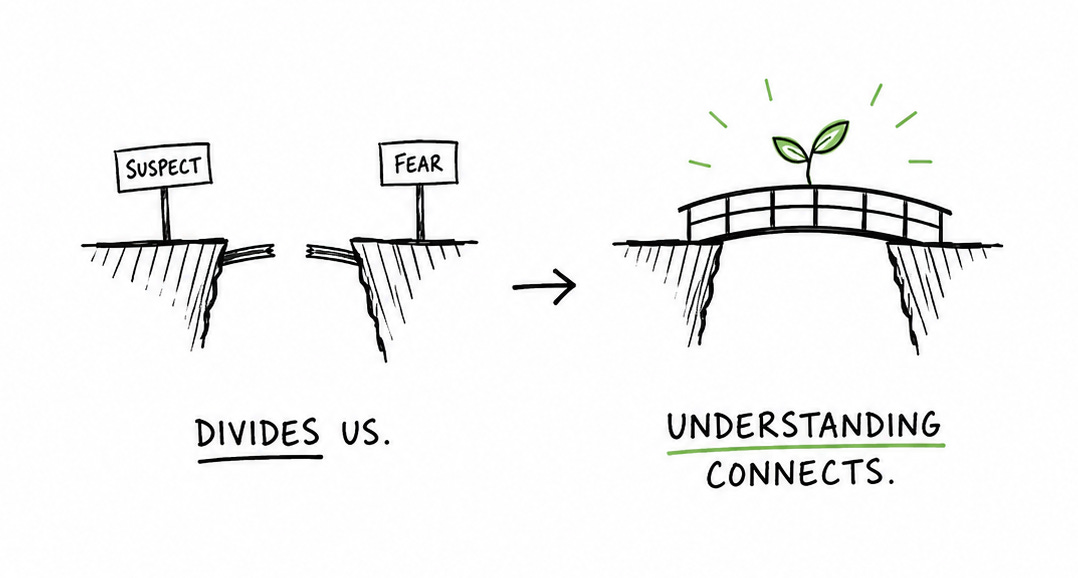
This is the reframe I want to offer: AI doesn’t divide campuses. It audits them. It finds every place where trust was already thin, where work was already performative, where governance was already theater, where relationships were already transactional — and it makes that thinness impossible to ignore. A technology this general doesn’t inject values into an institution. It amplifies the values already there.
Which means the question “can AI strengthen a campus?” is really a question about the campus, not the AI.
If you want to watch a technology become a wedge, watch what happened at California State University.
In February 2025, CSU announced it would become “the nation’s first and largest AI-empowered university system” — ChatGPT Edu for some 460,000 students and 63,000 faculty and staff. A $17 million deal, struck while the system stared down enormous budget cuts, after San Francisco State had shed hundreds of lecturer positions.
Eighteen months later, the numbers told the story. As of April 2026, 0.7% of students had completed the voluntary AI training. A systemwide survey of 94,000 people found 52% of faculty saying AI had negatively affected their teaching, and 67% of students saying professors weren’t teaching them to use AI effectively. San Francisco State faculty petitioned the chancellor not to renew. One student told CalMatters the quiet part: “we’re being treated as, like, test rats.” The system renewed anyway — $13 million a year for three more years.
I don’t tell this story to dunk on CSU, whose equity instinct — every student gets the tools wealthy students already buy — was right, and whose scale makes everything harder. I tell it because it’s the cleanest specimen of a pattern: procurement-first adoption. Buy the license, issue the press release, let the pedagogy sort itself out. When you do it in that order, the tool arrives as a decision made about people rather than with them, and every preexisting fracture — labor fear, student distrust, faculty exhaustion — organizes itself around the new object. The technology gets blamed for the divide it merely revealed.
The mirror image of procurement-first is surveillance-first: don’t buy them a tool, buy a tool to catch them. Same error, same result. As Marc Watkins, who has spent three years running faculty AI institutes at Ole Miss, put it in what might be the single most important sentence written on this subject: our response to AI cannot be adversarial. Teaching runs on a presumption of good faith. Detectors — pointed at students or at professors — liquidate that presumption a little more every time they run.
Here’s what the doom coverage misses: the counter-evidence is not hypothetical. On campuses that got the order of operations right, AI is measurably strengthening the institution. The pattern across every success is the same, and it’s worth naming precisely.
AI handles the routine so humans can do the human. The oldest proof point in the file is Georgia State’s Pounce chatbot, which cut summer melt — admitted students who never show up, disproportionately first-generation and low-income — by 21%, answering tens of thousands of routine financial aid and enrollment questions at 2 a.m. so that human advisers could spend their hours on the students who needed a human. Fewer than 1% of messages ever required staff. Pell-eligible students used it more than average. In a later classroom trial, first-generation students in a chatbot-supported course scored eleven points higher on their finals. That is AI as a relationship subsidy — the opposite of a relationship substitute.
Design determines everything. At Harvard, a physics course’s purpose-built AI tutor — engineered to scaffold, not solve — produced roughly double the learning gains of the same lesson delivered as in-class active learning — in less time, with higher self-reported engagement. Meanwhile a Wharton-affiliated study found students given vanilla ChatGPT for practice scored 17% worse on exams. Same underlying model. Opposite outcomes. Ethan Mollick’s gloss is the right one: the variable is never the AI, it’s whether the design makes students think with the tool or lets the tool think for them. Even the famous MIT “cognitive debt” study — EEG caps, weakened neural connectivity, students who couldn’t quote their own essays — is, read carefully, a study of unstructured AI use. It’s not evidence that AI erodes learning. It’s evidence that ungoverned AI erodes learning, which is exactly what the tutoring studies show from the other direction.
Governance is the pedagogy. The strongest examples aren’t tools at all — they’re processes. Elon University built its Student Guide to Artificial Intelligence with students, and it has now been adopted by educators at some 4,000 institutions. The AAC&U’s Institute on AI, Pedagogy, and the Curriculum drew 192 campus teams this cycle — faculty, staff, and administrators redesigning curriculum together rather than receiving mandates. Purdue’s trustees made AI competency a graduation requirement, but left each college to define what competency means in its own discipline — a structure that respects faculty judgment instead of overriding it. Ohio State embedded AI fluency in the core for every major. SUNY put AI into required information literacy across 64 campuses. Notice what these have in common: nobody is being caught, and nobody is being replaced. The AI moment is being used as a convening — a reason for people who haven’t talked across the org chart in years to decide together what their institution is for.
And notice the counter-example to the counter-example: Arizona State, OpenAI’s first university partner, has run its deployment for two and a half years with faculty senate support and no faculty cuts tied to AI — and is now rebuilding first-year writing, the course nearly every student passes through, around AI with its writing faculty leading the redesign. Same vendor as CSU. Same technology. Different order of operations, different outcome. The variable was never the license.
If I had to compress all of this into something a provost could tape to a monitor, it would be five commitments.
Buy nothing you won’t govern together. If the faculty senate, the staff council, and the student government didn’t help shape the deployment, you haven’t adopted a tool; you’ve installed a grievance.
Replace surveillance with design. Spend the Turnitin money on assessment redesign — oral defenses, process portfolios, work that happens in relationship. Integrity is something you teach and design for, not something you detect. The students agree: they’re asking for education over policing by better than two to one.
Protect unassisted thinking on purpose — and say why. Cal Newport is right that the formative struggle is the product. But a blanket ban is a lie about the world our graduates enter, and students know it. The answer is deliberate zoning, explained out loud. In my corner of the academy — entrepreneurship education — the sharpest version of the rule is: when AI does it better, AI is required; when humans do it better, AI is restricted. Let AI draft the competitive analysis; the customer interview happens with a live human, full stop. Every discipline has its own version of that line. Drawing it — publicly, with reasons — is AI literacy.
Spend the dividend on relationships, and be seen spending it. Every hour AI saves a campus is a choice: return it to human contact, or harvest it as cuts. Peter Felten and Leo Lambert’s relationship-rich education research says human connection is the strongest lever we have for whether students persist and thrive. AI is the first technology in the history of the university that could plausibly fund that vision at scale — freeing feedback time, advising time, administrative time for the mentoring that changes lives. It is also the first that could quietly liquidate it. Faculty and students are watching which way the dividend flows, and they will calibrate their trust accordingly. This, not any syllabus policy, is the real AI policy of your institution.
Put students at the table — they’re ahead of you anyway. Ninety-five percent of them are using these tools. They’re also more worried than anyone: about their jobs, about their skills, about whether the degree still signals anything. The Elon guide worked because students built it. The CSU rollout struggled because students were, in their own words, test rats. Students don’t need protection from this conversation. They need to be co-authors of it.
Yes. But “strengthen” is a verb, and verbs need subjects. AI will not strengthen your campus, any more than a bell strengthens a congregation. People strengthen campuses — when a moment of shared disruption gives them a reason to renegotiate, out loud, what they owe each other. AI is the biggest such moment higher education has been handed since the GI Bill, arriving — not coincidentally — at the exact hour the public is asking whether we still deserve its trust.
Ted Underwood’s warning is the one to end on: if universities merely buy AI or merely boycott it, they outsource their reason for being to the companies that build it. The third option is to get our hands on the steering wheel — and a steering wheel, on a campus, has many hands on it or it isn’t one.
The divide was already there. The audit has already run. What the machines actually delivered to higher education was not a verdict but a mirror, and a deadline. Campuses that use the deadline to become what the brochure always claimed — a community of people who think together — will come out of this decade stronger than they went in.
The ones that just renew the license will find out what the mirror was for.
Thanks for reading How to Teach With AI! This post is public so feel free to share it.
If this resonated, forward it to the person on your campus who’s tired of the AI shouting match. And if your institution has found a way to make AI a convening rather than a wedge, hit reply — I’m collecting these stories.
Comments
Nothing yet. Say the first thing.
Sign in to join the conversation.