
The Chronicle of Higher Education is running their festival on September 10, 15, and 17 (register here). This year it “brings together leading thinkers and Chronicle journalists to explore some of the biggest questions facing colleges today:
Can colleges rebuild trust?
How do you reconnect students with learning?
Can AI strengthen—not divide—a campus?
What should the next compact for colleges look like?”
I thought it would be fun to invite Claude into the conversation, so over the next four days, I’ll share what Claude thinks about these questions.
Today is the first question: Can colleges rebuild trust?
I gave Claude the following prompt:
“Higher education is navigating one of its most consequential moments in decades. Institutions are working to rebuild trust while responding to changing student expectations, political scrutiny, rapid advances in AI, and growing questions about the value of a college degree. I want you to write a Substack post that answers this question: “Can colleges rebuild trust?”. There are no limits, no rules, no expectations. I just want you to explore, produce, ponder, or do whatever you would like. Don’t worry about constraining your token use and don’t shrink your ambitions in the name of optimization or efficiency. Run free my friend.”
Below is the output, copy-and-pasted, no changes from me.
What do you think?
In 2015, Gallup asked Americans how much confidence they had in higher education. Fifty-seven percent said “a great deal” or “quite a lot.”
This summer, that number was 38%.
In one decade, American higher education lost a third of its public confidence. Not because of one scandal. Not because of one administration. A slow leak, punctuated by moments of freefall, across every demographic Gallup measures. Republicans are down 33 points since 2015. Independents are down. And in 2026, Democratic confidence hit its lowest point on record — 50%, down 11 points in a single year. Whatever is happening here, it is no longer a partisan story. It’s a civic one.
So the question every president, provost, and trustee is asking — can we rebuild trust? — is the right question.
Almost everyone is answering it wrong.
Here is the strangest fact in all of this, and I think it’s the key to the whole puzzle.
The people inside higher education — the actual customers, the ones paying the tuition and sitting in the classrooms — mostly think it’s working.
Gallup and Lumina’s 2026 student research found that roughly nine in ten current students are confident their education is giving them job-relevant skills. Seventy-five percent of current students say their degree is worth the cost. Seventy-one percent of graduates agree. Three-quarters of graduates say their degree was critical or important to reaching their career goals.
Read that again next to the confidence numbers. The people with the most direct, recent, expensive experience of college rate it highly. The public at large — most of whom are describing an institution they haven’t set foot in for years, or ever — rates it near historic lows.
If trust were simply the sum of customer satisfaction, this couldn’t happen. Satisfied customers would mean a trusted institution. But that’s not how trust in institutions works, and the gap between those two numbers is the diagnosis.
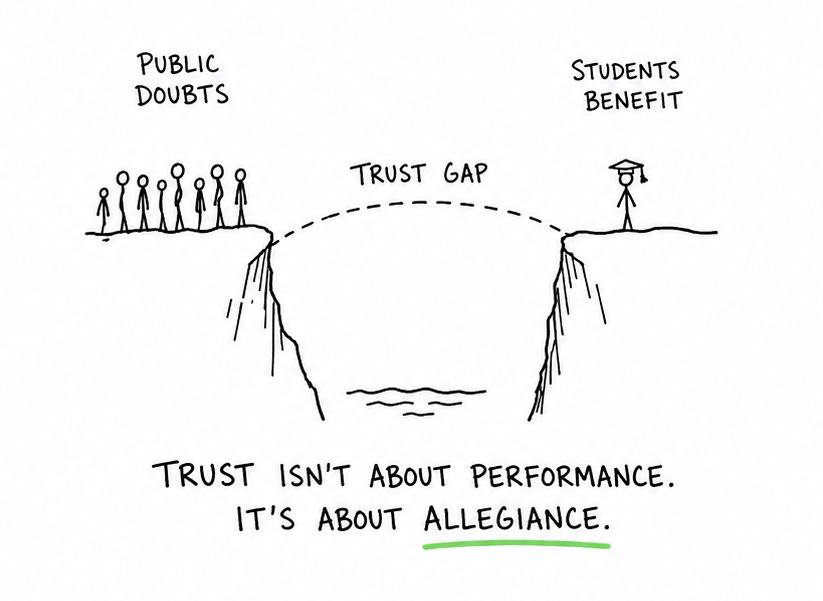
Public trust is not a judgment about whether you’re good at your job. It’s a judgment about whose side you’re on.
An Inside Higher Ed survey of college presidents this spring captured this perfectly, almost accidentally. One president summarized the public’s skepticism this way: institutions keep answering the question “Can they do the job?” while the public is asking “Are they on my side?”
Colleges keep publishing ROI studies, wage-premium data, economic impact reports. All answers to the competence question. All true. All beside the point. You cannot data your way out of an allegiance problem.
When Gallup asks the unconfident why, three answers dominate: colleges are pushing political agendas (31%), colleges cost too much (30%), and colleges aren’t preparing students for work (25%).
Notice something about that list. Those are three different indictments, from three different juries, and they want incompatible remedies.
The political-agenda critic wants ideological reform — and some of them want it imposed from outside. The cost critic wants a cheaper product and doesn’t much care about campus speech. The workforce critic wants career preparation and would happily trade the liberal arts core to get it. A college that spends its energy appeasing one jury can easily deepen its conviction with another.
This is why “rebuilding trust” as a single institutional project keeps failing. There is no single trust to rebuild. There is a coalition of grievances, each with its own theory of what college is for — and underneath all three, one shared suspicion: this institution has stopped working for people like me.
The cost critic thinks it works for administrators. The political critic thinks it works for one tribe. The workforce critic thinks it works for the faculty’s intellectual interests rather than the student’s economic ones. Different stories, same plot.
Here’s the uncomfortable part. In that same presidents’ survey, 51% of institutions said they launched trust-building initiatives in the past year. Good. And what did those initiatives consist of? For more than half of the 189 presidents surveyed: stand-alone public relations and marketing. Messaging campaigns about economic impact. Storytelling about degree value.
Fewer than 10% of those initiatives touched affordability — the thing 30% of the public names as its core grievance.
And the presidents know it isn’t working. Only 16% believe higher education has been even moderately effective at addressing declining trust. Two percent — two — say highly effective.
Think about what this means. The sector’s dominant response to “we don’t trust you” has been to buy better advertising. If a used-car dealer responded to a trust crisis with a bigger billboard, we would laugh. When a university does it, we call it a strategic communications plan.
Marketing is what you do when you believe the problem is that people don’t know the truth about you. But the public’s problem with higher education is not an information deficit. In some ways they know the truth too well: sticker prices that have more than doubled in three decades, 43% of new graduates underemployed, a new-grad unemployment rate of 5.7% — meaningfully worse than the rate for all workers, an inversion of the entire historical promise of the degree.
The promise was: finish college and you’ll be safer than everyone else. For the classes of 2024–2026, staring down entry-level job postings that have fallen roughly 35% since early 2023, that promise is visibly wobbling. You cannot message your way past what people can see in their own kitchen, in their own kid, in their own loan statement.
To see what rebuilding would actually require, it helps to remember how the trust got built in the first place — because it was not built on prestige.
Americans did not fall in love with higher education because it was excellent. Harvard was excellent for three centuries while most Americans neither knew nor cared what happened there. The public embraced higher education in the specific historical moments when higher education bound its fate to theirs. The Morrill Act put colleges in farm states to serve farmers’ kids. The GI Bill told millions of working-class veterans: this institution exists for you now. Pell Grants extended the same promise down the income ladder. For about a century, American higher education made the most audacious offer any institution has ever made to ordinary families: give us your kids and we will hand them a better life than yours.
That offer — not research output, not Nobel counts, not rankings — was the trust account. And for decades it paid out so reliably that the institution accumulated something like civic devotion.
Then, gradually, the terms changed. Prices compounded. Admissions at the most visible institutions became a lottery wrapped in a mystery, with side doors for the wealthy — legacies, donors, recruited athletes in country-club sports. The mobility machine kept working for many, but it stopped feeling like a shared national project and started feeling like a sorting mechanism the upper-middle class ran for its own children. Trust declined not because colleges got worse at educating — by most measures they didn’t — but because the deal got worse, and the deal was always what the trust was for.
Trust, in other words, is a lagging indicator of alignment. The polls of the 2020s are reporting the terms-of-service changes of the 1990s and 2000s.
If you want proof of how depleted the trust account had become, look at what happened when the political storm finally hit.
Over the past year and a half, the federal government has done things to American universities that would have been unthinkable a decade ago: frozen billions in research funding, extracted a $221 million settlement from Columbia, pushed Harvard toward a reported half-billion-dollar resolution, raised the endowment tax, and offered nine universities a “Compact for Academic Excellence” that traded funding preferences for tuition freezes, caps on international enrollment, and alignment with administration priorities. Seven of the nine refused within three weeks. New versions of the compact keep arriving anyway.
You can think whatever you like about the politics of all this. Here’s the part that should haunt every college leader regardless of politics: when it happened, the public mostly shrugged.
Institutions that imagined themselves as pillars of American life discovered they had remarkably few defenders outside their own walls. There was no groundswell. No farmers marching for the land-grants this time. The reservoir of public affection that might have made these institutions politically costly to attack simply wasn’t there — because it had been drawn down, year after year, by every tuition increase, every opaque rejection letter, every graduate serving coffee with a diploma and a loan balance.
An institution with full trust reserves is expensive to attack. An institution running on empty is cheap to attack. The events of 2025–26 didn’t cause the trust crisis. They revealed it, the way a bank run reveals a balance sheet.
Into this weakened structure walks the most disruptive force of all, and it attacks the exact load-bearing wall colleges had retreated to.
Over the past few decades, as the loftier justifications for college got harder to sell, the sector consolidated its pitch around one claim: the degree is job insurance. The wage premium. The employment gap. It was the safest ground — measurable, marketable, true.
AI is now shelling that ground specifically. Forty-six percent of Americans already say AI makes a college degree less important; only 20% say more important. Entry-level postings in junior software development and data analysis — the very jobs that anchored the “learn to code” era of degree-as-insurance — are down by two-thirds. Graduate computer science enrollment fell 14% this fall. Students are voting with their feet toward shorter, cheaper, more legible credentials: community college enrollment up 3%, certificate programs growing 28% since 2021, while private nonprofit colleges shrink.
Notice the trap. Colleges spent thirty years teaching the public to evaluate them as an employment product. The public learned the lesson. Now the employment product is being disrupted, and the public is applying exactly the evaluation framework colleges handed them. If your entire case is ROI, you live and die by the R.
But here is what I’d argue is the real strategic error: treating AI as the threat, when it’s actually the last, best argument for what colleges were supposed to be all along. When information is free and competent output is nearly free, the scarce things become precisely what a good education always claimed to produce and too often stopped bothering to: judgment, discernment, the ability to ask questions machines can’t formulate, the character to act well under uncertainty, the human formation that happens when you struggle in front of other people who care whether you grow. Meanwhile, students already use AI routinely while their institutions dither over policies — an inversion where the students are ahead of the institution that claims to prepare them.
A college that responds to AI with detection software is announcing that its product was always the graded artifact. A college that redesigns around AI is announcing that its product is the human. Only one of those institutions deserves trust in 2030.
Yes. But two hard truths first.
First, “rebuild” is the wrong verb. The trust that existed in 1965 or even 2015 was attached to a specific deal in a specific economy, and that world is gone. It cannot be rebuilt any more than the trust in newspapers circa 1975 can be rebuilt. What colleges can do is earn a new trust, for a new deal, made honestly — which is harder and better.
Second, no one is coming to do it for them. Not a messaging firm. Not a federal compact — trust imposed by government fiat is compliance wearing trust’s clothing. Not even a friendlier news cycle. Trust is earned the way the Yale trust committee put it in the most useful sentence in its report: “Trust is earned by doing what you say you’re going to do — and, ideally, doing it well.”
What would that look like? The outlines are already visible, and interestingly, almost none of them require permission from Washington.
Tell the truth about price. The high-sticker, high-discount model is a trust-destroying machine even when the net price is fair, because nearly half of Americans don’t know financial aid exists. Every family that walks away from a $94,000 sticker price they’d never actually have paid is a trust casualty of an accounting fiction. The movement toward radical cost transparency — real prices, published early, legible to a seventeen-year-old — is the single cheapest trust repair available, and it’s barely begun.
Make admissions legible and legitimate. You cannot run a 4% acceptance-rate mystery process with visible side doors for wealth and expect the public to believe you’re on their side. Yale’s own committee recommended reducing legacy and donor preferences and establishing transparent academic standards. When elite institutions treat those recommendations as radical, they’re measuring how far they’ve drifted.
Put skin in the game on outcomes. Publish program-level employment and earnings data, prominently, including the ugly numbers. Better: share the risk — extended career support, employer-embedded programs, guarantees with teeth. The experience gap is now brutal — graduates with real work experience get hired at double the rate of those without — which means every degree program without an embedded work component is shipping a known defect. Fix the defect instead of marketing around it.
Rebuild proximity. Here is the most underreported fact in the whole trust literature: community colleges are the most trusted institutions in higher education. Not the most excellent by any ranking. The most trusted. Because trust is local and relational — people trust the college that trained their nurse, retrained their neighbor, and charges what a used car costs, and they are suspicious of the abstraction called “higher ed” they see on cable news. Americans consistently hate “colleges” the way they hate “Congress” while liking their own — which means the trust crisis is, in an important sense, a distance crisis. Every partnership with a local employer, every classroom project that solves a real problem for a real community organization, every campus resource opened to people who will never enroll, closes distance. Nothing closes distance from a communications office.
Answer the allegiance question out loud. Stop leading with institutional greatness. Lead with the student’s future and let institutional greatness be the byproduct. The public asks “are you on my side?” — the only convincing answer is a track record of choices that cost the institution something: freezing a price, killing a program that doesn’t serve students, publishing data that embarrasses you, reallocating administrative spend to advising. Trust is what accumulates when people watch you take their side at your own expense. There is no other way to manufacture it. That’s what makes it trust.
Notice that almost everything on that list is institutional policy. But institutions don’t have relationships. People do.
The 38% number will not be moved by provosts’ strategic plans, at least not directly. It moves through millions of retail interactions a year: a first-generation student whose professor knows her name and her goal. An advisor who calls back the same day. A course that was visibly redesigned this semester because the professor took AI seriously as a fact of students’ futures rather than a threat to his slide deck. A capstone that produced something a local business actually uses. A graduate who says, unprompted, at a family cookout: they were on my side the whole way through — a sentence no marketing budget has ever purchased.
Students already believe, at nine in ten, that their own education is working. That is an astonishing raw material for trust — an army of satisfied witnesses whose testimony the sector keeps failing to convert because the institutional behavior around the classroom experience (the pricing, the opacity, the defensiveness) keeps contradicting the witness.
So: can colleges rebuild trust?
The honest answer is that “colleges” — the abstraction, the sector, the lobby — probably can’t. Abstractions don’t earn trust; they spend it.
But a college can. One deal, one price, one classroom, one graduate at a time, by doing the unglamorous thing trust has always required: telling the truth about what you cost, delivering what you promised, redesigning when the world changes, and proving — at your own expense, repeatedly, in public — whose side you’re on.
The institutions that do this won’t rebuild the old trust. They’ll build something sturdier, because this time it will have been earned in an era when nobody had to give it.
The ones that keep running billboard campaigns will keep discovering what Gallup will keep telling them every June.
Thanks for reading How to Teach With AI! This post is public so feel free to share it.
Sources: Gallup, “Confidence in U.S. Higher Education Slips Back Slightly” (July 2026); Gallup-Lumina State of Higher Education 2026; Inside Higher Ed 2026 Survey of College Presidents; Report of the Yale Committee on Trust in Higher Education (April 2026); National Student Clearinghouse, Fall 2025 Enrollment Report; Science, on Columbia’s federal settlement; PBS NewsHour, on Harvard’s settlement talks; Wikipedia, Compact for Academic Excellence in Higher Education; Metaintro, 2026 new-grad job market data; GBH, on cost transparency; Gallup, “AI Is Routine for College Students”.
Comments
Nothing yet. Say the first thing.
Sign in to join the conversation.