

The other day a friend sent me a tweet from September 2024 announcing Chloe, the world's first AI robot. Fascinated, and a bit incredulous, I started searching the web to learn more.

There were other videos promoting Chloe on Twitter and YouTube. But then I came across a fact checking article from 2019, which explained that the video of Chloe was actually a promotion for a video game called Detroit: Become Human.
Isn't it amazing how false information can snowball around the internet, with many people sharing the tantalizing clip for social media clout, or to help spread the word about something they see as important and informative.
In this information age where we're generating exponentially more content each year, it can be incredibly difficult to figure out what's true.
While we've all come across examples of social media, podcasters, and independent media spreading false or misleading information, there are also plenty of examples of mainstream news sources, academia, and the government getting things wrong.
From the origins of the Covid-19 pandemic, to the Trump-Russia collusion scandal, guarantees that the Covid vaccines would prevent transmission, referring to Ivermectin as "horse dewormer," and claims of 2020 election fraud, I could write pages about the misinformation and propaganda coming from so-called "trusted sources."
In this fast-paced onslaught of information, with trust in institutions at an all-time low, thinking people face a real challenge to make sense of the world.
As Neil Postman wrote in the foreword to his book, Amusing Ourselves to Death,
Orwell feared those who would deprive us of information. Huxley feared those who would give us so much that we would be reduced to passivity and egoism. Orwell feared that the truth would be concealed from us. Huxley feared the truth would be drowned in a sea of irrelevance.
The insights of Orwell and Huxley hint at the three failure modes I see playing out in the ways modern people are giving up on Sensemaking—that is, the conscious process an individual goes through to analyze and integrate information in order to make sense of the world, forming worldviews upon which to base their decisions.
The first failure mode is seen in those who give up on their own sensemaking and decide to trust whatever is told to them by corporate media, academia, and government sources.
Second, there are those who feel betrayed by official institutions and give up on their own sensemaking to put their trust in alternative sources such as podcasts, social media, independent news, and heterodox influencers.
The third, and perhaps most common failure mode I see, is both an outsourcing of sensemaking to a selection of trusted sources, as well as an overarching cynicism that says we can’t really know anything, so why even try.
I understand how overwhelming it can be, to have so much conflicting information bombarding us all the time and no way to know for sure what’s true. If this is relatable, keep reading—I’m going to share some easy-to-use tools for sensemaking that can empower you to shed that feeling of anxiety and confusion.
I want to note here that having a low information diet or not having opinions on every topic is different from giving up on sensemaking. To limit the amount of information you consume around topics you have no control over can be healthy, and is an active choice. In contrast, the three ‘failure modes’ each involve giving up on analysis and simply letting information "happen to you."
As an alternative to these failure modes which forego the agency of sensemaking, consider the practice of Skeptical Curiosity.
Skeptical Curiosity means being open-minded to information (again, this doesn't mean you must constantly be consuming information) while practicing Productive Skepticism.
Productive Skepticism requires not immediately trusting or distrusting information because of the source, though one may lower the probability of the source being true if you have personally experienced the source lying, misleading, or being wrong previously. Productive skepticism involves not using your personal values or worldview as an argument to disprove new information. Of course you should use previous information you've collected to weigh the strength of new information against. But worldviews and values are based on many assumptions and personal opinion, so to use them to judge new information means basically using your own bias to reinforce your bias. It will blind you and limit the information that you're willing to consider or critique.
Here are some questions we can use to practice Skeptical Curiosity:
1. Do I know that all the assumptions in this statement are true? For example, when the picture of Presidential VP Candidate Walz' family allegedly endorsing Trump came out, I wondered, how do we know these people are Tim Walz' family members? There are almost always underlying assumptions that a piece of information will take for granted. Practice identifying and questioning those underlying assumptions.
2. Are the base rates given? For example, if a study says the rate of cancer doubled, did they give the raw numbers of the original base rate for comparison? What if the rate of cancer doubled from 1 out of a million to 2 out of a million—is that really a big deal?
3. Ask, could there be any other explanations for this cause/effect relationship? We'll often come across information that says such-and-such happened and so here's what it means. If we verify that such-and-such really happened (see Skeptical Curiosity question #1), then next we could ask, are there any other potential explanations for why such-and-such might have happened other than the reasons this source is promoting? For example, the other day a friend sent me a video on 5-G towers which claimed that the towers weren't emitting ionizing radiation in the middle of the country because there weren't enough people there, implying this was evidence that the powers that be want to make the maximum number of people sick with radiation poisoning by targeting population centers. But another explanation for this is that it doesn't make sense from a business perspective to build a 5-G tower in the middle of nowhere where it would serve such a small number of customers.
4. Don't believe a narrative unless you come across sufficiently strong evidence, but also don't completely discount a narrative if you come across some false or unconvincing evidence. Is the above critique enough to disprove 5-G conspiracies? No. There will always be some bad arguments out there about any sufficiently complex or controversial topic. Don't make the mistake of thinking that if you can critique some evidence backing a theory that the whole narrative must be thrown out. (As an aside, I assign a moderate-certainty, very likely not true probability to any 5-G conspiracies at this time—this system will be explained in the next section.)
5. 'Cherry picking' is a common practice of collecting evidence that supports an argument and excluding any evidence that contradicts it. So we can ask, is there anything being omitted that would decrease the arguments' cohesion or cause it to no longer make sense? Can you think of any examples that contradict the information or the argument? Go looking for counter-evidence that was left out.
It’s true that there are a lot of things we can’t know for sure, but instead of waving our hands and giving up on analysis altogether, we can use our Skeptical Curiosity to generate quick-and-dirty probabilities.
It's helpful to make yourself pin down the likelihood that a particular piece of information is true/false, as well as the likelihood that the wider narrative it's arguing for is true/false. This provides psychological relief by allowing for a tangible (yet still nuanced) conclusion to your analysis.
I ask myself, based on my analysis, how likely do I think it is that the information or narrative is true, and how certain am I about that conclusion. You can visualize this with the x-y graph below.
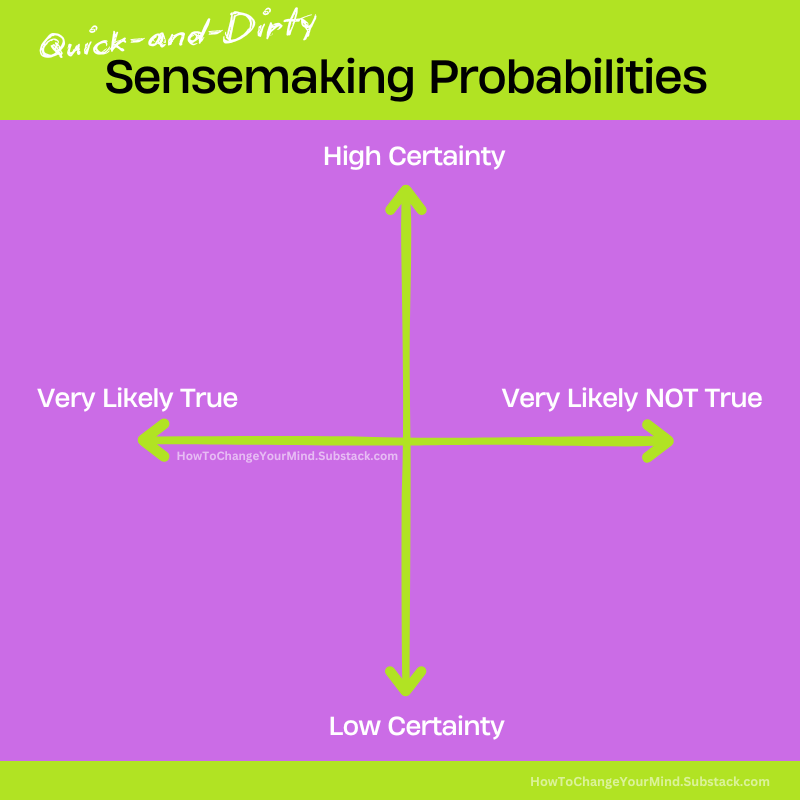
I might assign a numerical percentage to the likelihood of truth, such as, “low certainty, 70% likelihood of being true.” Or use words like “high certainty, very low likelihood of being true.”
These probability estimates are subjective, and that's fine. You're just trying to pin down a rough estimate for yourself of how likely you think it is that the specific argument or piece of evidence and the narrative it supports is true or false. Don't over-think it. You can always change your mind as you learn more.
In rare cases, I allow for a "not enough info" delineation. However, I encourage you to use this sparingly and opt for “very low certainty” instead, as you will almost never have enough info to know anything for sure and the whole point of assigning probabilities is to use the available evidence to make a current estimate (your brain will tend to do this subconsciously anyway) and to become aware of how strong or weak the evidence behind a probability estimate is.
If the information or narrative is not very important to me and my life, I might intentionally discard the information, where I quickly decide that with low certainty, I don't believe the information at this time. If we don't intentionally discard information that we don’t want to take the time to analyze, it's easy to subconsciously take in the information and let it affect our worldviews over time.
After some practice this process of sensemaking and then assigning flexible, quick-and-dirty probabilities can become second nature.
Even if you don't take the time to do any additional research on a topic, many of the Skeptical Curiosity questions can be implemented using information you already have. Determining what information is missing and would be useful for coming to a more certain probability decision is productive in and of itself. Skeptical Curiosity can keep us from falling into the three failure modes where we give up and let information affect our worldviews without engaging with it.
Homo sapiens use culture as our "software" to quickly evolve and adapt to new situations. It’s one of the reasons humans have become Earth's apex predators, spreading across the entire globe, from the icy Arctic to the tropical Equator, and now venturing into space.
As our hardware technologies continue to develop at breakneck speed, it's worth thinking about how we can update our software to thrive in the information age and beyond. I hope these ideas help. Let me know what you think in the comments.
No posts
Comments
Nothing yet. Say the first thing.
Sign in to join the conversation.