
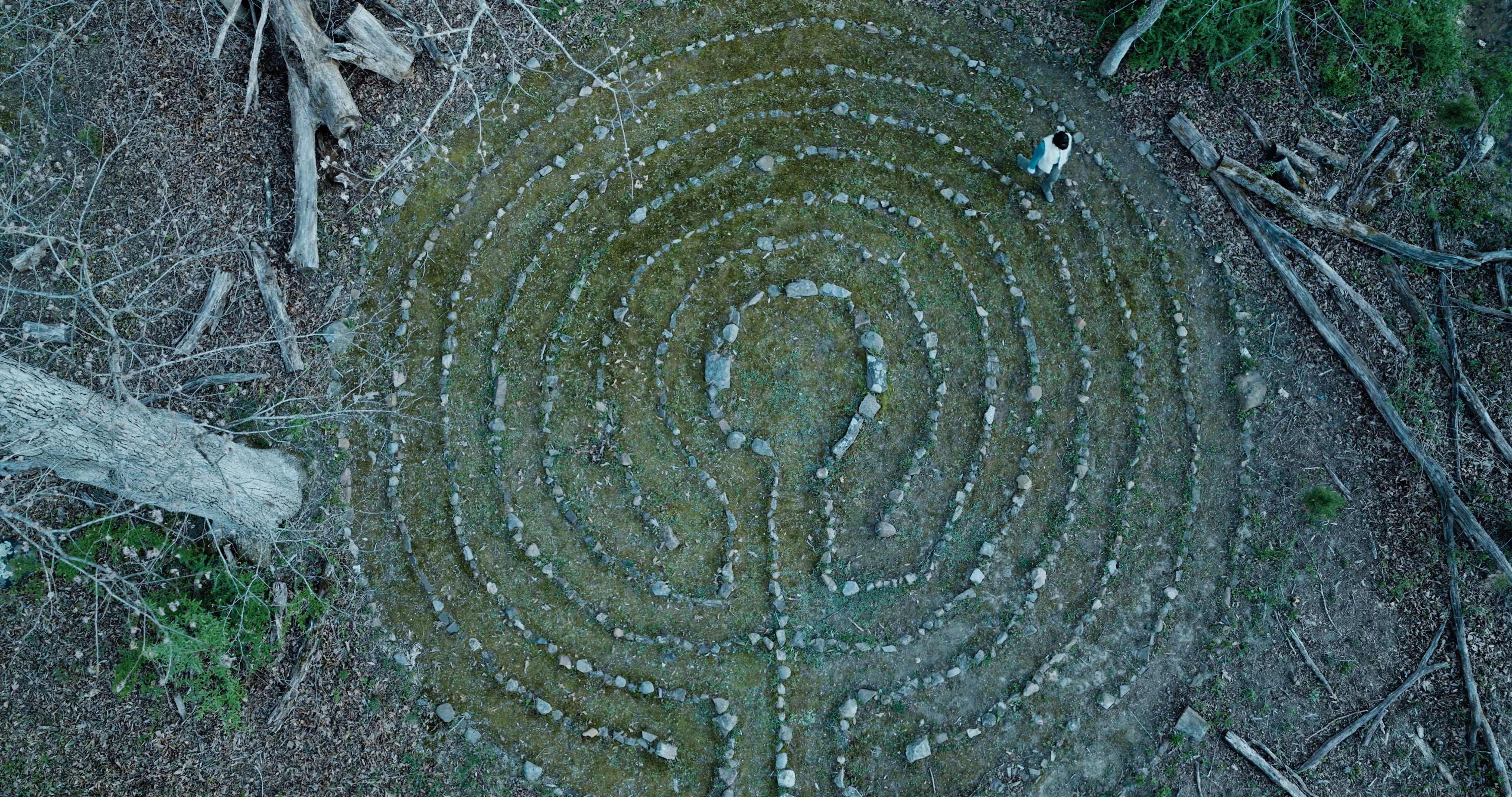
The picture above is a shot from our film, How to Build a Fire. This beautiful walking labyrinth is an important space for Jenna, one of the characters. It was built by her mother, “going through her Wiccan phase,” as a way to escape the contentious politics of their extended family. Jenna finds herself there toward the end of the film, desperate to find some peace, reckoning with her past and future.
We had nothing close to the resources or time needed to create such a thing for the movie; it was written in because it exists, just like every location in the film. It was actually built by my dear friend, Ellen, one of the many wonderful mother-figures in my life, the daughter of Fern (introduced in The Why, if you’re following along). And I’m sure Ellen would balk at Wicca as a “phase” for her or for most: it’s actually a spiritual connection to and reverence for nature and its cycles that we both deeply respect. And the older I’ve gotten, the more I’ve been able to witness those cycles: to see the seasons in so many aspects of our lives, the coming back around.
And though I hadn’t thought of it while writing the script, it occurred quite naturally that when Jenna’s mother appears in pictures in the film, the perfect person to represent her would be Ellen. Her permission came brightly and easily. She even traveled down from Maine to join us for a few days during the shoot and got to spend time with Jess, the actor playing Jenna. I have pictures from the shoot of Ellen holding Jess’s baby girl, who was also on set with us some days, a wild echo of the mother-daughter relationship in the film in which Jenna regrets not having a baby, a thing she knows her mother wanted.
This is just one of the circles within circles that have curled around the making of this movie. And more of them keep appearing.
A full circle I’ve mentioned in previous posts has to do with the organization my mother worked with in the 80s and 90s, and the friends we all gained from it. Peace Child brought Soviet and American kids together during the cold war to put on a musical about conflict resolution. It was one of the only NGOs allowed behind the iron curtain, and did impactful work to show the vast common ground that existed between so-called “enemies.” Two of the founders, David Woollcombe and Rosey Simonds, moved from England to the DC area with their young family in the mid-eighties and spearheaded Peace Child America. That’s when my mom got involved as a full-time volunteer. She had a major hand in their operations and traveled to the USSR with several groups, eventually leading the family tour which I’ve written about. (Again, see: The Why) David and Rosey became her close friends, and I became friends with their kids, Alexander and Natasha.
Alexander and I were the same age, and when we reconnected twenty years later, it was as if no time had passed (except for the frightening resemblance we now both bore to our fathers). Zander had followed the family tradition and was trying to do good on an impressive scale, matching large-scale philanthropy to causes in the developing world. In the years we’ve been friends again he’s done stints with Global Citizen, The [RED] Campaign, and The Gates Foundation, to name a few. Now he’s a senior consultant, and on a recent trip to New York (where he was casually speaking at the UN about the Ebola outbreak), we got together for burritos.
On the lawn in Fort Greene park he mentioned to me that he’d been enjoying this Substack about the film. He spoke about how disillusioned he was with a lot of the work he was doing (it’s a hard time for international aid), and about a recent insight from Richard Curtis about Impact Producers in film:
"Too often powerful stuff is made and everyone just hopes it will help make a difference. They don’t take the final step to create a mechanism in production to help change things. When projects have a dedicated person to take it and use it for campaigning, advocacy, targeted education or fundraising; when they are linked to the right causes and the right people see them at the right time; amazing things can happen."
Suddenly it was glaringly obvious what had been missing from our project. The dots connected so quickly, I felt ridiculous for not realizing it. Our film is purpose-driven: it’s meant to start conversations. We want to put it into the world on our own terms, build grassroots audiences, and not be beholden to release agreements or platforms. And we want to be present with it— to be in communal spaces, having a shared experience. OF COURSE we should be partnering with organizations that do that sort of work; OF COURSE we should have an impact producer; and OF COURSE it should be Zander. I think I interrupted him mid-sentence with the ask. “Wait till I’m done pitching you,” he replied. The idea that he was pitching me I found slightly absurd, but I played along. Underneath I was giddy: here was the third leg of the stool— the truth of what we wanted to do, married to the gesture of the film itself.
So now here we are: Zander and the production team strategizing on outreach to organizations that work in depolarization, conflict resolution, and bridge-building. Our parents’ work, reimagined through the lens of our own passions. The circle coming fully back around. In his words:
“The hope is to build a national network of partners to host screening events paired with facilitated audience conversation. The goal is to give people a shared emotional experience that opens the door to exactly the kind of listening such organizations already work to create. We're approaching this as partners, hoping to plug into what is already happening, and for the conversations it provokes to lead to action beyond a screening and discussion.”
If this sparks something in you, or if you know of somebody who does this kind of work and might be interested, please reach out.
We’d love to bring you into the circle.
No posts
Comments
Nothing yet. Say the first thing.
Sign in to join the conversation.