
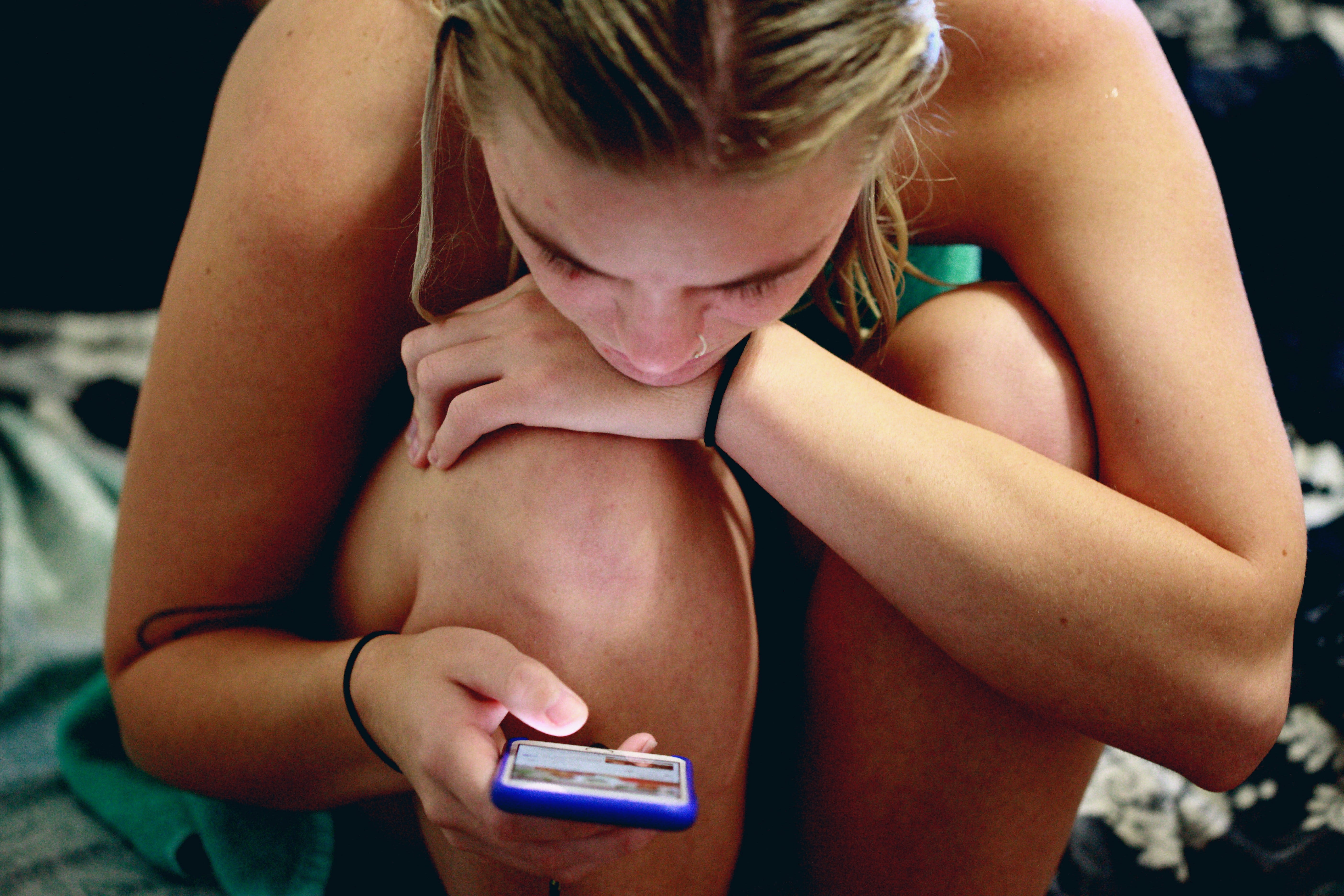
Photo: Alexander Grey for Unsplash
Data is starting to come in on smartphone bans in schools, and everyone is trying to make sense of it. The headline: Smartphone bans seem to make kids and teachers happier.
Of course, it’s not that simple. But in my opinion we should be massively excited and encouraged by this signal that when schools are willing to act on what has clearly become a problem, it works.
One big study came out last week led by researchers from the University of Pennsylvania and Stanford (Angela Duckworth and Thomas Dee), and others. It found that strict bans, requiring kids to lock their phones in Yondr pouches for the entire school day, resulted in happier teachers and students with higher levels of self-reported wellbeing. This came after an initial period of decreased wellbeing, as they adjusted to being without their phones.
The same study found that the bans had no effect on test scores, school attendance, self-reported classroom attention, or perceived online bullying.
It’s the first in what will be a wave of studies looking at smartphone bans. Should we be excited? Discouraged? Confused?
First, be excited! Banning the phones reduced screen time. Teaching is hard enough without having to compete with the deluge of distractions which is the entire freaking internet. Of course kids were more unhappy and behavioral incidents went up before they went down: kids hid their phones, got in trouble and had to adjust to an uncomfortable new reality. Which they did.
Wellbeing then went up in both groups. Happier teachers and students is a massive double win.
So what about test scores? Should we not be hoping that the removal of phones would improve those too? Personally, I’m not surprised test scores didn’t budge. It will take more than removing devices to move the needle on literacy and numeracy–these are complex issues! Test scores are an important measure of how kids and teachers are doing, but not the only way we should be measuring the ‘success’ of a school, or a system.
Beyond the headline data, however, I am struck by how much the school smartphone bans miss a critical part of the teen equation.
Kids spend about one thousand hours in school each year. They spend about FIVE thousand hours at home. Banning phones in schools or classrooms—whether they are in pouches or lockers, backpacks or on a teacher’s desk—won’t move the dial on what kids do at home.
One proposed solution is legislative bans, like Australia’s, which mandates that under 16s can’t have social media accounts. The jury is out here, but VPN usage soared, Roblox and Discord weren’t included, YouTube is as popular as ever, and TikTok is still top rated in the Apple store. We have not seen concrete evidence that social media use has fallen. Mike, co-founder of the Center for Teen Flourishing, summarizes five different attempts at bans here, including Austria, Australia, Brazil and the Netherlands, and the picture is bleak. South Korea and China found the same thing: bans on gaming and phones fail to significantly reduce screen time.
Personally, I worry hugely that bans will drive behavior underground, and we may lose more control than we gain. (I am also not sure what we gain from them, as parents, beyond permission to set rules. Of course, we had this before, but bans make it easier, for sure).
One great way to get kids off screens out of school sits in the oldest tech available: doing more stuff.
When kids do things like play sports, act in the school play, join a band, get a part-time job, or find a hobby, screen time drops precipitously.
But across the board, this isn’t happening. Kids have fewer part-time jobs than ever. Only an elite group of US kids compete in sports as they inch toward high school, and reading for pleasure has plummeted. Figures from the CDC show that about 40% of teens are neither suffering acutely nor flourishing. They are languishing at home, often on screens, stuck. School smartphone bans may help them focus on learning and IRL social connection from 8am to 3pm, but they’ve still got a hefty stretch from 3pm to midnight (they should go to bed at 10pm, or 11pm max. They usually don’t).
We don’t need new evidence to prove sports, social connection, and jobs are good for kids: there’s reams of it, collected over decades. When kids do find something to do, their screen time falls fast. The kid who takes up rock climbing is at the gym a few times a week, not on TikTok (hard when you are strapped to a steep wall). The 20-hour-a-week grocery store job definitely means no Discord in those 20 hours. The pottery class requires hands on the wheel, and volunteering at the Y means maybe being in charge of kids, which is a very effective way to not look at screens.
Research does in fact show that doing stuff is an effective way to treat mental health challenges. Behavioral activation, or BA, a subset of CBT, is deceptively simple: you help people do more things “that generate positive reinforcement and reduce avoidance,” as Mike and Sean from CTF explain. How? “You schedule activity—hopefully pleasant activity. You act first—get the patient off the couch—and let mood change follow.”
You can guess why therapists might not like this. “Go do stuff out of my office and where I can’t totally see the progress or feel helpful” won’t sustain a practice and might not feel good. Therapists got into therapy to feel helpful.
But researchers have shown that it can work (here and a 2023 meta analysis here).
It’s not surprising that mental health struggles are often addressed with therapy. But therapy doesn’t work for a lot of kids. It’s not an option for a lot of families for cost and access reasons. Many kids who get appointments don’t even go. And there are not enough therapists for every kid who is seeking one right now. We need better options that don’t pathologize being stuck, or funnel kids’ into counselling that is not likely to work.
Many of us want our kids to do stuff. But making it happen is hard. Maybe:
You have great ideas which your kid does not think are great at all
Your kids doesn’t know what they want to do
What if, rather than default to the idea of therapy, we were able to offer kids a menu of options to pick from, and a coach to help them past that friction point of starting? Remember: they are teens, they will be self conscious about trying something especially if it’s new (“Everyone will be better than me”). If they are already at home on their phones a lot, their trying and interacting muscles might need some work.
This is what Sean and Mike do with their RESET coaching business. The coach can do a few things: lower the stakes of trying, gently hold them accountable to go and try, and normalize ‘failure.’ Karate sucked? No problem. Let’s try something else. No chance you will try anything in the arts? Cool, get a part time job. They also have the key advantage that they are not you, the parent.
But that option requires money, which makes it hard for many families.
Another idea that has a lot of traction in the UK and is making its way to the US is social prescribing. Under the UK version, National Health Service doctors (GPs) refer subclinical— ie not acute—–cases to link workers, who then do two things: First, they get to know the person and the community. Then, then suggest, cajole, nudge, encourage, test, and hold accountable the person to whom they have been ‘prescribed’. It’s been used in adults for decades and is now trickling down to teens.
Social prescribing is in the US too, in its early days. SocialRX, a US based start up, is doing social prescribing for the arts and nature among other things at universities like Dartmouth and Stanford as well as in conjunction with health providers like Mass General. Set up to offer non-clinical, community-based and evidence-based support, if hopes to tackle the dual crises of poor mental health and loneliness.
So there’s some hope. And while I hate to end on the “it’s all on you!” note, here we are.
The route to getting kids to do stuff will be neither linear nor easy. But doing something is better than feeling helpless. I have suggested running to one of my daughters for years. I love it; I noticed she felt better when she did it; people almost always feel better about life after getting outside and moving. And for years she rebuffed it, scoffed at it, ignored it, did it grudgingly (on my birthday).
And then, weirdly, one day, she just started on her own. No fanfare. No '“thanks mom! You totally saw that I needed this!” Parenting is weird this way: totally ineffective and then, home run.
Notice what your kid likes (vs what might look good on a college transcript).
Find something they might be interested in (use AI, your friends, family, church members).
Offer ideas up in the most low-stakes way to your kid: I am not making you do this but I am not ok with you at home with screens all day. Here are some options, you pick.
Find a neighbor or mentor or friend who can back the idea up (subtly). I recruited an older kid at my daughter’s school to give her a push on tennis. She wanted to play but was unsure. The “why don’t you come try out” from someone who was NOT me seemed to do the trick (I seriously hope she doesn’t read this!)
Do not freak out when it doesn’t work right away. Just try something else.
If they feel judged by you they will not keep trying. Guaranteed.
Bans of phones in schools are looking promising. Kids aren’t suddenly soaring in math performance, but teachers and kids are happier. We look forward to more data coming out later.
But school only covers a fraction of their time (one sixth to be precise). We will need more to help kids who are languishing under too much screen time.
Doing stuff is one way to help, and some form of social prescribing may be a good path (longer post on this later!)
As parents, we can help by modelling—doing stuff ourselves—researching and recommending stuff, and ideally, finding other adults or peers to help get those ideas off the ground.
Megan Saxelby on why kids need third spaces (so related to this post) (WILD FEELINGS)
Fantastic Justin Reich LinkedIN Post: “If you are looking to confirm your prior beliefs about phone bans, you now have a nice collection of studies to choose from!” (MIT)
Kim Smith in the Stanford Social Innovation Review on renegotiating the education social contract in the age of AI. “What we cannot afford right now is to continue mistaking schooling for learning and efficiency for fairness.” (LEARNERSTUDIO)
I am late to this beautiful art essay but wow. Why AI cannot rob us of our humanity. Is My Toddler a Stochastic Parrot by Angie Wang. (NEW YORKER)
Jackie Nesi on how parents actually manage screen time. (TECHNO SAPIENS)
Robin Lake on AI in schools right now. “The problems we are seeing today are not new. When a promising new tool arrives, the field gets excited, but adoption spreads faster than understanding, and the results disappoint. This doesn’t happen because the new tool was bad. It happens because no one does the hard work of building the conditions for it to succeed.” (CENTER FOR REINVENTING PUBLIC EDUCATION)
Nature on why it retracted a major article touting the benefits of ChatGPT on student performance. Futurism making sense of it. (NATURE)
Emily Oster on the nuance behind the smart phone bans. “There are no magic bullets in education. Improving student learning is a game of inches, not miles.”
The Emotional Recession: Why the World’s Biggest Crisis isn’t Economic, It’s Emotional “A major study published in Frontiers in Psychology documents what the researchers call an “Emotional Recession”—a sustained, measurable global decline in emotional intelligence.”
The Problem with Belonging from WonkHE. “Belonging is rarely neutral. In practice, it is often translated into a familiar set of behaviours – including speaking in seminars, contributing to group work, engaging beyond the curriculum, disclosing difficulty, and being visible. These are not unreasonable expectations. They are also not universal ones. They privilege a particular model of the student: available, confident and willing to perform engagement in recognisable ways. Those who do not fit that model are not necessarily disengaged. They are simply harder to see.”
No posts
Comments
Nothing yet. Say the first thing.
Sign in to join the conversation.