
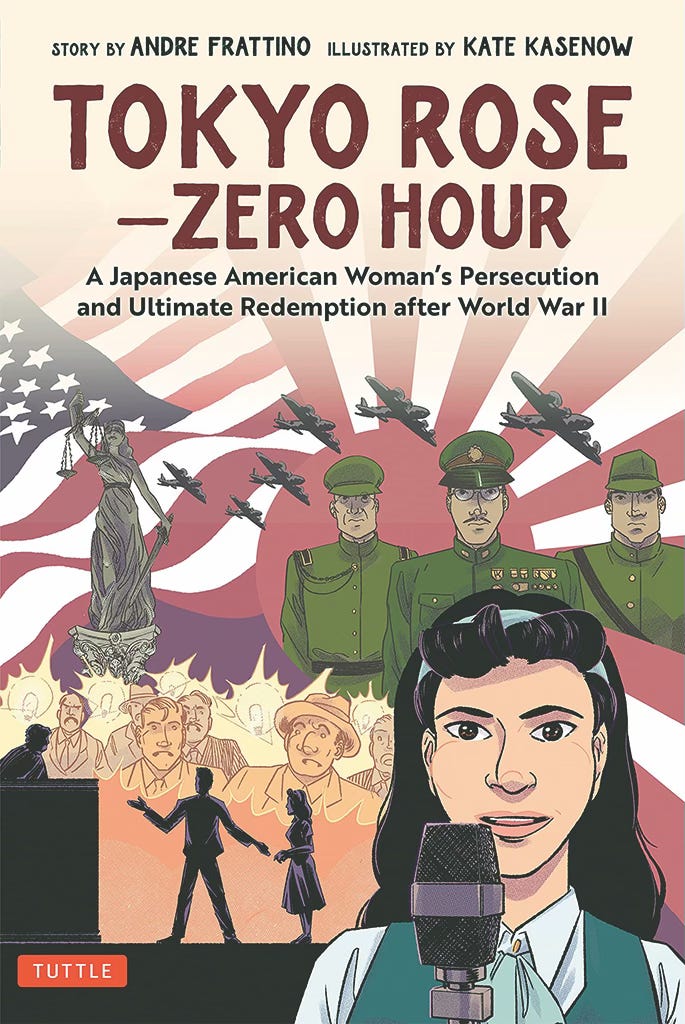
The cover of a 2022 graphic novel
Stoics tell us to discount irrational thoughts that pop into consciousness. Behaviorists say they are “learned.” But where do they come from? Why do we have them? And, more interestingly, just how smart are they?
I don’t think it’s a good idea to ignore more than a century of observations by psychodynamic thinkers. Thoughts, feelings, and impulses that arrive spontaneously are indeed products of the mind, that is, parts of the mind that are only indirectly knowable to us. As I work with clients and pay attention to the effects of these mental products, I am increasingly impressed by their power and cleverness.
“Tokyo Rose” was the name given during World War II, to a number of English speaking women who broadcast popular music along with Japanese propaganda to American Soldiers. These broadcast voices would tell the soldiers why they were sure to lose the war and might as well give up now. The truth is that one American woman, who happened to be in Japan on the day of Pearl Harbor refused to give up her American citizenship and, as a result, was forced to broadcast propaganda. She claimed to have done so in an ironic tone that made it clear she didn’t believe what she said. Nonetheless, after the war, she was tried and sent to prison as a result of false testimony against her. Ultimately, she was pardoned by Gerald Ford.
I sometimes use the name in recognition that inner selves use similar tactics to get their conscious decision makers to act against their own best interests. In a case I have often referred to, a man’s scary father inculcated his very young son with a morality that said enjoying success is immoral. Internalized in his conscience as an absolute and powerful rule, the client’s inner mind then produced Tokyo Rose-like thoughts such as “I’ll never get over this anxiety” or “It’s too late, I’m too old to restart my life.”
Well, we can’t know for sure, but there is an indirect way to tell. A passage in the Sermon on the Mount says, “Beware of false prophets, who come to you in sheep’s clothing, but inwardly they are ravenous wolves. You will know them by their fruits.” Asking where a thought leads is the most practical way to tell if a spontaneous thought, feeling, or impulse is coming from a place of health or from an inner self, frozen in time, with an outdated survival agenda that should not be followed.
So I am likely to tell my client. “Ask yourself, if you follow this product of your inner mind, where will it take you? Will it take you in a direction you consider healthy or the opposite? Sometimes it might be a compromise between the two, in which case, the test is still useful. A better answer will usually be a more purely healthy answer.
Yes! The inner mind or self is fighting for survival, based on an in outdated understanding of what is best for us. It’s a life and death fight, and one tactic the inner mind uses is to outlast the conscious mind and to send messages of inevitable defeat. I even wonder if this isn’t built into the phenomenon of grief, where a regular feature early on is the feeling that the state of grief will never end. Could that be evolution’s way to insure that we let go of all other priorities during a period of major loss?
I learned about this from listening to alcoholics. “Should I pay a visit to my old drinking buddy, Ralph?” My answer would be, “Tell your sponsor. If he rolls his eyes, then it probably comes from your alcoholic brain.” The thought was quite well disguised as a pathway to relapse. In another example, clients would accept admission to rehab when it was as obvious as it could be that their inner mind (and maybe the conscious one, too) was buying time and planned to resist whatever messages might be taught there. I have also used the example of small children who don’t want to go to sleep and buy time by asking for a drink of water. Beyond automatic thoughts, an umcomfortable, gnawing feeling might also push in an unhealthy direction. When we resist, they get stronger. A sense of inevitability sets in. “I had better do what my impulse says or this uncomfortable feeling will just get worse.”
I think it is highly likely that what we are witnessing is actually an adaptation for survival. Our mammalian survival instincts are mainly products of the automatic, nonconscious, survival-oriented, subcortical mind. These were originally focused on avoiding predators and bodily harm, but, in humans, they have been adapted to support social cohesion, our main means of survival. Since social cohesion is so much more complex, instinctive answers, especially those invented at a young age and frozen in time, are often less than ideal. That’s why evolution came up with a new decision making system, conscious logic, to balance the old one. Hopefully the two, even in conflict, can arrive at a better answer than either one alone.
One of the most powerful types of disconfirming information to send in to the inner mind is behavior. Taking an action is a potent way to show the inner mind (or critic) that it’s time for a change in perspective on what’s best. That’s when memory reconsolidation can be triggered and result in rewriting outdated schemas.
Jeffery Smith MD
Thank you for reading this post. Since you have come this far, I have great news. My new book, How Psychotherapy Works: Navigating the Therapeutic Space with Confidence, is at last available for pre-order, to be delivered after August 20, 2026. I describe it as a companion and guide for anyone interested in how change really works. And, to sweeten the offer, there is a 20% discount. Click here for the publisher’s description.
Comments
Nothing yet. Say the first thing.
Sign in to join the conversation.